Medical Transcriptionist Resume Examples: free ATS score
A Medical Transcriptionist Resume That Shows Clinical Accuracy
By Mustafa Tarabya, founder of CVBooster · Published · Updated
Medical transcriptionist resume example with report type bullets, editing and EHR keywords, credentials and a full writing guide.
Sample resumes for a medical transcriptionist
The same medical transcriptionist content laid out in three CVBooster templates, so you can see what the finished document looks like before you write a word.
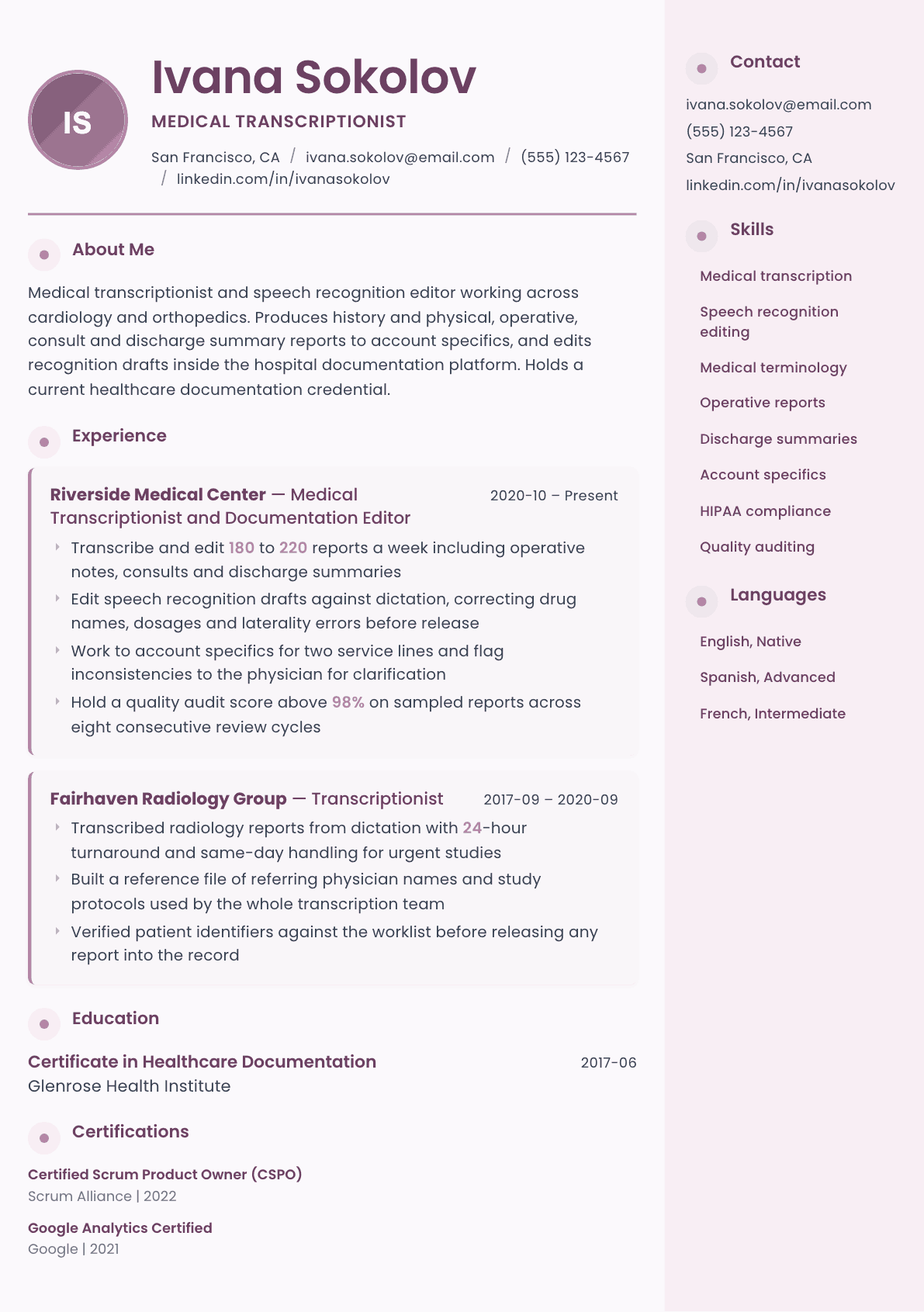
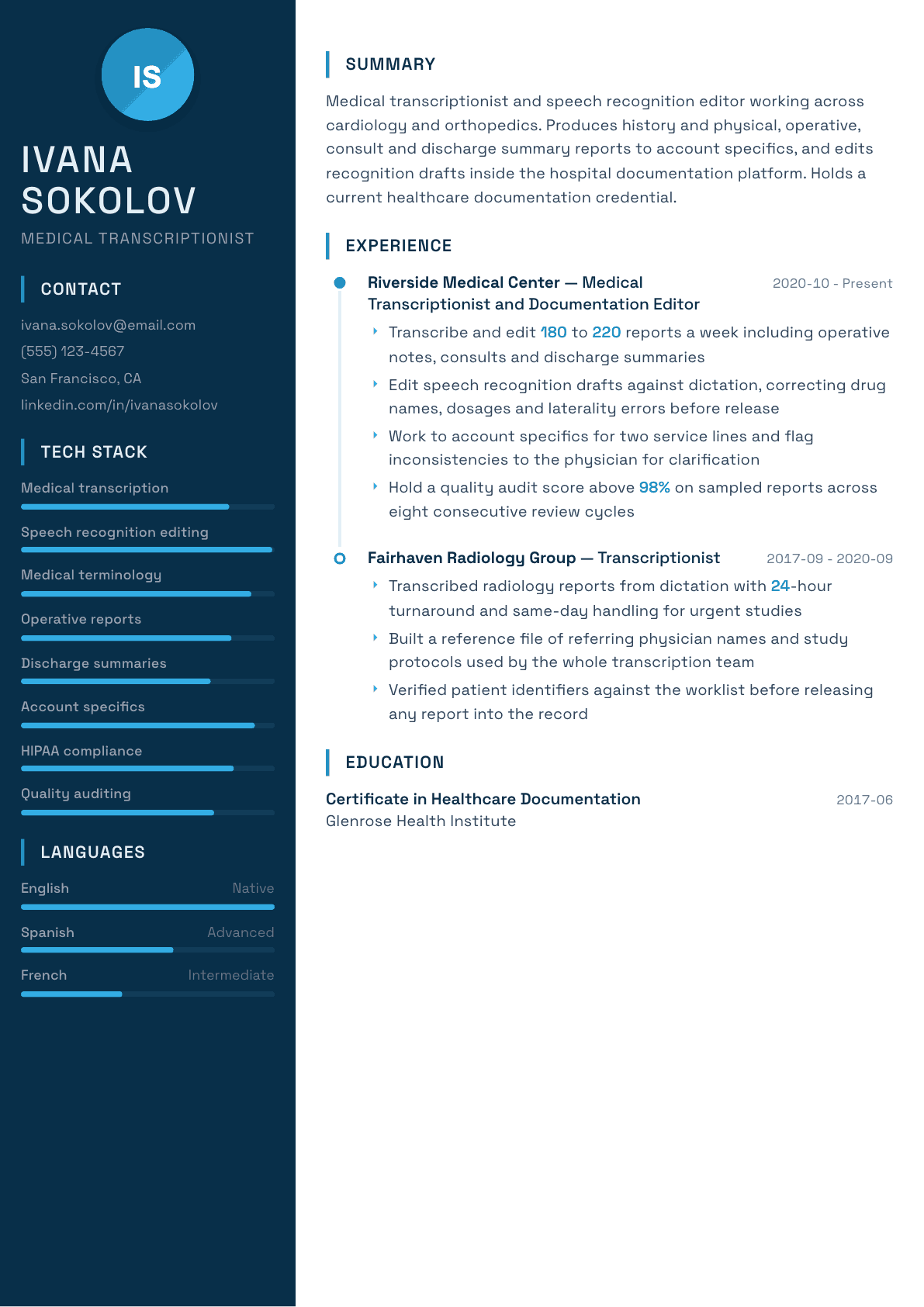
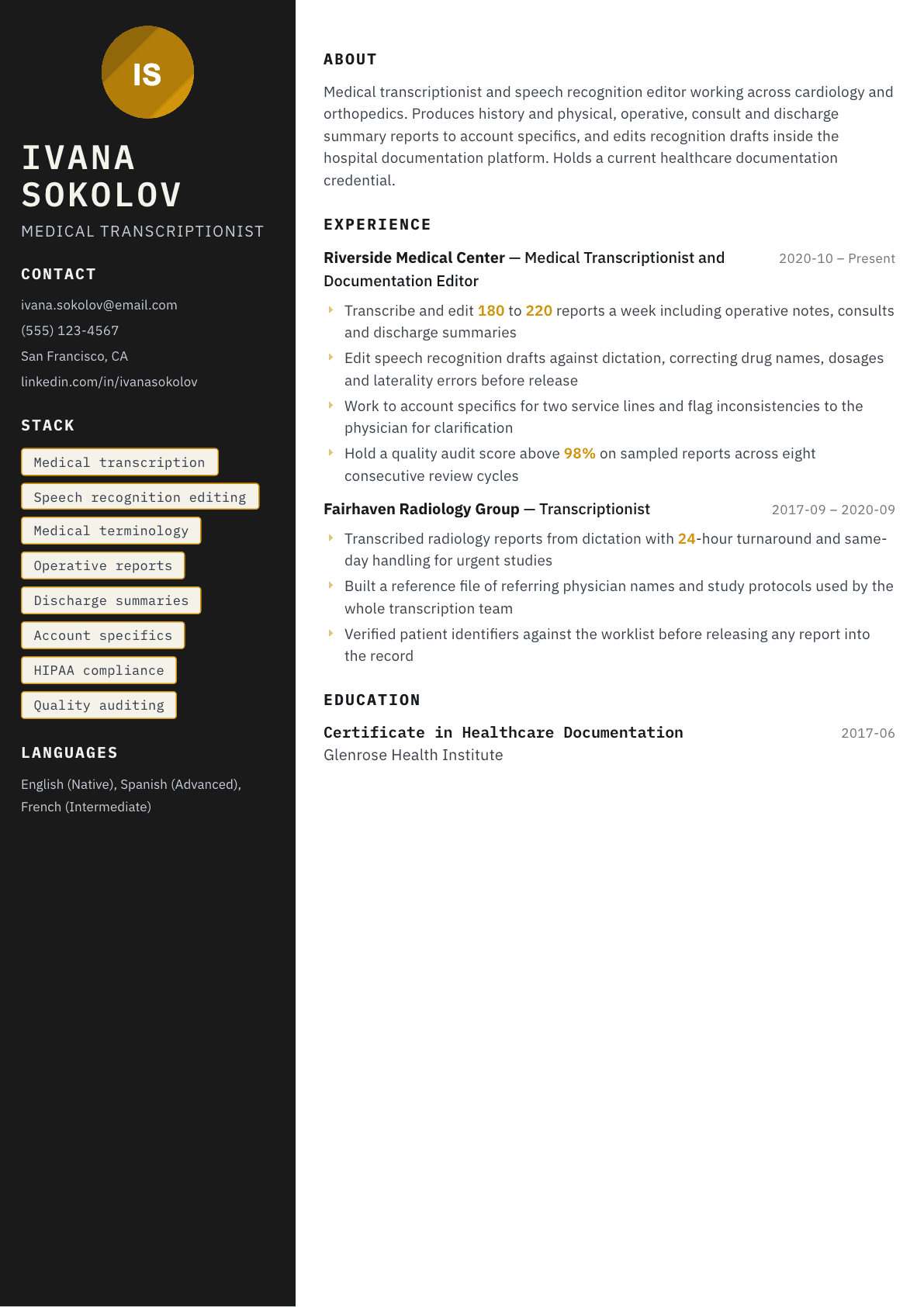
Example Medical Transcriptionist summary
Medical transcriptionist and documentation editor with eight years in hospital and radiology settings. Produces operative notes, consults and discharge summaries to account specifics, and edits speech recognition drafts for drug names, dosages and laterality. Holds a sampled quality score above 98% across consecutive audit cycles. Seeking a documentation role covering surgical service lines with a defined turnaround standard.
Skills to list on a Medical Transcriptionist resume
- Medical transcription
- Speech recognition editing
- Medical terminology
- Anatomy and physiology
- Pharmacology terminology
- Operative reports
- Discharge summaries
- Consult notes
- Account specifics
- Turnaround management
- HIPAA compliance
- Quality auditing
- Patient identifier verification
- Reference glossary building
What actually gets this resume read
- Name the report types you produce, because operative notes and discharge summaries are graded harder than clinic notes.
- Say which specialties you have transcribed, since cardiology and orthopedic vocabulary is checked in the hiring test.
- Show speech recognition editing separately from straight transcription, as most employers now hire for the editing work.
- Give a quality audit score with the review cycle, because healthcare documentation teams manage to a sampled score.
- List the platform you worked in, for example a hospital documentation system or a transcription workflow tool, by name.
- Put a real credential such as RHDS or CHDS in its own section, with the issuing body written out in full.
How to write a medical transcriptionist resume
A medical transcriptionist resume is read by a healthcare documentation supervisor who manages to a sampled quality score and a turnaround standard. She wants to know which report types you produce, which specialties you have transcribed, what your audit score has been, and whether you can edit speech recognition drafts rather than only type from dictation. Anything on the page that does not answer one of those four is filler.
Report type matters more than most candidates realize. Clinic notes are forgiving; operative reports, consults and discharge summaries are not, because an error in laterality, a drug name or a dosage travels into the patient record. Naming the harder report types is the fastest way to establish your level.
This guide covers how to present report mix and specialty vocabulary, how to write about speech recognition editing as skilled work, where credentials and quality scores belong, and how to handle turnaround and patient identifier checks without sounding generic.
Format: one page, credential and specialties visible immediately
One page for most careers, two only after a long hospital history across several service lines. Use a single column with your credential beside your name if you hold one, then a short block listing report types and specialties. A documentation supervisor scanning for cardiology or orthopedic experience should find it without reading a bullet.
Group the experience by facility with a line naming the setting: an acute care hospital, a radiology group, a multi-specialty clinic or a transcription service company. Each of those implies a different report mix and a different turnaround expectation, and the reader is placing you before your bullets begin.
- Header: name, credential, city and state, phone and email.
- A block for report types produced and specialties transcribed.
- Section order: summary, report types and specialties, experience, systems, credentials.
Summary: report mix, specialty, editing, quality
Name the report types, the specialties and whether you edit recognition drafts, then state your audit score with its cycle. That is the whole screening argument in three sentences, and a candidate who makes it directly will be read ahead of one who opens with detail oriented and dedicated.
If you hold a healthcare documentation credential, name it in the summary as well as its own section. Employers who list a credential as preferred use it to cut a long applicant list, and the abbreviation appearing early does real work.
Report types and specialties: the substance of the job
List the report types you produce by name: history and physical, consult notes, operative reports, procedure notes, discharge summaries, radiology reports and clinic letters. Then the specialties: cardiology, orthopedics, general surgery, radiology, oncology or whichever service lines you have covered with real volume.
Give the weekly volume across the mix. A range such as 180 to 220 reports a week tells a supervisor how you will fit a queue far better than a phrase like high volume. If a portion of the work is editing rather than straight transcription, say roughly how the mix splits, since the two have different productivity expectations.
Mention account specifics, meaning the formatting, heading structure and preferences a given account or physician requires. Working accurately to account specifics for two service lines is the daily reality of the job and the phrase itself is one the industry uses.
Speech recognition editing: name what you actually catch
Most hiring now is for editing rather than typing from scratch, so give it its own bullets and be specific about the errors you correct. Drug names that sound alike, dosages, units, laterality, negation that reverses a finding, and patient identifiers that do not match the worklist are all real failure points, and naming them proves you know the work.
Say what you do when the dictation itself is unclear or internally inconsistent. Flagging for physician clarification rather than resolving an ambiguity yourself is the safe practice, and a supervisor reads that sentence as clinical judgment rather than hesitation.
Include the verification step you perform before releasing a report into the record: checking patient identifiers against the worklist, confirming the encounter date and confirming the correct account template. This is the last checkpoint before a document becomes part of a chart.
Quality, turnaround and systems
Give the audit score with the sampling detail: what proportion of your reports were reviewed, how often the cycle ran and how many consecutive cycles you held the score. Healthcare documentation teams manage to a sampled score, so a figure without a cycle behind it does not mean much to the person reading it.
State the turnaround standard you worked to and how urgent work was handled, for example a 24-hour standard for routine radiology reports with same-day handling for urgent studies. Then name your systems: the hospital documentation platform, the record system where reports land, the recognition editing tool and any reference resources you keep.
Medical Transcriptionist resume summary examples
Newly credentialed
Healthcare documentation certificate holder transcribing clinic notes and history and physical reports during a supervised practicum, with coursework in anatomy, pharmacology and disease processes. Trained on speech recognition editing and account specific formatting. Seeking an entry-level medical transcription role with a structured quality review process.
Four years in
Medical transcriptionist and documentation editor producing 180 to 220 reports a week across cardiology and orthopedics, including operative notes, consults and discharge summaries. Edits recognition drafts for drug names, dosages and laterality, works to account specifics for two service lines, and holds a sampled audit score above 98%.
Senior documentation editor
Senior healthcare documentation editor with nine years in hospital and radiology settings, covering surgical service lines to a defined turnaround standard. Maintains a reference file of physician preferences and study protocols for the team, verifies patient identifiers against the worklist before release, and mentors new editors through their first audit cycles.
Work experience bullets: before and after
Before: Transcribed medical reports for physicians.
After: Transcribed and edited 180 to 220 reports a week including operative notes, consults and discharge summaries across cardiology and orthopedics.
Report types, specialties and weekly volume are the three facts a documentation supervisor uses to place a candidate.
Before: Used speech recognition software.
After: Edited speech recognition drafts against the dictation, correcting drug names, dosages and laterality errors before the report was released to the chart.
Naming the specific error classes proves the editing is clinical review rather than a spelling pass.
Before: Maintained good accuracy.
After: Held a sampled quality audit score above 98% across eight consecutive review cycles on operative and discharge documentation.
A score tied to a sampling cycle and a report type is verifiable, which a general accuracy claim is not.
Before: Followed hospital formatting requirements.
After: Worked to account specifics for two service lines and flagged inconsistent dictation to the physician for clarification rather than resolving it in the report.
Escalating an ambiguity instead of guessing is exactly the judgment a documentation supervisor is hiring for.
Before: Met turnaround times.
After: Delivered radiology reports within a 24-hour standard with same-day handling for urgent studies, verifying patient identifiers against the worklist before release.
The standard, the urgent exception and the final identity check show a controlled process end to end.
Hard skills
- Medical transcription
- Speech recognition editing
- Medical terminology
- Anatomy and physiology
- Pharmacology terminology
- Operative and procedure reports
- Discharge summaries and consult notes
- Radiology report transcription
- Account specific formatting
- Turnaround management
- Quality audit review
- Patient identifier verification
- Reference glossary maintenance
Soft skills
- Sustained listening accuracy
- Escalating rather than assuming
- Discretion with patient records
- Working alone to a queue
- Absorbing audit feedback
- Consistency across long shifts
Certifications worth listing
- Registered Healthcare Documentation Specialist (RHDS) (Association for Healthcare Documentation Integrity)
- Certified Healthcare Documentation Specialist (CHDS) (Association for Healthcare Documentation Integrity)
Mistakes that cost medical transcriptionist candidates the interview
- Listing medical transcription generically without naming the report types, which hides whether you handle surgical documentation.
- Omitting the specialties you have transcribed, when specialty vocabulary is what the hiring test checks first.
- Presenting yourself as a typist only, at a time when most openings are for editing recognition drafts.
- Quoting an accuracy figure with no sampling cycle behind it, which a quality-managed team will not treat as evidence.
- Burying a healthcare documentation credential at the bottom instead of putting the abbreviation beside your name.
- Naming a physician or a patient encounter as an example, which is a confidentiality failure before the interview even starts.
Medical Transcriptionist resume questions
Do I need a credential to work as a medical transcriptionist?
Not always, but employers use one to shorten a long list, and hospital documentation teams often prefer it. A registered or certified healthcare documentation credential from a recognized body signals verified terminology knowledge, and it is worth putting beside your name in the header.
How do I write about speech recognition editing?
Give it separate bullets and name the error classes you catch: sound-alike drug names, dosages, units, laterality and negation. Add the volume you edit per week and the turnaround, so the reader sees editing productivity rather than assuming you only type from scratch.
Should I list a quality audit score?
Yes, if the score came from a real sampled review. Give the figure, what proportion of your reports were sampled, how often the review ran and how many consecutive cycles you held it, because documentation teams read a score without a cycle as an estimate.
Which specialties are worth naming on the resume?
The ones with genuine volume behind them, since a hiring test will use that vocabulary. Cardiology, orthopedics, general surgery and radiology are the specialties most commonly recruited for, and honest gaps are better than a list you cannot support under a terminology test.
How do I move from general transcription into medical documentation?
Complete a healthcare documentation program covering anatomy, pharmacology and disease processes, then lead with the ear skills and format discipline you already have. Name any exposure to clinical vocabulary, and expect to start on clinic notes before moving to operative reports.
Related resume examples
- Medical Coder Resume example
- Medical Receptionist Resume example
- Medical Records Clerk Resume example
- Transcriptionist Resume example
- Medical Front Desk Resume example
- Data Entry Clerk Resume example