Peer Tutor Resume Examples: free ATS score and gap list
A Peer Tutor Resume That Names Subjects, Hours and Session Notes
By Mustafa Tarabya, founder of CVBooster · Published · Updated
Peer tutor resume example and writing guide covering subject coverage, session logs, CRLA tutor training, drop-in centers and learning outcomes.
Sample resumes for a peer tutor
The same peer tutor content laid out in three CVBooster templates, so you can see what the finished document looks like before you write a word.
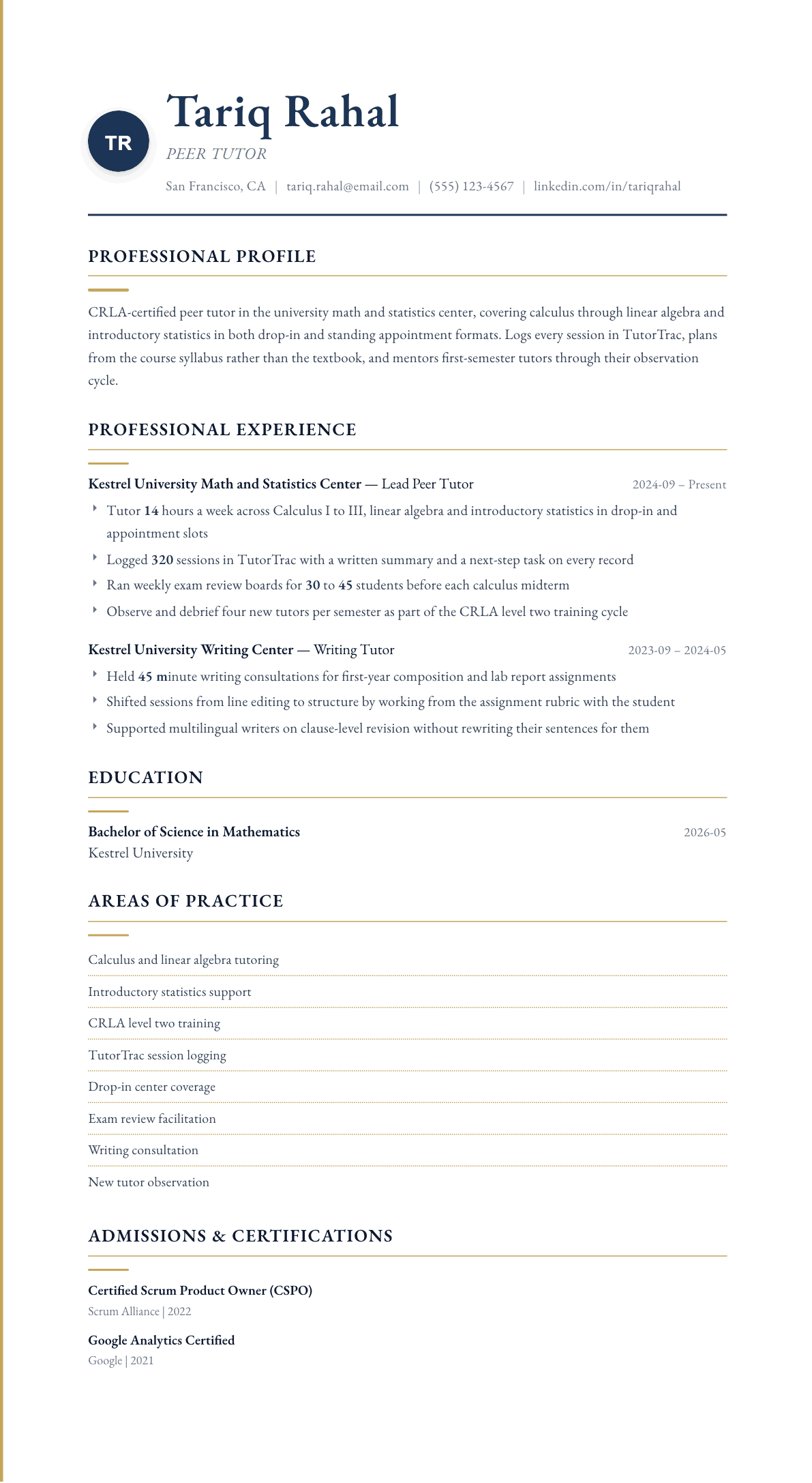
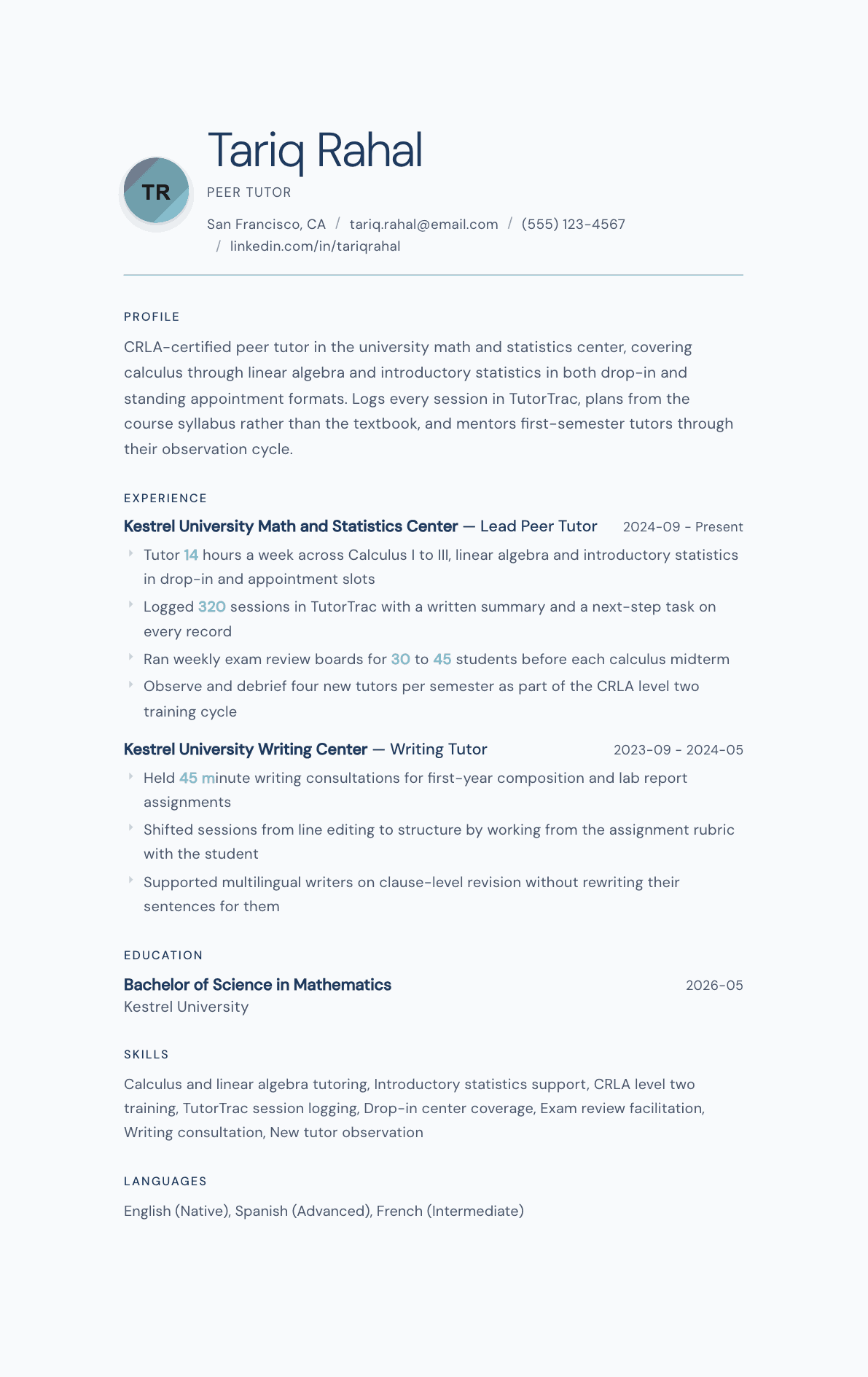
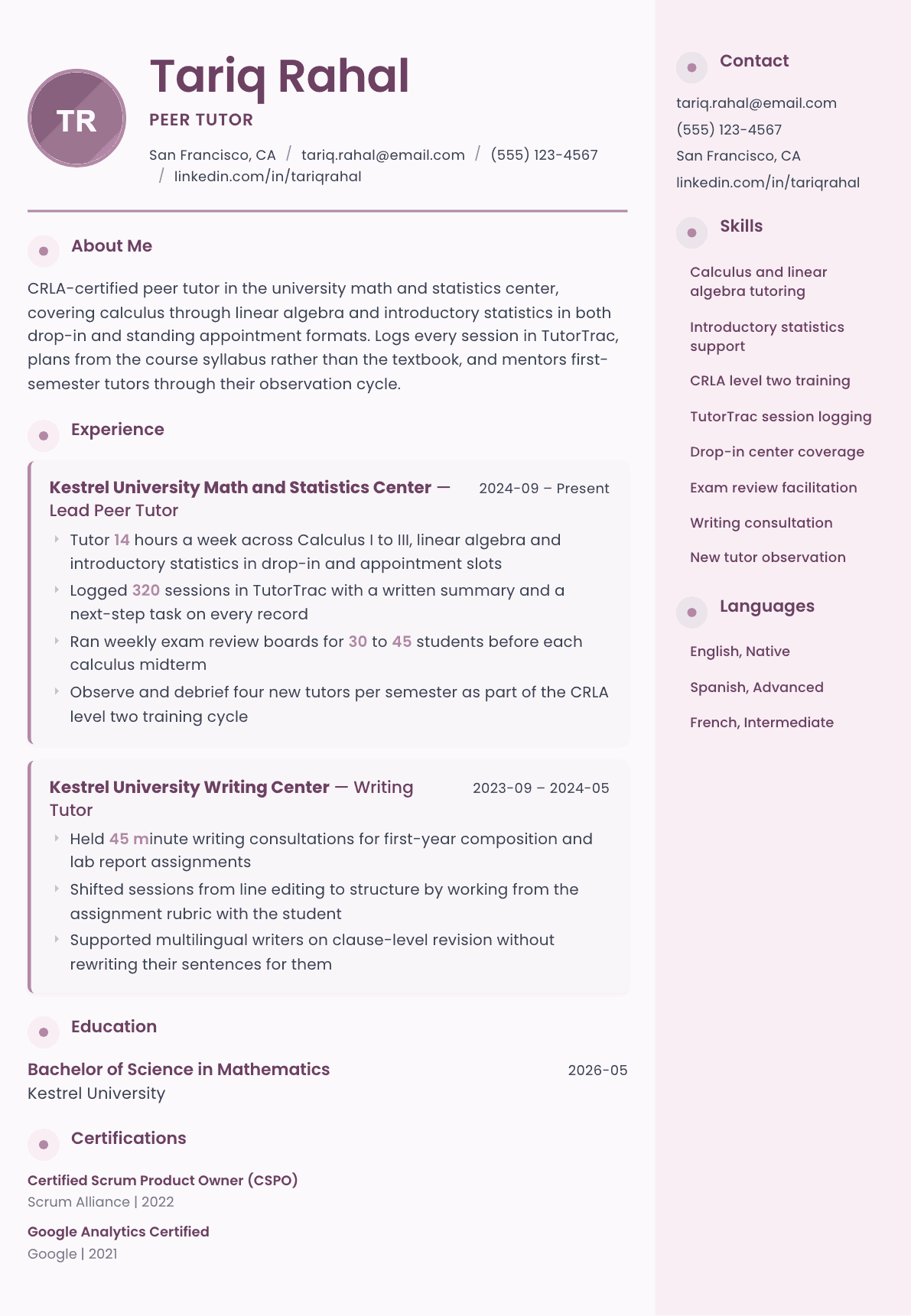
Example Peer Tutor summary
Peer tutor with two years in a university math and statistics center, covering calculus, linear algebra and introductory statistics across drop-in and appointment formats. Holds level two tutor certification, logs every session with a next-step task, and runs midterm review boards for large groups. Trains and observes new tutors each semester. Seeking a lead tutor or learning center coordinator assistant role.
Skills to list on a Peer Tutor resume
- Subject tutoring by course number
- Drop-in center coverage
- Standing appointment scheduling
- Group exam review facilitation
- Session note documentation
- TutorTrac and scheduling software
- CRLA tutor training
- Learning strategy coaching
- Rubric-based writing feedback
- Support for multilingual students
- New tutor observation and debrief
- Academic integrity boundaries
- Online tutoring platforms
- Referral to accessibility services
What actually gets this resume read
- List the exact courses you tutor by number and title, because centers hire against gaps in their schedule.
- Give weekly tutoring hours and total sessions, since coordinators build the schedule from availability first.
- Say whether you cover drop-in traffic, standing appointments, group review or online sessions.
- Name your tutor training level and the certifying body, because funded centers report those numbers.
- Show the session note habit: what you record, and what the next tutor can do with your record.
- Explain how you avoid doing the work for a student, which is the question every interview asks.
- Add any course you have taken the grade and the instructor for, since centers match tutors to syllabi.
How to write a peer tutor resume
A learning center coordinator hires peer tutors against a grid: which courses are uncovered, which hours have queues out the door, and which subjects lost a tutor to graduation. She is not looking for the strongest student in the department. She is looking for someone who can sit with a student stuck on the same integral for twenty minutes and not take the pencil.
That is why course lists beat grade point averages on a peer tutor resume. A center that has nobody for organic chemistry on Tuesday afternoons will interview the applicant who names the course number, the instructor whose section they took, and the afternoon they are free, ahead of a candidate with a better transcript and a vague claim to tutor sciences.
This guide covers the format learning centers scan, how to write subject coverage and session work so a coordinator can schedule you, three summaries across a first-semester tutor, an experienced one and a lead, and the questions that come up when centers interview.
Format: subjects by course number, then hours, then everything else
One page. The block that goes highest is your subject coverage, written as a list of course numbers and titles you are prepared to tutor today, separated from courses you have taken but would need a refresher on. Coordinators build the schedule from that list and nothing else, so burying it under an objective statement costs you the interview.
Second block is availability by day and hour, because a center covers fixed opening hours and a tutor who is free during the dead afternoon slot is more useful than one who can only work the hour everyone else wants. Then tutoring and teaching experience, then other work, then education with any tutor training level.
- Subject block: course numbers and titles, marked as ready now or available with preparation.
- Availability block: days, hours, and whether you can cover online or evening sessions.
- Experience entries name the setting: drop-in center, appointment based, embedded in a course, or private.
- Training level and certifying body sit with education, since funded centers report those numbers.
Session work: what you record and what happens next
Centers run on session records. Say how many sessions you have logged, in what scheduling system, and what a record of yours contains. The habit that impresses a coordinator is writing a next step: the problem set section to attempt alone, the office hour to attend, the concept to bring back. That turns a tutoring hour into a sequence rather than a rescue.
Then describe your session structure. Most centers train some version of a start where the student states the task, a middle where you ask before you tell, and an end where the student summarizes what changed. Name your version. A tutor who can describe the shape of a session is a tutor who can be observed and coached, and coordinators hire for that.
The line you do not cross
The question every peer tutor interview asks, in some form, is what you do when a student pushes the graded assignment across the table and asks you to check the answers. Answer it on the resume before it is asked. A line saying you work from the assignment rubric and the course policy, and that you redirect graded work to the instructor, does more than any adjective in your profile.
The same boundary shows up in writing consultations, where the failure mode is taking over the sentence. Describe what you do instead: reading aloud, marking pattern errors rather than fixing each one, working at the level of paragraph purpose before clause repair. Centers that support multilingual writers care about this more than any other skill on the page.
- One line on academic integrity: what you will and will not look at, and where you send graded work.
- One line on your feedback method in writing sessions, at the level of structure before surface.
- Any referral you make: accessibility services, the counseling center, supplemental instruction, the instructor.
- How you handle a student who arrives an hour before the exam wanting a full unit reviewed.
Group work, review boards and training other tutors
Once a center trusts a tutor it hands over group work: exam review boards, supplemental instruction sessions, workshop series. These belong on the page with the attendance figure, because holding a room of forty before a calculus midterm is a different skill from a one on one appointment and coordinators staff them separately.
Training and observing new tutors is the other promotion path. If you have run a shadow cycle, observed a session and delivered feedback, or written the center guide to a topic students keep getting stuck on, write it as the artifact it produced. That is what moves an application from tutor to lead tutor.
Skills, keywords and certification language
Learning center postings recycle a narrow vocabulary: drop-in, appointment, embedded tutoring, supplemental instruction, session notes, learning strategies, metacognition, scaffolding, academic integrity, accessibility referral. Mirror the ones that are true of you, once in a skills block and once inside a bullet.
Tutor training certification carries real weight because many centers are funded against it. Name your level and the certifying body exactly, and if you are mid-cycle, say which level you are working toward and how many observation hours you have completed. Coordinators track those hours for reporting and a candidate who already knows the vocabulary saves them a conversation.
Peer Tutor resume summary examples
First-semester tutor
Second-year mathematics major applying for a first center position, prepared to tutor Calculus I and II and introductory statistics after earning an A in both sequences. Tutored algebra weekly for two years through a high school peer program. Available Monday and Wednesday afternoons, including the 4 pm drop-in block.
Two years in the center
Peer tutor with 320 logged sessions across Calculus I to III, linear algebra and introductory statistics in both drop-in and appointment formats. Writes a next-step task on every session record, runs midterm review boards for 30 to 45 students, and holds level two tutor certification.
Lead tutor
Lead peer tutor covering the math and statistics center schedule, observing four new tutors a semester through the shadow and feedback cycle. Rewrote the center guide to integration by parts after tracking the topic across a semester of session notes, and covers the exam week evening extension.
Work experience bullets: before and after
Before: Tutored students in math.
After: Tutored Calculus I to III, linear algebra and introductory statistics for 14 hours a week, split between drop-in coverage and standing weekly appointments.
Named courses and weekly hours let a coordinator place you against an uncovered slot immediately.
Before: Kept records of tutoring sessions.
After: Logged 320 sessions with a written summary and a next-step task on every record, so a student returning to a different tutor arrived with the work already scoped.
The record content and its purpose show a habit that makes the whole center work better, not just a compliance step.
Before: Ran review sessions before exams.
After: Ran weekly exam review boards for 30 to 45 students before each calculus midterm, working from the past two years of released problems and the instructor topic list.
Audience size and source material turn a review session into something a coordinator can hand to you again.
Before: Helped students with their essays.
After: Held 45 minute writing consultations working from the assignment rubric, addressing paragraph purpose before sentence repair and marking error patterns rather than correcting each instance.
The method proves you improve the writer instead of improving the draft in front of you.
Before: Trained new tutors.
After: Observed and debriefed four new tutors per semester through the level two certification cycle, using a shared observation form and a follow-up session two weeks later.
A named cycle, an instrument and a follow-up mark you as staff development rather than an informal helper.
Hard skills
- Subject tutoring by course number
- Drop-in center coverage
- Standing appointment scheduling
- Exam review board facilitation
- Supplemental instruction sessions
- Session note documentation
- Tutor scheduling software
- Learning strategy and study skill coaching
- Rubric-based writing feedback
- Support for multilingual writers
- New tutor observation and debrief
- Academic integrity boundaries
Soft skills
- Waiting through a silence instead of filling it with the answer
- Asking the question that exposes the actual gap
- Staying patient with the fourth explanation of the same concept
- Telling a student honestly that one hour will not cover a full unit
- Handling a busy drop-in table without losing anyone waiting
Certifications worth listing
- International Tutor Training Program Certification (College Reading and Learning Association)
- Tutor Certification (National Tutoring Association)
Mistakes that cost peer tutor candidates the interview
- Claiming to tutor a whole subject area instead of listing the course numbers a coordinator is trying to cover.
- Leaving availability off the page, which forces the center into an email exchange before they can schedule you.
- Leading with a transcript when centers hire for the ability to hold back an answer, not for the highest grade.
- Skipping the academic integrity boundary, the exact question every interview panel asks about graded work.
- Counting hours worked without counting sessions held, so the reader cannot judge your actual student contact.
- Describing writing help as proofreading, which tells a writing center you would edit the draft rather than teach the writer.
Peer Tutor resume questions
How many courses should I list that I am willing to tutor?
List every course you could walk into cold this week, and mark separately any you would take a few days to prepare for. Overclaiming is the fastest way to lose a center position, because the first appointment in a course you half remember tends to be reported.
Do I need tutor certification before I apply?
Almost never for a first position, since most centers train and certify their own staff. Say if you have started a cycle or completed observation hours elsewhere, because a coordinator reporting on certification levels will note that you already understand the process.
How do I write private tutoring on a resume for a campus center?
Give the subject, the level of the students, the number of families or clients, and how long you kept each one. Retention is the useful number in private work, because it stands in for the satisfaction survey a center would otherwise use.
What should I say about a student who wanted answers rather than help?
Describe your redirect, not the student. A short line about restating the assignment rubric, working a parallel problem rather than the graded one, and pointing them to the instructor for anything scored shows a coordinator you have already handled that pressure.
Is peer tutoring worth putting on a resume after graduation?
Yes, if you translate it. Session records become documentation, review boards become group facilitation, and new tutor observation becomes training delivery. Employers outside education read those as instruction and coaching skills rather than as a campus job.