Online Tutor Resume Examples: free ATS score and gap list
Tutor Your Way to a Resume That Wins Clients and Contracts
By Mustafa Tarabya, founder of CVBooster · Published · Updated
Create an online tutor resume showcasing subject expertise, virtual instruction skills, and student success rates across popular tutoring platforms.
Sample resumes for a online tutor
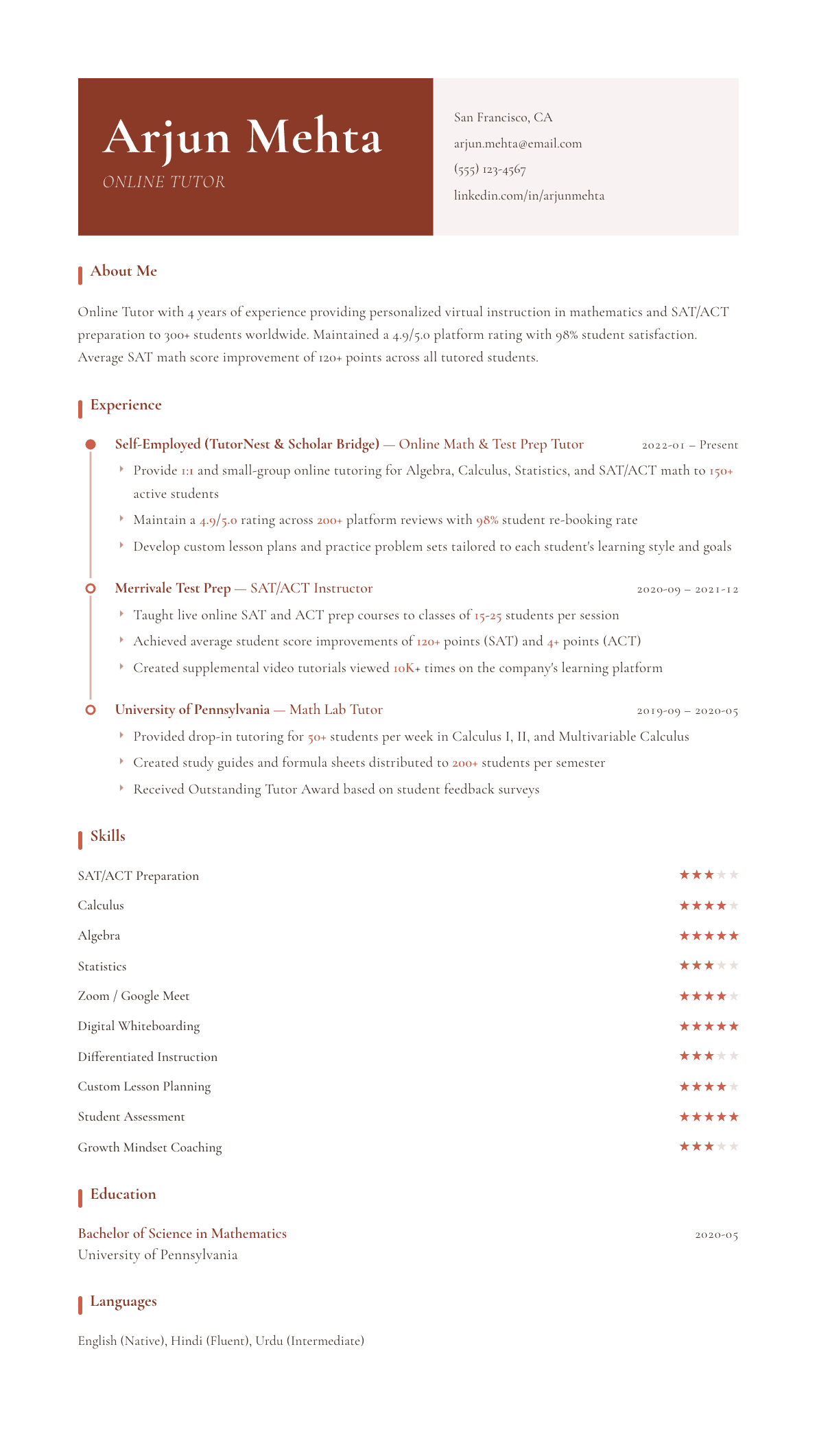
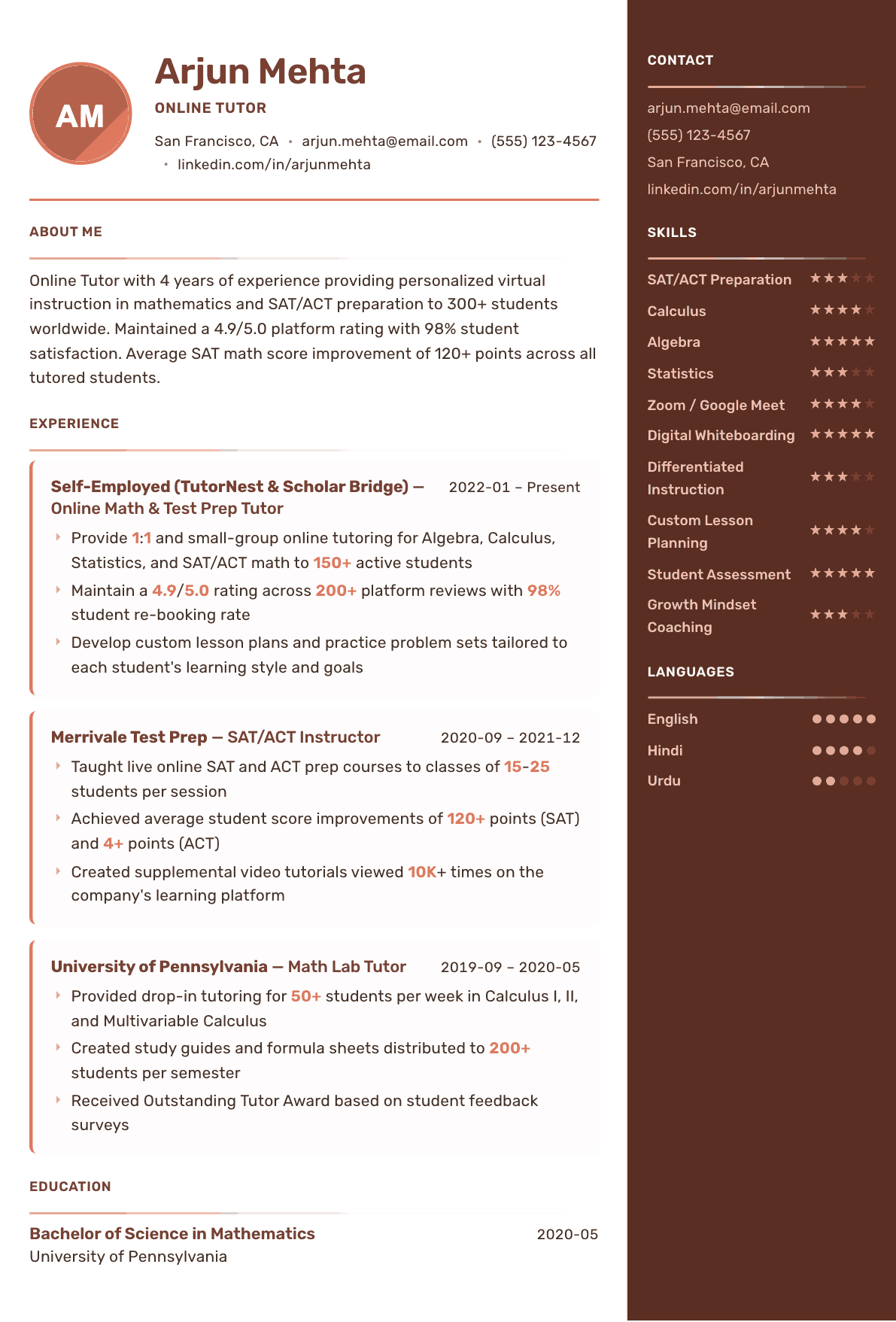
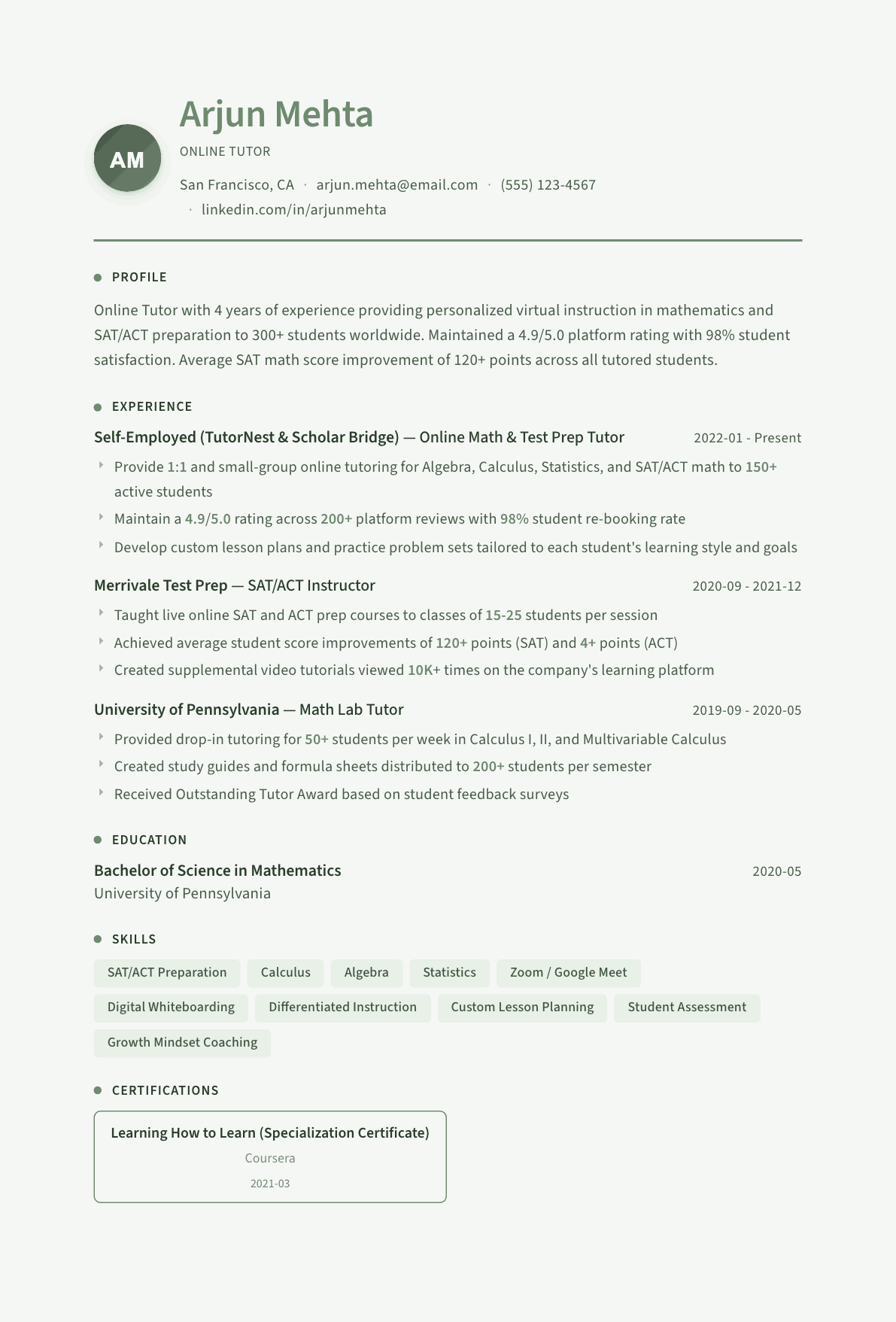
The same online tutor content laid out in three CVBooster templates, so you can see what the finished document looks like before you write a word.
Example Online Tutor summary
Online Tutor with 4 years of experience providing personalized math and test prep instruction to 300+ students worldwide. Rated 4.9/5.0 across 200+ platform reviews with 98% satisfaction. Achieved average SAT math improvement of 120+ points through diagnostic-based, adaptive lesson planning.
Skills to list on a Online Tutor resume
- SAT / ACT Test Preparation
- Mathematics (Algebra through Calculus)
- Statistics & Probability
- Zoom / Google Meet
- Digital Whiteboarding (Jamboard)
- Desmos / GeoGebra
- Differentiated Instruction
- Custom Lesson Planning
- Student Diagnostic Assessment
- Growth Mindset Coaching
- Time Management Strategies
- Khan Academy Integration
- Progress Tracking
What actually gets this resume read
- Lead with subject expertise and test score improvement data.
- Include platform ratings and reviews: Wyzant, Varsity Tutors, Tutor.com, Chegg.
- Quantify student outcomes: score improvements, grade increases, re-booking rates.
- List virtual teaching tools: Zoom, Google Meet, Jamboard, Desmos, Khan Academy.
- Describe your tutoring methodology: diagnostic assessment, scaffolding, formative checks.
- Mention total students served and hours of instruction delivered.
How to write a online tutor resume
Online tutor resumes go to two very different readers. One is a tutoring company recruiter filling seats on a platform, who screens for subject qualification, availability in a time zone, a background check and a working home setup, and can decide in under a minute. The other is a parent or a school district contracting for high-dosage tutoring, who reads for evidence that students actually improved and that you will show up every week.
The mistake most tutors make is writing the resume as a list of subjects. Subjects are the entry ticket. What earns the interview is the shape of your practice: how many students you carry, how long they stay with you, how you diagnose a gap before the first lesson, and what you do when a student arrives with a camera off and no work done.
This guide covers the format that works for both readers, how to write tutoring outcomes without inflating them, three summaries from a first tutoring role to an independent practice, and the questions tutors ask when they build a resume out of self-employment and platform work.
Format: one page, with subjects and levels visible immediately
One page is right for most tutors. Put a subjects and levels block near the top, written the way a family searches: not "mathematics" but Algebra I, Geometry, Algebra II, Precalculus, AP Calculus AB, SAT math and ACT math. A parent looking for help with one specific course wants to see that course named.
Self-employment is normal in this field and does not need to be disguised. Give your practice a name and treat it as an employer entry with dates, then list the platforms you have worked through as separate entries or as clients underneath.
- Header: name, city and time zone, phone, email, and a scheduling or profile link if you have one.
- Order: summary, subjects and levels, tutoring experience, results, education, certifications and background check status.
- A new tutor leads with subject coursework, peer tutoring or teaching assistant work, and any test scores that qualify them.
Summary: subjects, levels, student volume, and the outcome you own
Say what you tutor, at what level, to whom, and at what volume. Weekly hours and active student count tell a company whether you can fill a schedule, and tell a parent that you do this seriously rather than occasionally. Add the age range, because tutoring a struggling seventh grader and coaching a motivated senior through AP Calculus are different jobs.
Close with the result you are known for: score gains on a named test, grade recovery, a pass rate on a specific exam, or long retention with the same families. One verifiable outcome beats a paragraph of adjectives about your passion for helping students.
Experience: sessions, diagnosis, and what happens between lessons
For each engagement, give the format and the load: one-to-one or small group, session length, sessions per week, and the number of students on your roster. Then describe your method concretely. A diagnostic before the first paid session, a written plan the family can see, homework between sessions, and a progress check every few weeks are the practices that separate a tutor from a homework helper.
Write about the online part explicitly, because it is a skill in itself. The video platform and the shared whiteboard you use, how you handle written mathematics or annotated text on screen, how you keep a middle schooler engaged for 50 minutes remotely, how you record and share notes afterward, and what you do when a connection drops mid-session.
If you have worked through tutoring marketplaces or agencies, say what you did to earn work there: rating, review volume, rebooking rate, and how you managed scheduling and cancellations. Companies hiring experienced tutors read those signals as a proxy for reliability.
Results: be specific and be honest about attribution
Test preparation gives you the cleanest numbers, since a baseline diagnostic and an official score are both documented. Report the average change across a stated number of students rather than the single best outcome you ever had, and say how many sessions the typical student had before the test.
Academic tutoring is harder to measure, so use what exists: grade change over a marking period, a course passed after a prior failure, an exit exam cleared, or a student who moved out of intervention. Attribute carefully. A tutor who says a student went from failing to passing after twelve weeks of weekly sessions and consistent homework is credible; a tutor who claims credit for a college admission is not.
Credentials, safety and setup
Add a short block that answers the operational questions a platform will otherwise email you about: background check status and the year it was completed, availability by time zone, whether you can take evenings and weekends, and the equipment you tutor with, such as a document camera, a drawing tablet, a headset and a wired connection.
Then the qualifications: your degree and major, any teaching license, subject-specific credentials, and your own scores on the tests you coach when they are strong. Many companies require a qualifying score or a transcript for the subject before they will assign students in it.
Online Tutor resume summary examples
First tutoring role
Online tutor in high school algebra, geometry and introductory statistics, with two years of campus peer tutoring covering about 15 students a week in a drop-in center. Comfortable teaching on a shared whiteboard with a drawing tablet and building short practice sets between sessions.
Four years tutoring
Online tutor with four years and roughly 2,000 delivered sessions in high school mathematics and SAT and ACT preparation, carrying 18 to 22 active students a week. Average SAT math gain of 90 points across 60 students who completed at least ten sessions after a diagnostic.
Independent practice
Founder of an independent online tutoring practice serving 40 families a term across mathematics and science, with three contracted tutors. Built the diagnostic and progress reporting process, holds a state teaching license, and retains about three quarters of families from one school year to the next.
Work experience bullets: before and after
Before: Tutored students online in math and test prep.
After: Carried 20 active students a week in one-to-one 60-minute online sessions across Algebra II, Precalculus and SAT math, working with students in three time zones on weekday evenings.
Roster size, session format, courses and availability are precisely what a scheduler needs to know.
Before: Helped students raise their test scores.
After: Raised SAT math scores by an average of 90 points across 60 students who completed at least ten sessions, measured from an official diagnostic to a reported test date.
Naming the sample, the session threshold and the measurement points makes the average defensible.
Before: Created personalized lesson plans for each student.
After: Opened every engagement with a 30-minute diagnostic, wrote a four-week plan the family received in writing, and reassessed the weakest two topics at the end of each cycle.
A named process with a cadence is far more convincing than the word personalized.
Before: Maintained good reviews on tutoring platforms.
After: Held a 4.9 average across 200 reviews on a tutoring marketplace with a rebooking rate above 90%, and filled a full evening schedule from repeat families and referrals rather than platform placement.
Review volume, rebooking and where the work came from all point at reliability rather than luck.
Before: Used online tools during sessions.
After: Taught with a drawing tablet on a shared whiteboard so students saw work built line by line, then sent an annotated session summary and a short practice set within an hour of each lesson.
The specific setup and the follow-up routine show you have solved the hard part of remote instruction.
Hard skills
- One-to-one and small group online instruction
- Diagnostic assessment and gap analysis
- SAT and ACT test preparation
- Advanced Placement exam coaching
- Curriculum-aligned homework support
- Interactive whiteboard and drawing tablet instruction
- Video conferencing platforms
- Progress tracking and written reporting
- Practice set and worksheet creation
- Scheduling and cancellation management
- Learning management system familiarity
- Study skills and exam strategy coaching
Soft skills
- Building rapport through a screen
- Reading confusion without body language cues
- Patience with repeated explanation
- Parent communication
- Reliability and punctuality
- Motivating disengaged students
Certifications worth listing
- Certified Tutor, levels 1 to 3 (College Reading and Learning Association)
- National Tutoring Association Certification (National Tutoring Association)
- Wilson Reading System Level I Certification (Wilson Language Training)
Mistakes that cost online tutor candidates the interview
- Listing subjects as broad fields when families and platforms search by course name and exam name.
- Hiding self-employment or writing it as a gap, when independent practice is the normal shape of this career.
- Quoting a best-ever score jump instead of an average across a stated number of students.
- Leaving out weekly availability and time zone, the operational facts a staffing coordinator screens on first.
- Ignoring the remote craft entirely, so the resume could describe a tutor sitting at a kitchen table.
- Claiming credit for admissions decisions or final grades that many other factors produced.
Online Tutor resume questions
How do I write a resume when all my tutoring is self-employed?
Treat your practice as the employer. Give it a name, the dates, the subjects, the roster size and the weekly hours, then write bullets about your process and results. List marketplaces and agencies underneath as channels rather than pretending each was a staff job.
Do I need a teaching license to tutor online?
Not for most private tutoring or marketplace work, where a degree in the subject or a qualifying test score is enough. District-contracted tutoring and some high-dosage programs do require a license or a paraprofessional credential, so check the contract requirements before applying.
Should I put my own test scores on the resume?
Yes if you coach that test and the score is strong, because companies use it as a qualification threshold and parents find it reassuring. Keep it to one line near your education, and leave it off entirely once you have several years of documented student results.
How many hours of tutoring should I claim?
Claim what your records support. Session counts are checkable on most platforms and in your own calendar, so give a total you could produce if asked, and pair it with the active weekly roster, which tells a recruiter more about your current capacity than a career total.
What do tutoring companies check before hiring?
Subject qualification through a transcript, degree or test score, a background check, availability that matches their demand windows, and a working setup with a reliable connection. Many also run a mock session, so name the platform and tools you already teach with.