Policy Analyst Resume Examples: the lines they read
Build a Policy Analyst Resume That Influences Decision-Makers
By Mustafa Tarabya, founder of CVBooster · Published · Updated
Create a policy analyst resume that highlights your research expertise, legislative knowledge, and data-driven recommendations for government and think tank roles.
Sample resumes for a policy analyst
The same policy analyst content laid out in three CVBooster templates, so you can see what the finished document looks like before you write a word.
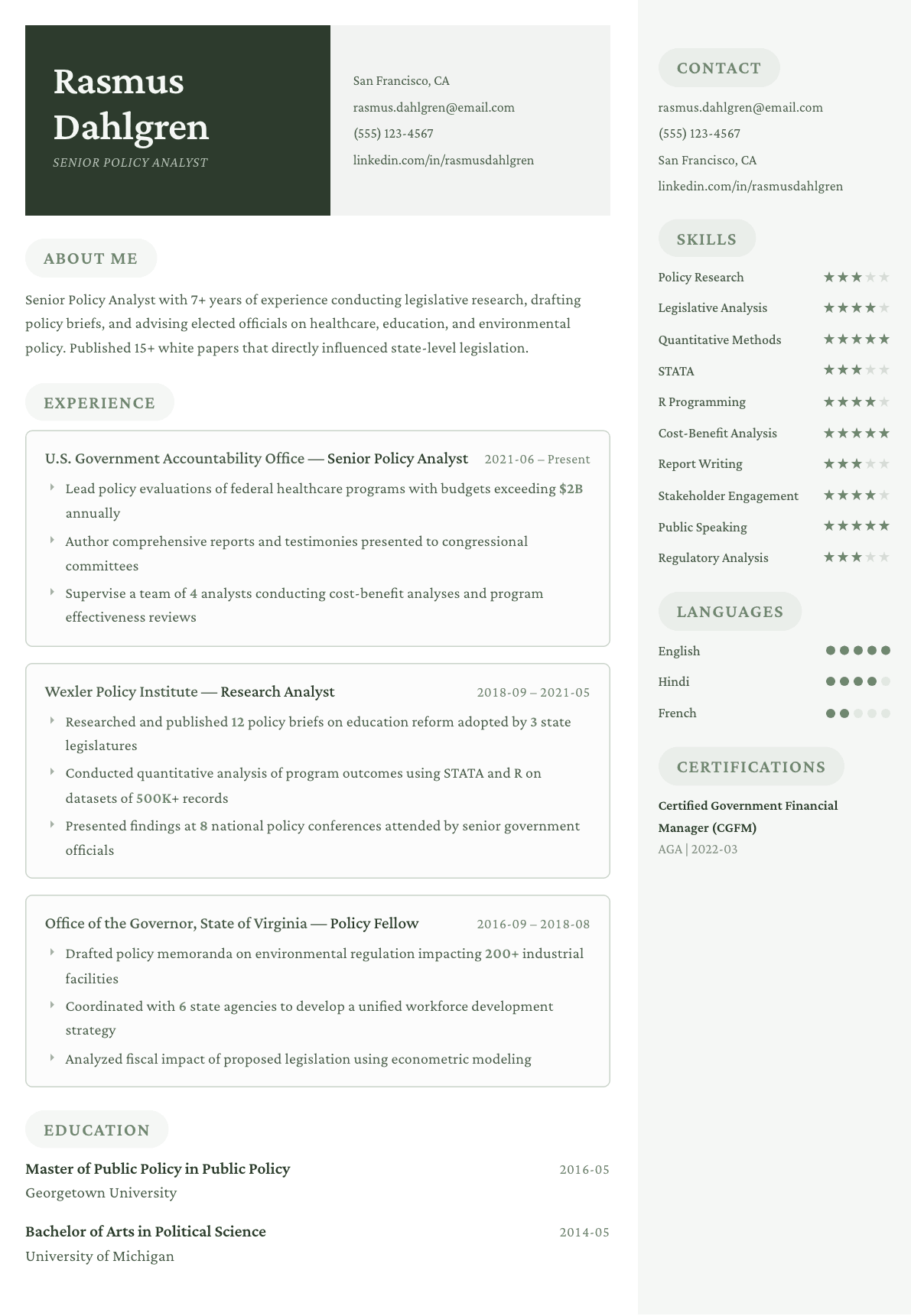
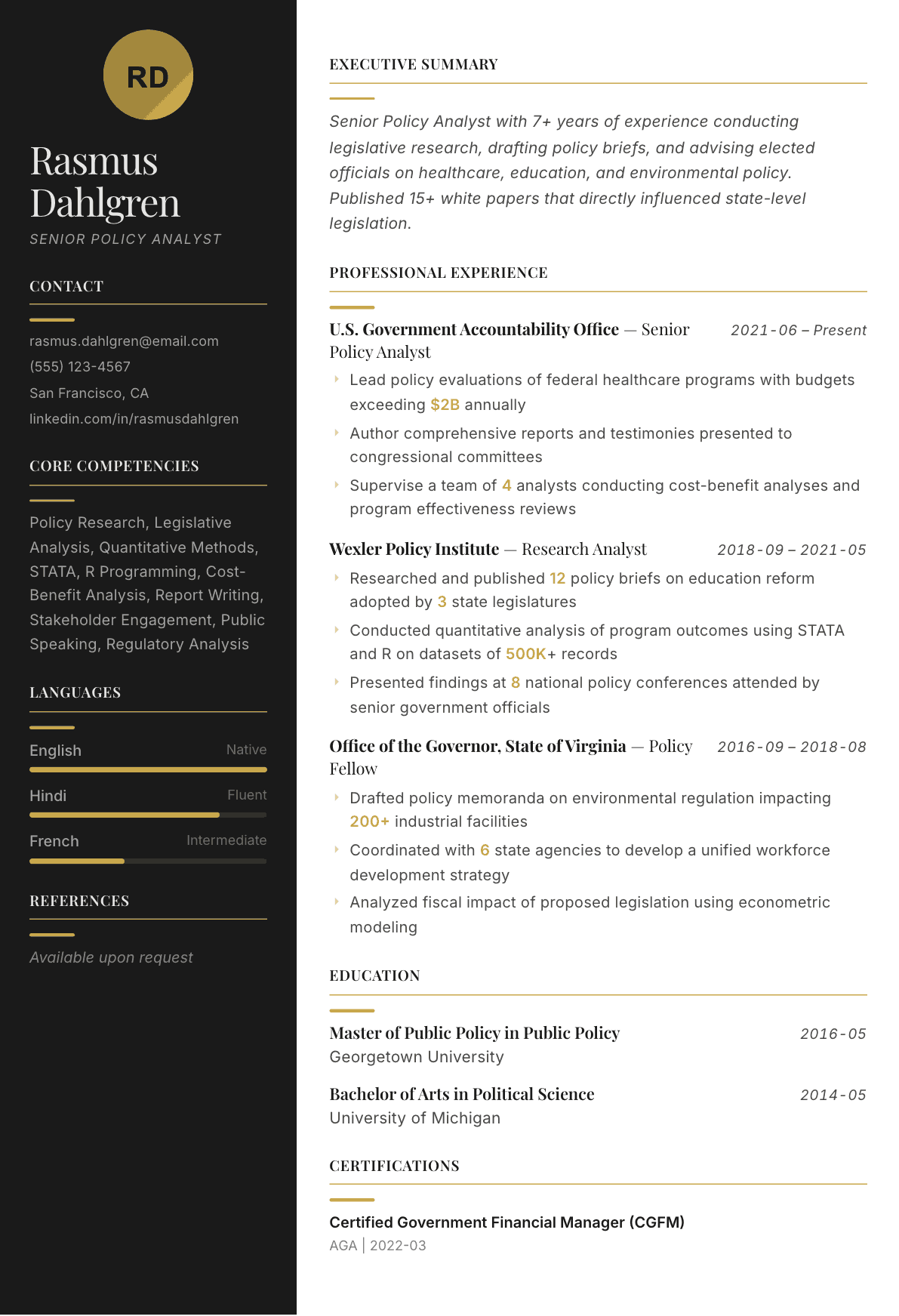
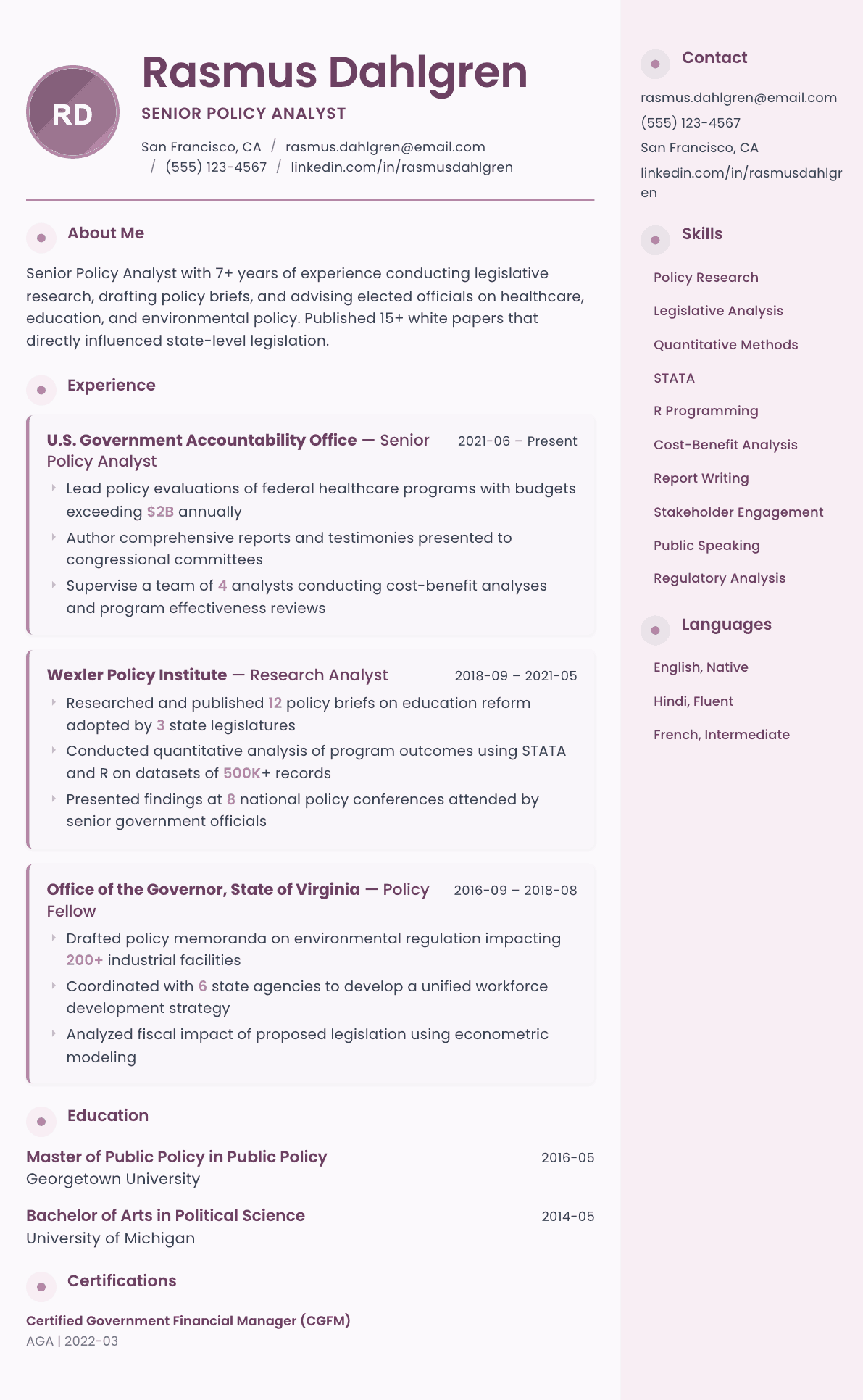
Example Policy Analyst summary
Senior Policy Analyst with 7 years of experience in legislative research, program evaluation, and data-driven policy development. Published 15+ white papers influencing state and federal policy decisions. Seeking a director-level role in government affairs or public policy research.
Skills to list on a Policy Analyst resume
- Policy Research & Analysis
- Legislative Drafting
- Quantitative Analysis
- STATA / R / SPSS
- Cost-Benefit Analysis
- Regulatory Impact Assessment
- Report Writing
- Stakeholder Engagement
- Program Evaluation
- Public Speaking
- Data Visualization
- Fiscal Impact Modeling
- Grant Writing
- Interagency Coordination
What actually gets this resume read
- Highlight publications, white papers, or policy briefs you have authored with their impact on legislation.
- Quantify your work: number of reports produced, budget sizes analyzed, or populations affected by your recommendations.
- Include statistical and analytical tools (STATA, R, SPSS, Tableau) to demonstrate data-driven capabilities.
- Mention any testimony, briefings, or presentations delivered to elected officials or committees.
- Showcase your ability to translate complex research into actionable policy recommendations.
- List relevant security clearances or public trust determinations if applicable.
How to write a policy analyst resume
A policy analyst resume is read by someone who will hand you a question with a deadline and no clean data. A research director at a think tank, a legislative fiscal office supervisor, a state agency policy chief or a government affairs lead all want the same proof: that you can define a question precisely, find the evidence that exists, be honest about what does not exist, and write a recommendation a decision maker can act on.
Two failure patterns dominate the applicant pool. Academic candidates present publications and methods with no decision attached, so the reader cannot tell whether the work ever informed anything. Advocacy candidates present positions with no analysis behind them. The hire goes to the person whose resume shows a real question, a defensible method and a product that reached an audience with authority.
This guide covers the structure policy hiring managers expect, how to present written products as evidence, how to describe quantitative methods without overstating them, how the sector you target changes the emphasis, and the questions analysts ask when they move between research, government and advocacy.
Format: one to two pages, publications given their own home
One page early in a career and two once you have a body of work. Give written products their own section rather than scattering them through job entries. A short publications and testimony list with titles, the publishing organization and the year lets a research director assess your output in a few seconds, which is what she came for.
Cut the academic apparatus if you are leaving a university. A policy shop does not want a full curriculum vitae with conference presentations and teaching evaluations. Keep the peer reviewed work that supports your subject expertise and move everything else into a single line.
- Header: name, city and state, phone, email, and a portfolio or publications link if you have one.
- Order: summary, professional experience, selected publications and testimony, technical skills, education.
- Note any public trust determination or clearance if you are applying to a government or contractor role.
Summary: the policy domain, the method, the audience
Three lines carrying three facts: the domain you know deeply, the analytic methods you can defend, and the decision makers who have used your work. A housing analyst who builds fiscal impact models for a state legislature and a health analyst who runs qualitative implementation studies for a foundation both hold this title and neither could take the other job on Monday.
If you are moving between sectors, say so and translate. Academic research becomes evidence synthesis under deadline. Consulting becomes client facing analysis with defined deliverables. Advocacy becomes stakeholder engagement plus applied research. Name the crossing rather than hoping the reader makes the connection alone.
Experience: the question, the method, the recommendation, the outcome
Write each significant project as a four part story compressed into one bullet. What question was asked, how you answered it, what you recommended and what happened. The last part is where most resumes stop short, and it is the part that separates an analyst from a researcher: a bill amended, a rule commented on, a program redesigned, a budget option adopted, an agency practice changed.
Show the range of products you can produce. A long form report, a two page brief for a principal, a fiscal note under a short statutory deadline, a regulatory comment letter, an issue explainer for the press, testimony before a committee, a data dashboard maintained for a program office. Each has a different audience and a different discipline, and naming several shows versatility.
Be exact about methods. Descriptive analysis of administrative data, a difference in differences design, a cost benefit analysis with a stated discount rate, a microsimulation model, structured interviews with a stated sample, a systematic evidence review. Vague references to research and analysis invite a technical interview you will not enjoy.
Data, tools and the limits you acknowledge
Name the statistical environment you work in and the level at which you work in it. There is a real difference between running regressions someone else specified and building and documenting a model that a colleague can reproduce. Say which you do. Name the data sources you know well, such as federal survey microdata, state administrative records, or program level reporting.
Acknowledging limits is a professional signal, not a weakness. An analyst who writes that a finding rests on two years of administrative data with known undercounting reads as trustworthy. Where you have handled a data limitation in published work, that is worth a line, because policy audiences remember analysts whose numbers held up.
Sector differences and the vocabulary to mirror
Tune the emphasis to the employer. A legislative fiscal office wants speed, statutory deadlines, neutrality and fiscal notes. A think tank wants publication record, media reach and a defined research agenda. An agency wants regulatory process, rulemaking, program evaluation and internal briefing. A government affairs team wants the ability to translate a rule into a business consequence.
Recurring vocabulary across postings includes policy analysis, program evaluation, cost benefit analysis, fiscal impact, regulatory analysis, evidence synthesis, stakeholder engagement, briefing and testimony, data visualization, and legislative tracking. Mirror the specific words of the posting where your record genuinely supports them.
Policy Analyst resume summary examples
Research associate
Policy analyst with two years at a state research office producing fiscal notes under statutory deadlines and descriptive analyses of program administrative data. Authored six issue briefs on housing affordability and built a public dashboard tracking voucher utilization by county. Masters in public policy.
Five to seven years in
Health policy analyst with six years across a state agency and a research organization, specializing in coverage and access. Ran two program evaluations using administrative claims data, testified twice before a legislative committee and authored a report that informed a payment rule revision.
Senior analyst or research director
Senior policy analyst leading a four person team on labor and workforce policy. Owns the research agenda, publishes long form reports and short briefs, and manages relationships with two state agencies that supply administrative data. Built the microsimulation model now used for the office fiscal impact estimates.
Work experience bullets: before and after
Before: Conducted research and analysis on policy issues.
After: Evaluated a state rental assistance program using three years of administrative records, identified a county level gap in voucher utilization and recommended a landlord outreach change the agency adopted.
Question, data, finding and adoption make the work verifiable rather than a description of a research job.
Before: Wrote reports and policy briefs.
After: Authored nine issue briefs and two long form reports on workforce training outcomes, including a two page version prepared for a committee chair ahead of a markup.
Volume plus a product written for a named decision point shows the audience awareness policy shops hire for.
Before: Performed cost-benefit analysis for proposed programs.
After: Built a cost benefit model for three early childhood proposals with a documented discount rate and sensitivity ranges, and presented the tradeoffs to the budget committee staff.
Documented assumptions and sensitivity ranges are how a quantitative claim earns trust from a skeptical reader.
Before: Presented findings to stakeholders and officials.
After: Testified before a legislative health committee on coverage estimates, and briefed agency leadership and two advocacy coalitions on the same analysis with materials tailored to each audience.
Naming the venues and the tailoring shows communication skill across audiences with different needs.
Before: Used statistical software to analyze data.
After: Built and documented reproducible analysis pipelines in R for survey microdata and state administrative extracts, with version controlled code a colleague could rerun without support.
Reproducibility is the technical detail that distinguishes a serious analyst from an occasional software user.
Hard skills
- Policy analysis and option development
- Program evaluation design
- Cost benefit and cost effectiveness analysis
- Fiscal impact and revenue estimation
- Regulatory and rulemaking analysis
- Administrative data analysis
- Survey microdata analysis
- Evidence synthesis and literature review
- Statistical analysis in R or Stata
- Data visualization and dashboards
- Policy brief and report writing
- Testimony and legislative briefing
- Stakeholder interviews and qualitative methods
Soft skills
- Framing a question precisely
- Neutrality under political pressure
- Writing for a nontechnical decision maker
- Honesty about uncertainty
- Meeting statutory deadlines
- Collaboration with agency data owners
Mistakes that cost policy analyst candidates the interview
- Listing research projects with no decision attached, so the reader cannot tell whether the analysis was ever used.
- Sending a full academic curriculum vitae to a policy shop instead of a two page resume with a selected publications section.
- Describing methods vaguely, which guarantees an uncomfortable technical interview when the specifics are probed.
- Writing in advocacy language for a nonpartisan office, where perceived neutrality is a hiring requirement.
- Omitting the audience for each product, when a brief for a committee chair and a report for a general readership are different skills.
- Padding a skills list with software you have opened rather than tools you can use unsupervised.
Policy Analyst resume questions
Do I need a graduate degree to work as a policy analyst?
A masters in public policy, economics, public health or a related field is the common entry route and many postings list one. It is not absolute. Strong administrative data experience inside an agency, or a demonstrable publication record, can substitute at organizations that value applied work.
How do I show policy impact when I do not set policy?
Trace the path your work traveled. Name the committee that received it, the rule comment docket it entered, the agency that adopted a recommendation or the budget option it supported. Analysts influence rather than decide, and showing the route is enough.
Should I list publications on a policy analyst resume?
Yes, as a selected list of five to ten with the title, the publishing organization and the year. Prioritize policy relevant work over academic output, and include testimony and regulatory comments, since both prove your writing reached people with authority.
How do I move from academia into policy analysis?
Rewrite your record around questions and decisions rather than contributions to a literature. Cut the curriculum vitae down, add any short form writing you have done, and get one applied product into the file such as a two page brief or a public comment.
How technical should my quantitative claims be?
Precise enough to defend and no more. State the method, the data source and the period. If you built the model, say so. If you ran an analysis someone else specified, say that instead, because the distinction always surfaces in the interview.
Related resume examples
- Legislative Assistant Resume example
- Urban Planner Resume example
- Public Affairs Specialist Resume example
- Federal Government Resume example
- Public Policy Analyst Resume example
- Regulatory Analyst Resume example