Zoning Administrator Resume Examples: what gets the call
Write a Zoning Administrator Resume for Ordinance and Board Work
By Mustafa Tarabya, founder of CVBooster · Published · Updated
Zoning administrator resume example, keyword list and guide covering variances, site plan review, board staffing and ordinance amendments.
Sample resumes for a zoning administrator
The same zoning administrator content laid out in three CVBooster templates, so you can see what the finished document looks like before you write a word.
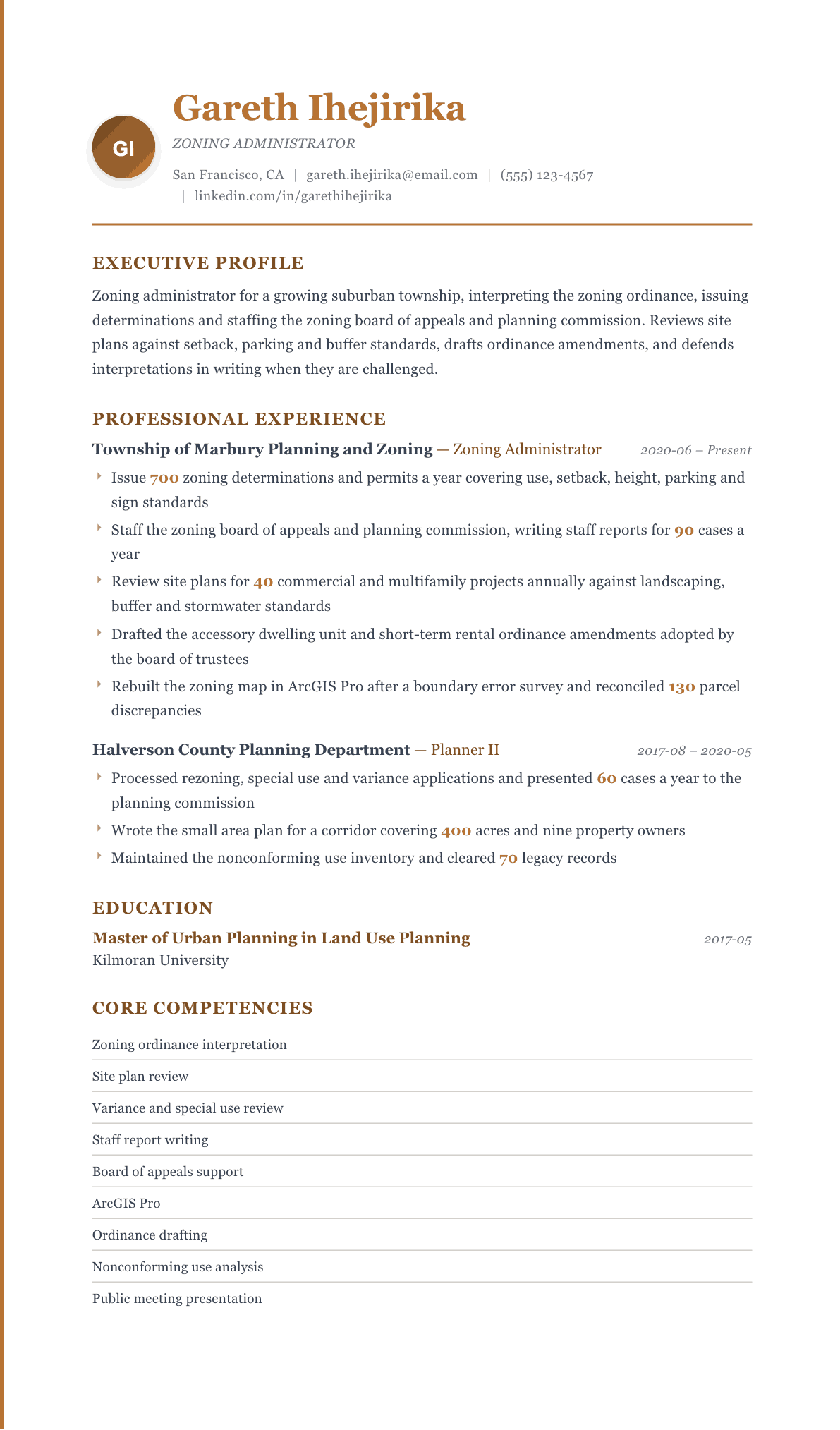
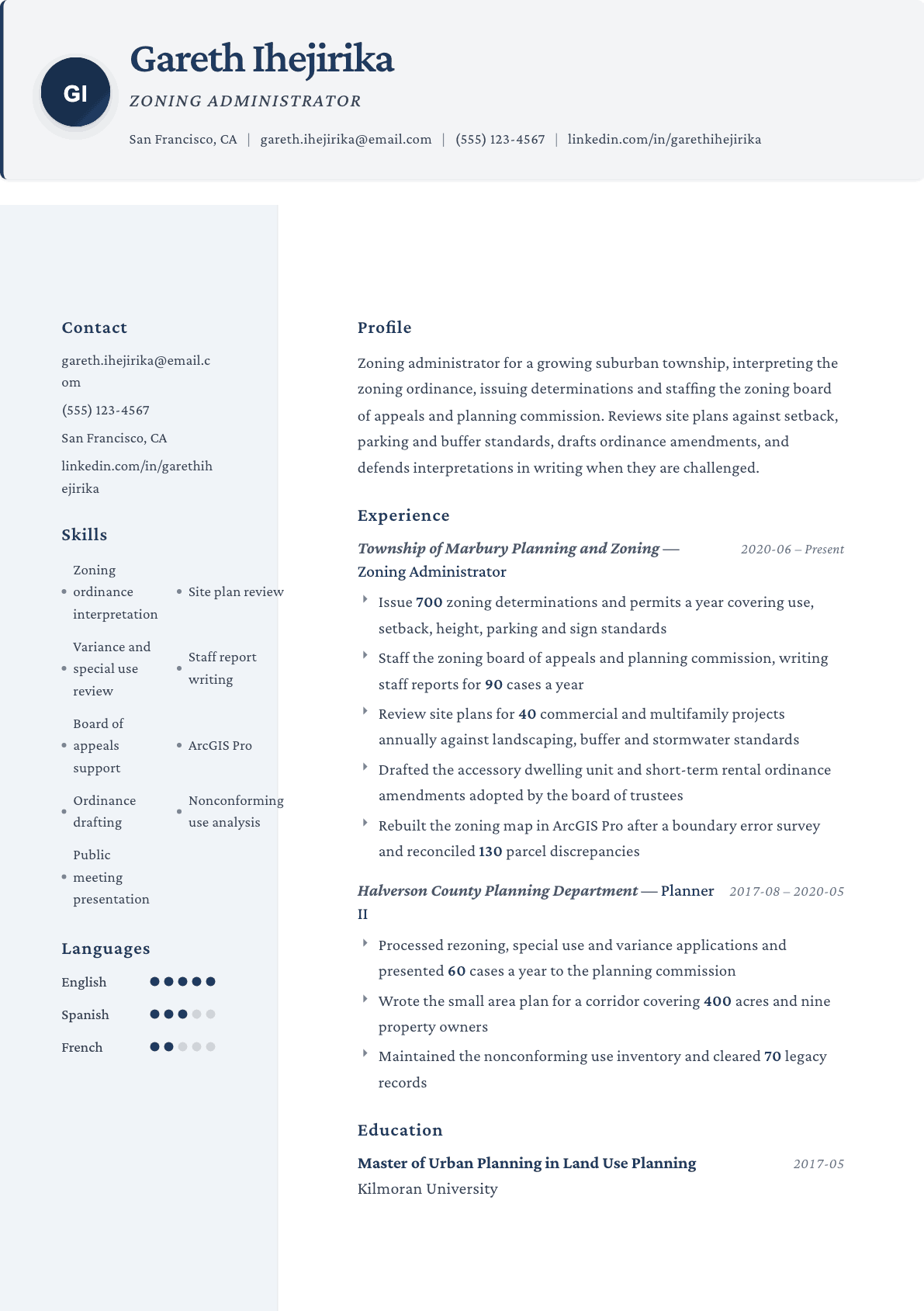
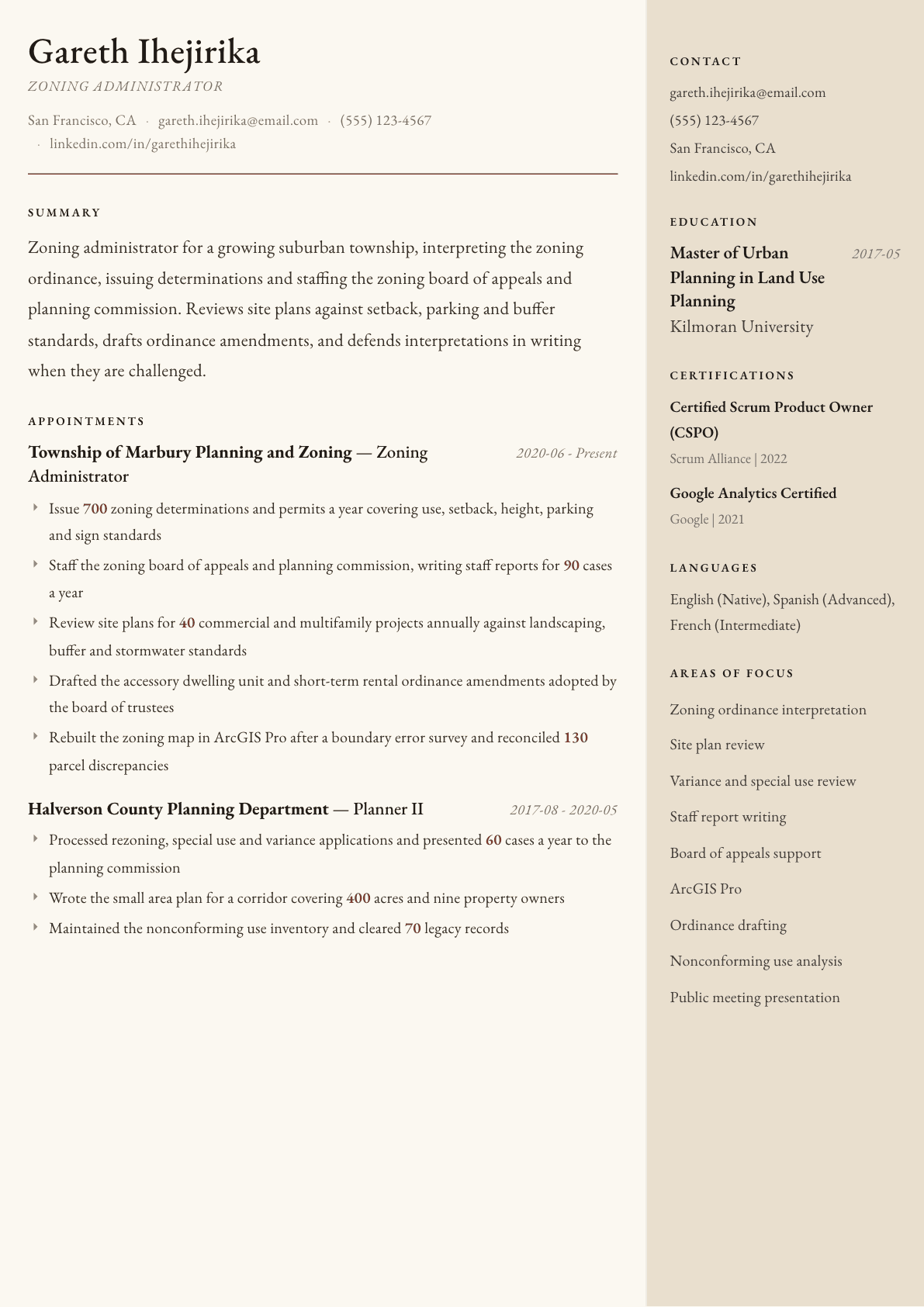
Example Zoning Administrator summary
Zoning administrator with seven years across a county planning department and a suburban township, issuing 700 determinations a year and staffing both the zoning board of appeals and the planning commission. Reviews commercial and multifamily site plans, drafts adopted ordinance amendments on accessory dwellings and short-term rentals, and maintains the zoning map in ArcGIS Pro. Master of urban planning.
Skills to list on a Zoning Administrator resume
- Zoning ordinance interpretation
- Zoning determinations and permits
- Site plan review
- Variance and special use permits
- Rezoning and map amendments
- Ordinance drafting
- Staff report writing
- Zoning board of appeals support
- Planning commission presentation
- Nonconforming use analysis
- Comprehensive plan consistency review
- Subdivision review
- Sign and parking standards
- ArcGIS Pro and parcel mapping
- Public notice and hearing procedure
What actually gets this resume read
- Say how many determinations and permits you issue a year, because volume tells a manager the size of the desk.
- Name the boards you staff, since a zoning board of appeals and a planning commission need different report writing.
- Show ordinance amendments you drafted and whether they were adopted, which proves you can write code not just read it.
- List your GIS tools, because a zoning administrator who can fix the map is worth more than one who calls the GIS team.
- Give site plan review numbers by project type, since commercial and multifamily review carry the most scrutiny.
- Include how you handle challenged interpretations, because the job lives or dies on a defensible written record.
- Put the AICP certification and the American Planning Association affiliation where a screener sees them immediately.
How to write a zoning administrator resume
A planning director hiring a zoning administrator is handing over the authority to interpret an ordinance. Every determination that leaves the desk can be appealed, litigated or used as precedent by the next applicant, and the boards that meet each month need staff reports written well enough that volunteer members can make a defensible decision. That is the job the resume has to answer.
Most zoning resumes read like a planner resume with the word zoning added. Reviewed development applications and provided planning support tells a director nothing about whether you can look at a parcel, a use table and a set of setbacks and issue a determination you would be willing to defend in front of a board and an attorney.
This guide covers the format a planning department expects, how to write determinations, board work and ordinance drafting into your experience section, three summaries by career stage, before and after examples, and the questions zoning staff ask when they move to a larger jurisdiction.
Format: one to two pages, ordinance work and boards visible early
Reverse chronological, two pages once you have staffed boards in more than one jurisdiction. Under the summary, put a block naming the boards you staff, the application types you process, and the tools you use. A director can staff a desk from that block alone.
Jurisdiction context matters more here than in most fields. A township with a use based ordinance, a city with a form based code and a county with overlay districts are three different environments, and naming yours tells a reader how much of your experience transfers directly.
- Employer line: jurisdiction type, growth context, and whether the ordinance is use based, form based or a hybrid.
- Application block: determinations, variances, special uses, rezonings, site plans and subdivisions with annual counts.
- A zoning administrator resume names the boards staffed and how many cases were written for each per year.
- Include the permitting and GIS platforms, since a department buys weeks of training when a hire does not know them.
Summary: determination volume, boards staffed, ordinance authorship
Three lines carrying determination volume, the boards you staff, the review types you handle and any ordinance text you have drafted that was adopted. Adopted text is the strongest single signal in this field because it proves you can write regulation, not just apply it.
If you hold planning certification, put it in the first line with the issuing body. Directors in larger jurisdictions often treat it as a threshold, and it also signals you keep current with the continuing education that certification requires.
Experience: determinations, review, boards, amendments
Start with the determination workload, because it is the daily reality of the seat. Give the annual count and the standards you apply: permitted and conditional use tables, setbacks, height, lot coverage, parking and loading, signage, buffers and screening, accessory structures. A number plus a list of standards shows a working desk rather than an occasional review.
Site plan and subdivision review comes next. Say what project types you review and what you check: circulation and access, stormwater conformance, landscaping and tree preservation, lighting, screening of mechanical equipment, and consistency with the comprehensive plan. Note where you coordinate with engineering, fire and the utility, since a zoning administrator who cannot run a review committee will not last in a growing jurisdiction.
Board work deserves its own bullets. Report count and quality: how many staff reports a year, for which boards, and whether you make recommendations or present findings only. Then describe the hardest part, which is writing findings of fact that support a decision under the ordinance criteria rather than under public sentiment. A director reading that sentence knows you have been in a contentious hearing.
End with amendments and map work. Ordinance text you drafted and the body that adopted it, map amendments you processed, and any zoning map rebuild or parcel reconciliation you have done. GIS competence is increasingly the difference between two otherwise equal candidates.
Defensibility, records and the appeal you have not had yet
Every determination should be written as if it will be appealed, and the resume should reflect that discipline. Describe how you document an interpretation: the ordinance section, the facts on the parcel, the reasoning, the precedent if one exists, and the appeal rights notice. A director who has lost an appeal on a thin written record will read that bullet twice.
Public notice procedure is the quiet failure point. Mailing radius, posted signs, newspaper publication and the timing requirements are all statutory in most states, and a missed notice can void a decision entirely. An administrator who states that they own the notice process is claiming responsibility for the thing that actually voids hearings.
Keywords, credentials and the move to a bigger desk
Mirror the posting terms: use table, dimensional standard, variance criteria, practical difficulty, special use permit, conditional use, nonconforming use, vested rights, site plan approval, plat review, overlay district, comprehensive plan consistency. Panels score against these, and paraphrasing costs points.
When moving to a larger jurisdiction, address the scale question directly. Say how many cases a year you handled, how many boards you staffed simultaneously, and whether you have supervised staff or managed consultants. A candidate who names their capacity ceiling honestly is easier to hire than one who leaves the director guessing.
- Name the permitting system and the GIS tools separately, since departments buy them separately.
- Say whether you sign determinations under delegated authority or route them through a director.
- Include any litigation support or deposition experience, which is rare and valuable.
- List public engagement work such as open houses and corridor studies where you led the room.
Zoning Administrator resume summary examples
Planner moving into zoning
Urban planning graduate with two years as a planner processing rezoning, special use and variance applications for a county department and presenting 60 cases a year to the planning commission. Maintained the nonconforming use inventory and drafted a small area plan. Seeking a zoning administrator role in a growing township.
Running the zoning desk
Zoning administrator issuing 700 determinations and permits a year covering use, setback, height, parking and sign standards, staffing both the zoning board of appeals and the planning commission with 90 staff reports annually. Reviews commercial and multifamily site plans and maintains the zoning map in ArcGIS Pro.
Zoning administrator and code author
Senior zoning administrator with delegated signing authority, supervising two planners and managing consultant led ordinance rewrites. Drafted the accessory dwelling unit and short-term rental amendments adopted by the governing body, rebuilt the zoning map after a boundary survey, and supported the attorney on two land use appeals.
Work experience bullets: before and after
Before: Reviewed zoning applications and issued permits.
After: Issued 700 zoning determinations and permits a year against the use table, setback, height, parking and sign standards, documenting the ordinance section and parcel facts behind each decision.
Annual volume plus the standards applied and the documentation habit shows a defensible working desk.
Before: Provided support to the zoning board of appeals.
After: Staffed the zoning board of appeals and planning commission, writing 90 staff reports a year with findings of fact tied to each ordinance criterion rather than to public testimony.
Report volume and findings written to the criteria is exactly what makes a board decision survive appeal.
Before: Helped update the zoning ordinance.
After: Drafted the accessory dwelling unit and short-term rental ordinance amendments, ran two public workshops on the drafts, and carried both to adoption by the board of trustees.
Naming the amendments, the engagement and the adoption proves authorship rather than participation.
Before: Worked with GIS on zoning maps.
After: Rebuilt the zoning map in ArcGIS Pro after a boundary survey and reconciled 130 parcel discrepancies against deed records and adopted map amendments.
A specific mapping project with a reconciliation count shows real GIS capability instead of tool familiarity.
Before: Reviewed site plans for new developments.
After: Reviewed site plans for 40 commercial and multifamily projects a year against landscaping, buffer, lighting and stormwater standards, and chaired the review committee with engineering and fire.
Project counts, the standards checked and the coordination role show the full review responsibility.
Hard skills
- Zoning ordinance interpretation
- Zoning determinations and permit issuance
- Variance and practical difficulty analysis
- Special and conditional use review
- Rezoning and map amendment processing
- Site plan review
- Subdivision and plat review
- Nonconforming use analysis
- Ordinance text drafting
- Staff report and findings of fact writing
- Public notice and hearing procedure
- Comprehensive plan consistency review
- ArcGIS Pro and parcel mapping
- Permitting system administration
Soft skills
- Even treatment of an applicant with political backing and one without
- Reading a hostile room without conceding the ordinance
- Explaining a dimensional standard to a homeowner in one pass
- Written precision when the wording will be read by an attorney
- Restraint in giving advice that could bind the jurisdiction
Certifications worth listing
- AICP Certification (American Institute of Certified Planners)
- Zoning Inspector Certification (International Code Council)
- Certified Floodplain Manager (CFM) (Association of State Floodplain Managers)
Mistakes that cost zoning administrator candidates the interview
- Writing a general planner resume when the posting is for a determination and board seat.
- Leaving out determination volume, which is how a director judges whether you can carry the counter.
- Describing board support without saying whether you wrote findings of fact or only assembled packets.
- Claiming ordinance work without naming the amendment or whether the governing body adopted it.
- Skipping public notice procedure, the failure point that voids more hearings than any substantive error.
- Omitting GIS skills, which increasingly decides between two candidates with similar case experience.
Zoning Administrator resume questions
Do I need AICP certification for a zoning administrator role?
Smaller jurisdictions rarely require it, while larger cities and counties often list it as preferred or required for senior seats. If you do not hold it, state your degree, your years of qualifying experience and your eligibility timeline so a director can see the path.
How do I show zoning experience when my title was planner?
Describe the determinations you issued, the staff reports you wrote and the ordinance sections you interpreted. Public panels score tasks against qualifications rather than titles, so the specific work is what earns you credit for zoning administration.
What should I say about a decision that was overturned on appeal?
Do not put individual case outcomes on a resume. If it comes up in an interview, describe the reasoning, what the reviewing body found and what you changed in your written record afterward, which shows professional judgment rather than defensiveness.
How much does GIS matter for a zoning administrator?
It matters more each year. A department where the administrator can query parcels, produce a notice mailing list and correct the zoning map directly moves faster than one that queues every request with a GIS analyst, so name your tools and a project you completed.
Should I list every application type I have processed?
List the types you processed independently with annual counts, and separate anything you only supported. A director needs to know whether you can run a variance case alone, since that is the case most likely to end in an appeal.
Related resume examples
- Urban Planner Resume example
- City Planner Resume example
- Code Enforcement Officer Resume example
- Public Works Director Resume example
- Budget Officer Resume example
- Health Inspector Resume example