Mover Resume Examples: what a hiring manager reads first
Write a Mover Resume That Shows Reliability, Care and Speed
By Mustafa Tarabya, founder of CVBooster · Published · Updated
Mover resume example with load planning, packing and damage claim bullets, equipment skills, keywords and a guide to standing out at hiring.
Sample resumes for a mover
The same mover content laid out in three CVBooster templates, so you can see what the finished document looks like before you write a word.
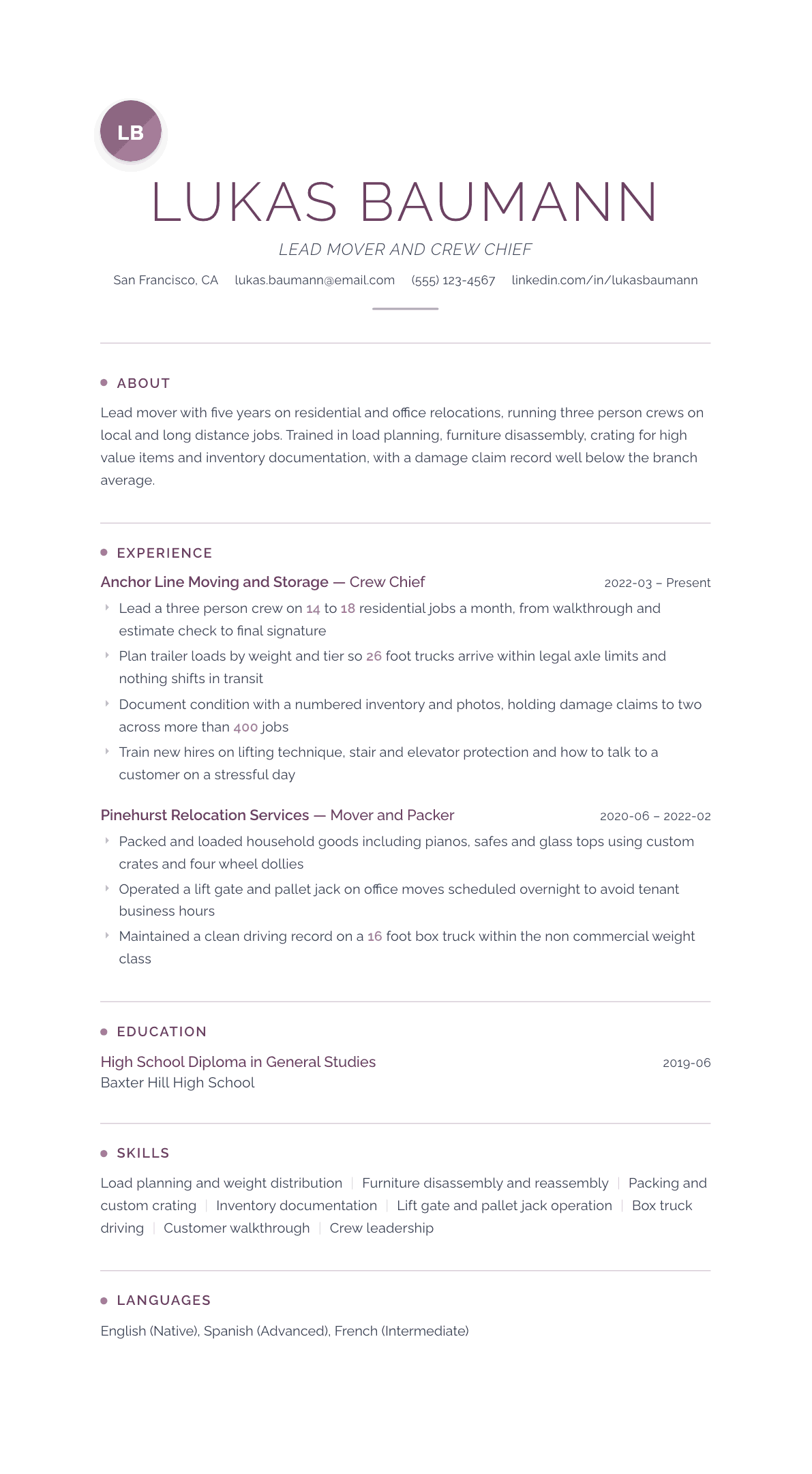
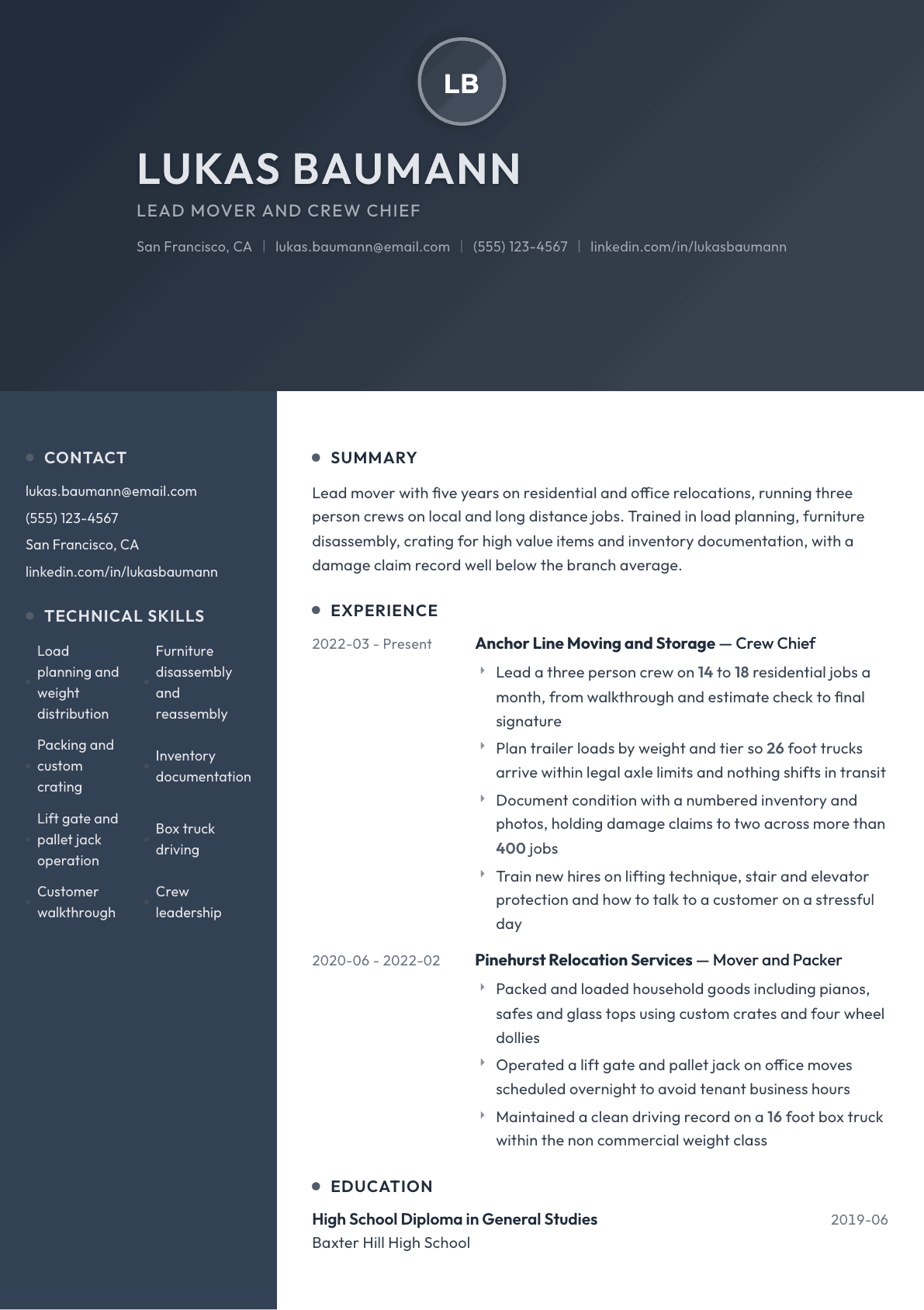
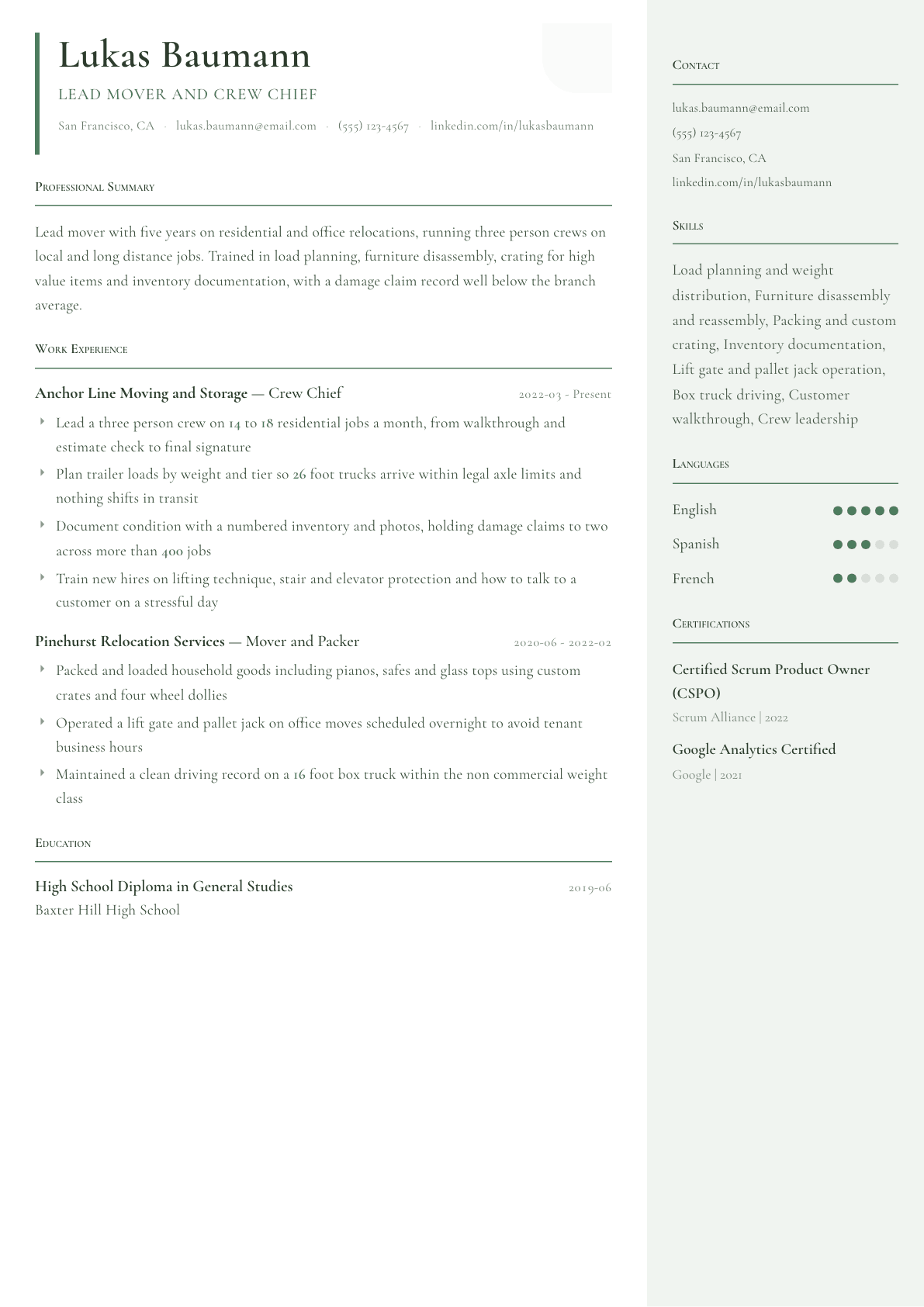
Example Mover summary
Lead mover and crew chief with five years on residential and office relocations, running three person crews on local and long distance work. Plans trailer loads by weight and tier, handles pianos, safes and glass in custom crates, and documents condition with a numbered inventory. Holds damage claims to two across more than 400 jobs and trains new hires on lifting technique and customer handling.
Skills to list on a Mover resume
- Load planning and weight distribution
- Furniture disassembly and reassembly
- Packing and custom crating
- Piano and safe handling
- Inventory and condition documentation
- Lift gate operation
- Pallet jack and dolly use
- Box truck driving
- Floor and doorway protection
- Long distance load securement
- Customer walkthrough and estimates
- Crew leadership and scheduling
- Warehouse vault storage
- Safe lifting technique
What actually gets this resume read
- Say how many jobs a month you run and whether they are local, long distance, residential, office or specialty.
- Show load planning knowledge: weight distribution, tiering, tie downs and keeping a truck inside its axle limits.
- Give the damage claim number, because a low claim rate is the single strongest signal a branch manager looks for.
- List equipment you can run: lift gates, pallet jacks, four wheel dollies, shoulder dollies, stair climbers, hoisting gear.
- Include your driver license class and driving record if you can drive the truck, since crews that can drive get more work.
- Add the customer facing part: walkthroughs, estimate checks, protecting floors and doorways, and calm handling of complaints.
How to write a mover resume
Moving companies hire on three things and everyone in a branch office will tell you the same three: does the person show up, do they break things, and can a customer stand being in a house with them for eight hours. A mover resume that answers those three questions in the top third of the page gets a call, even from someone with two seasons of experience.
The trade itself is more technical than outsiders assume. Loading a trailer is a weight distribution problem with legal axle limits attached. Packing a china cabinet, crating a glass top, hoisting a sofa through a second floor window and taking apart an adjustable bed frame are all learned skills. The resumes that stall are the ones that write it all as lifting boxes.
This guide covers what belongs in the header, how to write load planning and packing bullets, why the damage claim number is the single most persuasive figure you own, how to present driving ability, and the questions that come up moving from helper to crew chief or into long distance work.
Format: one page, dependable before impressive
One page, plain layout, phone number large. Branch managers hire in bursts before a busy season and read fast. Order the page: header with license class and availability, a short skills block, experience, certifications or safety training, education.
Put availability high on the page. Weekends, early starts, overnight office moves, out of town multi day trips and short notice call ins are the coverage a dispatcher is trying to fill, and stating what you can take makes you easier to schedule than a stronger candidate who has not said.
- Header: name, city, phone, email, driver license class, clean record note, and the hours you can work.
- A one line summary of scale: jobs a month, crew size led, local or long distance, residential or commercial.
- A damage or claim figure if you have one, because it is the number branch managers trust most.
Load planning: the part that separates a mover from a helper
Write the truck as a technical problem. Tiering the load so it does not shift, distributing weight so the vehicle sits inside its axle limits, decking and tying off, using pads, bands and rope, building a wall that survives a highway trip. Anyone can carry a box. Loading a trailer that arrives with nothing broken and nothing shifted is the skill a company pays for.
Add inventory and condition work. Numbered inventory tags, existing damage noted at pickup, photographs of high value items, signatures at both ends. That paperwork is what protects the company when a claim comes in, and a mover who does it consistently is worth more than one who is merely fast.
Packing, specialty items and equipment
Name the items that require a technique: pianos, safes, gun cabinets, glass tops, marble, mirrors, artwork, aquariums, treadmills, adjustable beds and wall mounted screens. Each one has a method and a company that hears you name them assumes correctly that you have done them.
Then name the equipment you can run. Lift gates, pallet jacks, four wheel dollies, appliance and shoulder dollies, stair climbers, hoisting straps, ramps, e track and load bars. Office moves add library carts, panel carts and computer crates. Equipment vocabulary is quick evidence of real time on jobs.
Include the protection routine: floor runners, door jamb pads, banister and elevator protection, shrink wrap on upholstery. Customers judge a crew on the house being undamaged as much as on the furniture arriving.
- Give a monthly job count and say whether they are local, long distance, residential, office or storage in and out.
- Give the truck size you have loaded and whether you have worked trailers, vaults or containers.
- Give a claim number, an injury free stretch, or both, over a stated period of work.
Crew leadership and the customer half of the job
A crew chief runs the walkthrough, checks the estimate against what is actually in the house, sequences the load, keeps two or three people busy, manages the clock and gets the paperwork signed. Write those as leadership duties, because that is what a branch is promoting into.
The customer part deserves a bullet of its own. People are moving on the worst week of their year and they take it out on the crew. A mover who can absorb that, keep the crew calm, explain a delay, and turn a complaint into a signed sheet is protecting the company from a claim and a review. Say plainly that you do it.
Driving, licenses and getting more work
A crew member who can also drive the truck gets scheduled more, because the branch needs fewer bodies per job. State your license class, the largest vehicle you have driven, your record, and whether you hold a medical card or a commercial license if long distance work is your target.
Add the safety training that lets a company put you on commercial sites: safe lifting and back care, forklift or pallet jack certification, hazard awareness, and any building access or loading dock procedure you have worked under. Office and commercial moves pay better and gate on that paperwork.
Mover resume summary examples
First season
Mover with one season of residential work covering local moves, storage loads and packing days. Trained in safe lifting, furniture wrapping and floor protection, comfortable with early starts and weekends, and holding a clean driver record with experience on a sixteen foot box truck.
Experienced crew member
Mover with five years on residential and office relocations, running three person crews on local and long distance work. Plans trailer loads by weight and tier, handles pianos, safes and glass in custom crates, and documents condition with a numbered inventory at both ends of every job.
Crew chief and trainer
Crew chief with nine years in household goods, leading crews of up to five on long distance and corporate relocations. Owns the walkthrough, the load plan and the paperwork, trains new hires on lifting technique and customer handling, and has held claims well below the branch average for four consecutive seasons.
Work experience bullets: before and after
Before: Loaded and unloaded trucks for residential moves.
After: Plan trailer loads by weight and tier so 26 foot trucks arrive inside their axle limits with nothing shifted, including decking, banding and building a tied off wall for highway runs.
Load planning described as a weight and securement problem shows a trade skill rather than manual labor.
Before: Careful with customer belongings.
After: Documented condition with a numbered inventory and photographs of high value items, holding damage claims to two across more than 400 completed jobs.
A claim count against a job count is the single figure a branch manager weighs most heavily.
Before: Moved heavy and awkward items.
After: Packed and moved pianos, safes and glass tops using custom crates, hoisting straps and four wheel dollies, with stair and doorway protection set before the first piece left the room.
Specialty items plus the equipment and protection routine prove trained technique, not brute strength.
Before: Led a moving crew.
After: Lead a three person crew on 14 to 18 residential jobs a month, from walkthrough and estimate check through load sequencing to the final signature.
Crew size, job volume and the span of the job from arrival to signature define a real supervisory role.
Before: Good with customers on moving day.
After: Handled walkthroughs and complaints on stressful move days, explaining delays and revised timing so jobs closed with a signed sheet and no follow up call to the branch.
Tying customer handling to a signed job and no escalation makes a soft skill into a business result.
Hard skills
- Trailer load planning and weight distribution
- Load securement with straps, bands and load bars
- Furniture disassembly and reassembly
- Packing and custom crating
- Piano, safe and specialty item handling
- Numbered inventory and condition reporting
- Lift gate and pallet jack operation
- Dolly, stair climber and hoisting equipment use
- Box truck and moving van driving
- Floor, doorway and elevator protection
- Warehouse vault storage handling
- Safe lifting and back care technique
Soft skills
- Reliability and on time arrival
- Patience with stressed customers
- Crew coordination through a long day
- Clear explanation of delays
- Physical stamina in heat and cold
- Care with other people belongings
Certifications worth listing
- OSHA 10-Hour General Industry (Occupational Safety and Health Administration)
- Powered Industrial Truck Operator Certification (Occupational Safety and Health Administration)
- Commercial Driver License Class B (State Department of Motor Vehicles)
- Department of Transportation Medical Examiner Certificate (Federal Motor Carrier Safety Administration)
Mistakes that cost mover candidates the interview
- Writing the job as lifting and carrying, which hides the load planning, packing and inventory skills a company is buying.
- Leaving out the damage claim record when it is the most persuasive number a mover can put on a page.
- Not stating availability for weekends, early starts and overnight commercial work.
- Skipping the driver license class, which decides whether a branch can schedule you as a driver or only as a helper.
- Listing no specialty items, so a dispatcher assumes you cannot be sent on a piano or a safe.
- Ignoring the customer facing part of the day, which is where most complaints and reviews are actually generated.
- Giving no job volume, so a manager cannot tell one busy season from three years of occasional work.
Mover resume questions
What should a mover put on a resume with only one season of experience?
Lead with reliability and availability, then name the specific skills you did learn: wrapping, packing, disassembly, floor protection and dolly use. Add any warehouse, construction or landscaping work, because branch managers screen hardest for people who can handle a long physical day.
How do I show that I do not break things?
Quote a claim count against a job count over a stated period, and describe the inventory and photograph routine you follow at pickup and delivery. A documented process makes the low claim figure believable instead of a claim about yourself.
Do I need a commercial driver license to work as a mover?
Not for most local crew positions, since many moving trucks fall under the weight threshold. A commercial license opens long distance and larger vehicle work and makes you far easier to schedule, so state your class and your record either way.
How do I move from crew member to crew chief?
Show that you already do the chief work: running the walkthrough, sequencing the load, keeping the crew paced, handling the paperwork and dealing with the customer. Then name the new hires you have trained and what you trained them on.
Should I include physical ability on the resume?
Mention it briefly and concretely rather than as a boast, for example the weight you routinely handle with a partner and the number of stair flights a typical job involves. Pair it with a safe lifting credential so it reads as trained capability rather than a risk.
Related resume examples
- Warehouse Worker Resume example
- Truck Driver Resume example
- Delivery Driver Resume example
- Forklift Operator Resume example
- Logistics Coordinator Resume example
- Van Driver Resume example