Warehouse Associate Resume Examples: what gets the call
Create a Warehouse Associate Resume That Gets Interviews
By Mustafa Tarabya, founder of CVBooster · Published · Updated
Warehouse associate resume example with sample bullets, pick and pack keywords, skills recruiters scan for, and a guide to writing each section.
Sample resumes for a warehouse associate
The same warehouse associate content laid out in three CVBooster templates, so you can see what the finished document looks like before you write a word.
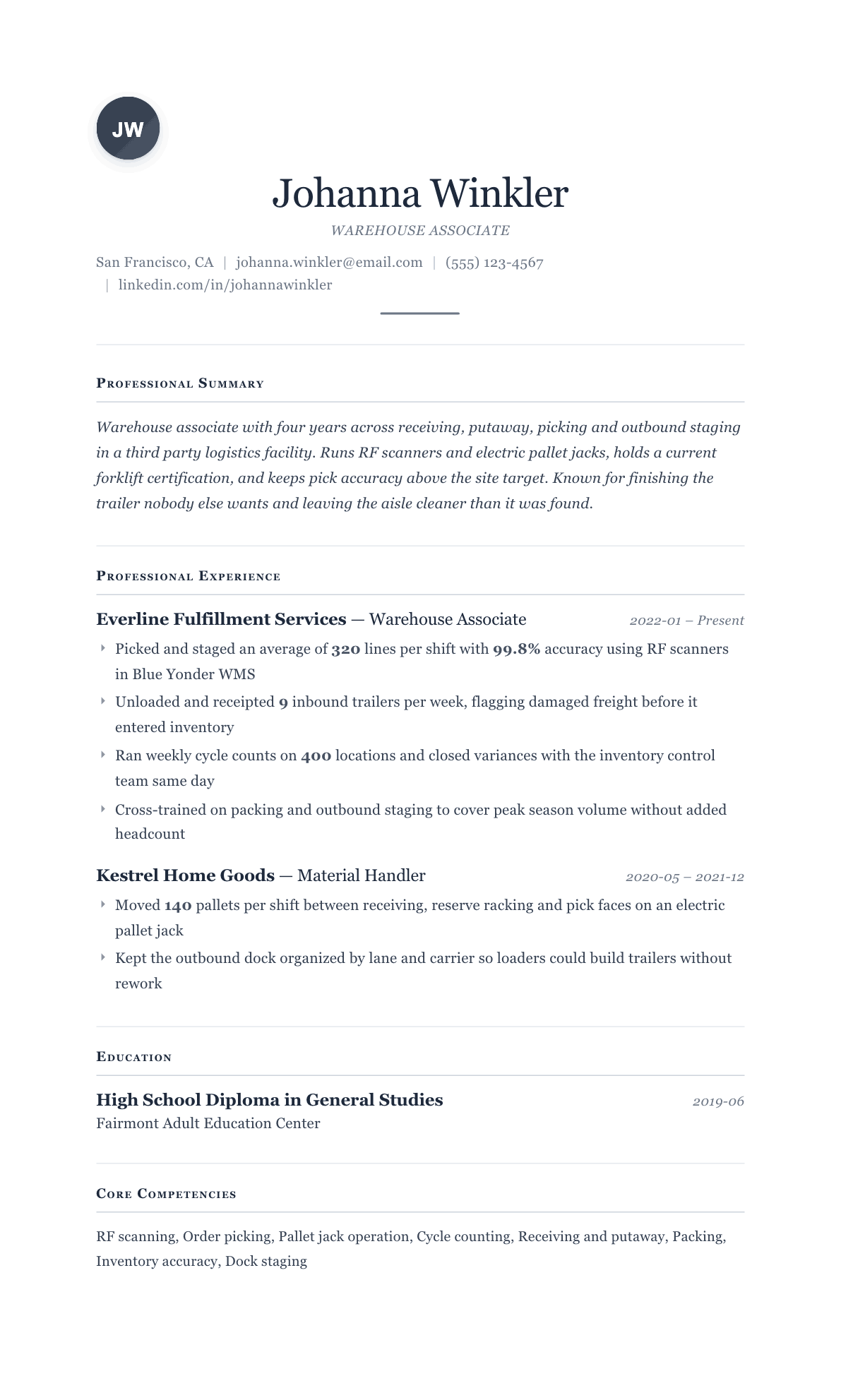
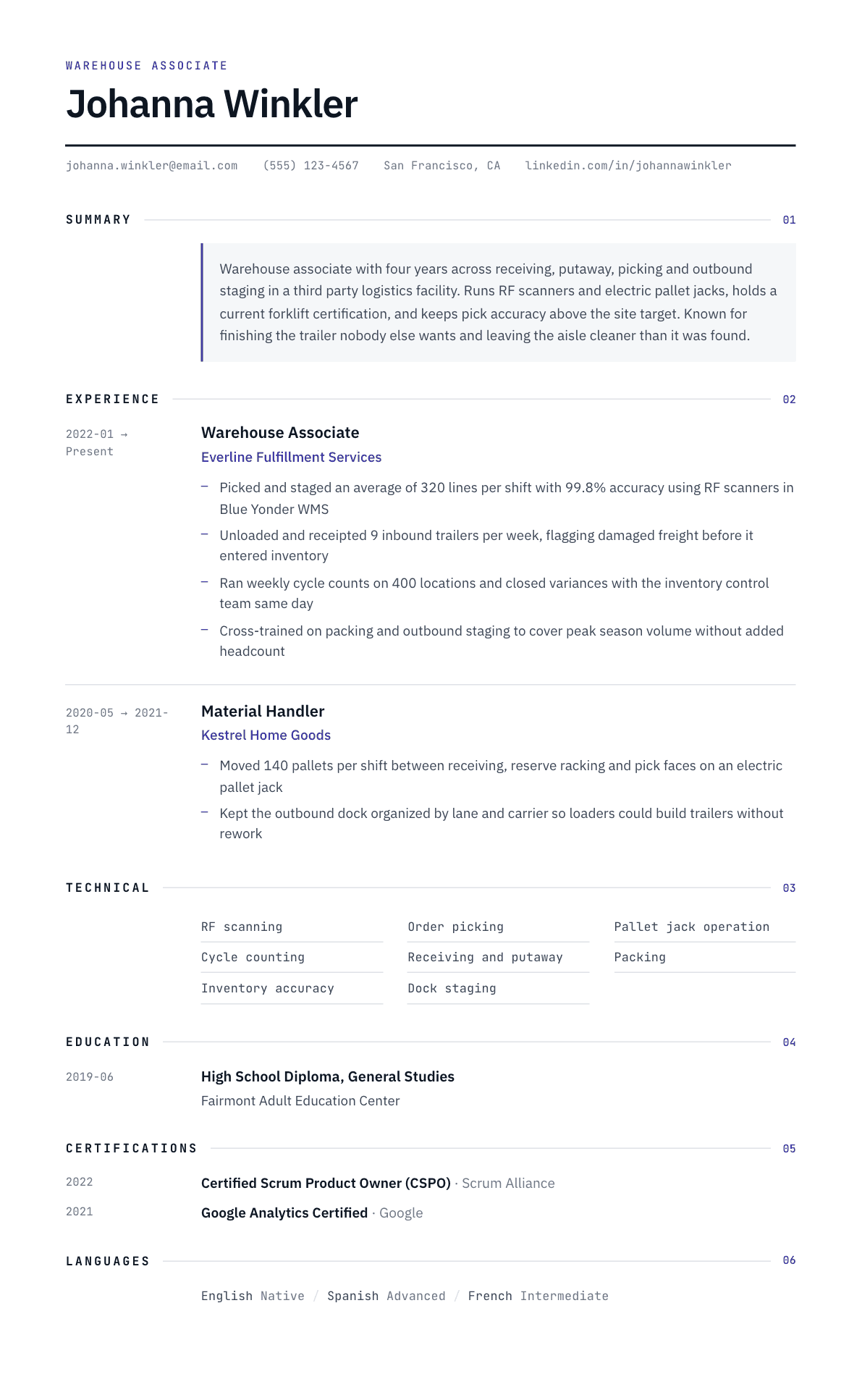
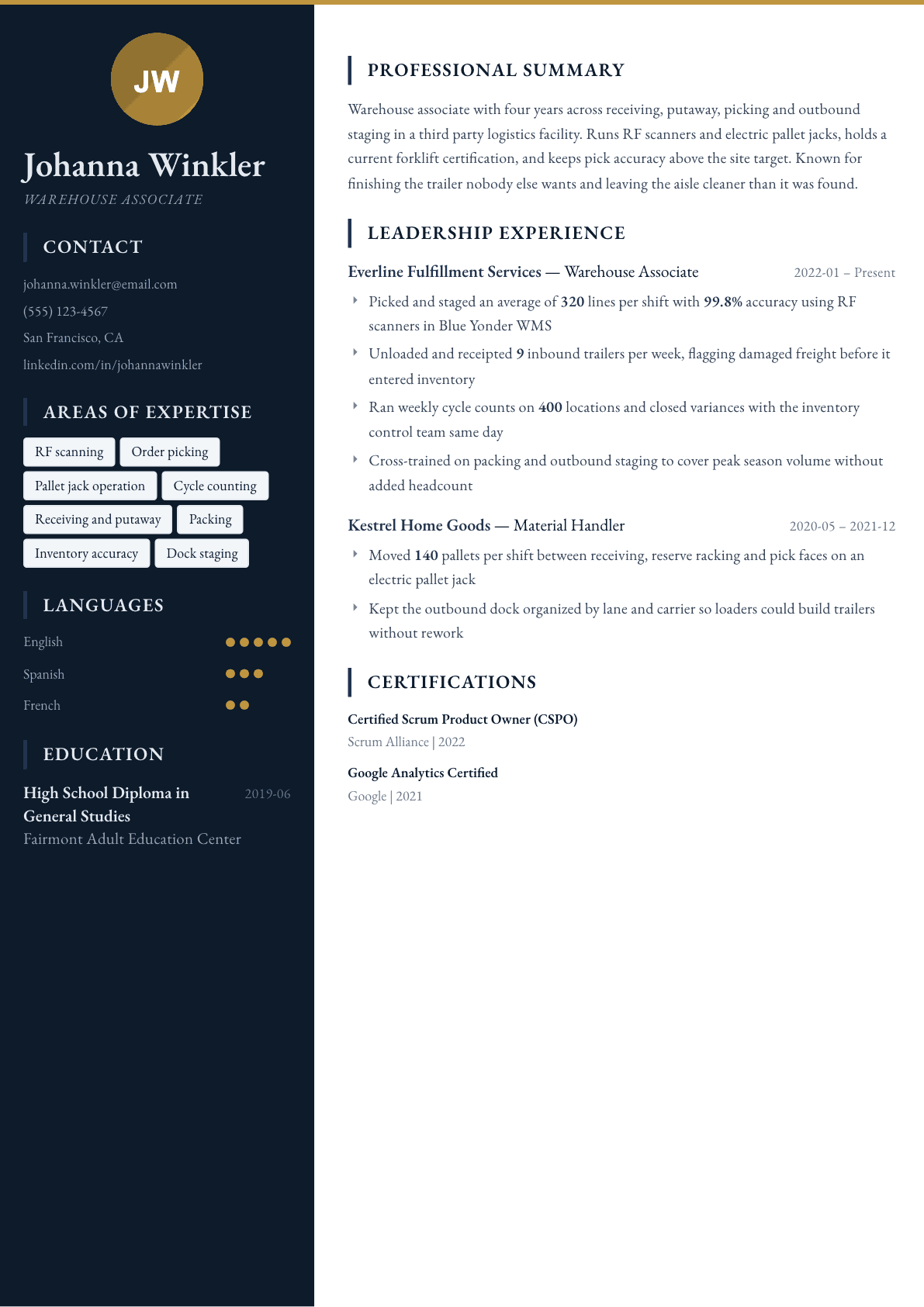
Example Warehouse Associate summary
Warehouse associate with four years in a third party logistics operation covering receiving, putaway, picking, packing and outbound staging. Picks roughly 320 lines per shift at 99.8% accuracy on RF scanners, holds a current forklift certification, and runs weekly cycle counts on 400 locations. Reliable attendance across two peak seasons. Seeking a full-time associate role with a path into inventory control.
Skills to list on a Warehouse Associate resume
- Order picking
- RF scanner operation
- Receiving and putaway
- Cycle counting
- Electric pallet jack
- Forklift operation
- Packing and cartonization
- Outbound staging
- Inventory accuracy
- Pallet wrapping
- Label verification
- WMS transactions
- Housekeeping and 5S
- Lift and carry to 50 pounds
What actually gets this resume read
- Give numbers for lines picked, pallets moved or trailers unloaded per shift, since throughput is the whole conversation.
- List your forklift or pallet jack certification even if the posting does not ask, because it moves you up the pile.
- Name the warehouse management system by product name so the automated screen matches you to the site.
- Show breadth across receiving, putaway, picking and packing, because managers hire associates they can move around.
- Add attendance and safety record in one line, since reliability is the trait most cited in warehouse hiring.
- Keep the layout single column with plain headings, because high volume warehouse recruiters skim on a phone.
How to write a warehouse associate resume
Warehouse associate openings are filled fast and in volume. A staffing agency recruiter or a site talent coordinator reads your application for about the length of a phone screen, and what she is deciding is narrow: can this person start on the shift we cannot cover, will they still be here in six weeks, and do we have to train them from zero on the scanner.
That is why the strongest associate resumes read like a capability list with numbers attached, not a career story. Breadth across receiving, putaway, picking, packing and outbound staging is worth more than depth in one of them, because associates get moved wherever the volume is that day. Reliability, stated plainly, is worth almost as much, since attendance is the reason most associate roles reopen.
What follows is the section order that suits a high volume screen, three example summaries covering a first warehouse job through to a senior associate ready for a lead track, before and after bullets drawn from ordinary floor work, and the questions associates ask when the posting says experience preferred.
Format: one page, plain, scannable on a phone
One page, single column, no graphics, no tables. Large distribution employers push applications through automated screening before a human sees them, and a decorative layout is the most common reason an otherwise good associate application never surfaces.
Because the screen is fast, front load the page. A short capability line under the header listing the functions you can cover and the equipment you are certified on lets a coordinator match you to an open shift without reading further. Put shift availability there too, since an associate who can work nights is filling a different vacancy than one who cannot.
- Header: name, city, phone, email, shift availability, forklift or pallet jack certification status.
- Capability line: receiving, putaway, picking, packing, loading, cycle counting, whichever you have done.
- Then summary, experience, certifications, skills, education. Education last unless you have no work history.
Summary: functions covered, volume handled, how steady you are
Two or three lines. Say how long you have worked in a warehouse, which functions you cover, one throughput figure, and one reliability fact. A summary that names four functions and a pick rate does more for you than a paragraph about being a hard worker who thrives in a team environment.
If this is your first warehouse role, use the summary to convert what you have. Retail stockroom work, grocery backroom shifts, moving crews, restaurant receiving and military supply all involve counting, staging and lifting on a clock. Name the transfer explicitly instead of hoping a coordinator makes the connection for you.
Experience: what you handled and how accurately
Head each job with the site type and the product: a third party logistics site handling apparel, a grocery distribution center, a manufacturer with an outdoor yard, a returns processing operation. Product and setting tell a supervisor what your hands are used to, and case weights in grocery are nothing like polybags in apparel.
Give every function you covered a bullet with a number in it. Lines picked per shift, trailers unloaded per week, pallets moved, locations counted, orders packed per hour. Then attach accuracy wherever you have it, because in a warehouse a fast associate who creates exceptions is a net cost and everyone on the floor knows it.
Cross-training deserves its own bullet. An associate who can be moved from picking to the pack line during a volume spike solves a staffing problem, and saying so directly is more persuasive than the word flexible sitting in a skills list.
Certifications and systems: the two things that shorten training
Equipment certification is the highest value line an associate can carry. Name the trucks you have been trained and evaluated on, and note that authorization is granted by each employer so you expect a site evaluation. Even a pallet jack and walkie rider card moves your application ahead of a candidate with nothing.
Then the warehouse management system. Naming the platform you scanned into tells the site you already understand waves, license plates, location checks and exception prompts. Add the device type as well, because a wrist scanner, a ring scanner and a truck mounted terminal are different working habits.
Reliability and safety, stated as facts
Attendance is the quiet centerpiece of associate hiring, so give it a line with something checkable behind it: consecutive quarters at perfect attendance, two peak seasons worked without a call out, an attendance award from the site. It reads as unglamorous, and it is exactly what a coordinator is trying to predict.
For safety, list practices rather than adjectives. Reporting near misses, keeping aisles and fire lanes clear, correct lifting and team lift rules, housekeeping standards on your station. An associate who describes housekeeping is telling a supervisor the floor will look right on an audit day.
Warehouse Associate resume summary examples
First warehouse role
Reliable worker with two years in a grocery backroom handling deliveries, stock rotation and inventory counts, moving into warehouse work. Comfortable lifting to 50 pounds across a full shift, quick on handheld scanners, and available for nights and weekends. Seeking an associate role with equipment training.
Three years on the floor
Warehouse associate with three years covering receiving, putaway, picking and packing at an apparel fulfillment site. Picks 300 lines a shift at 99.7% accuracy on RF scanners, unloads eight inbound trailers a week, and holds a current pallet jack certification. Perfect attendance across two peak seasons.
Senior associate, lead track
Senior warehouse associate with six years in third party logistics, certified on reach truck and electric pallet jack and cross-trained on every outbound function. Runs weekly cycle counts on 400 locations, onboards new hires on scanning and pack quality, and covers the lead during vacations.
Work experience bullets: before and after
Before: Picked orders in the warehouse.
After: Picked and staged an average of 320 lines a shift across four zones using RF scanners, holding accuracy at 99.8% over eighteen months.
Volume, zones, device and a sustained accuracy figure replace a sentence that only restates the job title.
Before: Unloaded trucks and put stock away.
After: Unloaded nine inbound trailers a week, checked piece counts against the packing slip, and flagged damaged freight before it was receipted into inventory.
The count check and the damage catch show you protect inventory accuracy instead of just moving boxes.
Before: Helped with inventory counts.
After: Ran weekly cycle counts on 400 pick locations and worked variances with inventory control the same shift so on hand figures stayed usable for planners.
Naming the scope and the resolution loop turns a helper line into ownership of a recurring process.
Before: Worked in different areas as needed.
After: Cross-trained on packing, loading and outbound staging, and covered the pack line through two peak seasons so the site absorbed volume spikes without added headcount.
Flexibility becomes valuable when the reader can see the staffing problem it solved.
Before: Kept the work area clean and safe.
After: Kept fire lanes and aisle intersections clear on the outbound dock and reported four near misses that led to a repainted pedestrian crossing.
A near miss you reported and a change that followed is proof of safety habit rather than a claim about it.
Hard skills
- Order picking
- RF and wrist scanner operation
- Receiving and putaway
- Cycle counting
- Electric pallet jack
- Forklift operation
- Packing and cartonization
- Outbound staging and loading
- Pallet wrapping and banding
- Label and lot verification
- Warehouse management system transactions
- Housekeeping and 5S
Soft skills
- Dependable attendance
- Steady pace under volume
- Following written work standards
- Team lift coordination
- Willingness to cross-train
- Raising problems early
Certifications worth listing
- Certified Logistics Associate (CLA) (Manufacturing Skill Standards Council)
- OSHA 10-Hour General Industry (OSHA Outreach Training Program)
- Adult First Aid, CPR and AED (American Red Cross)
Mistakes that cost warehouse associate candidates the interview
- Writing duties instead of output, so a coordinator sees the job description she already wrote rather than your record.
- Hiding a pallet jack or forklift card at the bottom of the page when it is the fastest reason to call you.
- Leaving out the product type, which is how a grocery site decides whether you are used to case weights.
- Filling the page with a two column design that automated screening reads out of order and discards.
- Saying hard worker and team player in a skills list while giving no rate, accuracy or attendance fact anywhere.
- Omitting temporary assignments through an agency, which are legitimate warehouse experience and often the best of it.
Warehouse Associate resume questions
Do I need experience to get a warehouse associate job?
Often not, since many sites hire and train. Your resume still has to argue for you, so convert stockroom, grocery, moving or military supply work into counting, staging and lifting on a clock, and state your shift availability clearly.
Should I list temp agency assignments?
Yes, and name both the agency and the site you worked at. Assignment work is where most associates get their equipment training and peak season volume, and leaving it off creates employment gaps that a screener has to ask about.
How do I show pick accuracy if my site never told me the number?
Use what you can defend: no accuracy write ups, zero mispicks traced to your badge in a quarter, or a place on the accuracy board. If nothing was tracked, describe the verification habit you used at each location instead.
Is a warehouse associate resume different from a warehouse worker resume?
The titles are used interchangeably by most employers, so mirror whichever word the posting uses in your headline. The content does not change: functions covered, throughput, accuracy, equipment certification, systems and attendance.
How do I get from associate to lead?
Put the lead behaviors on the page before you have the title. Cross-training others, running cycle counts, covering the lead during absences, and holding equipment certification are the four items that promotion conversations usually start from.
Related resume examples
- Warehouse Worker Resume example
- Logistics Coordinator Resume example
- Order Picker Resume example
- Material Handler Resume example
- Warehouse Lead Resume example
- Packer Resume example