Manager Skills for a Resume: 26 and the Bullet for Each
By Mustafa Tarabya, founder of CVBooster · Published · Updated
8 min read
The manager skills a resume needs are the ones that show results through other people: hiring and developing a team, planning work, owning a budget, improving how things run, and reporting to the people above you. The catch is that a hiring panel reads "leadership" on every manager resume, so each skill has to come with a team size, a budget or a result. Task wording below is quoted from O*NET OnLine, checked in October 2026. The 26 skills come first in five groups, each with a bullet you can adapt, then full skills sections by level and the words that do not survive an interview. Written by Mustafa Tarabya, who hired for his own company, read every application himself and now writes CVBooster's guides.
Every manager resume says "led a high performing team". Nobody has ever written "led a team of average performers, and kept them". The second one would get the interview.
The 26 manager skills, each with a bullet
Read each group, keep the skills you can defend in an interview, and change every number to your own. A number you cannot explain is worse than no number.
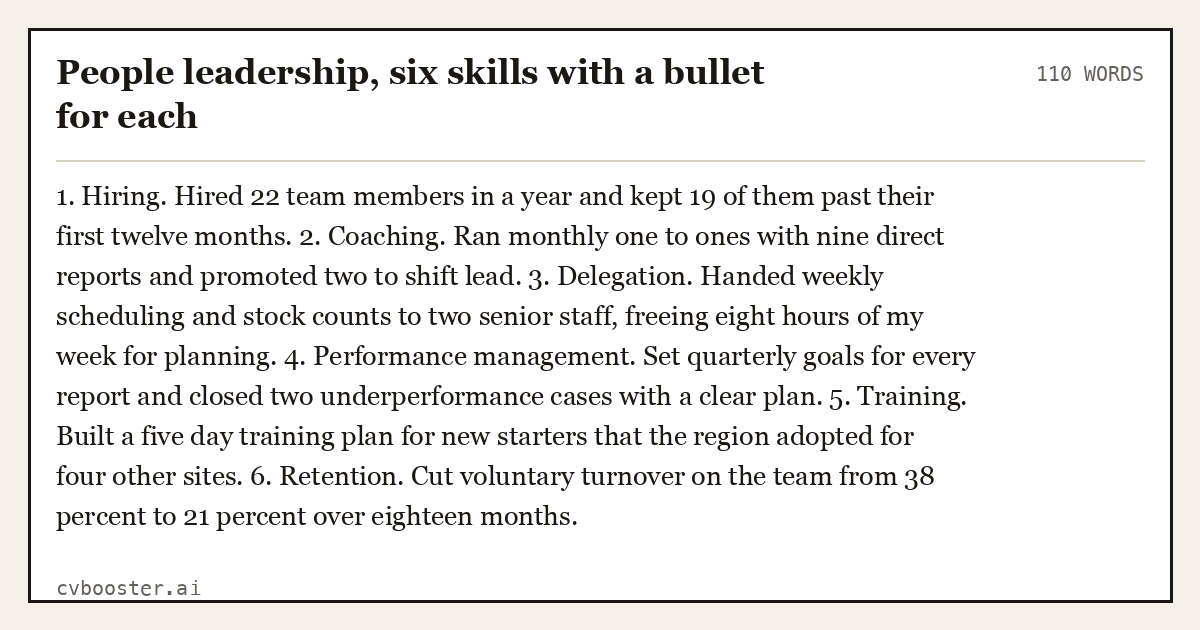
People leadership, six skills with a bullet for each (110 words)
1. Hiring. Hired 22 team members in a year and kept 19 of them past their first twelve months. 2. Coaching. Ran monthly one to ones with nine direct reports and promoted two to shift lead. 3. Delegation. Handed weekly scheduling and stock counts to two senior staff, freeing eight hours of my week for planning. 4. Performance management. Set quarterly goals for every report and closed two underperformance cases with a clear plan. 5. Training. Built a five day training plan for new starters that the region adopted for four other sites. 6. Retention. Cut voluntary turnover on the team from 38 percent to 21 percent over eighteen months.
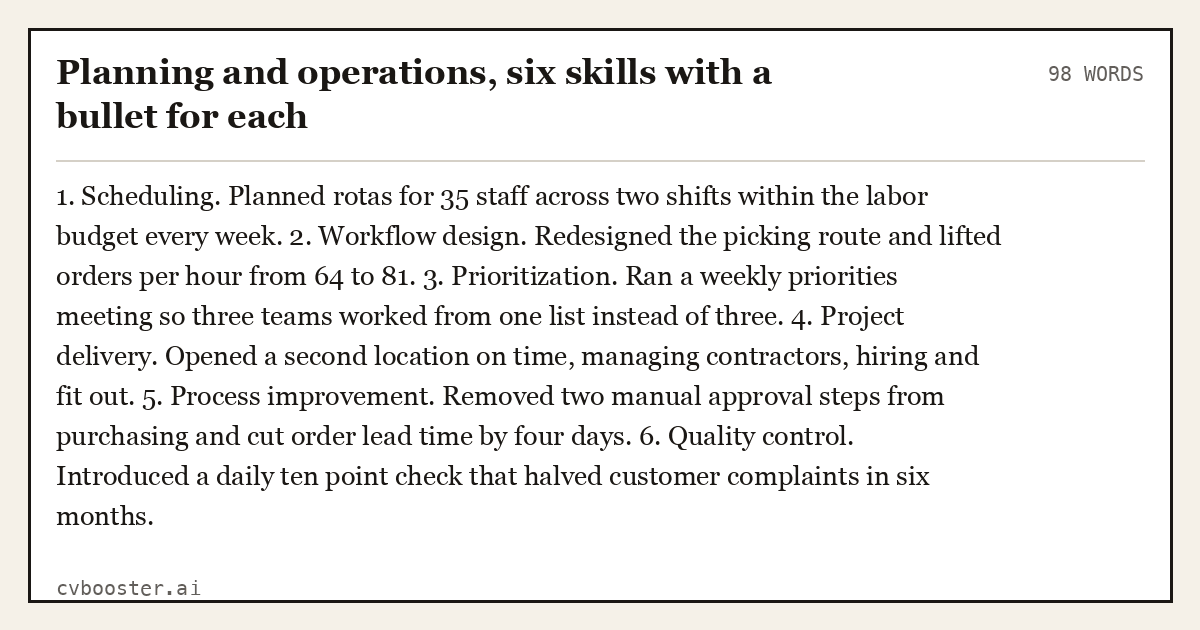
Planning and operations, six skills with a bullet for each (98 words)
1. Scheduling. Planned rotas for 35 staff across two shifts within the labor budget every week. 2. Workflow design. Redesigned the picking route and lifted orders per hour from 64 to 81. 3. Prioritization. Ran a weekly priorities meeting so three teams worked from one list instead of three. 4. Project delivery. Opened a second location on time, managing contractors, hiring and fit out. 5. Process improvement. Removed two manual approval steps from purchasing and cut order lead time by four days. 6. Quality control. Introduced a daily ten point check that halved customer complaints in six months.
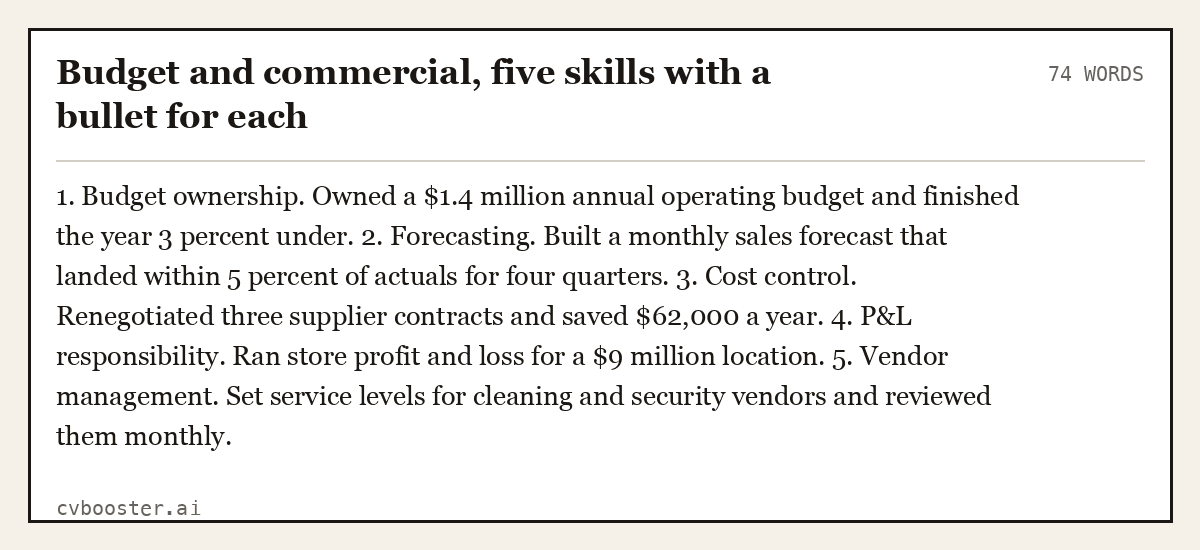
Budget and commercial, five skills with a bullet for each (74 words)
1. Budget ownership. Owned a $1.4 million annual operating budget and finished the year 3 percent under. 2. Forecasting. Built a monthly sales forecast that landed within 5 percent of actuals for four quarters. 3. Cost control. Renegotiated three supplier contracts and saved $62,000 a year. 4. P&L responsibility. Ran store profit and loss for a $9 million location. 5. Vendor management. Set service levels for cleaning and security vendors and reviewed them monthly.
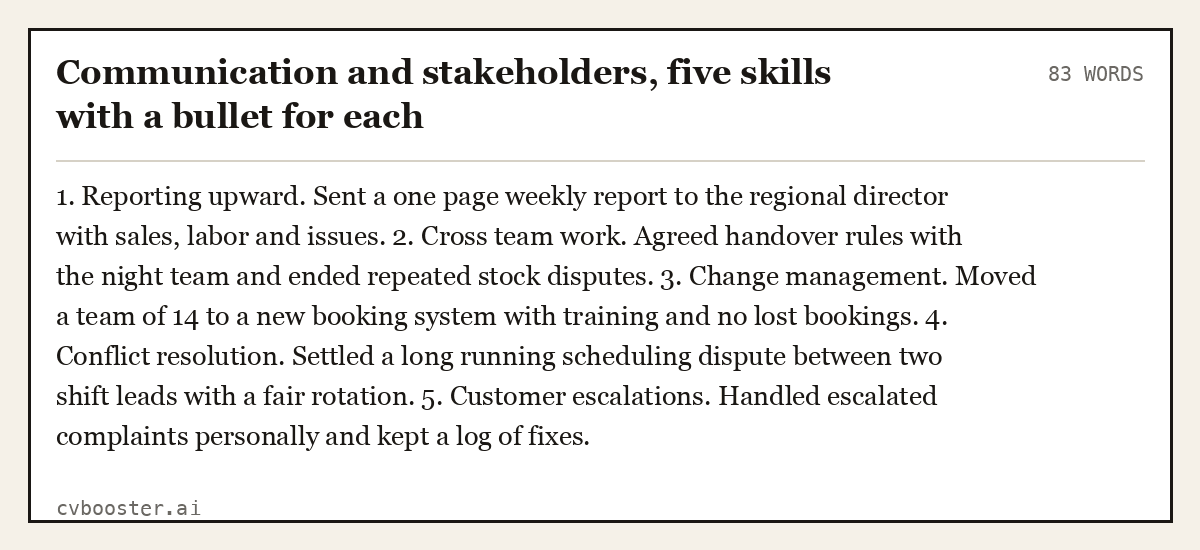
Communication and stakeholders, five skills with a bullet for each (83 words)
1. Reporting upward. Sent a one page weekly report to the regional director with sales, labor and issues. 2. Cross team work. Agreed handover rules with the night team and ended repeated stock disputes. 3. Change management. Moved a team of 14 to a new booking system with training and no lost bookings. 4. Conflict resolution. Settled a long running scheduling dispute between two shift leads with a fair rotation. 5. Customer escalations. Handled escalated complaints personally and kept a log of fixes.
Data and systems, four skills with a bullet for each (62 words)
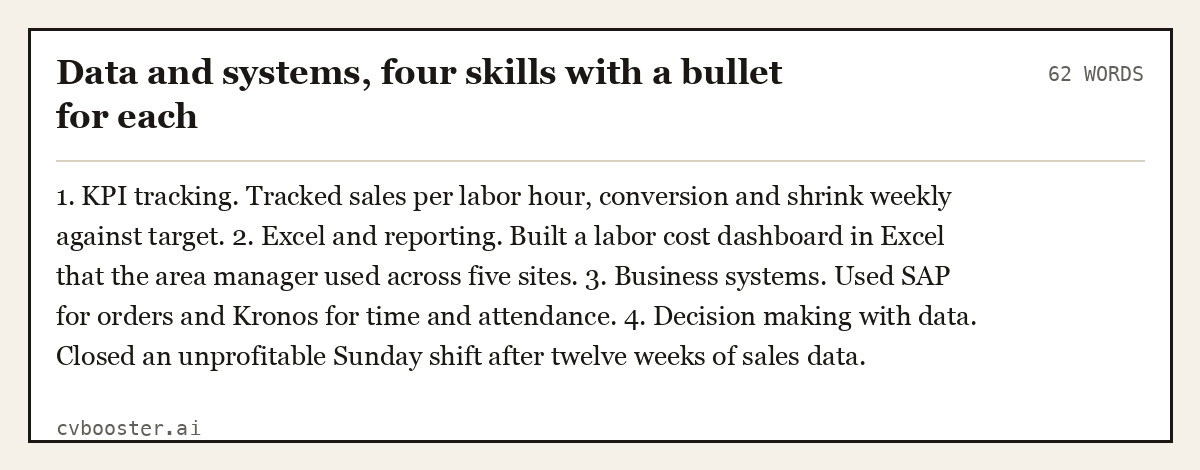
1. KPI tracking. Tracked sales per labor hour, conversion and shrink weekly against target. 2. Excel and reporting. Built a labor cost dashboard in Excel that the area manager used across five sites. 3. Business systems. Used SAP for orders and Kronos for time and attendance. 4. Decision making with data. Closed an unprofitable Sunday shift after twelve weeks of sales data.
What the job data says a manager does
O*NET OnLine describes general and operations managers as people who "Plan, direct, or coordinate the operations of public or private sector organizations, overseeing multiple departments or locations" on its general and operations managers summary. Its first listed task is to "Review financial statements, sales or activity reports, or other performance data to measure productivity or goal achievement or to identify areas needing cost reduction or program improvement." That is why budget and data skills belong on a manager resume, not only people skills.
At the first line level the work is closer to the floor. O*NET says first line supervisors of retail sales workers "Directly supervise and coordinate activities of retail sales workers in an establishment or department" and lists tasks such as "Assign employees to specific duties" and "Plan and prepare work schedules and keep records of employees' work schedules and time cards" on its retail supervisors summary. If that is your job now, scheduling and assigning work are real manager skills; write them that way.
For office and administrative managers, O*NET lists tasks to "Set goals and deadlines for the department" and to "Plan, administer, and control budgets for contracts, equipment, and supplies" on its administrative services managers summary.
| Occupation | Median wage (2025) | Source |
|---|---|---|
| General and operations managers | $50.85 hourly, $105,770 annual | O*NET OnLine 11-1021.00 |
| Administrative services managers | $54.87 hourly, $114,130 annual | O*NET OnLine 11-3012.00 |
| First line supervisors of retail sales workers | $23.33 hourly, $48,520 annual | O*NET OnLine 41-1011.00 |
Full manager skills sections by level
Keep the skills block short and grouped. The bullets in your experience section do the proving.
Entry level: shift lead or first time supervisor, skills section (46 words)
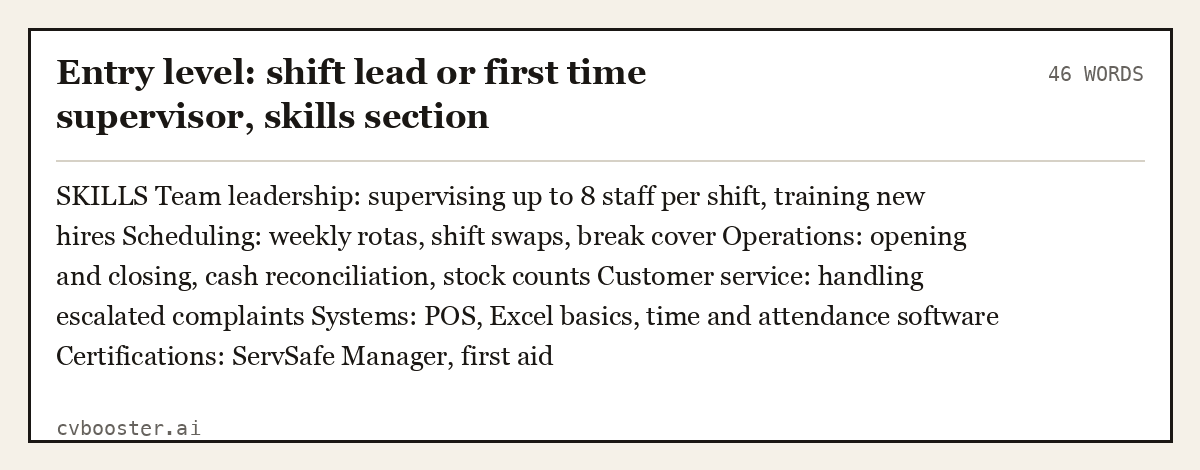
SKILLS Team leadership: supervising up to 8 staff per shift, training new hires Scheduling: weekly rotas, shift swaps, break cover Operations: opening and closing, cash reconciliation, stock counts Customer service: handling escalated complaints Systems: POS, Excel basics, time and attendance software Certifications: ServSafe Manager, first aid
Senior: general manager or operations manager, skills section (51 words)
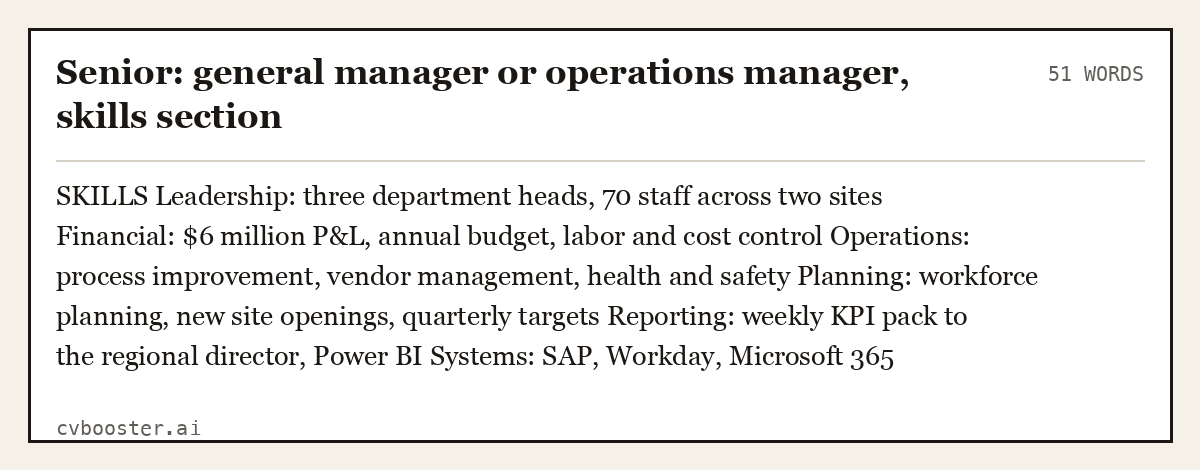
SKILLS Leadership: three department heads, 70 staff across two sites Financial: $6 million P&L, annual budget, labor and cost control Operations: process improvement, vendor management, health and safety Planning: workforce planning, new site openings, quarterly targets Reporting: weekly KPI pack to the regional director, Power BI Systems: SAP, Workday, Microsoft 365
If you manage in food service, write the certification in full. The ServSafe Manager page says students "can earn the ServSafe Food Protection Manager Certification, accredited by the ANSI National Accreditation Board (ANAB)-Conference for Food Protection (CFP)." Many restaurant postings ask for it by name, so it goes in the skills block, not buried at the end.
How to show manager skills when you have never had the title
Plenty of people manage without the word "manager" in their job title. If you trained new starters, ran the rota when the boss was away, or owned a project end to end, those are manager skills. Write them with the same structure: what you led, how many people, what changed.
- Acting up counts. "Covered the store manager role for six weeks, running a team of 12" is a fair, checkable line.
- Projects count. Leading a system rollout, an office move or a training program shows planning and stakeholder skills.
- Never inflate. Do not write "managed" if you coordinated. A reference call will find the difference, and you lose the job you would otherwise have got.
If you are moving into project work, the entry level project manager guide covers that route. For the letter, the manager cover letter examples show how to carry the same numbers across.
Where manager skills go on the resume
Put the three skills the posting stresses most into your summary, in the advert's own words. The posting is the brief: if it says "P&L ownership" and "multi site", those exact phrases belong in the first three lines.
Then build each job entry around results, with the skill visible in the verb: hired, coached, cut, planned, opened. The resume action verbs list helps when every line starts with "responsible for". Keep the separate skills block for named systems, certifications and the four or five headline skills. The skills to put on a resume guide covers how the block works on any resume, and soft skills for a resume explains how to prove the softer ones.
Manager skills to cut
These appear on almost every manager resume and say nothing an interviewer can test:
- Results driven. Every manager is supposed to be. Show the result instead.
- Strong leadership skills. Replace it with team size, a promotion you made happen or a turnover number.
- Strategic thinker. Name the plan you wrote and what it changed.
- Excellent multitasker. Show priorities you set for others, not how busy you were.
- Hands on. Say what you did on the floor and why it mattered.
When the resume is done, run it against the posting. The free score in CVBooster lists the manager keywords from the advert that your resume still does not mention.
Frequently asked questions
What are the best manager skills to put on a resume?
Hiring and coaching people, planning and scheduling work, owning a budget, improving processes and reporting results upward. Most manager postings ask for some mix of those five. Pick the three the advert repeats, put them in your summary, and prove each one with a bullet that carries a team size, a figure or an outcome.
How do I list management skills if I was never a manager?
List what you led, not the title you held. Training new staff, covering for your manager, running a shift or leading a project all count. Write them as bullets with numbers, such as how many people you trained, and be precise about the role. "Coordinated" and "covered" are honest words that still read well.
How many skills should a manager resume have?
Eight to twelve in the skills block, grouped into four to six lines, is enough. The rest of the evidence belongs in your experience bullets. A long list of thirty skills reads as filler, while five well proven skills tied to the posting read as someone who knows what the job is.
What is the difference between leadership and management skills on a resume?
Management skills keep work running: scheduling, budgets, processes and reporting. Leadership skills move people: coaching, hiring, setting direction and handling change. A manager resume needs both, and the strongest bullets combine them, for example a process you changed by bringing the team with you, with the result in numbers.
Should a manager resume include soft skills?
Yes, but inside bullets rather than as adjectives. "Communication" alone means nothing; "sent a weekly one page report to the director" shows it. Keep one or two soft skills in the skills block only if the posting names them, and prove each one somewhere in your experience section.
Related articles
- Accounting Executive Resume: 5 Examples by Career Level
- Administration Resume Examples: 8 Samples, Entry to Manager
- Another Word for Resume: CV, Bio and 10 More Options
- Apple Pages Resume Template: 6 Examples Built for ATS
More articles
- Managing a Quality Service: 4 Worked Examples, EO to G7
- Marketing Covering Letter Examples: 7 UK Samples by Level
- Example of Marketing CV: 6 UK Marketing CV Samples by Level
Looking for a worked example for your job title? Browse the resume examples by job title.