Roofer Resume Examples: what a hiring manager reads first
Top Off Your Career with a Professional Roofer Resume
By Mustafa Tarabya, founder of CVBooster · Published · Updated
Create a roofer resume that showcases your roofing system expertise, safety record, and project completion capabilities.
Sample resumes for a roofer
The same roofer content laid out in three CVBooster templates, so you can see what the finished document looks like before you write a word.
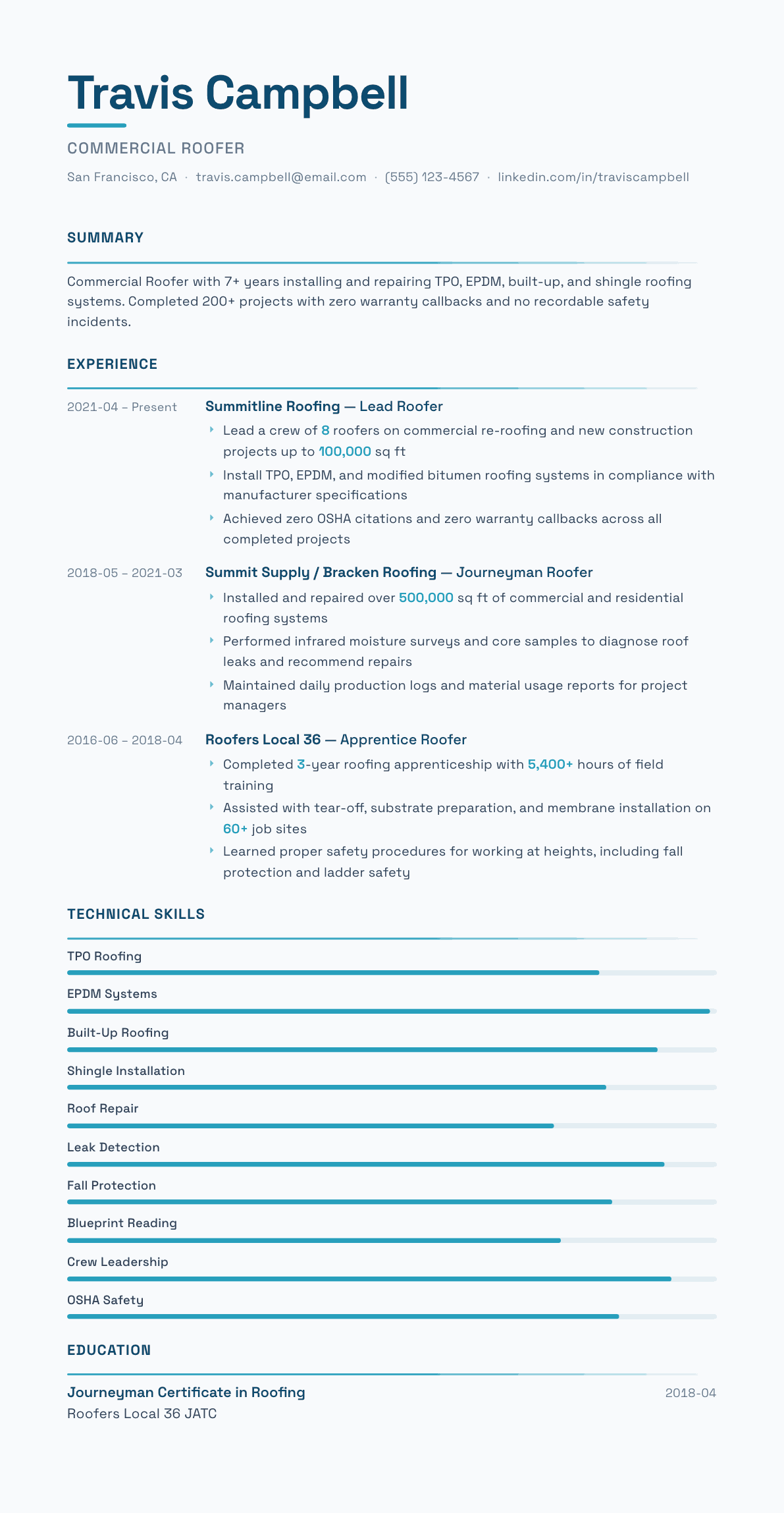
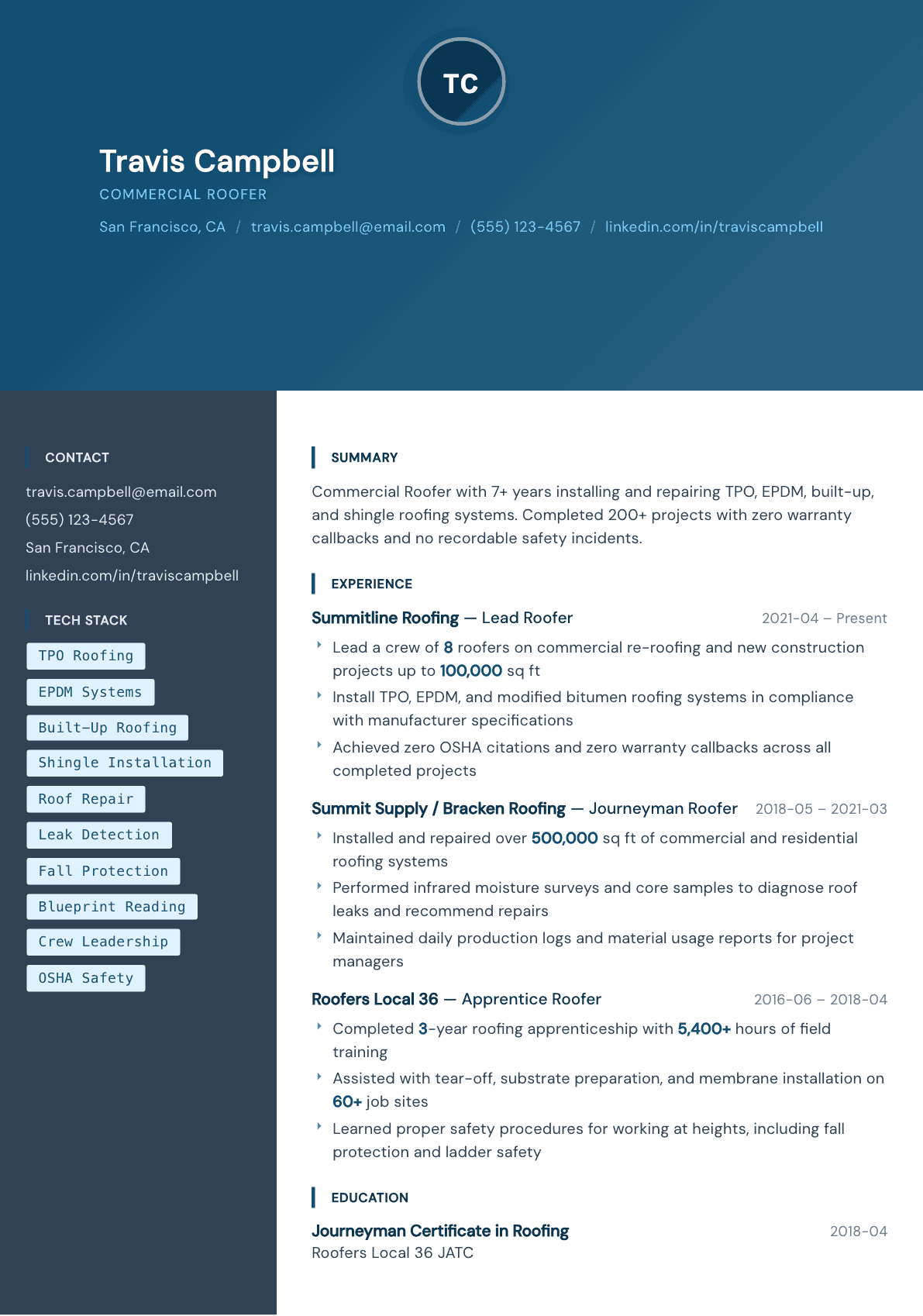
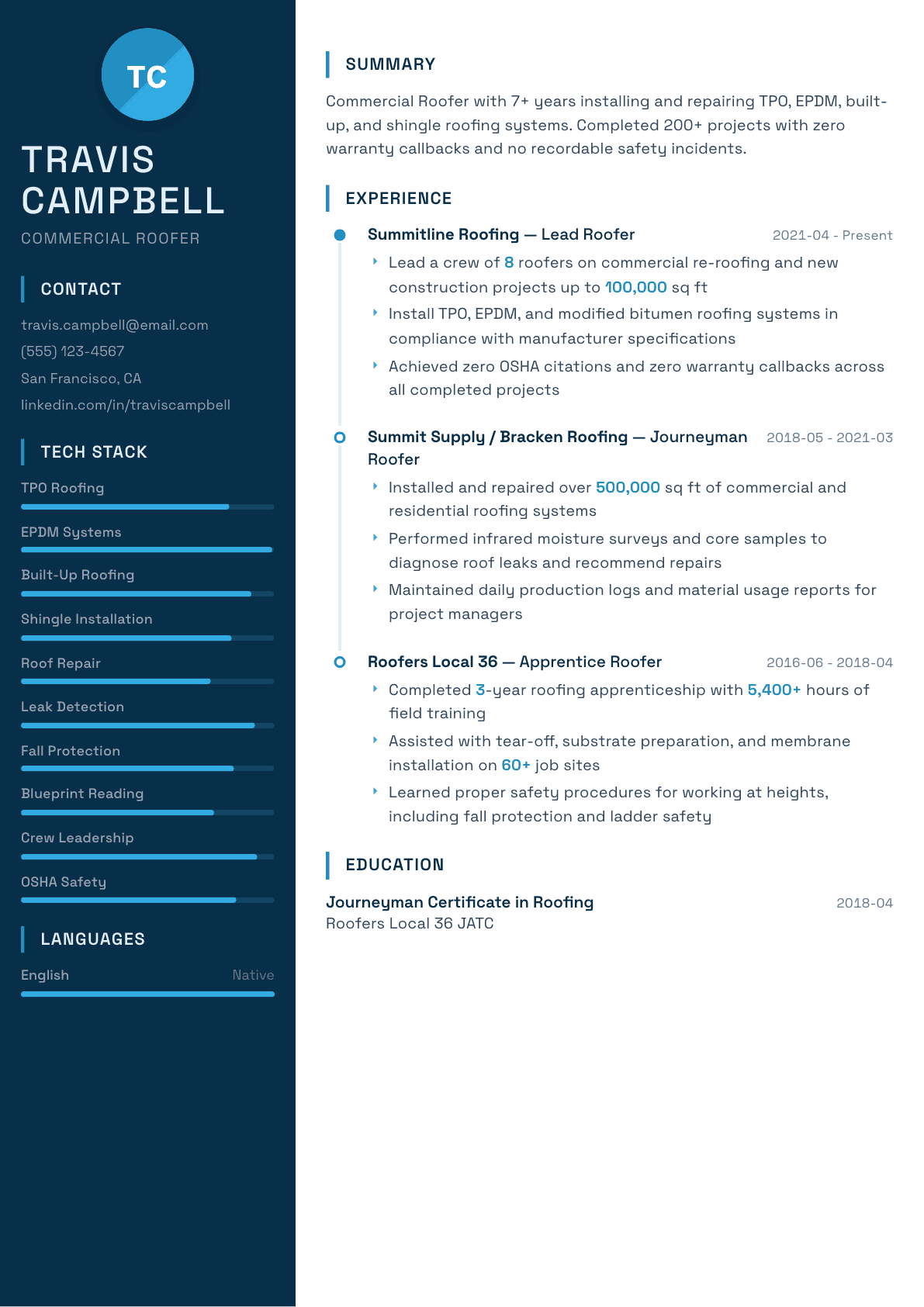
Example Roofer summary
Journeyman Commercial Roofer with 7 years of experience installing TPO, EPDM, and built-up roofing systems on projects up to 100,000 sq ft. Zero warranty callbacks and a spotless safety record. Seeking a lead roofer or foreman position with a top commercial roofing contractor.
Skills to list on a Roofer resume
- TPO Membrane Installation
- EPDM Roofing
- Built-Up Roofing (BUR)
- Modified Bitumen
- Shingle Roofing
- Metal Roofing
- Roof Leak Repair
- Infrared Moisture Detection
- Fall Protection
- Blueprint Reading
- Crew Leadership
- Torch Application
- OSHA Compliance
- Quality Inspection
What actually gets this resume read
- Specify roofing systems you are certified in: TPO, EPDM, PVC, modified bitumen, built-up, metal, shingle.
- Quantify your experience: square footage installed, number of projects, or project dollar values.
- Highlight safety credentials: OSHA certifications, zero-incident records, and fall protection training.
- Include manufacturer certifications (GAF, Carlisle, Firestone) as these are highly valued by employers.
- Mention diagnostic skills like infrared moisture scanning and core sampling for repair-focused roles.
How to write a roofer resume
Roofing hires on system experience and on safety history, in that order. A commercial contractor running single ply work wants somebody who has welded thermoplastic seams with a hot air gun and probed them afterward. A residential outfit wants speed on tear off, clean valley and step flashing, and no callbacks. Those are different crews, and a resume that says roofer without naming the system reads as neither.
The second thing the reader checks is whether you are a liability. Roofing carries one of the highest fall exposure rates on any job site, so a superintendent scans for fall protection training, harness and anchor experience, ladder and scaffold discipline, and any incident history you volunteer. A resume that treats safety as an afterthought sends the file to the bottom of the pile no matter how fast you strip a deck.
This guide sets out the section order a roofing superintendent expects, how to write the systems and manufacturer credential block, three summaries covering apprentice through foreman, before and after bullets, and the questions roofers ask when they sit down to write.
Format: one page, systems block near the top
Keep it to a single page in reverse chronological order. Roofing resumes are often read on a phone in a truck, so use one column, generous line spacing and no graphics. Under your name put your city, your driver license class, and whether you own hand tools and can travel to out of town jobs, because storm and re roof work moves crews across state lines.
Order the sections the way the superintendent triages: header, two line summary, roofing systems and manufacturer credentials, safety training, experience, apprenticeship and education. The systems block belongs above experience because it answers the question that decides the interview.
- A systems line: for example TPO and PVC hot air welded single ply, EPDM adhered and mechanically attached, modified bitumen torch and cold adhesive, four ply built up, standing seam metal, asphalt shingle, tile.
- A safety line: fall protection and harness training, ladder and aerial lift use, OSHA outreach card and hours, torch down fire watch.
- A scale line: typical roof size you have worked, crew size you have run, and whether the work was new construction, re roof or repair.
Systems and manufacturer credentials: the part that sorts the pile
Membrane roofing is warranted by the manufacturer, and the manufacturer only warrants crews trained on its product. Naming the systems you have installed and any manufacturer training you have completed tells a commercial contractor whether adding you to a crew keeps a warranty intact. Be exact: hot air welded thermoplastic is a different skill from adhered rubber, and torch applied modified bitumen carries a fire watch requirement the others do not.
Add the details that separate a finisher from a laborer: detail work at curbs, drains, scuppers and pipe penetrations, pitch pans, termination bars and counterflashing, tapered insulation layout, cover board and fastening patterns, and seam probing after welding. Detail work is where leaks start, and it is the skill a lead roofer is actually paid for.
For steep slope work name the underlayment types, ice and water shield placement, valley method, ridge venting, and the tear off and deck repair you have done. Say whether you have worked tile, slate or standing seam metal, since those crews are smaller and harder to staff.
Experience: sector, scale, and what came back
Give each employer the sector and the type of work. Commercial re roof on occupied buildings, new construction on a shell, insurance restoration after hail, and residential service repair are four different rhythms, and a superintendent hires for one of them.
Then bullets on production and on outcomes. Square footage or squares installed per crew day, roof size and deck type, tear off and disposal, crane or conveyor loading, and how the building stayed dry overnight. Callbacks and warranty claims are the outcome measure in roofing, so if you have a clean record on completed roofs, put it in a bullet with the number of projects behind it.
Leave out bullets that describe roofing itself. Installed roofing materials and worked at heights are true of everyone who has ever been on a crew and waste a line you could spend on infrared moisture surveys or on running a four man crew through a tapered insulation layout.
Safety: name the training, not the attitude
Write safety as credentials and practices, not as a claim to be careful. List the outreach card and hours, competent person training if you hold it, harness inspection and anchor point selection, warning line and controlled access zone setup, ladder tie off, aerial and scissor lift operation, and fire extinguisher and fire watch duty on torch work.
If you have led toolbox talks, run a daily hazard analysis, or been the person who signed the pre task plan, say so. That is the difference between a roofer and a lead, and it is exactly what a contractor looking for a foreman searches the page for.
Keywords a roofing recruiter searches on
Recruiters and staffing agencies search product and system names, so carry both the generic and the trade term: thermoplastic polyolefin and TPO, ethylene propylene diene monomer and EPDM, modified bitumen and mod bit, built up roofing and BUR. Add the tasks they filter on such as tear off, flashing, membrane welding, coping, gutter and downspout, roof coating and restoration.
Mirror the words a posting uses once in the systems block and once inside a bullet where you show the work. A page stuffed with product names and no context reads as padding to the superintendent who calls you.
Roofer resume summary examples
First or second season
Roofing laborer with 2 seasons on residential tear off and shingle installation, comfortable on steep pitch with harness and rope, and trained on ladder setup and debris handling. OSHA 10 card current and looking to move onto a commercial single ply crew.
Journeyman roofer
Commercial roofer with 7 years installing TPO, EPDM and modified bitumen on occupied buildings up to 80 thousand square feet. Strong on curb, drain and penetration detailing, hot air weld probing and tapered insulation layout, with no warranty callbacks across 60 completed roofs.
Foreman
Roofing foreman with 13 years running crews of up to 10 on commercial re roof and restoration. Manufacturer trained on two single ply systems, leads daily hazard analysis and pre task planning, and closed the last 3 seasons with zero recordable incidents and zero warranty claims.
Work experience bullets: before and after
Before: Installed commercial roofing systems.
After: Installed mechanically attached TPO over polyisocyanurate and cover board on occupied retail buildings, hot air welding and probing every seam before the daily tie off.
The attachment method, the assembly and the seam check tell a superintendent you have done warranty grade single ply work.
Before: Did tear offs and cleanup.
After: Stripped and disposed of three layers of asphalt shingle on a steep slope re roof, replaced 40 sheets of rotten decking, and dried in the whole roof with synthetic underlayment before dark.
Layers, deck repair and drying in the same day show production and judgment rather than general labor.
Before: Worked safely at heights.
After: Set warning lines and anchor points on every low slope roof, inspected harnesses and lanyards each morning, and ran the fire watch on all torch applied modified bitumen work.
Named controls and duties prove a safety system, while working safely is the claim of every applicant.
Before: Found and fixed roof leaks.
After: Traced chronic leaks on a warehouse roof with an infrared moisture survey and core samples, mapped the wet insulation, and scoped a partial replacement instead of a full tear off.
Diagnosis and a scoped recommendation show a service roofer who saves the owner money, not just a patcher.
Before: Led a crew.
After: Ran a 6 person crew on commercial re roof, setting daily production targets by square, staging material by crane load, and closing every shift with a watertight temporary tie in.
Crew size, planning method and the end of shift standard turn a title into evidence of foreman work.
Hard skills
- TPO and PVC hot air welding
- EPDM adhered and mechanically attached
- Modified bitumen torch and cold applied
- Built up roofing
- Asphalt shingle installation
- Standing seam metal roofing
- Flashing and penetration detailing
- Tapered insulation layout
- Tear off and deck repair
- Infrared moisture survey and core sampling
- Fall protection and anchor point setup
- Gutter, coping and sheet metal work
Soft skills
- Weather call judgment
- Pace on a production roof
- Crew briefing and toolbox talks
- Homeowner and tenant communication
- Care with an occupied building below
Certifications worth listing
- ProCertification for Roofing Installers (National Roofing Contractors Association)
- OSHA 10-Hour Construction Outreach Training (OSHA Training Institute)
- OSHA 30-Hour Construction Outreach Training (OSHA Training Institute)
- NCCER Roofing Certification (National Center for Construction Education and Research)
Mistakes that cost roofer candidates the interview
- Writing roofer with no systems named, which leaves the reader unable to tell a shingle crew from a single ply crew.
- Putting safety training at the very bottom of the page when it is the second thing a roofing superintendent looks for.
- Claiming every system on the market, which falls apart the moment someone asks how you probe a hot air weld.
- Skipping the detail work at curbs, drains and penetrations, which is what separates a finisher from a helper on the pay scale.
- Leaving off crew size and roof size, so nothing on the page shows the scale of work you can actually carry.
- Ignoring callbacks and warranty history when a clean record on completed roofs is the strongest number a roofer has.
Roofer resume questions
How long should a roofer resume be?
One page. Roofing hiring moves fast and the superintendent is scanning for systems, safety and crew size. If you have twenty years, keep the last three employers in full detail and compress everything older into a single earlier experience line.
Do manufacturer trainings belong on a roofing resume?
Yes, and near the top. Membrane warranties depend on trained installers, so a contractor bidding warranted work needs to know which systems you are approved on. List the manufacturer, the system, and the year of training in your certifications block.
How do I get on a commercial crew with only residential experience?
Lead with what transfers: tear off production, deck repair, flashing and sheet metal, ladder and harness discipline. Then say plainly that you are moving to commercial single ply and name any low slope, torch or coating work you have touched, even on small jobs.
Should I mention an injury or a safety incident?
Do not volunteer an incident on the resume. Do put the safety training and practices that show current discipline. If an employer asks during the interview, answer directly and say what changed in your routine afterward, since that answer is what they are actually testing.
What numbers work best on a roofing resume?
Squares or square feet installed, roof sizes, crew size, projects completed, warranty callbacks, and consecutive incident free seasons. Production per crew day is convincing because a superintendent can price it immediately against the bids they are writing.
Related resume examples
- Carpenter Resume example
- Painter Resume example
- Construction Manager Resume example
- Masonry Worker Resume example
- Welder Resume example
- Construction Foreman Resume example