Sheet Metal Worker Resume Examples: the lines they read
Create a Sheet Metal Worker Resume That Gets Results
By Mustafa Tarabya, founder of CVBooster · Published · Updated
Build a sheet metal worker resume featuring fabrication skills, HVAC ductwork expertise, and precision measurement capabilities.
Sample resumes for a sheet metal worker
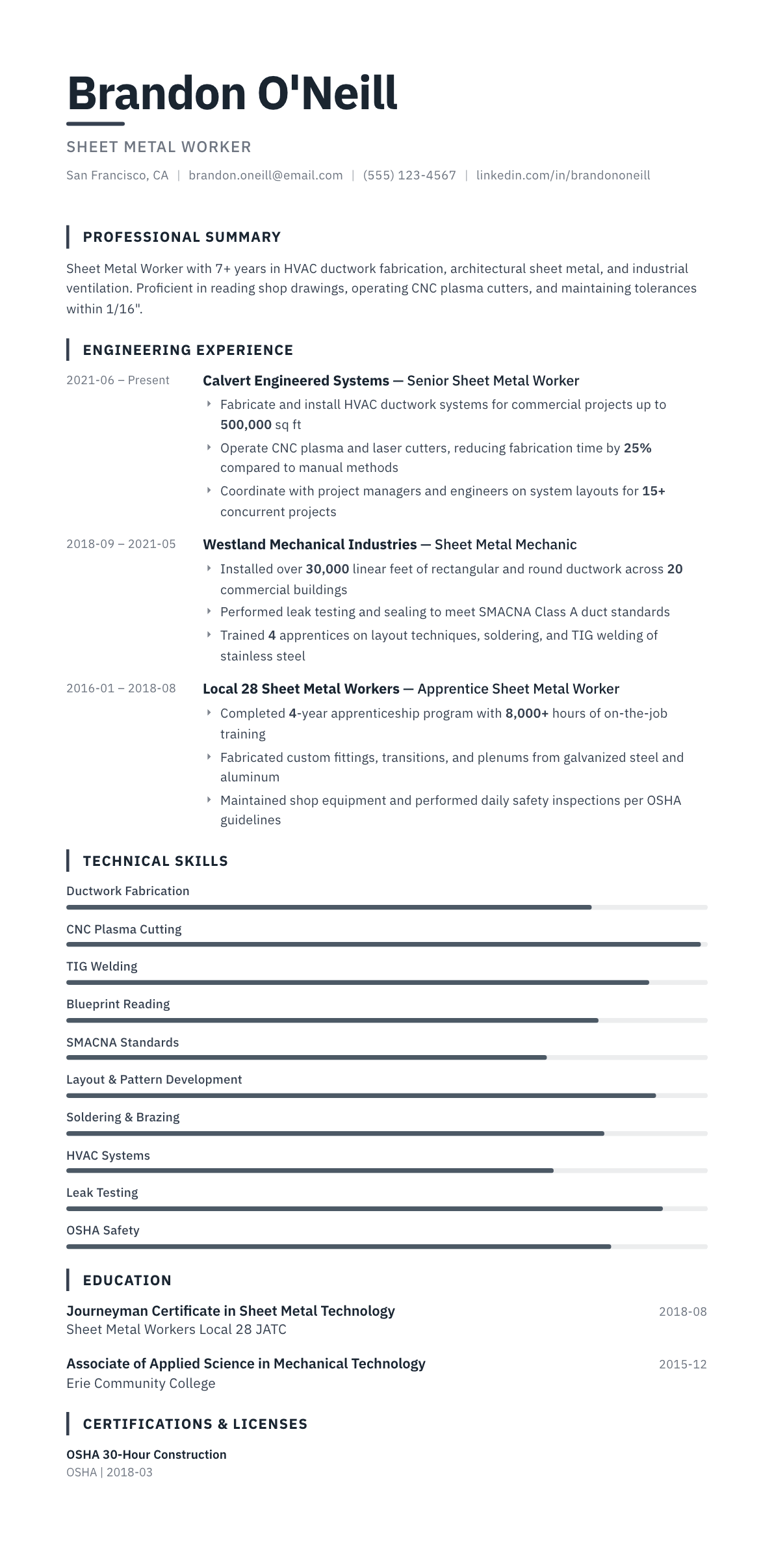
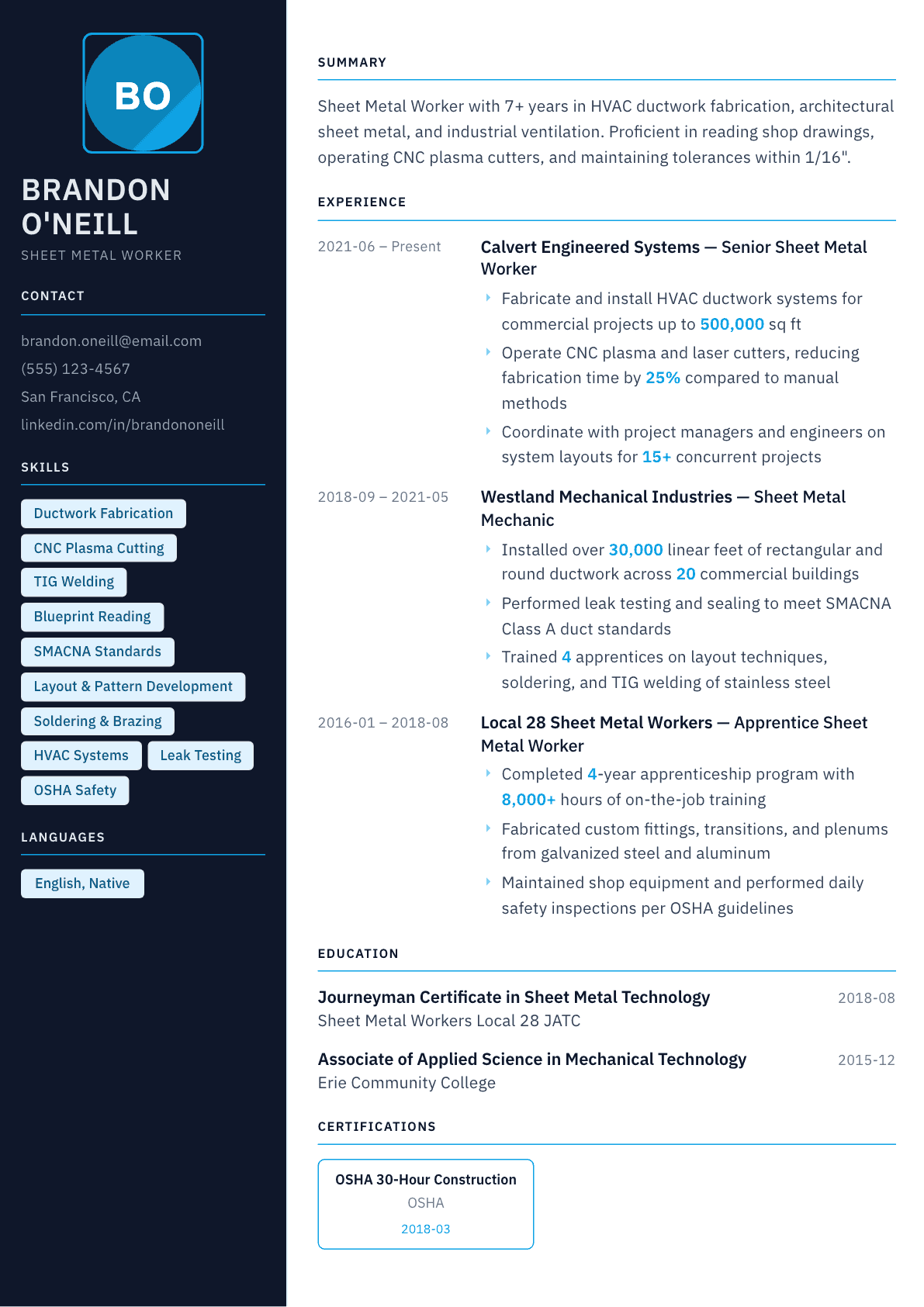
The same sheet metal worker content laid out in three CVBooster templates, so you can see what the finished document looks like before you write a word.

Example Sheet Metal Worker summary
Journeyman Sheet Metal Worker with 7 years of experience in HVAC ductwork fabrication and installation for commercial and industrial projects. Proficient in CNC plasma cutting, TIG welding, and SMACNA code compliance. Seeking a lead fabricator role with a top mechanical contractor.
Skills to list on a Sheet Metal Worker resume
- HVAC Ductwork
- Sheet Metal Fabrication
- CNC Plasma Cutting
- Laser Cutting
- Press Brake Operation
- TIG/MIG Welding
- Soldering & Brazing
- Blueprint Reading
- Layout & Pattern Development
- SMACNA Standards
- Architectural Sheet Metal
- Leak Testing
- AutoCAD / BIM
- OSHA Compliance
What actually gets this resume read
- Highlight your union journeyman status and apprenticeship completion. These are strong credentials in the trade.
- Specify duct types (rectangular, round, spiral) and standards you follow (SMACNA, UL).
- Quantify your output: linear feet installed, number of projects, or fabrication efficiency improvements.
- Include proficiency with CNC equipment (plasma, laser, press brake) and CAD/BIM software if applicable.
- Mention materials you work with: galvanized steel, stainless steel, aluminum, copper.
How to write a sheet metal worker resume
Sheet metal work splits into shops that look nothing alike from the outside. HVAC duct fabrication, architectural metal and roofing, industrial ventilation and dust collection, kitchen and food service stainless, and testing and balancing all fall under the same trade title. The person reading your resume works in one of them, and the first thing they want to know is whether your hands have been in their kind of metal.
The second thing is whether you work to standard. Duct is built and sealed to SMACNA construction and leakage classes, welded stainless has its own finish expectations, and architectural panel work lives or dies on tolerance and on how a joint looks from the sidewalk. Naming the standard, the gauge and the tolerance you hold is what turns a claim into a qualification.
This guide covers the layout a mechanical contractor expects, how to write the fabrication and installation sections so both a shop foreman and a parser find what they need, three summary examples from apprentice through lead, before and after bullets, and the questions sheet metal workers ask most when rewriting their resume.
Format: one page, shop and field split clearly
Reverse chronological, one column, no graphics. Under your name put your city, your union local if you have one, your journeyman status, and whether you are shop, field or both. That last detail matters more than candidates expect, because a fabrication shop and an install contractor are hiring for different bodies of skill and often for different pay scales.
Section order: header, short summary, trade credentials and apprenticeship, fabrication and installation skills, experience, safety and equipment tickets. Put the journeyman certificate and apprenticeship hours high on the page, since those numbers are how the trade measures a resume.
- A materials line: galvanized steel and the gauges you work, stainless grades, aluminum, copper, and any coated or painted panel stock.
- A machines line: press brake, shear, plasma table, coil line, Pittsburgh and rollformer, spot welder, TIG setup for stainless.
- A standards line: SMACNA duct construction and leakage classes, seal classes, and any specification work such as clean room or laboratory exhaust.
Fabrication: gauge, machine, tolerance, standard
Shop foremen read for machine time. Say which equipment you set up and run rather than which equipment existed in the building, and give the range: brake capacity and bend allowance, shear length, plasma or laser table with the nesting software you used, coil line and auto duct line, rollformer profiles, and hand tools for transitions and offsets.
Then say what you build from a drawing. Rectangular duct with the seam type, round and spiral with fittings, plenums, transitions and offsets, elbows with turning vanes, custom hoods and curbs, and stainless or aluminum specialty work. Naming the fitting types shows layout ability, which is the skill that carries the highest rate in a fab shop.
Tolerance is your quality metric. If you hold parts to a sixteenth on architectural work or run pattern development by hand for a transition that no software produced, that belongs on the page. It is the closest thing sheet metal has to a portfolio in words.
Installation: hanging, sealing, testing, coordination
Field work reads differently. Give the building type and the system: commercial office, hospital, laboratory, data center, kitchen exhaust, or industrial process ventilation. Then the install work itself: hanger spacing and trapeze support, connecting systems such as slip and drive or flanged joints, sealing to the specified class, insulation coordination, and testing for leakage.
Coordination is a real skill and hiring contractors pay for it. If you have worked from a coordinated model, resolved conflicts with pipe, conduit and structure before fabrication, or built off spool drawings from a detailer, say so. That is the difference between a mechanic who installs what shows up on the truck and one who keeps the job from tearing out its own work.
Apprenticeship, credentials and safety
The trade counts hours. Put your apprenticeship program, the training center, the completion date and the on the job hours you logged. If you are mid apprenticeship, put the year you are in and the hours so far, because contractors staff by apprentice ratio and need to know exactly where you sit.
Add the tickets that let you work: outreach safety card and hours, scissor and boom lift operation, forklift, rigging and signaling, welding certification if you carry one, respirator fit test, and confined space entry. For anyone who has moved toward testing and balancing or toward detailing, name the software or instruments, since those are separate career tracks with their own postings.
Keywords a mechanical contractor filters on
Carry both the trade word and the plain word: duct and ductwork, Pittsburgh lock and standing seam, spiral and round, plenum and air handling. Include the sheet metal specific terms a recruiter types such as layout, pattern development, transitions, fittings, and the standard bodies the specification cites.
Detailing and modeling software names belong on the page if you have used them, and so do the coil line or auto duct systems in the shop, because a fabrication shop searching for a candidate who already knows their line will search by that name.
Sheet Metal Worker resume summary examples
Apprentice
Third year sheet metal apprentice with 4,200 on the job hours split between the fab shop and commercial install. Runs shear, brake and Pittsburgh machine, builds transitions and offsets from shop drawings, and holds a current lift and outreach safety card.
Journeyman
Journeyman sheet metal worker with 8 years in HVAC fabrication and installation on commercial and healthcare projects. Runs CNC plasma nesting and press brake, builds and hangs rectangular and spiral duct to SMACNA construction and seal classes, and TIG welds stainless kitchen exhaust.
Shop or field lead
Sheet metal lead with 15 years, the last 5 running a 12 person fabrication shop feeding three concurrent hospital projects. Owns layout and pattern development on custom fittings, schedules the coil line and plasma table, and trains apprentices through their layout modules.
Work experience bullets: before and after
Before: Fabricated ductwork in the shop.
After: Built rectangular supply and return duct in 26 through 18 gauge galvanized with Pittsburgh and standing seam joints, working from spool drawings to SMACNA construction and seal class specifications.
Gauge range, seam type, drawing source and standard let a shop foreman price your output instead of guessing at it.
Before: Operated shop machinery.
After: Set up and ran the CNC plasma table and the press brake, nesting parts to cut drop on galvanized sheet and tuning bend allowances so fittings closed without rework.
Setup, nesting and bend allowance are the judgment calls that separate a machine operator from a fabricator.
Before: Installed HVAC systems in commercial buildings.
After: Hung and connected duct mains and branches in an operating hospital wing on off hours, sealing to the specified leakage class and coordinating hanger locations around existing pipe and conduit.
The building type, the off hours constraint and the coordination detail show a mechanic who can work in a live facility.
Before: Welded stainless steel parts.
After: TIG welded 16 gauge stainless kitchen exhaust hoods and grease duct with continuous liquid tight seams, then ground and polished the welds to a sanitary finish for inspection.
The alloy, gauge, joint requirement and finish standard describe work an inspector signs off on, not generic welding.
Before: Trained apprentices.
After: Walked three apprentices through pattern development on square to round transitions, from stretch out layout to notching, so each could produce a closing fitting without a template.
A named skill and a clear endpoint show real instruction in the hardest part of the trade.
Hard skills
- Rectangular and round duct fabrication
- Pattern development and layout
- Press brake and shear operation
- CNC plasma cutting and nesting
- Pittsburgh and standing seam joints
- TIG welding on stainless
- Spot and tack welding
- Blueprint and shop drawing reading
- SMACNA construction and seal classes
- Duct hanging and trapeze support
- Leakage testing and sealing
- Architectural metal and flashing
Soft skills
- Layout patience
- Coordination with other trades
- Care in an occupied building
- Reading a detail before cutting
- Apprentice mentoring
Certifications worth listing
- Journeyman Sheet Metal Worker Certificate (International Training Institute for the Sheet Metal and Air Conditioning Industry)
- OSHA 30-Hour Construction Outreach Training (OSHA Training Institute)
- Certified Welder (CW) (American Welding Society)
- NCCER Sheet Metal Certification (National Center for Construction Education and Research)
- Air Balancing Technician Certification (Testing, Adjusting and Balancing Bureau)
Mistakes that cost sheet metal worker candidates the interview
- Writing sheet metal worker without saying whether you are shop, field or both, which is the first split a contractor makes.
- Listing machines that sat in the building instead of machines you set up and ran, a claim that unravels on the first shop tour.
- Leaving out gauges, materials and standards, so nothing on the page proves you build to specification.
- Skipping apprenticeship hours and journeyman status when the trade sizes candidates by exactly those numbers.
- Describing installation as ran duct with no building type, connection method or seal class behind it.
- Forgetting lift, rigging and welding tickets, which decide whether you can be put to work on day one or wait for scheduling.
Sheet Metal Worker resume questions
Should a sheet metal resume list union membership?
Yes if you are in the trade through a local. Put the local number and your journeyman date near the top, because contractors staffing union projects verify status through the hall and non union shops still read it as proof of completed training.
How do I show layout skill on paper?
Name the fittings you can develop from scratch: square to round transitions, offsets, tapers, ogee and radius elbows. Say whether you lay out by hand, from a stretch out, or from nesting software. Layout is the highest rated skill in a fab shop and it deserves its own bullet.
Do I need welding certification for a sheet metal job?
Not for standard duct work, but it opens the higher paid stainless, kitchen exhaust and industrial jobs. If you hold a certification, list the process, position and material. If you weld without a card, say what you weld and offer to test.
What if my experience is only residential HVAC?
Lead with the transferable work: duct fabrication and fitting, flexible and rigid connections, register and grille install, sealing and insulation. Then name any light commercial you have touched, and add machine time in a shop even if it was part time, since machine hours are what commercial fab shops screen for.
How do I write a resume for a detailing or estimating move?
Keep the field and shop history, then add a section for drawing and model work: the software you have used, spool drawings you produced, conflicts you resolved before fabrication, and takeoffs you priced. Contractors promote from the floor into detailing, so evidence of both sides is the whole case.
Related resume examples
- HVAC Technician Resume example
- Welder Resume example
- Plumber Resume example
- HVAC Installer Resume example
- BIM Modeler Resume example
- Masonry Worker Resume example