Fitness Instructor Resume Examples: the lines they read
Create a Fitness Instructor Resume That Gets You Hired
By Mustafa Tarabya, founder of CVBooster · Published · Updated
Build a professional fitness instructor resume with ATS-friendly formatting, real examples, and tips to showcase your certifications and client results.
Sample resumes for a fitness instructor
The same fitness instructor content laid out in three CVBooster templates, so you can see what the finished document looks like before you write a word.
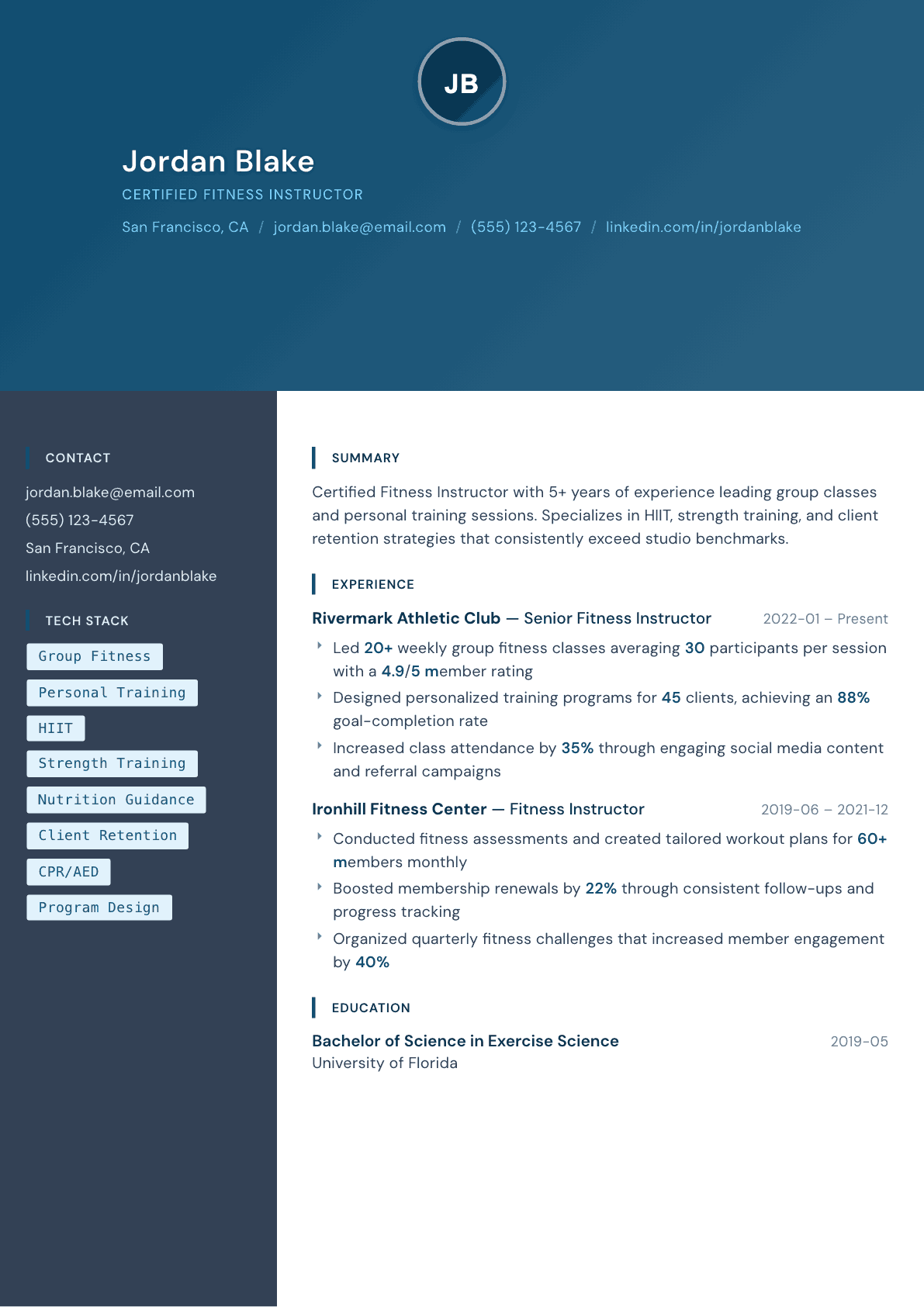
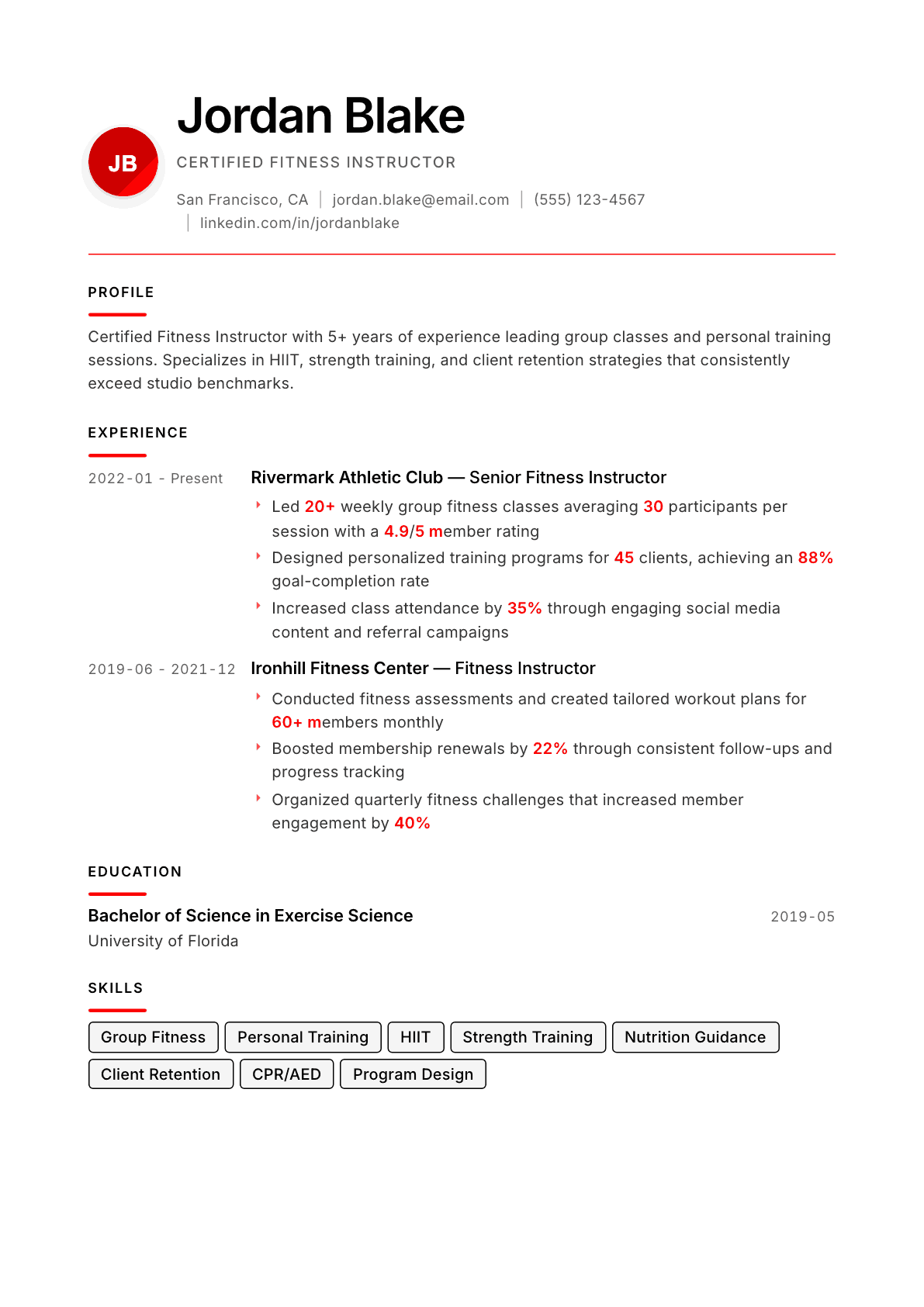
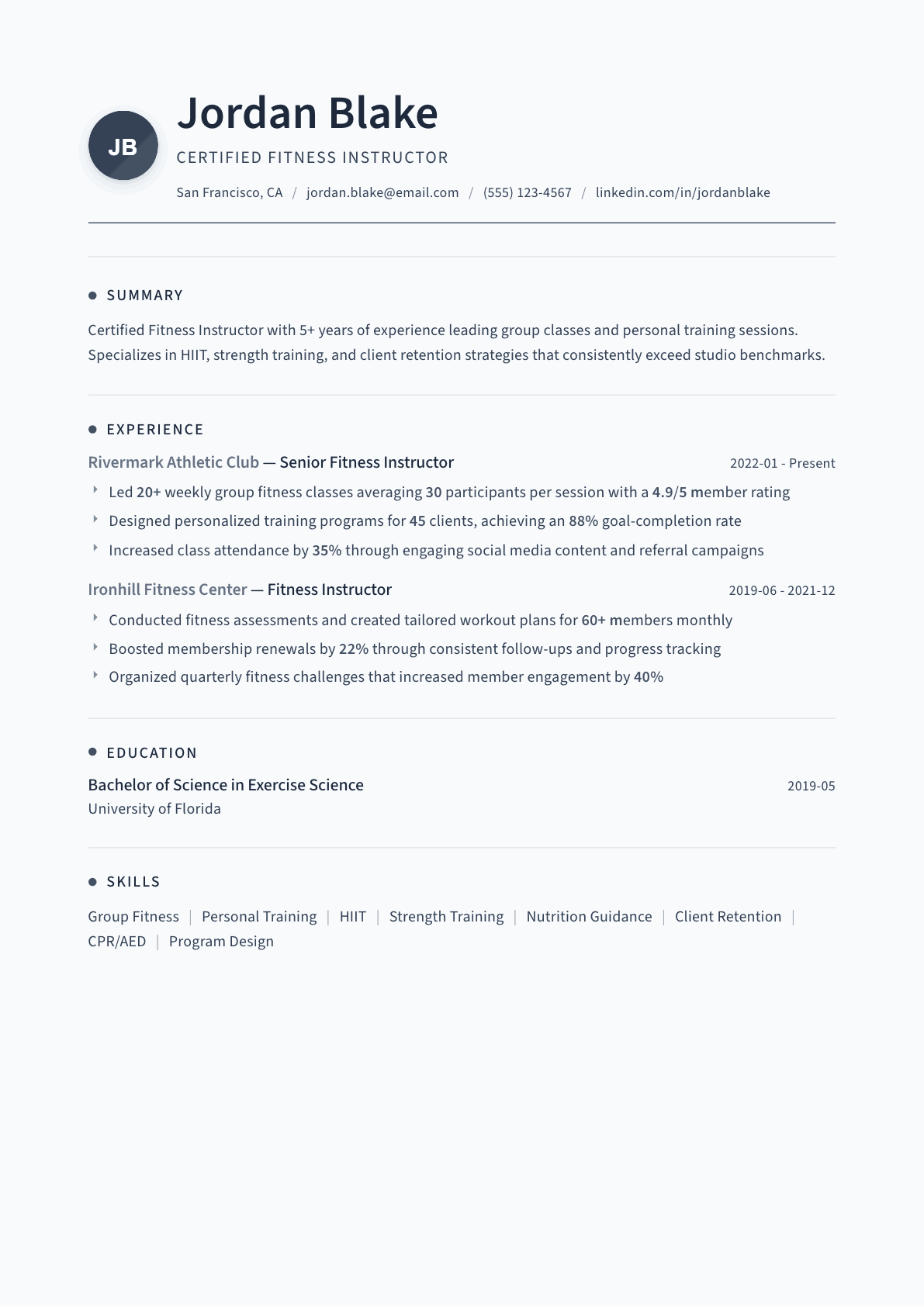
Example Fitness Instructor summary
NASM certified instructor, 5 years, teaching 20 group classes a week at an average of 30 members a class and carrying 45 personal training clients. Took a struggling evening HIIT slot to full capacity, holds a 4.9 member rating, and renews packages at well above the studio average.
Skills to list on a Fitness Instructor resume
- Group Fitness Instruction
- Personal Training
- HIIT Programming
- Strength & Conditioning
- Nutrition Coaching
- Client Assessment
- Program Design
- Injury Prevention
- Motivational Coaching
- Class Management
What actually gets this resume read
- Highlight specific certifications like NASM, ACE, or ISSA prominently near the top of your resume.
- Quantify what the club measures: average class size, attendance growth on a slot you took over, and package renewal.
- Include specialties like yoga, HIIT, or strength training to match the job description.
- Mention CPR/AED and First Aid certifications as they are required by most employers.
How to write a fitness instructor resume
A fitness instructor resume is read by a group fitness manager or studio owner who has one immediate problem: a slot on the schedule that needs filling with someone members will come back for. They are checking the accreditation of your certification, the formats you can teach tomorrow, the times you are available, and whether your classes hold attendance.
That last part is where most instructor resumes go quiet. They list certifications and formats and stop. The instructor who reports average class size, how attendance moved after they took over a slot, and their client retention is answering the only business question the manager has, which is whether the room fills.
This guide covers where certifications go and which accreditation matters, how to write about class formats, cueing and modification, summaries from a newly certified instructor through a lead instructor or master trainer, and the rewrites that turn a class list into a track record.
Format: one page, formats and availability easy to find
One page, always. Managers scan instructor resumes fast and often on a phone between classes. Put a formats line high on the page listing exactly what you are certified and comfortable teaching: indoor cycling, strength conditioning, HIIT, barre, mat Pilates, yoga with the style named, aqua fitness, boxing conditioning, senior fitness, prenatal and postpartum.
Add an availability line. Group fitness hiring is a scheduling puzzle, and an instructor who can cover the six in the morning slot and Saturday mornings is often chosen over a stronger candidate who can only teach midday.
- Header: name, credentials, city, phone, email.
- Formats line: what you teach, with the certifying program for branded formats.
- Order: summary, certifications, teaching experience, personal training if applicable, education, availability.
- Include your certification expiration dates, since lapsed credentials are a liability issue for the facility.
Certifications: accreditation is the quiet screen
Facilities and insurers care whether your primary certification is from a program accredited by the National Commission for Certifying Agencies. Certifications from NASM, ACE, ACSM, NSCA, ISSA and AFAA sit in that conversation, and branded format certifications such as Les Mills, Zumba, Schwinn or Stott Pilates sit alongside them as format licenses rather than replacements.
CPR and AED certification is required almost everywhere and is checked, so list it with the issuer and the expiration. Then list specialty credentials in a way that maps to a population the facility serves: senior fitness, youth, prenatal, corrective exercise, nutrition coaching within your scope of practice.
- Primary certification with the issuing organization and expiration.
- CPR and AED with the issuer, since it is verified at hire.
- Format licenses with the release or module level where relevant.
- Specialty credentials tied to populations, not collected for volume.
Teaching experience: attendance, retention and the room
For each facility, give the type of club or studio, the formats you taught, the number of classes a week and the average class size. Then show movement. Taking a slot with eight regulars to twenty-two, holding a full waitlist on a Saturday, or rebuilding attendance after a schedule change are the results a manager is buying.
Describe the craft as well. Cueing that keeps a mixed-level room moving together, offering three levels of a movement without stopping the class, music and beat matching for choreographed formats, layering a progression across an eight-week cycle, and knowing when to modify for an injury and when to refer out.
Include substitute reliability. Instructors who reliably cover last-minute subs get more permanent slots, and managers know exactly which of their instructors those are.
- Classes per week, formats, and average and peak attendance.
- Attendance change on a specific slot you took over.
- Member retention or class package renewal where the studio tracks it.
- Special populations served and how you adapted programming.
Personal training and client results, kept honest
If you also train individuals, treat it as a separate block. Give the client load, the session volume per week, the assessment process you use, and the retention or package renewal rate. Managers who pay a base plus session revenue read the renewal number closely.
Keep results claims inside your scope. Describe adherence, strength progressions, movement quality and consistency rather than making medical or body composition promises. Nutrition guidance should be described within the limits of your credential, because overstating it is both a professional and a liability problem.
The business side instructors forget to mention
Studios run on member experience and on filling classes, so the instructors who get lead roles are usually the ones who do a little more. Greeting first-timers and following up afterward, promoting a class through the studio social account, hosting an introductory workshop, and mentoring newly certified instructors are all worth a line.
Name the systems you have worked in: Mindbody, ABC Fitness, Club Automation, Glofox or Zen Planner for scheduling and check-ins, and the heart rate or performance tracking system your club uses in class. Familiarity shortens onboarding and a manager notices.
Fitness Instructor resume summary examples
Newly certified
Newly certified group fitness instructor teaching strength conditioning and indoor cycling, with CPR and AED current and 40 practice classes taught during certification. Available for early morning and weekend slots, and comfortable modifying every movement for a mixed-level room.
Four years teaching
Group fitness instructor with 4 years teaching 9 classes a week across HIIT, strength and indoor cycling at a mid-size health club. Grew a Tuesday evening slot from 8 regulars to a 22-person average, and holds a personal training roster of 14 clients with strong package renewal.
Lead instructor
Lead group fitness instructor with 9 years across boutique and health club settings, teaching 12 classes a week and mentoring 6 newly certified instructors. Built an 8-week strength progression used across the schedule, and covers formats from barre to boxing conditioning.
Work experience bullets: before and after
Before: Taught group fitness classes at a local gym.
After: Taught 9 classes a week across HIIT, strength conditioning and indoor cycling at a health club with 3,000 members, averaging 24 participants per class in peak evening slots.
Class volume, formats, club size and average attendance answer the manager's question about filling the room.
Before: Increased class attendance.
After: Took over an underattended Tuesday evening strength class with 8 regulars and built it to a 22-person average within 4 months by adding an 8-week progression and following up with first-time attendees.
Naming the starting point, the timeline and the two tactics makes attendance growth a method rather than luck.
Before: Modified exercises for participants with injuries.
After: Cued 3 levels of every movement so a mixed-level room stayed together, adapted programming for members returning from knee and shoulder rehabilitation, and referred out when a complaint fell outside scope.
Level cueing plus a clear referral boundary shows teaching skill and professional judgment at the same time.
Before: Trained personal training clients.
After: Maintained a roster of 14 personal training clients at 22 sessions a week, ran a movement assessment at intake and every 12 weeks, and held package renewal above the studio average for 2 years.
Roster size, session volume, the reassessment rhythm and renewal give a manager the revenue picture directly.
Before: Helped with studio promotion and events.
After: Hosted 6 free introductory workshops for new members, created weekly class previews for the studio social account, and personally followed up with every first-time attendee within 2 days.
Specific promotional actions with counts show an instructor who grows the business, not just the class.
Hard skills
- Group fitness instruction and cueing
- Indoor cycling and beat matching
- HIIT and circuit programming
- Strength and conditioning basics
- Class progression design across a cycle
- Movement assessment and screening
- Exercise modification and regression
- Special populations programming
- Personal training session design
- Mindbody and Zen Planner scheduling
- Heart rate zone training systems
- CPR and AED response
Soft skills
- Energy that carries a room
- Learning member names fast
- Encouraging without pressuring
- Reliability for last-minute subs
- Reading the room and adjusting
- Coaching newer instructors
Certifications worth listing
- Certified Personal Trainer (NASM-CPT) (National Academy of Sports Medicine)
- Certified Personal Trainer (ACE-CPT) (American Council on Exercise)
- Group Fitness Instructor (American Council on Exercise)
- Certified Exercise Physiologist (ACSM-EP) (American College of Sports Medicine)
- Certified Strength and Conditioning Specialist (CSCS) (National Strength and Conditioning Association)
- CPR and AED (American Red Cross)
- Group Fitness Instructor Certification (Athletics and Fitness Association of America)
Mistakes that cost fitness instructor candidates the interview
- Listing formats without a single attendance number, leaving the manager with no way to judge whether classes fill.
- Omitting certification expiration dates, when a lapsed credential is an insurance problem for the facility.
- Leaving availability off the page, since group fitness hiring is largely a scheduling problem.
- Claiming nutrition or medical outcomes that sit outside the scope of a fitness credential.
- Collecting specialty certifications for volume rather than tying them to populations the club actually serves.
- Describing your own athletic achievements at length instead of what happens in the room when you teach.
- Sending the same resume to a boutique studio and a large health club without reordering the formats.
Fitness Instructor resume questions
Which fitness certification do employers actually check for?
Most facilities require a primary certification from an accredited program such as NASM, ACE, ACSM, NSCA or ISSA, plus current CPR and AED. Branded format certifications are treated as additional licenses to teach that format rather than as a substitute for the primary credential.
How do I show results as a fitness instructor?
Use attendance and retention rather than body composition claims. Average class size, growth in a specific time slot, waitlist frequency, package renewal and client roster stability are all measurable, appropriate and directly connected to what the facility earns.
Should I list every class format I can teach?
List the ones you can teach well tomorrow and note the ones you are certified in but rusty at. Managers build schedules from your formats line, and being placed in a format you overstated is the fastest way to lose a slot.
How do I get hired with a new certification and no teaching history?
Show practice classes taught during certification, any community or workplace classes you led, and your availability for the hardest slots to fill. Then offer to teach a demo class, which is the standard hiring step in group fitness anyway.
Does a fitness instructor resume need a personal training section?
Only if you train individuals or want to. Keep it separate from group teaching so a manager hiring for the schedule is not distracted, and include roster size, weekly session volume and renewal rather than general client praise.
Related resume examples
- Sports Coach Resume example
- Athletic Trainer Resume example
- Sports Nutritionist Resume example
- Pilates Instructor Resume example
- CrossFit Coach Resume example
- Climbing Instructor Resume example