Pilates Instructor Resume Examples: the lines they read
Write a Pilates Instructor Resume Studios Read to the End
By Mustafa Tarabya, founder of CVBooster · Published · Updated
Pilates instructor resume example covering apparatus hours, training lineage, class and private mix, rehabilitation referrals and studio hiring keywords.
Sample resumes for a pilates instructor
The same pilates instructor content laid out in three CVBooster templates, so you can see what the finished document looks like before you write a word.
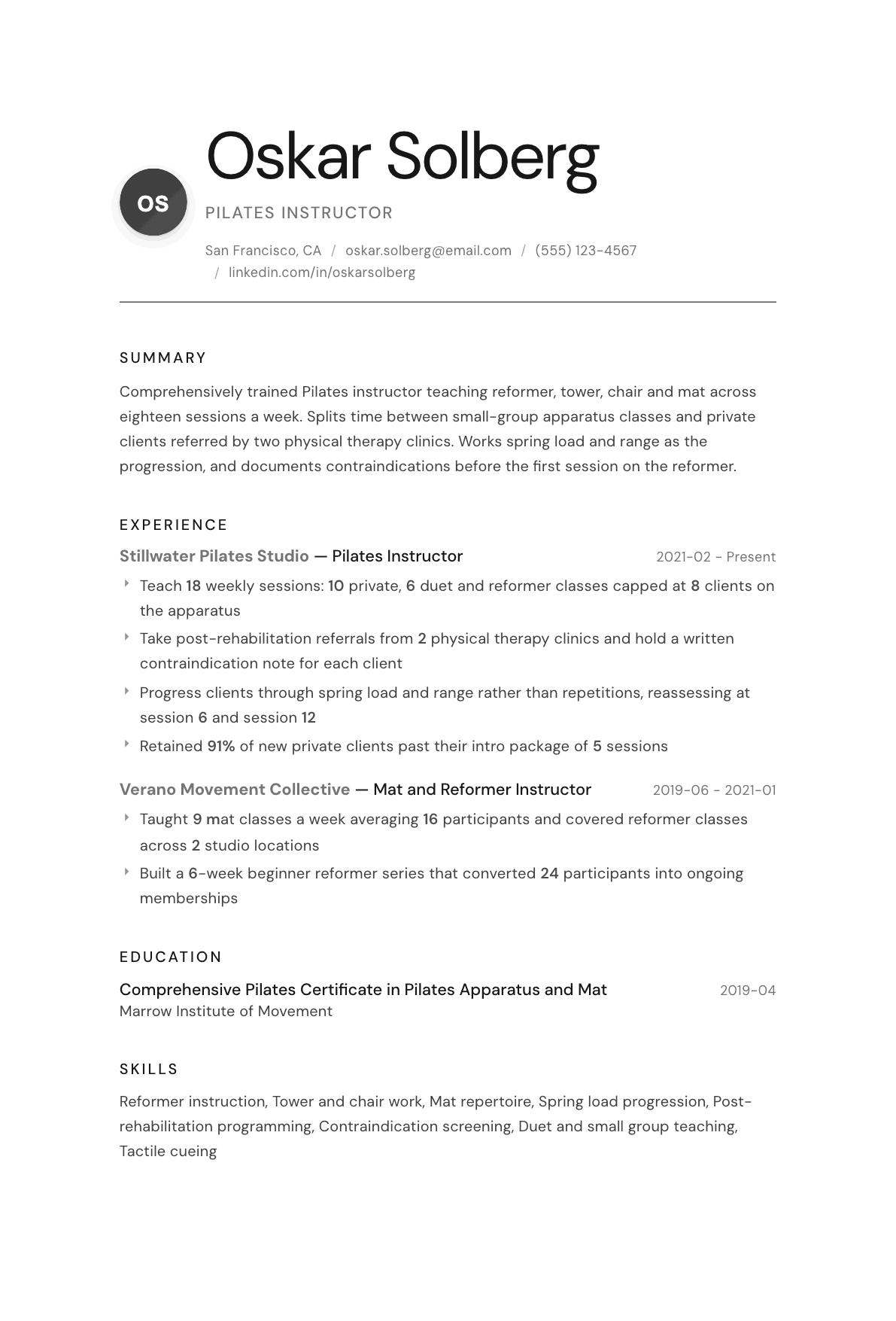
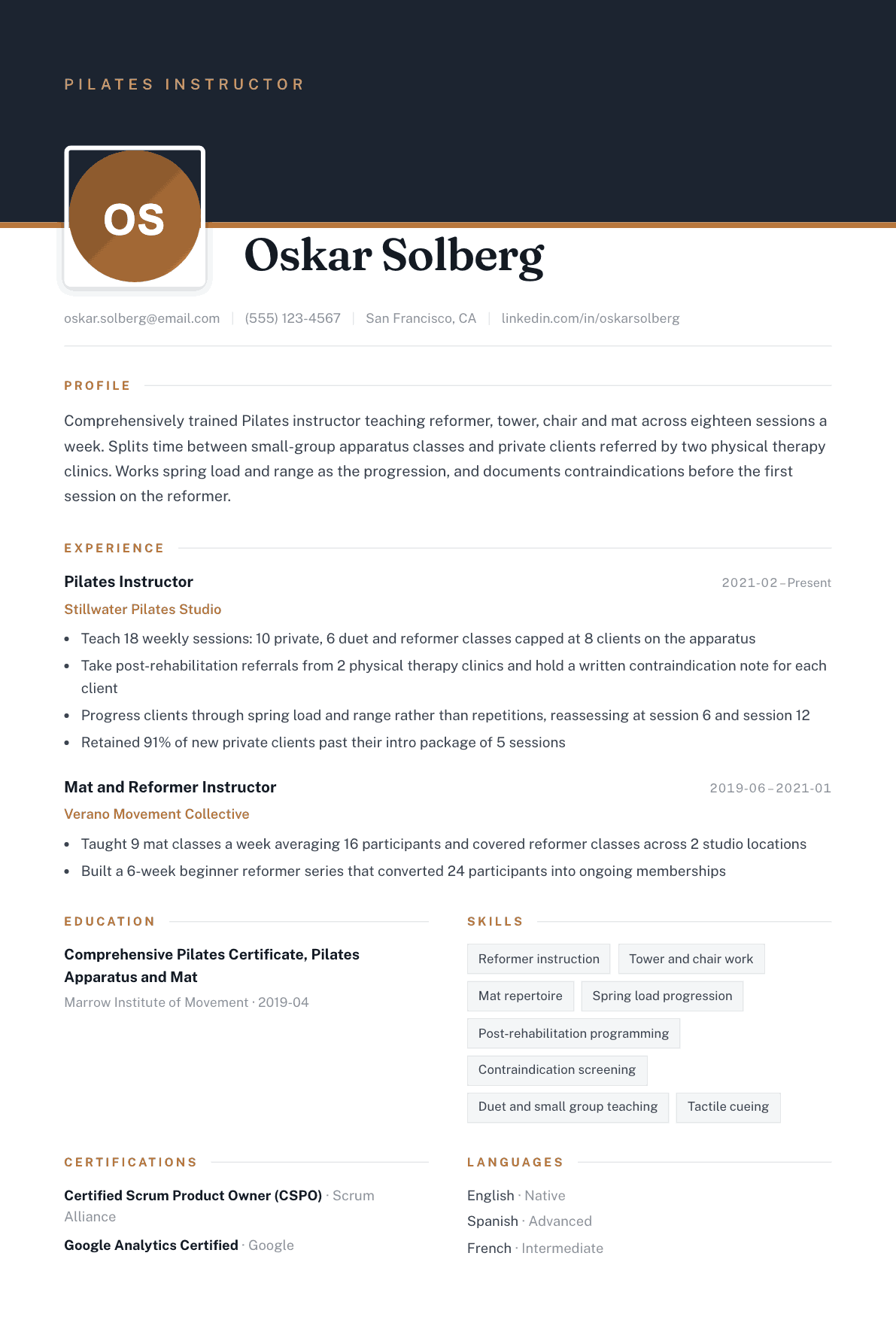
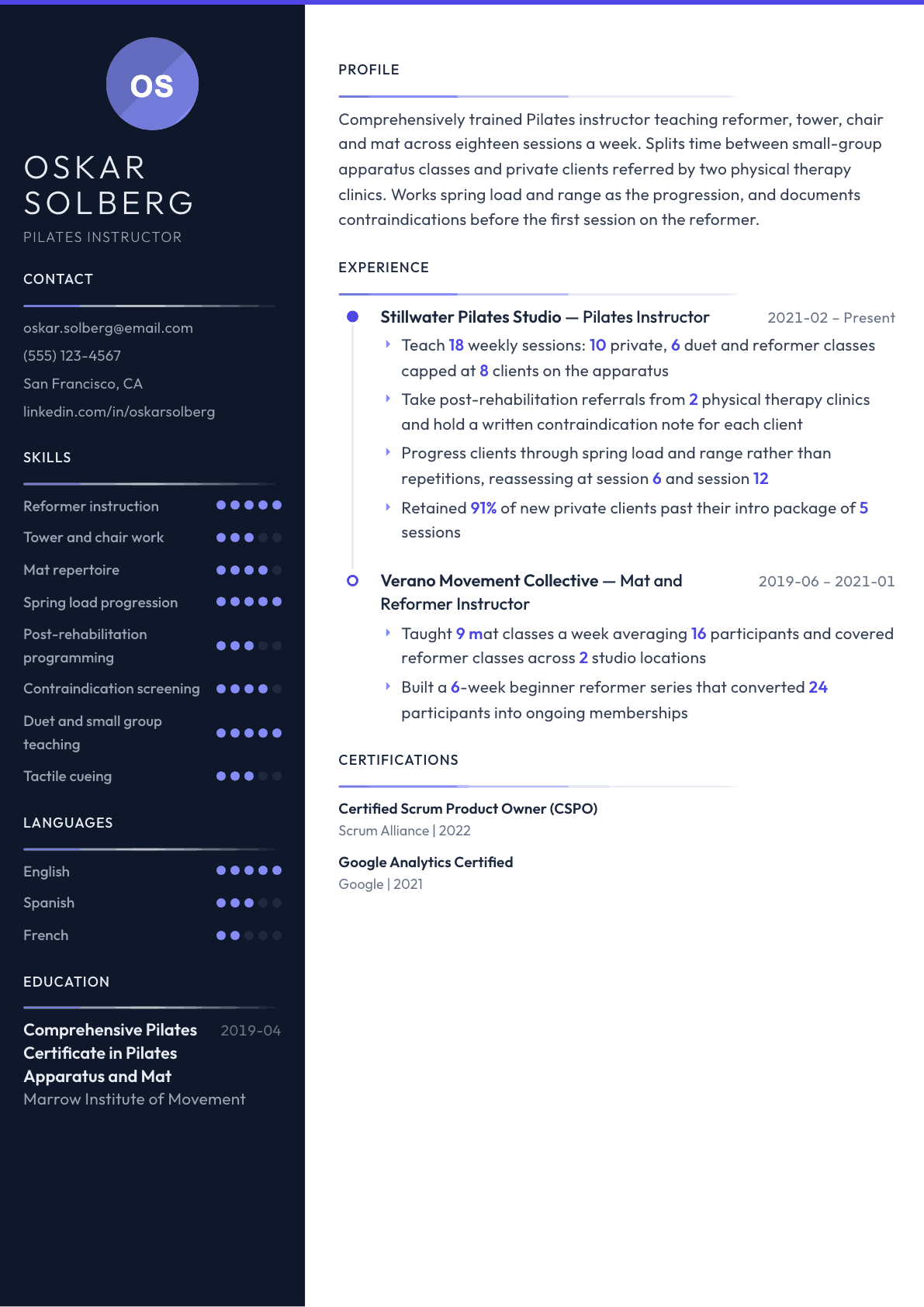
Example Pilates Instructor summary
Comprehensively trained Pilates instructor teaching eighteen weekly sessions across reformer, tower, chair and mat. Splits a private book with small-group apparatus classes, accepts post-rehabilitation referrals from two clinics, and progresses clients by spring load and range rather than repetition count. Retains most intro-package clients into ongoing memberships. Seeking a senior teaching role with apprentice mentoring.
Skills to list on a Pilates Instructor resume
- Reformer
- Cadillac and tower
- Wunda chair
- Ladder barrel
- Mat repertoire
- Spring load progression
- Pre and postnatal programming
- Post-rehabilitation referrals
- Contraindication screening
- Tactile cueing
- Duet instruction
- Class sequencing
- Client reassessment
- Studio scheduling
What actually gets this resume read
- State whether your training is comprehensive or mat only, and name the school, because studios hire on lineage.
- Give the apparatus you teach by name: reformer, tower, chair, barrel and mat each carry different studio value.
- List your supervised teaching and observation hours if you trained recently, the way a studio director expects to see them.
- Split your weekly load into private, duet and class sessions, since pay rates and studio staffing plans follow that split.
- If you take clinical referrals, say which clinics and how you document contraindications before a client touches a spring.
- Describe progression in Pilates terms, spring load and range of motion, rather than borrowing gym language about weight added.
How to write a pilates instructor resume
Pilates hiring runs on lineage. A studio owner reading an application looks first at where you trained and whether the training was comprehensive or mat only, because that single fact tells her which equipment you can be scheduled on and how much supervision you will need in your first month. A resume that buries the training school under a list of adjectives loses at that first glance.
The second thing she is checking is the apparatus. Reformer teaching is the commercial core of most studios, but tower, chair and barrel work, and the ability to take a client whose physical therapist just discharged them, are what make an instructor worth a full timetable rather than three classes a week.
This guide sets out the section order studio directors expect, how to present training hours and apparatus experience, how to describe progression in Pilates terms rather than gym terms, and the questions that come up when a newly certified teacher applies to a studio with a waiting list of applicants.
Format: training lineage in the header area
One page. Under your name, put the training school, whether the certification is comprehensive or mat, and the apparatus you teach. If your training body requires ongoing continuing education to keep the credential current, say that it is current. Studio owners know which schools train on which repertoire, and that shorthand is doing most of the work on your behalf.
Keep the layout plain and text-first. Many studio groups run applications through general small business hiring software, and decorative two-column layouts come back scrambled. Save the aesthetic for your teaching page.
- Header block: name, city, training school, comprehensive or mat certification, apparatus taught.
- Section order that suits Pilates: summary, training and certification, teaching experience, apparatus and specialty populations, education, skills.
- If you trained recently, add observation, self-practice and supervised teaching hours as a single line, the way training programs record them.
Teaching experience: the weekly split
Break each studio position into the weekly session split: private sessions, duets, and apparatus or mat classes with the cap on each. This matters because studios build their revenue and their staffing around that mix, and an instructor who can carry a private book is valued differently from one who only teaches group mat.
Then write bullets that show teaching decisions. How you sequence a session for a client with a stiff thoracic spine, how you choose spring load rather than repetitions to progress someone, when you swap footwork for a supine leg series because the knee is not tolerating flexion. This is the language of a trained teacher and it cannot be faked.
Retention belongs here as well. Studios sell intro packages and then hope the client stays. Share of intro clients who continued into ongoing membership is a direct commercial contribution and one of the few numbers a studio owner will recognize immediately.
Clinical referrals and special populations
If you take post-rehabilitation clients, say which clinics refer to you and how you handle the handoff: a written contraindication note before the first session, communication back to the referring clinician, and the boundary where you stop and send the client back. That process is what makes a studio comfortable putting a discharged patient on your schedule.
Special populations deserve their own short list: pre and postnatal, older adults working on bone density and balance, hypermobile clients, scoliosis, dancers. Name only the ones you have trained for, and name the training. Claiming a population you have only read about is quickly exposed the first time a client with that condition books.
- Say how you document contraindications before a client is loaded on a spring.
- Name the apparatus you use for a given population, since that is the concrete part of the claim.
- Give the number of reassessment points inside a package, because a structured review is what separates teaching from supervising.
Apparatus and repertoire as a skills section
Instead of a generic skills list, write an apparatus and repertoire block: reformer, tower or Cadillac, wunda chair, ladder barrel, spine corrector, mat. Note where you are strong and where you are still building hours, because a studio owner would rather know than discover it during a trial class.
Add the practical studio skills that keep a timetable running: cleaning and maintaining apparatus, checking springs and straps, adjusting a reformer for a client between sessions in under a minute, and running the booking system. Those details tell an owner you can hold a busy back-to-back schedule.
Keywords studios search for
Studio postings reuse a narrow set of terms: comprehensive certification, reformer, mat, tower, chair, duet, private sessions, contraindications, post-rehabilitation, pre and postnatal, cueing and client retention. Mirror the ones that are true of you inside experience bullets.
Include your training school name in full at least once in prose as well as in the header. Owners and studio managers search for schools by name when they are looking for a particular teaching approach, and an acronym alone will not surface.
Pilates Instructor resume summary examples
Newly certified
Comprehensively trained Pilates instructor who completed 450 program hours including observation, self-practice and supervised teaching on reformer, tower, chair and mat. Teaches six mat classes and four private sessions a week, and documents contraindications before any apparatus work. Seeking a studio position with mentoring on the schedule.
Four years teaching
Pilates instructor teaching 18 sessions a week: 10 private, 6 duet and reformer classes capped at 8. Takes post-rehabilitation referrals from two physical therapy clinics, progresses clients by spring load and range, and retained 91% of new private clients past their intro package.
Senior teacher and mentor
Senior Pilates instructor and teacher trainer who mentors apprentices through supervised teaching hours and runs the studio continuing education calendar. Carries a full private book, teaches advanced apparatus classes, and works alongside referring clinicians on complex spine and shoulder cases.
Work experience bullets: before and after
Before: Taught Pilates classes and private sessions.
After: Taught 18 sessions a week made up of 10 privates, 6 duets and reformer classes capped at 8 clients, covering reformer, tower, chair and mat repertoire.
The weekly split and the apparatus list let an owner see immediately how you would fill her timetable.
Before: Worked with clients recovering from injuries.
After: Accepted post-rehabilitation referrals from two physical therapy clinics, kept a written contraindication note for each client, and returned progress updates to the referring clinician after the sixth session.
It describes a referral process a clinic can trust rather than a general willingness to work with injuries.
Before: Progressed clients over time.
After: Progressed clients through spring load and range of motion rather than repetition count, with formal reassessments at session six and session twelve of every package.
Progression written in Pilates terms proves comprehensive training in a way that gym vocabulary never does.
Before: Helped grow the studio membership.
After: Built a six-week beginner reformer series that converted 24 participants into ongoing memberships and retained 91% of new private clients past the five-session intro package.
A named offer plus two retention figures turns a growth claim into a commercial contribution.
Before: Used hands-on cues with clients.
After: Used tactile cueing at the ribs and pelvis with consent asked before every session, switching to verbal and visual cues for clients who preferred no contact.
Consent and an alternative show professional judgment, which studio owners weigh heavily on hands-on work.
Hard skills
- Reformer instruction
- Cadillac and tower repertoire
- Wunda chair
- Ladder barrel and spine corrector
- Mat repertoire
- Spring load progression
- Postural assessment
- Contraindication screening
- Post-rehabilitation programming
- Pre and postnatal adaptation
- Duet and small group sequencing
- Tactile and verbal cueing
- Apparatus maintenance
- Studio booking systems
Soft skills
- Precise observation
- Calm teaching voice
- Consent-based touch
- Client rapport over long packages
- Patience with slow progress
- Collaboration with clinicians
Certifications worth listing
- NCPT Certified Pilates Teacher (National Pilates Certification Program)
- Comprehensive Pilates Certification (Balanced Body)
- STOTT PILATES Comprehensive Certification (Merrithew)
- Comprehensive Teacher Training (BASI Pilates)
- Adult and Pediatric First Aid, CPR and AED (American Red Cross)
Mistakes that cost pilates instructor candidates the interview
- Hiding the training school, which is the first thing a studio owner looks for and the thing she judges your repertoire by.
- Failing to say whether the certification is comprehensive or mat only, leaving the owner to assume the narrower answer.
- Describing progression in gym language about added weight, which signals that the apparatus training is thin.
- Claiming special populations without naming the training behind them, which collapses in the first client interview.
- Listing sessions as one total instead of splitting private, duet and class, so the reader cannot judge your commercial value.
- Leaving out apparatus maintenance and studio operations, which matter to any owner running back-to-back sessions.
Pilates Instructor resume questions
Does a Pilates studio care which school I trained with?
Yes, more than in most fitness roles. The school signals the repertoire, the teaching approach and the apparatus you covered. Name it in the header and again in your summary, and state clearly whether the training was comprehensive or mat only.
Should I list my training hours on a Pilates resume?
List them while you are early in your teaching career, broken into observation, self-practice and supervised teaching the way your program recorded them. Once you have a few years of studio work, replace hours with weekly session counts and client retention.
How do I present post-rehabilitation work without overstating my scope?
Say that clients arrive by clinician referral, that you keep written contraindication notes, and that you return progress updates and refer back when symptoms change. Describe adaptation rather than treatment, since treating an injury sits outside a teaching scope.
Can I get a studio job with a mat-only certification?
You can teach mat classes, and many studios hire mat teachers for group timetables. For reformer and apparatus hours, which is where most studio revenue sits, comprehensive training is usually required, so state your plan if you are mid-program.
What should a Pilates instructor put in a summary?
The training school and certification type, the apparatus you teach, your weekly session split, and one specialty such as post-rehabilitation referrals or prenatal work. That gives an owner everything she needs to decide whether to book a trial class.
Related resume examples
- Fitness Instructor Resume example
- Massage Therapist Resume example
- Group Fitness Instructor Resume example
- Wellness Coach Resume example
- Martial Arts Instructor Resume example
- Tennis Coach Resume example