Amazon Interview: 12 Full Answers to the Loop Questions
By Mustafa Tarabya, founder of CVBooster · Published · Updated
12 min read
An Amazon interview is a set of one to one meetings, and each interviewer is assigned different Leadership Principles to probe. Amazon calls this the interview loop and says each person "will assess different aspects of your skills and experience". That is the constraint: you are not being judged on rapport, you are being scored against published wording, twice over, by people who compare notes afterwards. Twelve full answers follow, checked in September 2026, each mapped to the principle it proves, plus the version that fails and five questions to ask back. Written by Mustafa Tarabya, who hired for his own company, read every application himself and now writes CVBooster's guides.
One complete answer first, so the shape is clear.
Tell me about a time you went above what was asked for a customer.
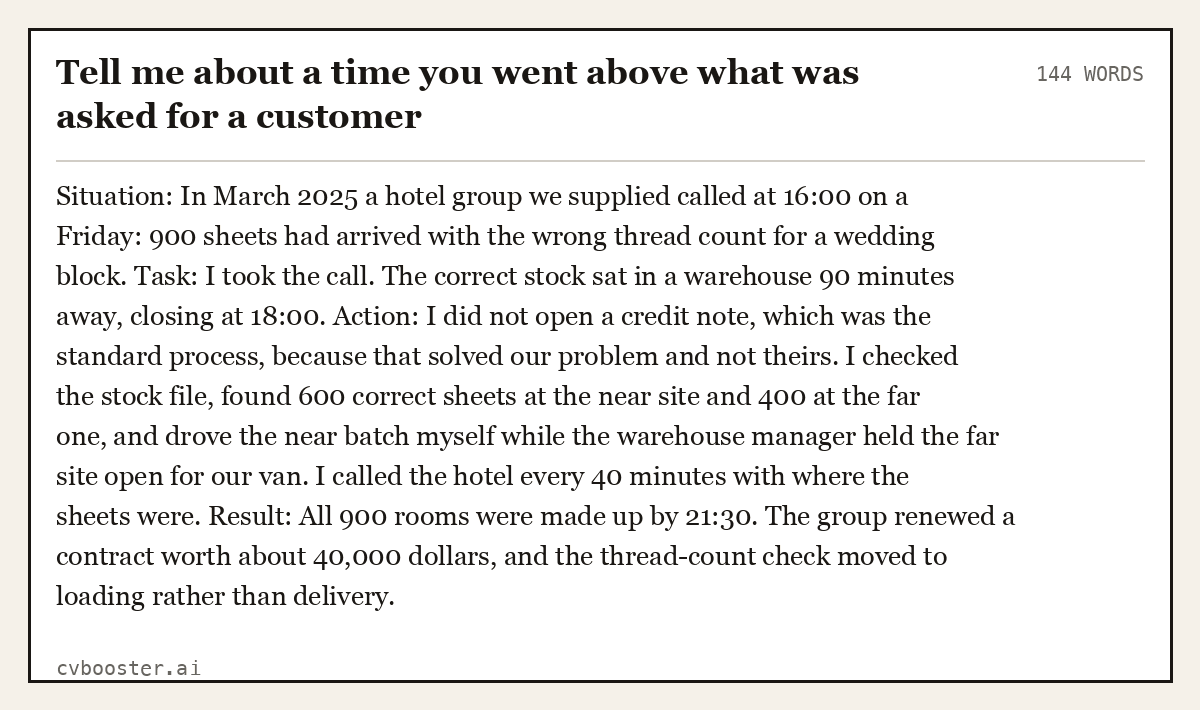
Situation: In March 2025 a hotel group we supplied called at 16:00 on a Friday: 900 sheets had arrived with the wrong thread count for a wedding block. Task: I took the call. The correct stock sat in a warehouse 90 minutes away, closing at 18:00. Action: I did not open a credit note, which was the standard process, because that solved our problem and not theirs. I checked the stock file, found 600 correct sheets at the near site and 400 at the far one, and drove the near batch myself while the warehouse manager held the far site open for our van. I called the hotel every 40 minutes with where the sheets were. Result: All 900 rooms were made up by 21:30. The group renewed a contract worth about 40,000 dollars, and the thread-count check moved to loading rather than delivery.
How Amazon scores these answers
Amazon publishes its Leadership Principles in full, and interviewers quote them back in debriefs. Customer Obsession says "leaders start with the customer and work backwards" and that "although leaders pay attention to competitors, they obsess over customers". Ownership says "leaders are owners" who "never say 'that's not my job'". Dive Deep says leaders "stay connected to the details, audit frequently, and are skeptical when metrics and anecdote differ". Frugality says "constraints breed resourcefulness, self-sufficiency, and invention".
Two principles decide most weak answers. Have Backbone, Disagree and Commit requires leaders to "respectfully challenge decisions when they disagree", then, "once a decision is determined", to "commit wholly". Earn Trust asks leaders to be "vocally self-critical, even when doing so is awkward or embarrassing". With no story where you were wrong, you cannot pass that one.
The format is fixed too. Amazon's recruiters state that "the STAR method is the preferred way to answer these questions", and that candidates should "use 'I' rather than 'we' statements". One is blunt about evidence: "Through data points, you can paint a really clear picture for the interviewers about the results you were able to drive."
Expect a Bar Raiser, described by Amazon's recruiting team as "an objective interviewer who helps ensure Amazon's hiring standards", often from another part of the business. Amazon's how we hire pages list the stages by role.
Tip: Write eight or nine stories, then tag each with two principles. You will be asked about roughly five.
Ownership and bias for action
Tell me about a time you took on something outside your job description.
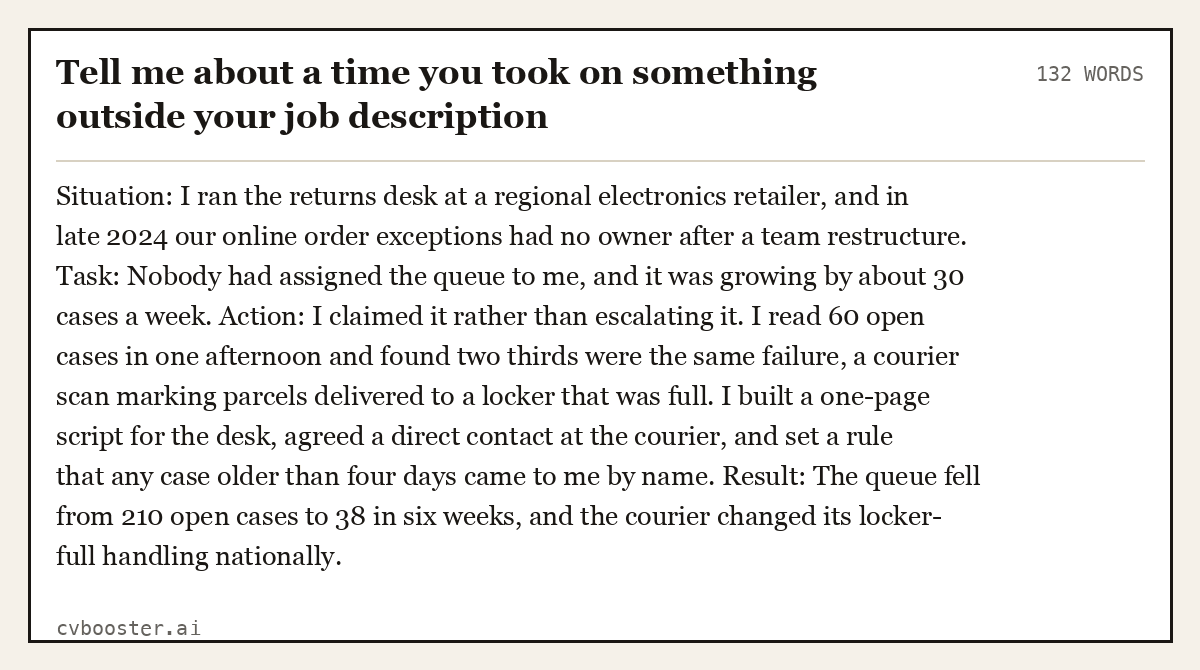
Situation: I ran the returns desk at a regional electronics retailer, and in late 2024 our online order exceptions had no owner after a team restructure. Task: Nobody had assigned the queue to me, and it was growing by about 30 cases a week. Action: I claimed it rather than escalating it. I read 60 open cases in one afternoon and found two thirds were the same failure, a courier scan marking parcels delivered to a locker that was full. I built a one-page script for the desk, agreed a direct contact at the courier, and set a rule that any case older than four days came to me by name. Result: The queue fell from 210 open cases to 38 in six weeks, and the courier changed its locker-full handling nationally.
Describe a time you had to act quickly without complete information.
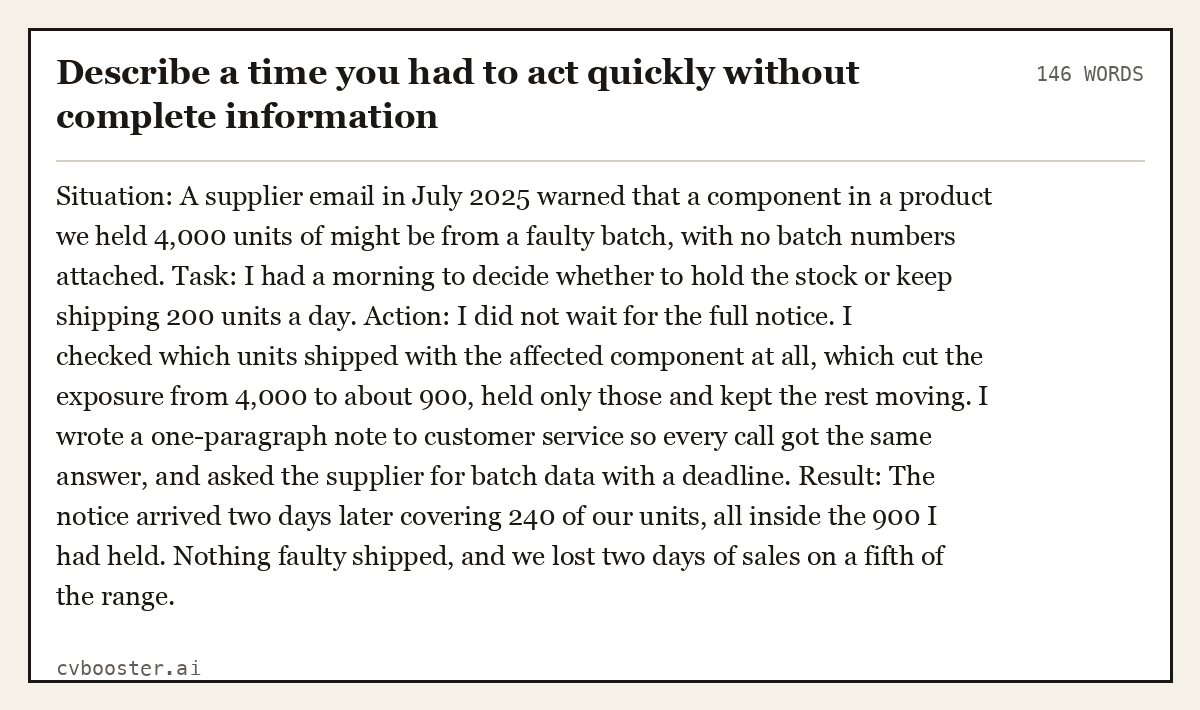
Situation: A supplier email in July 2025 warned that a component in a product we held 4,000 units of might be from a faulty batch, with no batch numbers attached. Task: I had a morning to decide whether to hold the stock or keep shipping 200 units a day. Action: I did not wait for the full notice. I checked which units shipped with the affected component at all, which cut the exposure from 4,000 to about 900, held only those and kept the rest moving. I wrote a one-paragraph note to customer service so every call got the same answer, and asked the supplier for batch data with a deadline. Result: The notice arrived two days later covering 240 of our units, all inside the 900 I had held. Nothing faulty shipped, and we lost two days of sales on a fifth of the range.
Dive deep and being right
Tell me about a time the data disagreed with what everyone believed.
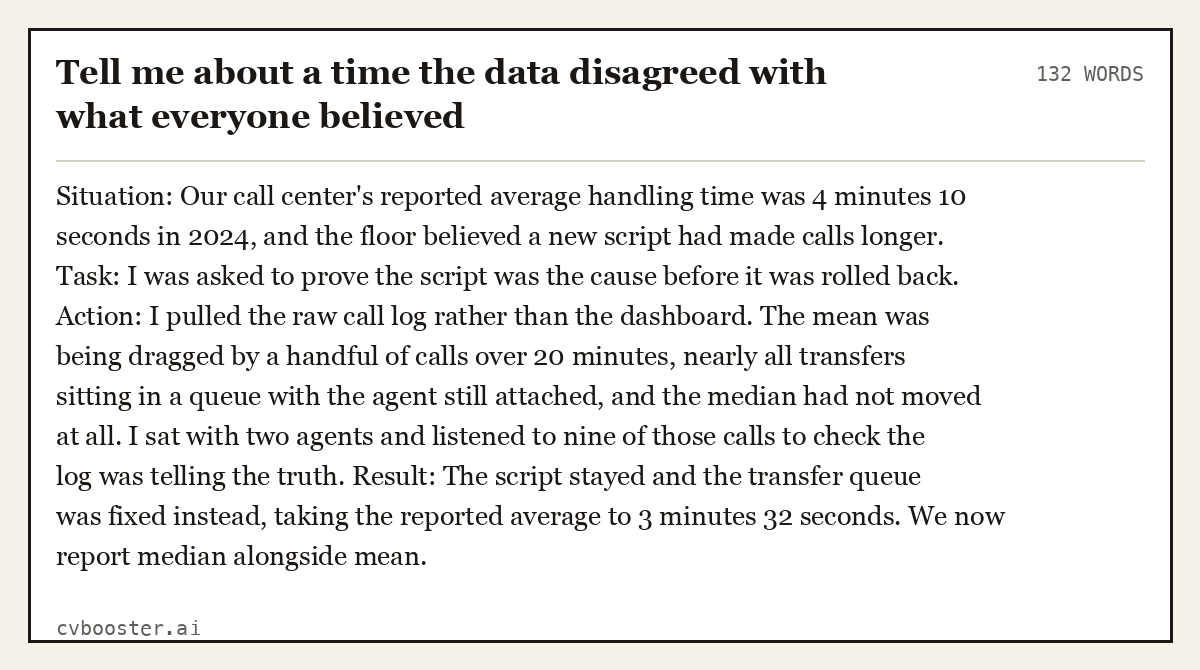
Situation: Our call center's reported average handling time was 4 minutes 10 seconds in 2024, and the floor believed a new script had made calls longer. Task: I was asked to prove the script was the cause before it was rolled back. Action: I pulled the raw call log rather than the dashboard. The mean was being dragged by a handful of calls over 20 minutes, nearly all transfers sitting in a queue with the agent still attached, and the median had not moved at all. I sat with two agents and listened to nine of those calls to check the log was telling the truth. Result: The script stayed and the transfer queue was fixed instead, taking the reported average to 3 minutes 32 seconds. We now report median alongside mean.
Describe the most complex problem you have solved.
Situation: A stock count at a 12,000-line wholesaler in 2025 was out by about 90,000 dollars, and three departments each blamed the others. Task: I was asked to find the cause with two weeks of data access and no authority over any of the three teams. Action: I stopped looking for a culprit and looked for a pattern. I sorted the variances by value and found 70 of them made up most of the gap, all in lines sold both by the case and by the unit. The conversion factor lived in two systems and had been updated in one. I matched the update date to the variance start and reconciled those 70 lines by hand. Result: The gap resolved to about 4,000 dollars of genuine shrinkage, the conversion factor moved to a single source, and the next quarter's count came in inside 0.2 percent.
Invent, simplify and frugality
Tell me about a time you simplified a process.
Situation: New starters at a 60-person logistics firm needed nine forms across four systems before their first shift in 2024, and one in four arrived without a badge. Task: I owned onboarding admin and had no software budget. Action: I mapped who used each field and found three of the nine forms existed only to feed a report nobody read. I cut those, merged two more, and put the rest into one shared form with the badge request first rather than last. I tested it on three starters before proposing it. Result: Badge failures on day one stopped for the next 22 starters, and admin time per starter fell from about 90 minutes to 35.
Describe a time you did more with less.
Situation: Our warehouse's seasonal agency budget was cut by a third in November 2024, two weeks before peak. Task: The same 18,000 orders had to ship in December with 12 agency staff instead of 18. Action: I did not spread the loss evenly. I timed each task and found packing was the constraint while picking had slack, so I moved four permanent staff to packing and gave the agency picking, which takes an hour to learn. I pre-built 900 gift boxes in the quiet week, using labor when it was cheap. Result: We shipped 17,800 of 18,000 orders inside the service promise with 12 agency staff, and the overtime bill came in about 6,000 dollars under the previous December.
Earn trust and have backbone
Tell me about a time you disagreed with your manager.
Situation: In 2025 my manager wanted to move our monthly stock report from Thursday to Monday so it could go in a Monday meeting. Task: I thought it would make the report wrong, and I had to say so before the change was announced. Action: I did not argue in the meeting. I wrote three lines showing that weekend deliveries post on Monday morning, so a Monday report would miss between 200 and 400 lines a month, and brought last month's numbers to prove it. I offered a Tuesday report with a Monday one-page summary. When he chose Tuesday, I built it that week and did not reopen it. Result: The report moved to Tuesday and the meeting got its summary. Two other teams copied the summary format.
Tell me about a time you received difficult feedback.
Situation: In a 2024 review I was told I was the bottleneck on approvals, because four people were waiting on my sign-off most days. Task: My instinct was to defend the checking, since I had caught real errors. I needed to test whether that was true. Action: I logged every approval for three weeks: 96 items, 7 changed by me, and 5 of those 7 the same error from the same process gap. The checking was mostly waste. I fixed the upstream template, raised the no-approval threshold for two categories, and kept sign-off only above 2,000 dollars. Result: Average wait fell from about two days to under four hours, with no error through in the following quarter. I tell this one because it is the clearest thing I have been wrong about.
Deliver results
Tell me about a time you missed a deadline.
Situation: I committed to a stock system migration for the first weekend of October 2024 and went live two weeks late. Task: I had told three departments to plan around that date. Action: I found the problem on the Wednesday before, when a test import dropped supplier lead times. I called the delay myself rather than going live and fixing it afterwards, told all three departments the same morning with a new date and the reason, and kept the old system running in parallel. I rewrote the import to count lead times before loading anything. Result: It went live two weeks later with no data loss and no rollback. The parallel-running rule and the pre-load count check were used on the two migrations after it.
Tell me about a time you raised the standard on something.
Situation: Our despatch notes in 2024 were handwritten, and about 1 in 12 arrived with an illegible line that generated a customer call. Task: Nobody had asked me to change it, and printed notes meant a cost. Action: I counted the calls for a month, 41 of them, and put the cost beside the fix: about nine hours of desk time against 300 dollars for a thermal printer. I borrowed a printer for a two-week trial on one bay and measured that bay's calls against the others. Result: Illegible-line calls on the trial bay went to zero and printers were bought for all four bays. The month after rollout had 3 despatch calls against 41.
Tell me about a time you had to say no to a customer.
Situation: A long-standing account asked in 2025 for a same-day delivery slot our network genuinely could not serve to their postcode. Task: Saying yes would have missed, and saying a flat no risked the account. Action: I checked the network data before answering, so my no had a reason: the last collection for that postcode left at 11:40 and their orders were placed at 14:00. I said that in one sentence, then offered the two real options, a pre-08:00 next-day slot and held stock at their nearest depot, both in writing with the cost. Result: They took the depot option, and on-time delivery for that account went from 71 percent to 98 percent over the next quarter.
The answers that fail the loop
The first question on this page, answered the way most candidates answer it.
"We are really customer focused in my team, so when a customer has a problem we always do whatever it takes. There was a delivery issue with a hotel client once and we sorted it out for them the same day. They were very happy and stayed with us, which shows how much we value our customers and always go the extra mile."
This fails on Amazon's own terms. "We" carries every verb, which breaks the rule Amazon's recruiters state outright. There is no date, size or decision, so nothing shows judgment. The result is a feeling rather than a number. Nowhere does the candidate choose one option over another, so the interviewer cannot tell what they own.
Rewrite it by naming the day, the number of units, the option you rejected and the figure at the end.
Questions to ask them
Amazon notes that every interview has time built in for questions and calls it "your opportunity to interview Amazon and find out if the role is right for you". Five that produce usable answers:
- Which Leadership Principles does this role get measured on most?
- What does the first 90 days look like, and what is the first document I write?
- How is success defined for this team this year, in numbers?
- Who is the single-threaded owner for this area?
- What would make someone struggle here?
For the answer structure, see our STAR interview questions page. Competency based questions covers the same evidence rules and common interview questions and answers covers the rest.
Frequently asked questions
What's the Amazon interview process like?
It runs online application, assessment, phone screen, then the interview loop of one to one meetings. Each interviewer covers different Leadership Principles and one is a Bar Raiser from outside the team. Feedback is written up and compared in a debrief before any offer.
How do I prepare for an Amazon interview?
Learn the Leadership Principles in Amazon's own wording, then write eight or nine stories in the situation, task, action, result shape and tag each with two principles. Put a number in every result. Expect follow-up questions two or three layers deeper than your first answer.
How many examples should I prepare for an Amazon interview?
Amazon's own recruiting advice is a document with eight or nine strong examples from previous work, each mapped to specific principles, and notes that stories overlapping several principles is fine. You will not be asked about every principle, so breadth of examples matters more than polish.
How long does it take to prepare for an interview?
Amazon says this is up to the individual, and encourages enough time to feel confident. In practice, writing and testing nine stories out loud takes two evenings plus a rehearsal. Learning the principles well enough to name them takes an hour.
More in this series: Interview questions and answers
- STAR Interview Questions: 12 Full Answers and the Budget
- Teacher Interview Questions and 12 Full Answers (US)
- Technical Interview Questions and 12 Worked Answers
Related articles
- STAR Interview Questions: 12 Full Answers and the Budget
- STAR Method Answers Examples: 12 Weak Answers Rewritten
- Job Interview Tips: A Timeline From Preparation to Follow-Up
- Adjectives to Describe Yourself and the Sentence for Each
More articles
- APS Pitch Example: One Page at APS4, Two Pages at EL1
- APS Statement of Claims Example: APS4, APS5 and APS6
- How to Make an ATS-Friendly Resume: Complete Guide
Looking for a worked example for your job title? Browse the resume examples by job title.