Do You Want to Tell Us Anything Else? 8 Sample Answers
By Mustafa Tarabya, founder of CVBooster · Published · Updated
7 min read
When an interviewer asks "do you want to tell us anything else about yourself", answer in under a minute with one thing they have not heard: a strength you did not get to use, a clarified answer, or a specific reason you want this company. The one constraint: do not recap your resume. This is the last open question, and the Job-Hunt guide describes it as "a chance to share some personality or creatively share that you've researched the company and are excited about the possibilities". Below are the three-part formula and eight complete answers, from a spoken reply to a written application box. Written by Mustafa Tarabya, who hired for his own company, read every application himself and now writes CVBooster's guides.
The question sounds like an invitation to say anything. It is closer to a last offer to add one more document to the file, so pick the one the file is missing.
A first answer, done properly
An applicant for a customer success role, asked at the end of a second interview. The answer adds one fact the interviewers did not hear.
Mid level: Customer success interview, spoken answer (89 words)
"Yes, one thing we did not get to. You asked about handling difficult clients, and I talked about my current account manager role. What I did not mention is that I wrote the renewal playbook our team uses now. It lists the five questions I ask in the 90 days before a contract ends, and we used it on 40 renewals last year. I would be happy to share it, because the problem it solves, keeping accounts that go quiet, looks very like the one in your job description."
Create my CV
Or start from one of our free resume templates
What the question is testing
It is not a trick. Interviewers ask it for three reasons:
- To give you a fair last chance. Some candidates leave a good answer on the table, and this is the fix.
- To see how you close. A candidate who rambles for five minutes at the end undoes the first fifty.
- To check your interest. A specific reason for wanting the job is more persuasive than "I'd love to join".
Purdue's Online Writing Lab, in its quick tips for cover letters, gives the rule for any piece of persuasive writing: "Give specific examples to prove where you got these skills and how you have used them before." The same applies to a spoken answer. A claim without an example uses up your thirty seconds.
MIT's career advising office reminds students that "Interviewing takes practice", on its interviewing page. This is the question to practice, because it is the one you can prepare in advance without knowing what you will be asked.
The three-part formula
- Point to a gap. "One thing we did not cover..." or "I would like to add to my answer on..."
- Give the evidence. One example with a number or a result.
- Tie it to the role. One sentence on why it matters for this job.
Stop there. If you are speaking, that is about 45 seconds.
Six more sample answers
Each is complete and can be adapted. The names and numbers are invented.
Clarifying an earlier answer
Mid level: Clarifying an earlier answer (66 words)
"Yes, I would like to go back to one answer. When you asked about my biggest weakness, I said I can be too detail-focused. What I should have added is how I manage it: I set a 30-minute limit on first drafts of reports and ask a colleague to read for the big picture. Last quarter that cut my report turnaround from four days to two."
Showing research on the company
Entry level: Showing specific company research (66 words)
"Yes, I would like to say why this company. I read your sustainability report and saw that you reduced packaging weight across three product lines. In my capstone project I redesigned a snack package for a food company and cut its material by about a fifth. That is the kind of problem I would like to work on, and your team is doing it at scale."
Addressing a gap or career change briefly
Mid level: Career change, brief explanation (65 words)
"One thing I would like to add is why I am moving from teaching into operations. For eight years I managed schedules, budgets and 120 families' communication, and I realized that this was the part of teaching I liked most. I took a certificate in supply chain last spring and ran the logistics for our school's book fair, with 3,000 books moved in two days."
Adding an experience that did not fit the earlier questions
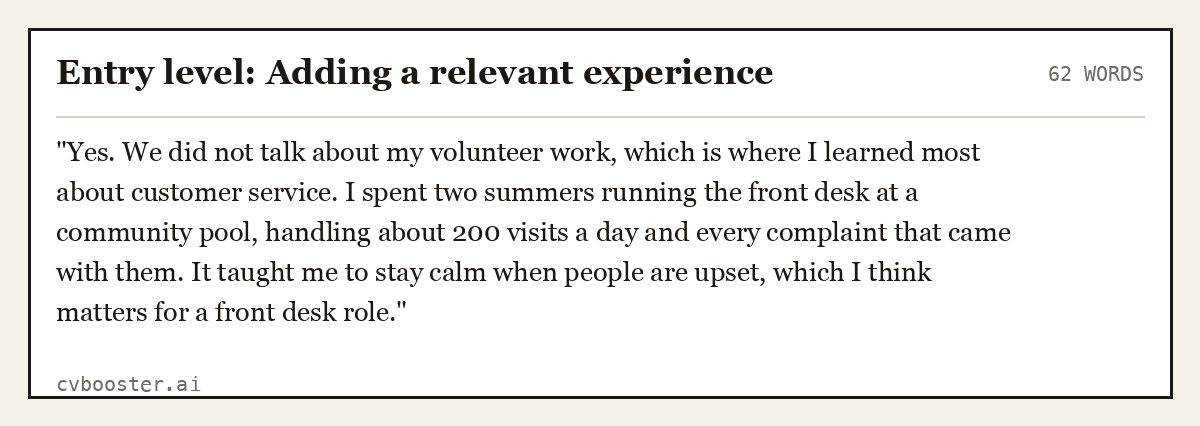
Entry level: Adding a relevant experience (62 words)
"Yes. We did not talk about my volunteer work, which is where I learned most about customer service. I spent two summers running the front desk at a community pool, handling about 200 visits a day and every complaint that came with them. It taught me to stay calm when people are upset, which I think matters for a front desk role."
A closing summary plus a question about next steps
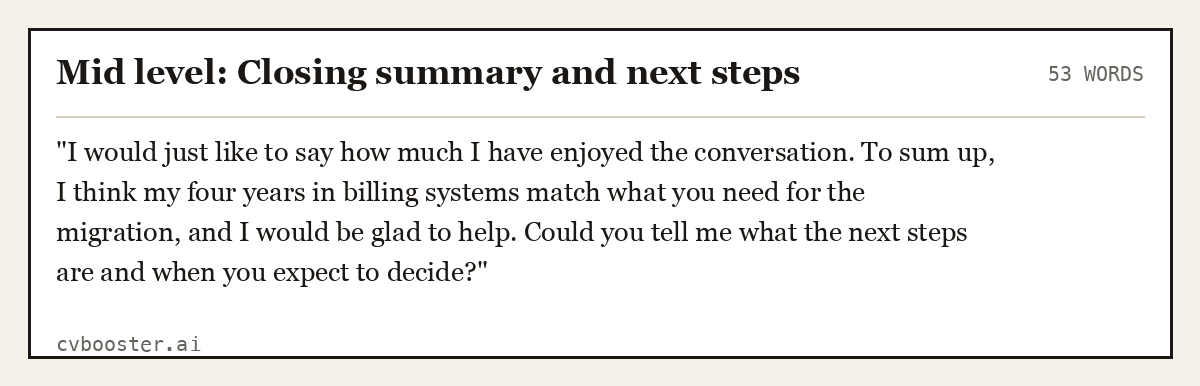
Mid level: Closing summary and next steps (53 words)
"I would just like to say how much I have enjoyed the conversation. To sum up, I think my four years in billing systems match what you need for the migration, and I would be glad to help. Could you tell me what the next steps are and when you expect to decide?"
When you have nothing to add
Sometimes everything has been covered. It is fine to say so, briefly.
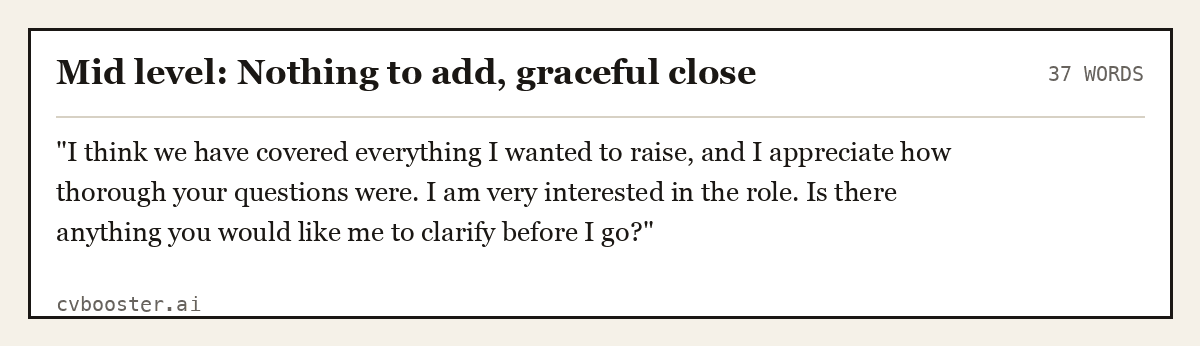
Mid level: Nothing to add, graceful close (37 words)
"I think we have covered everything I wanted to raise, and I appreciate how thorough your questions were. I am very interested in the role. Is there anything you would like me to clarify before I go?"
The written version
Application forms ask the same thing in a box: "Is there anything else you would like us to know?" The rules change slightly. There is more time to edit, a limit on length, and no chance to read the room.
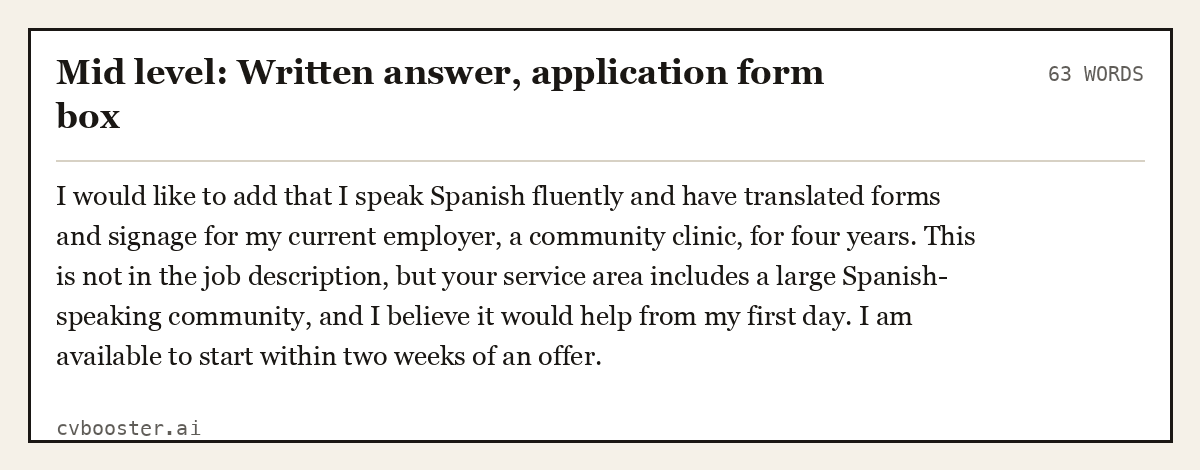
Mid level: Written answer, application form box (63 words)
I would like to add that I speak Spanish fluently and have translated forms and signage for my current employer, a community clinic, for four years. This is not in the job description, but your service area includes a large Spanish-speaking community, and I believe it would help from my first day. I am available to start within two weeks of an offer.
Keep a written answer to 60 to 100 words, add one fact the form did not ask for, and finish with availability or a link to a portfolio if it applies.
What not to say
- "No, I think that is everything." Said flatly, with nothing after it, this wastes the one open question.
- A repeat of your resume. The panel has it in front of them.
- Personal details that raise legal issues. Marital status, religion, plans for children and similar topics do not help your case.
- Complaints about a former employer. Even true ones.
- A joke you have not tested. If it fails, the last thing the panel hears is silence.
For related questions, see our pages on what makes you unique and why do you want to work here, and the wider list in common interview questions and answers. For the weak-point question that sometimes precedes it, our weaknesses for job interviews page has examples, and questions to ask in an interview covers the other end-of-interview prompt.
Frequently asked questions
How do you answer "Do you want to tell us anything else about yourself"?
Use one short, specific answer: name something the interview did not cover, give an example with a number or a result, and say why it matters for this job. Keep it under a minute. Do not repeat your resume or add personal information that is not relevant to the role.
What should I say if I have nothing to add?
Say so briefly and positively: that the interview has covered what you wanted to raise, that you appreciate the questions, and that you are interested in the role. Then ask whether there is anything the panel would like you to clarify, or about the next steps in the process.
Is "Is there anything else you would like us to know" the same question?
Yes. It is the same open question in different words, used in interviews and on application forms. In person you have about a minute, so use the three-part formula. On a form, write 60 to 100 words and add one fact that the form did not ask for elsewhere.
Should I ask a question when they ask me this?
You can, after your answer. A question about the next steps or the team shows interest and gives the panel something to respond to. Keep to one question, and do not use this moment to raise salary or benefits unless the interviewer has opened that topic.
Related articles
- Casual Interview Outfits: 9 Smart Casual Looks by Job
- How to Respond to an Interview Request: 7 Reply Emails
- What Makes You Unique: 7 Interview Answers That Stand Out
- Why Do You Want to Work Here: 8 Sample Answers That Work
More articles
- Apple Pages Resume Template: 6 Examples Built for ATS
- Application Letter for Student: 5 Full Samples to Copy
- Application Letter Format in Word: UK Layout and 5 Letters
Looking for a worked example for your job title? Browse the resume examples by job title.