Weaknesses for Job Interviews: Answers That Survive a Follow-Up
By Mustafa Tarabya, founder of CVBooster · Published · Updated
9 min read
The question is not really "what is wrong with you". It is a test of whether you can see yourself accurately and do something about what you see. Candidates who fail it usually fail because they refuse to answer, not because their weakness was disqualifying.
That reframing matters, because it changes what a good answer looks like. You are not being asked to minimise the damage. You are being asked to demonstrate self-awareness, and a non-answer demonstrates the opposite.
Why the perfectionist answer fails
"I'm a perfectionist", "I work too hard", "I care too much" — these are strengths wearing a costume, and interviewers have heard them hundreds of times. The moment one arrives, the interviewer learns something, just not what you intended: that you either cannot assess yourself or are unwilling to say so out loud.
There is a second, quieter problem. A disguised strength cannot be followed up. If they ask "when did that last cause a problem?", the answer collapses, because it was never built to survive a second question. Real answers get more solid under pressure; rehearsed ones get thinner.
The structure that holds
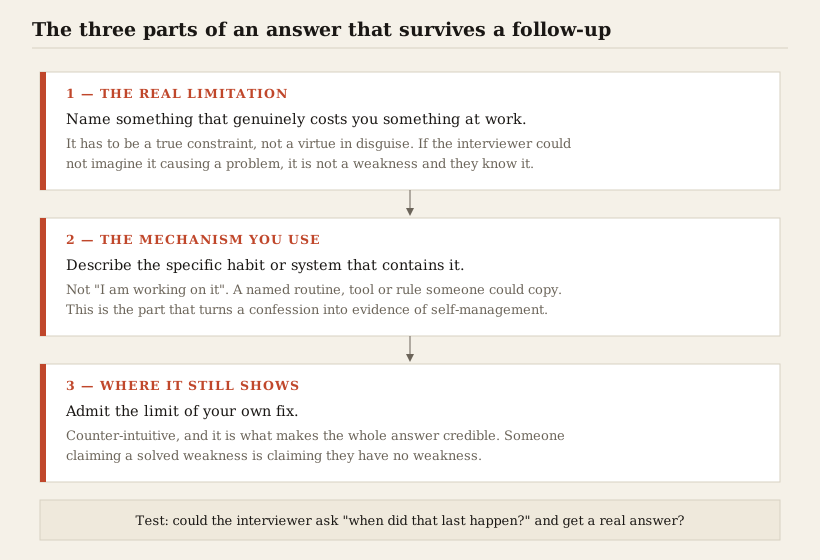
The third step is the counter-intuitive one. Saying the problem still shows up occasionally feels like weakening your case. It does the opposite: it signals that you are describing something real rather than performing recovery. A weakness that has been completely fixed is not a weakness, and both people in the room know it.
The same weakness, answered twice
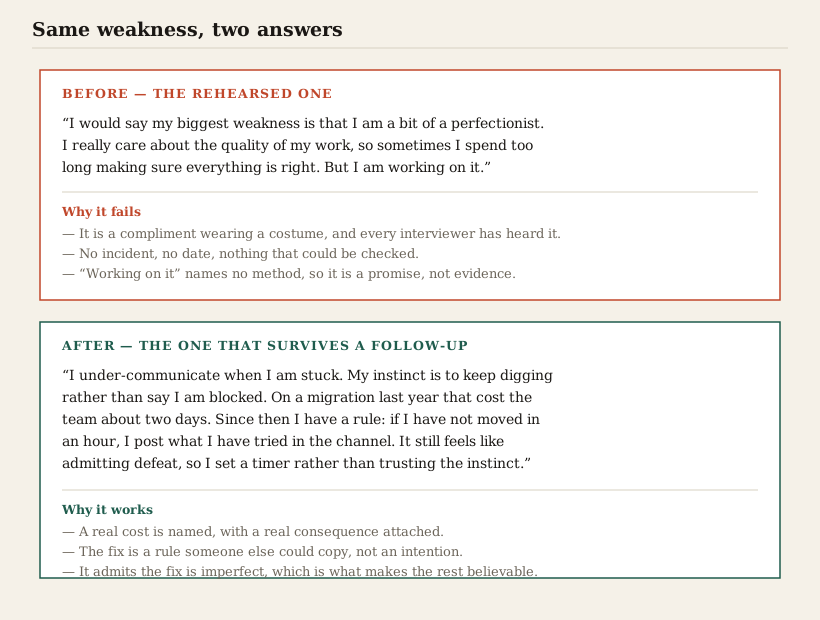
Notice what the stronger answer risks. It admits costing the team two days. Most candidates would never say that, and it is exactly why it lands — the specificity is the proof. Vague answers protect you from a conversation you were supposed to have.
Choosing which weakness to name
The rule is simple: pick something true that is not load-bearing for the job you are applying to.
- Safe: a skill adjacent to the role rather than central to it. Public speaking for a backend engineer. Spreadsheet modelling for a designer.
- Safe: a working habit with a visible fix — delegation, saying no to scope, asking for help late.
- Unsafe: the core competency in the job description. Never name attention to detail in an audit role or communication in a client-facing one.
- Unsafe: anything touching reliability or honesty. Timekeeping, follow-through and admitting mistakes read as character, not skill.
- Unsafe: anything about your colleagues. "I get frustrated with people who are slower than me" answers a different question than the one asked.
Tip: Read the job ad and underline the three things the role genuinely depends on. Your weakness comes from outside that list. That single filter removes most bad answers.
Three more worked examples
Delegation: "I hold on to work too long. When a project matters I would rather do a task myself than explain it, which caps how much the team can carry. I now write the brief before I decide who does it — if I can write it down, there is no reason it has to be me. I still catch myself picking up small things because it is faster in the moment."
Saying no: "I say yes too quickly. I have taken on work in a sprint that pushed something else late rather than saying the week was full. Now I answer scope questions the next morning instead of in the meeting, which is usually enough to give an honest answer. It works, but it makes me slower to respond than some people would like."
Detail under pressure: "When I am rushing, my writing gets sloppy — typos in client-facing emails, mostly. I started reading anything external out loud before sending, which catches nearly all of it. On a busy day I sometimes skip that step, so I have moved the important sends to the morning."
All three name a cost, name a mechanism, and admit a limit. None of them is a disguised compliment, and each would survive "can you give me an example?"
Strength and weakness in a nursing interview
Nursing panels ask both questions, often back to back, and they listen for one thing first: patient safety. A weakness that could hurt a patient, such as checking medications too quickly or avoiding difficult conversations with doctors, is the wrong one to name. A weakness about pace, delegation or confidence in a new skill is fine, as long as you show the fix. The strength should be one you can prove with a shift you remember.
Strength, from an invented med-surg nurse, Alicia Moreno: "My strength is noticing small changes early. On a night shift last winter, a post-op patient's breathing rate crept up over two hours while every other sign looked fine. I raised it with the charge nurse, we called the rapid response team, and he was treated for an early pulmonary embolism before it got worse. I chart trends, not just single readings, because of that night."
Weakness, same nurse: "I find it hard to hand over tasks to nursing assistants when the unit is busy, because I know exactly how I want them done. That slowed me down and left the assistants underused. Now I give each assistant a clear list at the start of the shift and check back at set times instead of doing it myself. I still have to remind myself on the heaviest days."
Both answers name a real shift, a cost and a change, and neither weakness puts a patient at risk. For the clinical questions that come next, see the emergency nurse interview questions with full sample answers.
The follow-up you should expect
Good interviewers push once. The usual forms are "can you give me a recent example?", "how did you find out that was a problem?", or "what happened the last time it came up?" The questions to ask an interviewee guide shows the same follow ups from the interviewer side.
Prepare one specific incident with a date, a consequence and what changed afterwards. If you cannot produce one, you have chosen a weakness you do not actually have — which is the real reason to answer honestly rather than strategically.
The second question is also worth noticing on its own. "How did you find out?" is really asking whether you learn about yourself from feedback or only from consequences. Being able to say a manager told you, and that you believed them, is a good answer to a question nobody asked directly.
What to do if you freeze
Buy time out loud rather than in silence. "Let me give you a real one rather than the rehearsed answer" is a perfectly good sentence, and it usually earns a moment of goodwill because the interviewer knows exactly what you mean.
What not to do is claim you cannot think of any. It reads as evasion, and it is the one response that genuinely damages you.
The whole question rewards the same thing: showing you can look at your own work honestly and act on what you see. Say a true thing, say what you do about it, and say where it still leaks. That is the entire answer.
Related articles
- STAR Interview Questions: 12 Full Answers and the Budget
- Teacher Interview Questions and 12 Full Answers (US)
- Technical Interview Questions and 12 Worked Answers
- Competency Based Interview Questions and 20 Answers
More articles
- Well Paid Trades in Australia: 12 Ranked by Real Pay
- Wendy's Interview Questions: Crew and Manager Answers
- What ATS Software Actually Does, and What Resume Tools Get Wrong About It
Looking for a worked example for your job title? Browse the resume examples by job title.