APS Statement of Claims Example: APS4, APS5 and APS6
By Mustafa Tarabya, founder of CVBooster · Published · Updated
15 min read
A statement of claims example is only useful at the length and level you are applying for, so there are three complete ones below, at APS4, APS5 and APS6. The constraint that decides your structure is the word limit in the advert, and the Australian Public Service Commission's rule on it is quoted in full further down. The guidance behind every claim is the APSC's Cracking the code, checked in September 2026, together with the APS Values in section 10 of the Public Service Act 1999. Each statement is annotated against the criteria it answers, and four weak sentences are rewritten at the end. Written by Mustafa Tarabya, who hired for his own company, read every application himself and now writes CVBooster's guides.
What a statement of claims actually is
The APSC describes the document in Applying for an APS job: cracking the code.
Quoted: "This could be in the form of a statement addressing particular selection criteria, or a short 'pitch' or statement setting out your skills, abilities and experience relevant to the job." (APSC)
The same page defines what selection criteria are: "Selection criteria, if they are used, describe the personal qualities, skills, abilities, knowledge and qualifications (if any) a person needs to perform the role effectively."
On length, the APSC gives one rule and repeats it twice. "If a word or page limit is set, make sure you stick to it." And, on pitches: "Remember to stick to the word limit - are they asking for a one or two page pitch or 1,000 word limit?"
Adverts on APSjobs set their own limit, so read yours before you write a word. The three statements below run at 400, 500 and 600 words so you can see the same kind of evidence held to three different budgets.
APS4 statement of claims, 400 words
For a fictional APS4 Client Support Officer role in a service delivery agency, against two criteria: demonstrated capacity to communicate effectively, and proven ability to work as part of a team.
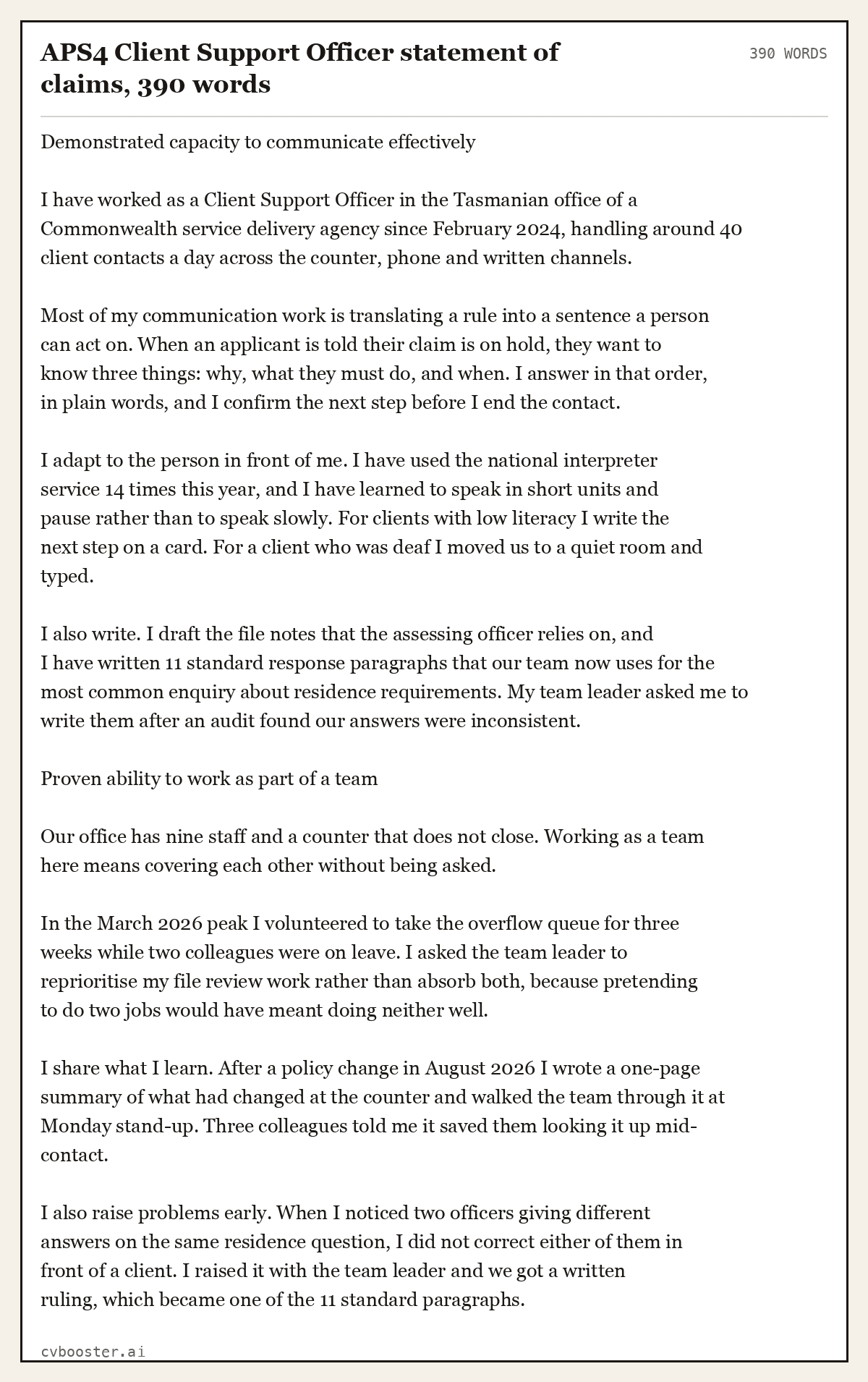
APS4 Client Support Officer statement of claims, 390 words (390 words)
Demonstrated capacity to communicate effectively
I have worked as a Client Support Officer in the Tasmanian office of a Commonwealth service delivery agency since February 2024, handling around 40 client contacts a day across the counter, phone and written channels.
Most of my communication work is translating a rule into a sentence a person can act on. When an applicant is told their claim is on hold, they want to know three things: why, what they must do, and when. I answer in that order, in plain words, and I confirm the next step before I end the contact.
I adapt to the person in front of me. I have used the national interpreter service 14 times this year, and I have learned to speak in short units and pause rather than to speak slowly. For clients with low literacy I write the next step on a card. For a client who was deaf I moved us to a quiet room and typed.
I also write. I draft the file notes that the assessing officer relies on, and I have written 11 standard response paragraphs that our team now uses for the most common enquiry about residence requirements. My team leader asked me to write them after an audit found our answers were inconsistent.
Proven ability to work as part of a team
Our office has nine staff and a counter that does not close. Working as a team here means covering each other without being asked.
In the March 2026 peak I volunteered to take the overflow queue for three weeks while two colleagues were on leave. I asked the team leader to reprioritise my file review work rather than absorb both, because pretending to do two jobs would have meant doing neither well.
I share what I learn. After a policy change in August 2026 I wrote a one-page summary of what had changed at the counter and walked the team through it at Monday stand-up. Three colleagues told me it saved them looking it up mid-contact.
I also raise problems early. When I noticed two officers giving different answers on the same residence question, I did not correct either of them in front of a client. I raised it with the team leader and we got a written ruling, which became one of the 11 standard paragraphs.
What the sifter is scoring
- Criterion quoted (APSC, Cracking the code): "demonstrated capacity to communicate effectively". Where the statement shows it: the three-part answer to a client on hold, the interpreter service, the card, and the 11 written paragraphs.
- Criterion quoted (APSC, Cracking the code): "proven ability to work as part of a team". Where the statement shows it: the three-week overflow queue, the Monday stand-up summary, and the way the disagreement was handled.
- APSC instruction quoted: "Where possible use actual, specific examples of what you have done, how well you did it, what you achieved, and how it relates to the requirements of the job." Where the statement shows it: every paragraph carries a date, a number or a named output.
- APS Value quoted: "Committed to service. The APS is professional, objective, innovative and efficient, and works collaboratively to achieve the best results for the Australian community and the government." Where the statement shows it: reprioritising rather than quietly dropping the file review work.
APS5 statement of claims, 500 words
For a fictional APS5 Program Officer role administering a grants program, against three criteria: good organisational and administrative skills, well-developed customer service skills, and proven ability to manage projects.
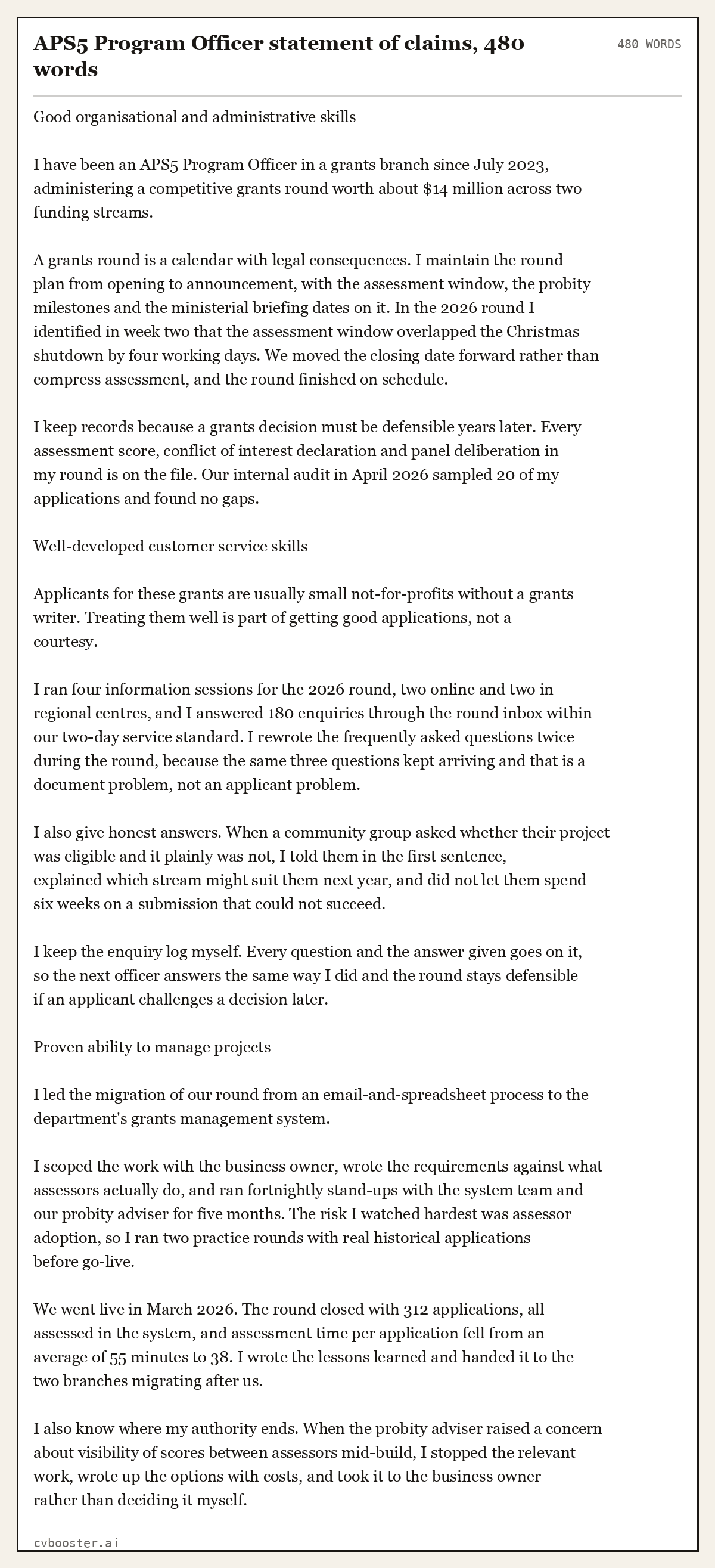
APS5 Program Officer statement of claims, 480 words (480 words)
Good organisational and administrative skills
I have been an APS5 Program Officer in a grants branch since July 2023, administering a competitive grants round worth about $14 million across two funding streams.
A grants round is a calendar with legal consequences. I maintain the round plan from opening to announcement, with the assessment window, the probity milestones and the ministerial briefing dates on it. In the 2026 round I identified in week two that the assessment window overlapped the Christmas shutdown by four working days. We moved the closing date forward rather than compress assessment, and the round finished on schedule.
I keep records because a grants decision must be defensible years later. Every assessment score, conflict of interest declaration and panel deliberation in my round is on the file. Our internal audit in April 2026 sampled 20 of my applications and found no gaps.
Well-developed customer service skills
Applicants for these grants are usually small not-for-profits without a grants writer. Treating them well is part of getting good applications, not a courtesy.
I ran four information sessions for the 2026 round, two online and two in regional centres, and I answered 180 enquiries through the round inbox within our two-day service standard. I rewrote the frequently asked questions twice during the round, because the same three questions kept arriving and that is a document problem, not an applicant problem.
I also give honest answers. When a community group asked whether their project was eligible and it plainly was not, I told them in the first sentence, explained which stream might suit them next year, and did not let them spend six weeks on a submission that could not succeed.
I keep the enquiry log myself. Every question and the answer given goes on it, so the next officer answers the same way I did and the round stays defensible if an applicant challenges a decision later.
Proven ability to manage projects
I led the migration of our round from an email-and-spreadsheet process to the department's grants management system.
I scoped the work with the business owner, wrote the requirements against what assessors actually do, and ran fortnightly stand-ups with the system team and our probity adviser for five months. The risk I watched hardest was assessor adoption, so I ran two practice rounds with real historical applications before go-live.
We went live in March 2026. The round closed with 312 applications, all assessed in the system, and assessment time per application fell from an average of 55 minutes to 38. I wrote the lessons learned and handed it to the two branches migrating after us.
I also know where my authority ends. When the probity adviser raised a concern about visibility of scores between assessors mid-build, I stopped the relevant work, wrote up the options with costs, and took it to the business owner rather than deciding it myself.
What the sifter is scoring
- Criterion quoted (APSC, Cracking the code): "good organisational and administrative skills". Where the statement shows it: the round plan, the shutdown clash found in week two, and the clean audit sample.
- Criterion quoted (APSC, Cracking the code): "well-developed customer service skills". Where the statement shows it: four information sessions, 180 enquiries inside the service standard, and the honest eligibility answer.
- Criterion quoted (APSC, Cracking the code): "proven ability to manage projects". Where the statement shows it: scope, stakeholders, the named risk, the go-live date and the before and after numbers.
- APS Value quoted: "Accountable. The APS is open and accountable to the Australian community under the law and within the framework of Ministerial responsibility." Where the statement shows it: records kept so a decision is defensible, and the probity escalation.
APS6 statement of claims, 600 words
For a fictional APS6 Team Leader role in a policy and reporting area, against four criteria: demonstrated capacity to communicate effectively, proven ability to manage projects, proven ability to work as part of a team, and good organisational and administrative skills.
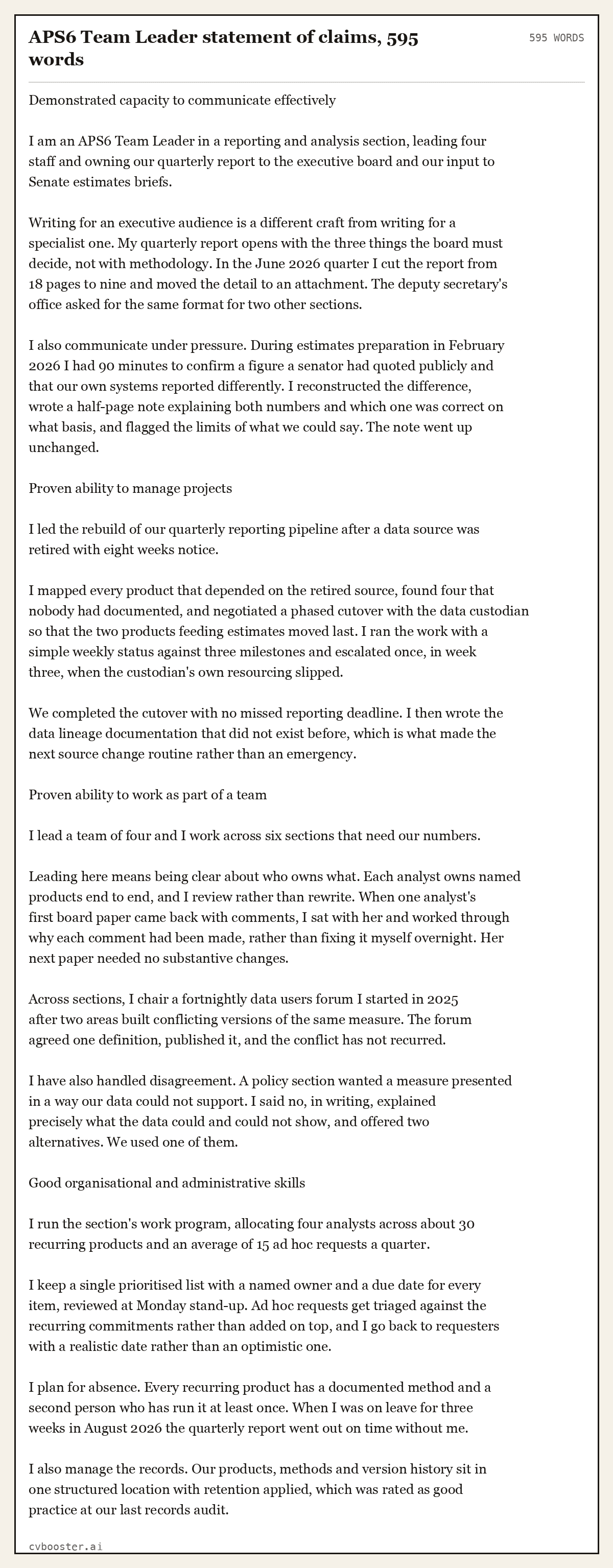
APS6 Team Leader statement of claims, 595 words (595 words)
Demonstrated capacity to communicate effectively
I am an APS6 Team Leader in a reporting and analysis section, leading four staff and owning our quarterly report to the executive board and our input to Senate estimates briefs.
Writing for an executive audience is a different craft from writing for a specialist one. My quarterly report opens with the three things the board must decide, not with methodology. In the June 2026 quarter I cut the report from 18 pages to nine and moved the detail to an attachment. The deputy secretary's office asked for the same format for two other sections.
I also communicate under pressure. During estimates preparation in February 2026 I had 90 minutes to confirm a figure a senator had quoted publicly and that our own systems reported differently. I reconstructed the difference, wrote a half-page note explaining both numbers and which one was correct on what basis, and flagged the limits of what we could say. The note went up unchanged.
Proven ability to manage projects
I led the rebuild of our quarterly reporting pipeline after a data source was retired with eight weeks notice.
I mapped every product that depended on the retired source, found four that nobody had documented, and negotiated a phased cutover with the data custodian so that the two products feeding estimates moved last. I ran the work with a simple weekly status against three milestones and escalated once, in week three, when the custodian's own resourcing slipped.
We completed the cutover with no missed reporting deadline. I then wrote the data lineage documentation that did not exist before, which is what made the next source change routine rather than an emergency.
Proven ability to work as part of a team
I lead a team of four and I work across six sections that need our numbers.
Leading here means being clear about who owns what. Each analyst owns named products end to end, and I review rather than rewrite. When one analyst's first board paper came back with comments, I sat with her and worked through why each comment had been made, rather than fixing it myself overnight. Her next paper needed no substantive changes.
Across sections, I chair a fortnightly data users forum I started in 2025 after two areas built conflicting versions of the same measure. The forum agreed one definition, published it, and the conflict has not recurred.
I have also handled disagreement. A policy section wanted a measure presented in a way our data could not support. I said no, in writing, explained precisely what the data could and could not show, and offered two alternatives. We used one of them.
Good organisational and administrative skills
I run the section's work program, allocating four analysts across about 30 recurring products and an average of 15 ad hoc requests a quarter.
I keep a single prioritised list with a named owner and a due date for every item, reviewed at Monday stand-up. Ad hoc requests get triaged against the recurring commitments rather than added on top, and I go back to requesters with a realistic date rather than an optimistic one.
I plan for absence. Every recurring product has a documented method and a second person who has run it at least once. When I was on leave for three weeks in August 2026 the quarterly report went out on time without me.
I also manage the records. Our products, methods and version history sit in one structured location with retention applied, which was rated as good practice at our last records audit.
What the sifter is scoring
- Criterion quoted (APSC, Cracking the code): "demonstrated capacity to communicate effectively". Where the statement shows it: the 18 pages cut to nine, and the half-page estimates note written in 90 minutes.
- Criterion quoted (APSC, Cracking the code): "proven ability to manage projects". Where the statement shows it: the dependency map, the phased cutover, the single escalation and the documentation left behind.
- Criterion quoted (APSC, Cracking the code): "proven ability to work as part of a team". Where the statement shows it: coaching rather than rewriting, the data users forum, and the refusal handled in writing with alternatives.
- Criterion quoted (APSC, Cracking the code): "good organisational and administrative skills". Where the statement shows it: one prioritised list, triage of ad hoc work, documented methods and a clean records audit.
- APS Value quoted: "Impartial. The APS is apolitical and provides the government with advice that is frank, honest, timely and based on the best available evidence." Where the statement shows it: refusing a presentation the data could not support, and flagging the limits of the estimates figure.
What changes between APS4, APS5 and APS6
The Integrated Leadership System explains why the same criterion reads differently at each level. The APSC states: "The Pathway is a cumulative model, with behaviours identified at one level becoming the 'floor level' for the levels above." It also says the descriptions are "level specific rather than job specific".
The table below is not official wording. It describes what the three statements above actually do differently, so you can test your own draft.
| Criterion | APS4 evidence | APS5 evidence | APS6 evidence |
|---|---|---|---|
| Communicate effectively | Adapts to one person in front of you | Explains a process to a group of applicants | Reframes what an executive audience needs to decide |
| Manage projects | Handles a task inside someone else's plan | Owns a defined project with stakeholders and a go-live | Owns a project with dependencies, escalation and handover |
| Work as part of a team | Covers colleagues and shares what you learn | Coordinates across a panel and an external adviser | Leads people and negotiates across sections |
| Organisational skills | Manages your own queue and records | Runs a calendar with legal consequences | Runs a work program with capacity and succession |
Tip: if your APS6 draft reads like a very good APS5 draft, the missing ingredient is usually other people. Name who you led, who you negotiated with and what you handed over.
The sentences that lose you the shortlist
| Before | After |
|---|---|
| "I have excellent written and verbal communication skills and can tailor my message to any audience." | "I cut the quarterly report from 18 pages to nine and moved the detail to an attachment. Two other sections adopted the format." |
| "I am highly organised and able to manage competing priorities in a fast-paced environment." | "Ad hoc requests are triaged against the recurring commitments, and I go back to requesters with a realistic date." |
| "I am a strong team player who always supports my colleagues." | "I took the overflow queue for three weeks and asked my team leader to reprioritise my file review work." |
| "I have extensive experience managing complex projects from start to finish." | "The source was retired with eight weeks notice. I mapped every dependent product, found four nobody had documented, and moved the estimates products last." |
The APSC says it directly: "Be clear and to the point" and "Don't write lengthy responses". A claim without an example is a sentence the panel cannot score.
Before you submit
- Check the word or page limit in the advert and stay inside it. The APSC treats this as a rule, not a preference.
- Use the criteria as headings if the advert lists them separately. Use one flowing statement if it asks for a pitch.
- Choose few examples, not many. The APSC says: "Remember to use only one or two of your strongest examples to respond to the selection criteria."
- Do not repeat your resume. The APSC says to avoid duplicating "information that can already be found in your CV".
- Structure each example so the reader can find the result. The APSC's own STAR wording is: "Results - What did you achieve? What was the end result and how does it relate to the job you are applying for?"
- Read the APS Values once before you submit, and check that nothing in your statement contradicts them.
- If the advert asks for a pitch instead, the format changes. See the APS one page pitch example.
- For criterion-by-criterion drafting, use the addressing selection criteria STAR examples, and prepare the same examples for the competency based interview questions.
Frequently asked questions
What is a statement of claims in a job application?
A statement of claims is a written document setting out how your skills, abilities and experience meet the requirements of a specific job. The APSC describes it as "a statement or 'pitch' about how your skills, abilities and experience meet the job requirements". It is assessed on merit alongside your resume, and it is usually what decides whether you are shortlisted.
How to write a strong supporting statement?
Answer the criteria in the advert's own order, with one or two strong examples rather than many weak ones. Give the situation, your task, what you did and the result, which is the STAR model the APSC publishes. Put a date, a number or a named output in every paragraph. Stay inside the word limit and cut every sentence that only describes your character.
What is a good professional statement?
A good professional statement is specific, honest and scoped to the job advertised. It shows what you did rather than what you value, it names the outcome, and it does not repeat your resume. The APSC's own advice is to "be clear and to the point", "be honest and factual" and "use relevant examples". If a panel cannot point to the sentence that meets a criterion, the statement has failed.
What are the three golden rules in writing the cover letter?
Answer the advert, evidence every claim, and respect the limit. The APSC's Do list is short: be clear and to the point, be honest and factual, check what form your written example should be in, use relevant examples, and provide all the information requested. Its Don't list is shorter still: do not write lengthy responses, and do not rely just on your resume.
Do all APS jobs still require a statement of claims?
No. The APSC notes that "long and complicated selection criteria are becoming a thing of the past" and that "many agencies now only want to see your CV and a one or two page document that sets out how your skills, abilities and experience fit the job". Read the information pack for the job you want, and ring the contact officer if it is unclear.
Related articles
- Selection Criteria Examples: 10 Full 250-Word Responses
- Selection Criteria Examples Administration: 3 Answers
- How to Address Selection Criteria: 6 Worked STAR Examples
- APS Pitch Example: One Page at APS4, Two Pages at EL1
More articles
- How to Make an ATS-Friendly Resume: Complete Guide
- ATS Resume 2026: How to Get Past the Screener
- 10 ATS Resume Tips That Actually Work
Looking for a worked example for your job title? Browse the resume examples by job title.