APS Pitch Example: One Page at APS4, Two Pages at EL1
By Mustafa Tarabya, founder of CVBooster · Published · Updated
15 min read
Two complete pitches are below: a one page APS4 pitch of about 500 words and a two page Executive Level 1 pitch of about 900 words, both written for the same fictional candidate. Length is set by the advert, and the page count you are given is also a signal about the level of judgement the panel expects to read. The wording assessed against here is quoted from the Australian Public Service Commission's Cracking the code and from its Integrated Leadership System page. Each pitch is annotated capability by capability, and four weak sentences are rewritten near the end. Written by Mustafa Tarabya, who hired for his own company, read every application himself and now writes CVBooster's guides. Checked September 2026.
What a pitch is, in the APSC's own words
A pitch replaces a set of criterion boxes with one piece of continuous writing. The Cracking the code guidance on applying for an APS job sets out what it is for.
Quoted: "Your pitch is a chance to tell the agency why you are the right person for the job." (APSC)
The same page lists what an agency is trying to learn from it: "why you want to work for them, why you are interested in that particular role, what you can offer, and how your skills, knowledge, experience and qualifications are applicable to the job."
It also sets the boundary with your resume: "Try not to duplicate information that can already be found in your CV, but do highlight any specific examples or achievements that will demonstrate your ability to perform the role."
So a pitch is evidence, not a covering note. Warmth, enthusiasm and admiration for the agency are unscoreable, because a merit process can only compare candidates on the work related qualities the panel published before it opened a single application.
APS4 one page pitch, annotated
Written for a fictional APS4 Compliance Officer vacancy in a Commonwealth regulator, where the advert asks for a one page pitch against four capabilities named in the candidate pack.
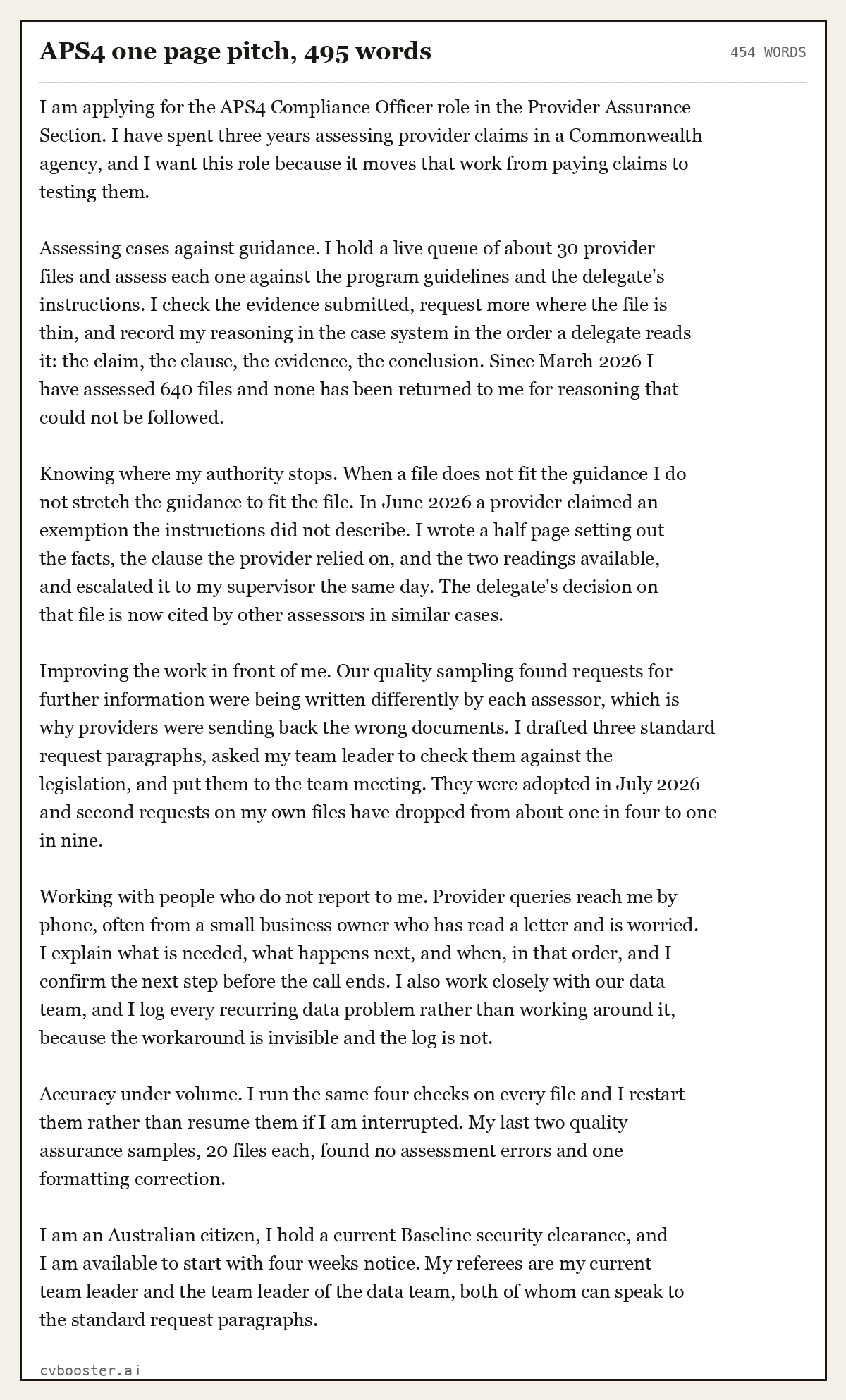
APS4 one page pitch, 495 words (454 words)
I am applying for the APS4 Compliance Officer role in the Provider Assurance Section. I have spent three years assessing provider claims in a Commonwealth agency, and I want this role because it moves that work from paying claims to testing them.
Assessing cases against guidance. I hold a live queue of about 30 provider files and assess each one against the program guidelines and the delegate's instructions. I check the evidence submitted, request more where the file is thin, and record my reasoning in the case system in the order a delegate reads it: the claim, the clause, the evidence, the conclusion. Since March 2026 I have assessed 640 files and none has been returned to me for reasoning that could not be followed.
Knowing where my authority stops. When a file does not fit the guidance I do not stretch the guidance to fit the file. In June 2026 a provider claimed an exemption the instructions did not describe. I wrote a half page setting out the facts, the clause the provider relied on, and the two readings available, and escalated it to my supervisor the same day. The delegate's decision on that file is now cited by other assessors in similar cases.
Improving the work in front of me. Our quality sampling found requests for further information were being written differently by each assessor, which is why providers were sending back the wrong documents. I drafted three standard request paragraphs, asked my team leader to check them against the legislation, and put them to the team meeting. They were adopted in July 2026 and second requests on my own files have dropped from about one in four to one in nine.
Working with people who do not report to me. Provider queries reach me by phone, often from a small business owner who has read a letter and is worried. I explain what is needed, what happens next, and when, in that order, and I confirm the next step before the call ends. I also work closely with our data team, and I log every recurring data problem rather than working around it, because the workaround is invisible and the log is not.
Accuracy under volume. I run the same four checks on every file and I restart them rather than resume them if I am interrupted. My last two quality assurance samples, 20 files each, found no assessment errors and one formatting correction.
I am an Australian citizen, I hold a current Baseline security clearance, and I am available to start with four weeks notice. My referees are my current team leader and the team leader of the data team, both of whom can speak to the standard request paragraphs.
What the sifter is scoring
- APSC instruction quoted: "Your pitch is a chance to tell the agency why you are the right person for the job." Where the pitch shows it: the first paragraph names the section and gives a reason for this role rather than any role.
- APSC instruction quoted: "Try not to duplicate information that can already be found in your CV, but do highlight any specific examples or achievements that will demonstrate your ability to perform the role." Where the pitch shows it: no employment history is restated, and every paragraph carries a date, a count or a named output.
- ILS wording quoted: "Layers of complexity" (APSC, Integrated Leadership System), which is what the Pathway calls the thing that changes as roles change. Where the pitch sits: the candidate applies guidance and escalates what falls outside it, which is the APS4 layer.
- What lifts the score: the escalation paragraph. A panel reads a candidate who names the limits of their delegation as one who can be trusted with a queue.
The page limit tells you the level
One page is roughly 500 words at a readable font. Two pages is roughly 900 to 1,000. That budget forces a choice, and the choice is the test.
| Element | One page, APS4 | Two pages, EL1 |
|---|---|---|
| Opening placement | Two lines | Three to four lines |
| Evidence paragraphs | Four, about 100 words each | Five or six, 130 to 160 words each |
| Decisions you made alone | One | Three or more |
| People and money named | Your own queue | A team, a budget, a risk you accepted |
| Closing | One line on availability | Two lines on availability and clearance |
Tip: write to the smaller number first. A 900 word draft cut to 500 keeps the judgement and loses the throat clearing, while a 500 word draft padded to 900 keeps the padding.
EL1 two page pitch, annotated
The same candidate, six years later, applying for a fictional EL1 Assistant Director role leading a compliance team. The advert asks for a two page pitch.
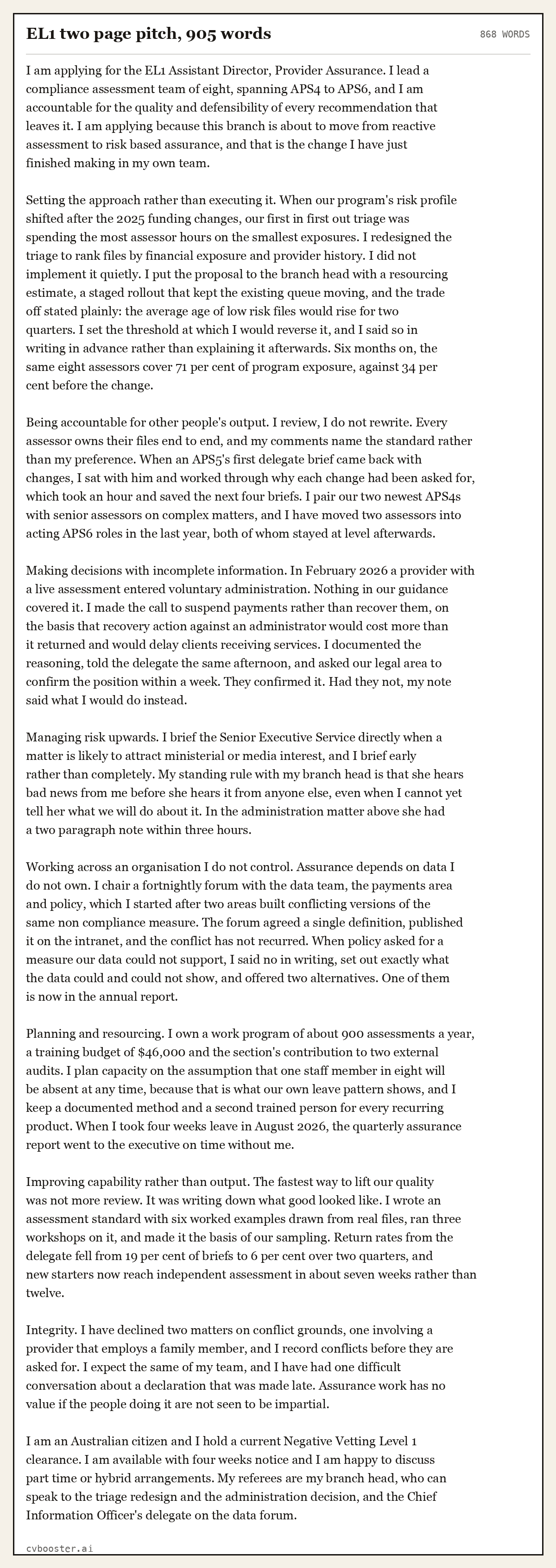
EL1 two page pitch, 905 words (868 words)
I am applying for the EL1 Assistant Director, Provider Assurance. I lead a compliance assessment team of eight, spanning APS4 to APS6, and I am accountable for the quality and defensibility of every recommendation that leaves it. I am applying because this branch is about to move from reactive assessment to risk based assurance, and that is the change I have just finished making in my own team.
Setting the approach rather than executing it. When our program's risk profile shifted after the 2025 funding changes, our first in first out triage was spending the most assessor hours on the smallest exposures. I redesigned the triage to rank files by financial exposure and provider history. I did not implement it quietly. I put the proposal to the branch head with a resourcing estimate, a staged rollout that kept the existing queue moving, and the trade off stated plainly: the average age of low risk files would rise for two quarters. I set the threshold at which I would reverse it, and I said so in writing in advance rather than explaining it afterwards. Six months on, the same eight assessors cover 71 per cent of program exposure, against 34 per cent before the change.
Being accountable for other people's output. I review, I do not rewrite. Every assessor owns their files end to end, and my comments name the standard rather than my preference. When an APS5's first delegate brief came back with changes, I sat with him and worked through why each change had been asked for, which took an hour and saved the next four briefs. I pair our two newest APS4s with senior assessors on complex matters, and I have moved two assessors into acting APS6 roles in the last year, both of whom stayed at level afterwards.
Making decisions with incomplete information. In February 2026 a provider with a live assessment entered voluntary administration. Nothing in our guidance covered it. I made the call to suspend payments rather than recover them, on the basis that recovery action against an administrator would cost more than it returned and would delay clients receiving services. I documented the reasoning, told the delegate the same afternoon, and asked our legal area to confirm the position within a week. They confirmed it. Had they not, my note said what I would do instead.
Managing risk upwards. I brief the Senior Executive Service directly when a matter is likely to attract ministerial or media interest, and I brief early rather than completely. My standing rule with my branch head is that she hears bad news from me before she hears it from anyone else, even when I cannot yet tell her what we will do about it. In the administration matter above she had a two paragraph note within three hours.
Working across an organisation I do not control. Assurance depends on data I do not own. I chair a fortnightly forum with the data team, the payments area and policy, which I started after two areas built conflicting versions of the same non compliance measure. The forum agreed a single definition, published it on the intranet, and the conflict has not recurred. When policy asked for a measure our data could not support, I said no in writing, set out exactly what the data could and could not show, and offered two alternatives. One of them is now in the annual report.
Planning and resourcing. I own a work program of about 900 assessments a year, a training budget of $46,000 and the section's contribution to two external audits. I plan capacity on the assumption that one staff member in eight will be absent at any time, because that is what our own leave pattern shows, and I keep a documented method and a second trained person for every recurring product. When I took four weeks leave in August 2026, the quarterly assurance report went to the executive on time without me.
Improving capability rather than output. The fastest way to lift our quality was not more review. It was writing down what good looked like. I wrote an assessment standard with six worked examples drawn from real files, ran three workshops on it, and made it the basis of our sampling. Return rates from the delegate fell from 19 per cent of briefs to 6 per cent over two quarters, and new starters now reach independent assessment in about seven weeks rather than twelve.
Integrity. I have declined two matters on conflict grounds, one involving a provider that employs a family member, and I record conflicts before they are asked for. I expect the same of my team, and I have had one difficult conversation about a declaration that was made late. Assurance work has no value if the people doing it are not seen to be impartial.
I am an Australian citizen and I hold a current Negative Vetting Level 1 clearance. I am available with four weeks notice and I am happy to discuss part time or hybrid arrangements. My referees are my branch head, who can speak to the triage redesign and the administration decision, and the Chief Information Officer's delegate on the data forum.
What the sifter is scoring
- ILS wording quoted: critical transition points "have been identified for each capability across the various levels and are points where new behaviours have been introduced" (APSC, Integrated Leadership System). Where the pitch shows the transition: the candidate now sets triage policy, accepts a named trade off, and is accountable for other people's work.
- ILS wording quoted: "The ILS is based on and expands the SELC framework around five core capability clusters" (APSC). Where the pitch shows the clusters: strategic thinking in the triage redesign, results in the exposure figures, relationships in the cross area forum, personal drive in the conflict declarations, and influence in the refusal offered with alternatives.
- APSC instruction quoted: "Be clear and to the point." Where the pitch shows it: every paragraph opens with the claim in bold and then spends its words on evidence.
- What lifts the score: the sentence about hearing bad news first. It is the clearest available evidence that the candidate can be trusted with a team and an SES relationship.
What changed between the APS4 and the EL1 pitch
The underlying person is the same. Four things moved, and they are the four things a panel is reading for.
- The size of the decision. Escalating an exemption became suspending payments during an administration.
- Who was affected. A file became a program, a team and a provider's clients.
- Where the words went. The APS4 pitch spends its budget on method. The EL1 pitch spends it on choices, including one that could have gone wrong.
- What is admitted. The EL1 pitch names a trade off and a reversal threshold. An EL1 pitch with no difficult call in it reads as an APS6 who has not yet been asked to decide anything.
The sentences that read as the wrong level
Four pairs below, each rewriting a real sentence without adding a single new fact.
- Before: "I am passionate about serving the Australian community and would welcome the opportunity to contribute." After: "I want this role because the branch is moving to risk based assurance, which is the change I have just made in my own team."
- Before: "We successfully implemented a new triage process that improved efficiency." After: "I proposed the triage change with a resourcing estimate and a stated trade off, and set the threshold at which I would reverse it."
- Before: "I have extensive stakeholder engagement experience across multiple business areas." After: "Policy asked for a measure the data could not support. I said no in writing and offered two alternatives, and one is in the annual report."
- Before: "I am highly organised and able to work under pressure with minimal supervision." After: "I plan capacity on one absence in eight, and the quarterly report went out on time while I was on four weeks leave."
Jobs and Skills WA makes the same point about evidence in Responding to selection criteria: "If you are to make statements like 'I am well versed in the provision of superior administrative support', then be prepared to back this up with actual examples of times you have demonstrated this, including the outcomes."
Before you submit
- Count the words against the page limit before you polish the prose.
- Use the candidate pack's own capability headings in the pack's order, so a panel scoring with the pack open can find each one.
- Put one decision you made without being told what to do into every pitch above APS4.
- Name citizenship, clearance and availability once, at the end, and nowhere else.
- Read the Integrated Leadership System profile for the level above yours to see what you are not yet claiming.
- If the advert asks for separate criterion responses instead, the shape changes. Use the APS statement of claims example.
- For criterion drafting method, see addressing selection criteria, and for administration roles see the administration selection criteria examples.
Frequently asked questions
What is a one page pitch for an APS job?
A one page pitch is a single continuous statement, usually about 500 words, saying how your skills, abilities and experience meet the job. The APSC describes it as a chance to tell the agency why you are the right person for the job, covering what you can offer and why this role. It is assessed on merit alongside your resume and it replaces separate criterion responses.
How do you write an APS pitch?
Write one short paragraph per capability in the candidate pack, in the pack's order, each carrying a situation, what you personally decided or did, and a result with a number or a date attached. Open with two lines placing yourself and why this role. Close with citizenship, clearance and availability. Do not repeat your resume, and do not spend a line on enthusiasm.
How long should an APS pitch be?
As long as the advert says and no longer. One page is about 500 words and two pages about 900 to 1,000. The APSC treats the limit as a rule, asking applicants to check whether the agency wants a one or two page pitch or a set word count. Some agencies instead use response boxes with character limits, which are counted by the system rather than by you.
What is the difference between a pitch and a statement of claims?
A pitch is one flowing statement covering the whole role. A statement of claims answers each published criterion under its own heading. The APSC notes that long and complicated selection criteria are becoming a thing of the past, and that many agencies now want only a CV and a one or two page document. The evidence is the same either way; only the packaging changes.
What are some good pitch examples?
A good APS pitch example is one written at the level you are applying for, with a decision in it. The APS4 pitch above is strong because it shows a file escalated rather than stretched to fit the guidance. The EL1 pitch is strong because it names a trade off, a reversal threshold and a conversation the candidate started before the news got worse. Copy the structure, never the content.
How to pitch yourself examples?
Open with two lines saying who you are and why this role, then give one short paragraph per capability in the candidate pack, each carrying a situation, your own decision and a result with a number attached. Close with citizenship, clearance and availability. Everything else is decoration. A panel scoring twelve applications needs to find your evidence for each capability without hunting for it.
Does the pitch replace a cover letter?
Usually yes. Where a pack asks for a pitch, that document is your written application and a separate covering letter adds nothing a panel can score. Read the pack literally, because some agencies ask for a covering letter, a pitch and a resume as three files, and an application missing a requested document can be set aside before it is assessed.
More in this series: Australian Public Service applications
- APS Statement of Claims Example: APS4, APS5 and APS6
- Attention to Detail Selection Criteria Examples: 4 Answers
- How to Address Selection Criteria: 6 Worked STAR Examples
- Selection Criteria Examples Administration: 3 Answers
- Selection Criteria Examples Nursing: 3 Full Responses
- Selection Criteria Examples Teaching: 3 Full Responses
- Selection Criteria Examples: 10 Full 250-Word Responses
Related articles
- APS Statement of Claims Example: APS4, APS5 and APS6
- Selection Criteria Examples Administration: 3 Answers
- Attention to Detail Selection Criteria Examples: 4 Answers
- Selection Criteria Examples: 10 Full 250-Word Responses
More articles
- How to Make an ATS-Friendly Resume: Complete Guide
- ATS Resume: how to get past the screener, in its own words