Selection Criteria Examples Administration: 3 Answers
By Mustafa Tarabya, founder of CVBooster · Published · Updated
12 min read
Three complete administration selection criteria responses are below, at 250 words for an APS3 administration officer, 400 words for an APS4 administration officer and 500 words for an APS5 executive assistant. Administration criteria are won on system rather than on effort, so each answer names a process the applicant runs and what it caught. The criterion wording is quoted from the Australian Public Service Commission's Cracking the code and from a Victorian government education support advert. The annotation under each answer names the criterion it meets, and three unscoreable sentences are rebuilt further down. Written by Mustafa Tarabya, who hired for his own company, read every application himself and now writes CVBooster's guides. Checked September 2026.
The criteria administration adverts actually use
Administration roles reuse a small set of published criteria. The APSC lists them in Applying for an APS job: cracking the code, including "good organisational and administrative skills", "well-developed customer service skills" and "demonstrated capacity to communicate effectively".
State school and agency adverts word the same ground differently. The education support advert on careers.vic.gov.au sets SC5 as one of its criteria.
Quoted: "Demonstrated capacity to provide advice and support to management and other school staff in respect to the work area." (careers.vic.gov.au, education support, SC5)
Its SC3 is the communication criterion in an administration setting: "Demonstrated capacity to communicate effectively in a team environment, including high level oral and written communication skills."
The APSC adds the rule that decides whether your answer is read: "Be clear and to the point."
APS3 administration officer, 250 words
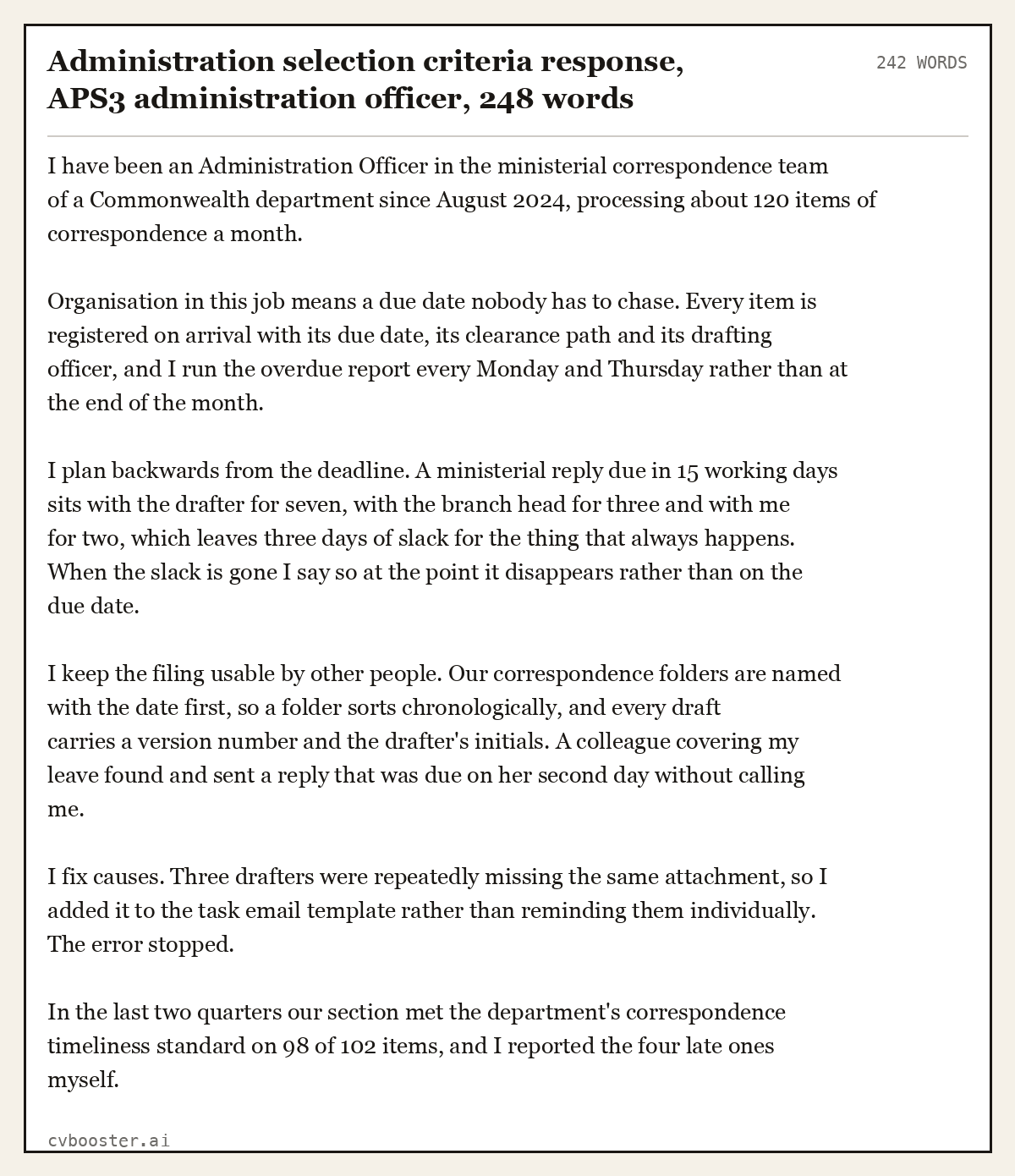
Written for a fictional APS3 Administration Officer role in a ministerial and parliamentary section, against the criterion "good organisational and administrative skills".
Administration selection criteria response, APS3 administration officer, 248 words (242 words)
I have been an Administration Officer in the ministerial correspondence team of a Commonwealth department since August 2024, processing about 120 items of correspondence a month.
Organisation in this job means a due date nobody has to chase. Every item is registered on arrival with its due date, its clearance path and its drafting officer, and I run the overdue report every Monday and Thursday rather than at the end of the month.
I plan backwards from the deadline. A ministerial reply due in 15 working days sits with the drafter for seven, with the branch head for three and with me for two, which leaves three days of slack for the thing that always happens. When the slack is gone I say so at the point it disappears rather than on the due date.
I keep the filing usable by other people. Our correspondence folders are named with the date first, so a folder sorts chronologically, and every draft carries a version number and the drafter's initials. A colleague covering my leave found and sent a reply that was due on her second day without calling me.
I fix causes. Three drafters were repeatedly missing the same attachment, so I added it to the task email template rather than reminding them individually. The error stopped.
In the last two quarters our section met the department's correspondence timeliness standard on 98 of 102 items, and I reported the four late ones myself.
What the sifter is scoring
- Criterion quoted: "good organisational and administrative skills" (APSC, Cracking the code). Where the response shows it: a register with due dates, a twice weekly overdue report, and a backwards plan with named slack.
- APSC instruction quoted: "Be clear and to the point." Where the response shows it: five short paragraphs, each one a system rather than an adjective.
- ILS wording quoted: "Layers of complexity" (APSC, Integrated Leadership System), the Pathway's term for what changes as roles change. Where the response sits: the applicant runs a process and reports exceptions, which is the APS3 layer.
- What lifts the score: reporting the four late items. A panel trusts an applicant who volunteers the number that is not perfect.
APS4 administration officer, 400 words
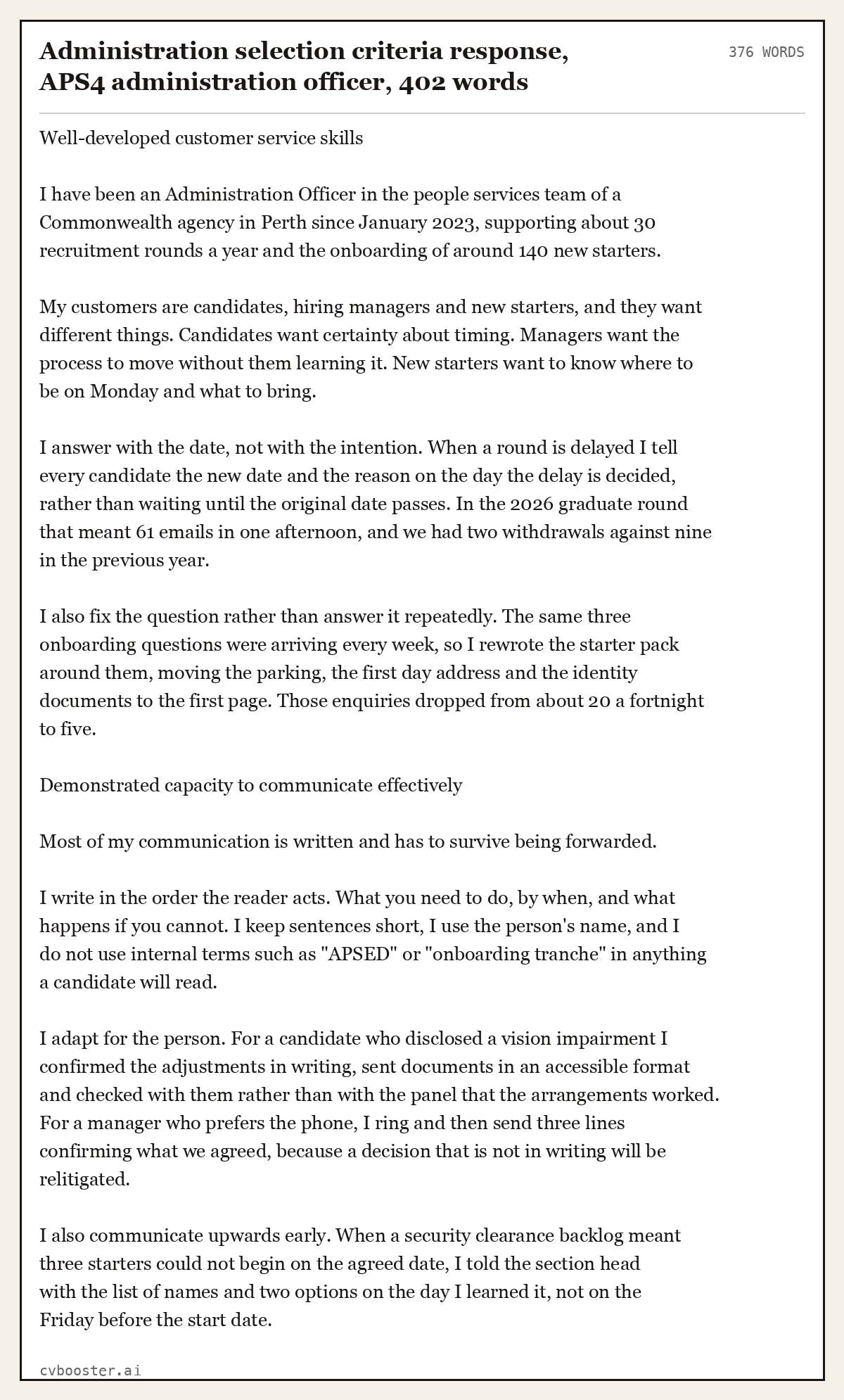
Written for a fictional APS4 Administration Officer role supporting a recruitment and onboarding team, against two criteria: "well-developed customer service skills" and "demonstrated capacity to communicate effectively".
Administration selection criteria response, APS4 administration officer, 402 words (376 words)
Well-developed customer service skills
I have been an Administration Officer in the people services team of a Commonwealth agency in Perth since January 2023, supporting about 30 recruitment rounds a year and the onboarding of around 140 new starters.
My customers are candidates, hiring managers and new starters, and they want different things. Candidates want certainty about timing. Managers want the process to move without them learning it. New starters want to know where to be on Monday and what to bring.
I answer with the date, not with the intention. When a round is delayed I tell every candidate the new date and the reason on the day the delay is decided, rather than waiting until the original date passes. In the 2026 graduate round that meant 61 emails in one afternoon, and we had two withdrawals against nine in the previous year.
I also fix the question rather than answer it repeatedly. The same three onboarding questions were arriving every week, so I rewrote the starter pack around them, moving the parking, the first day address and the identity documents to the first page. Those enquiries dropped from about 20 a fortnight to five.
Demonstrated capacity to communicate effectively
Most of my communication is written and has to survive being forwarded.
I write in the order the reader acts. What you need to do, by when, and what happens if you cannot. I keep sentences short, I use the person's name, and I do not use internal terms such as "APSED" or "onboarding tranche" in anything a candidate will read.
I adapt for the person. For a candidate who disclosed a vision impairment I confirmed the adjustments in writing, sent documents in an accessible format and checked with them rather than with the panel that the arrangements worked. For a manager who prefers the phone, I ring and then send three lines confirming what we agreed, because a decision that is not in writing will be relitigated.
I also communicate upwards early. When a security clearance backlog meant three starters could not begin on the agreed date, I told the section head with the list of names and two options on the day I learned it, not on the Friday before the start date.
What the sifter is scoring
- Criterion quoted: "well-developed customer service skills" (APSC, Cracking the code). Where the response shows it: three customer groups named, a delay communicated on the day it was decided, and a starter pack rewritten around the recurring questions.
- Criterion quoted: "demonstrated capacity to communicate effectively" (APSC, Cracking the code). Where the response shows it: a stated writing order, plain words instead of internal terms, and an adjustment confirmed with the candidate.
- Criterion wording quoted: "Demonstrated capacity to communicate effectively in a team environment, including high level oral and written communication skills." (careers.vic.gov.au, education support, SC3). Where the response shows it: the phone call followed by three lines in writing.
- What lifts the score: the withdrawal numbers. Customer service criteria are usually answered with feelings, and this one is answered with a consequence.
APS5 executive assistant, 500 words
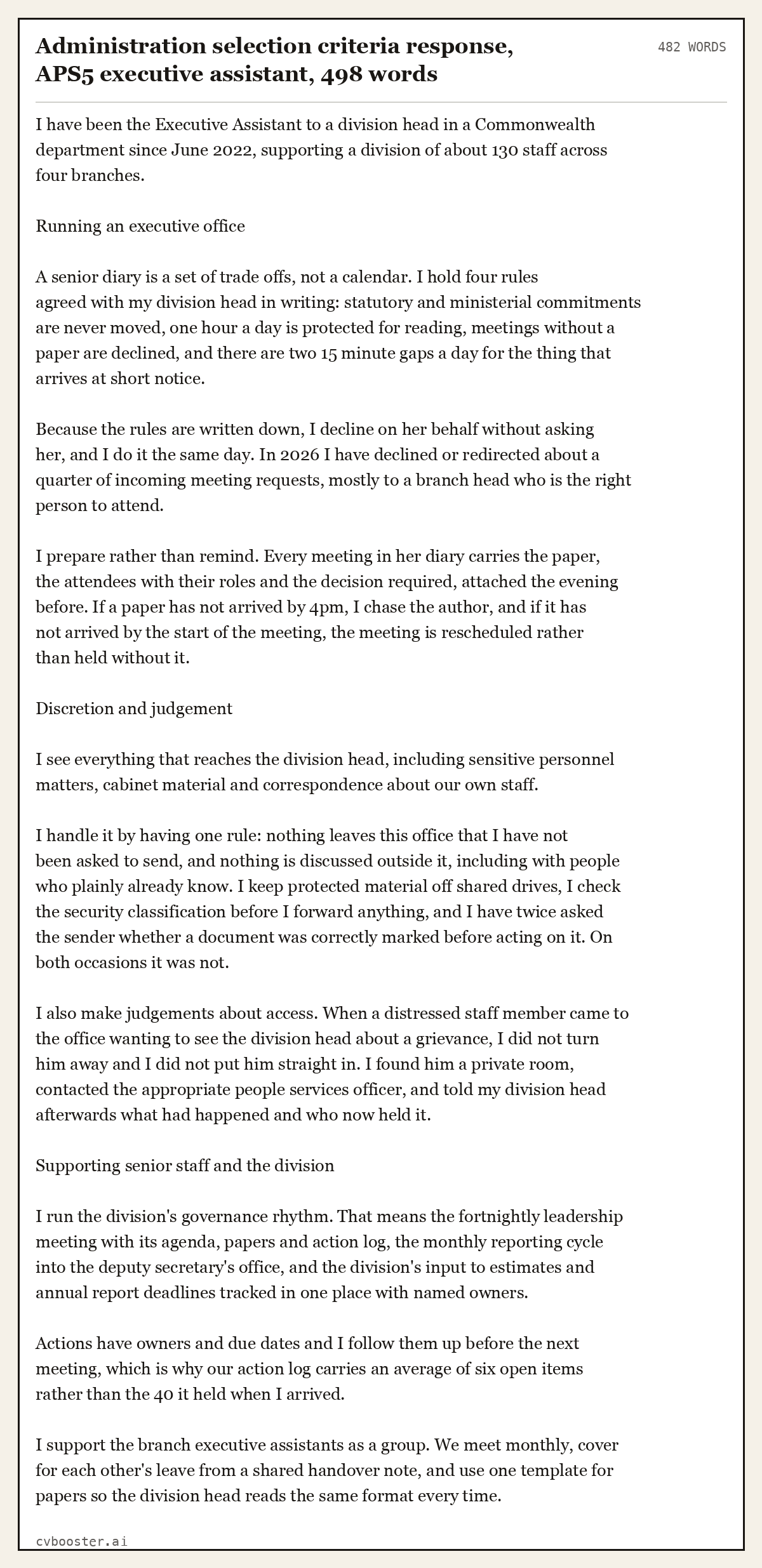
Written for a fictional APS5 Executive Assistant role supporting a First Assistant Secretary, against a three part criterion covering organisational skills, discretion and support to senior staff.
Administration selection criteria response, APS5 executive assistant, 498 words (482 words)
I have been the Executive Assistant to a division head in a Commonwealth department since June 2022, supporting a division of about 130 staff across four branches.
Running an executive office
A senior diary is a set of trade offs, not a calendar. I hold four rules agreed with my division head in writing: statutory and ministerial commitments are never moved, one hour a day is protected for reading, meetings without a paper are declined, and there are two 15 minute gaps a day for the thing that arrives at short notice.
Because the rules are written down, I decline on her behalf without asking her, and I do it the same day. In 2026 I have declined or redirected about a quarter of incoming meeting requests, mostly to a branch head who is the right person to attend.
I prepare rather than remind. Every meeting in her diary carries the paper, the attendees with their roles and the decision required, attached the evening before. If a paper has not arrived by 4pm, I chase the author, and if it has not arrived by the start of the meeting, the meeting is rescheduled rather than held without it.
Discretion and judgement
I see everything that reaches the division head, including sensitive personnel matters, cabinet material and correspondence about our own staff.
I handle it by having one rule: nothing leaves this office that I have not been asked to send, and nothing is discussed outside it, including with people who plainly already know. I keep protected material off shared drives, I check the security classification before I forward anything, and I have twice asked the sender whether a document was correctly marked before acting on it. On both occasions it was not.
I also make judgements about access. When a distressed staff member came to the office wanting to see the division head about a grievance, I did not turn him away and I did not put him straight in. I found him a private room, contacted the appropriate people services officer, and told my division head afterwards what had happened and who now held it.
Supporting senior staff and the division
I run the division's governance rhythm. That means the fortnightly leadership meeting with its agenda, papers and action log, the monthly reporting cycle into the deputy secretary's office, and the division's input to estimates and annual report deadlines tracked in one place with named owners.
Actions have owners and due dates and I follow them up before the next meeting, which is why our action log carries an average of six open items rather than the 40 it held when I arrived.
I support the branch executive assistants as a group. We meet monthly, cover for each other's leave from a shared handover note, and use one template for papers so the division head reads the same format every time.
What the sifter is scoring
- Criterion wording quoted: "Demonstrated capacity to provide advice and support to management and other school staff in respect to the work area." (careers.vic.gov.au, education support, SC5), which is the state sector version of executive support. Where the response shows it: written diary rules, papers attached the night before, and the governance rhythm with an action log.
- Criterion quoted: "good organisational and administrative skills" (APSC, Cracking the code). Where the response shows it: the open action count falling from about 40 to six.
- ILS wording quoted: the Integrated Leadership System says its critical transition points are "points where new behaviours have been introduced" (APSC). The new behaviour here: declining meetings on the executive's behalf under agreed rules, which is judgement rather than task completion.
- What lifts the score at this length: the distressed staff member. It is the only paragraph that shows the applicant deciding something with a person in front of them and a rule that did not cover it.
What changes between APS3, APS4 and APS5
The same work, at three scopes. Test your own draft against this before you send it.
| Criterion | APS3 evidence | APS4 evidence | APS5 evidence |
|---|---|---|---|
| Organising | Runs a register and reports exceptions | Runs a process across several rounds | Sets the rules the process runs on |
| Customer service | Answers the person in front of you | Redesigns the answer so the question stops | Decides who should be answering at all |
| Communication | Writes a clear task email | Writes for candidates and managers differently | Writes on behalf of an executive |
| Judgement | Escalates what is outside the pattern | Raises a problem with options | Acts without asking, inside an agreed boundary |
The sentences that cost marks
Three rewrites using nothing that is not already in the answers above. The South Australian guide, Addressing selection criteria, states the standard plainly: "For each criteria or statement, you are required to provide a response that highlights your skills, and or experience and an example to show your competence or ability to perform the task."
- Before: "I am highly organised and able to prioritise a busy workload to meet deadlines." After: "A reply due in 15 working days is planned backwards with three days of slack, and I say so the day the slack disappears."
- Before: "I provide excellent customer service to internal and external stakeholders at all times." After: "When the graduate round slipped, 61 candidates had the new date that afternoon, and we had two withdrawals against nine the year before."
- Before: "I am trusted with confidential information and exercise a high level of discretion." After: "I checked the classification before forwarding and twice asked the sender whether a document was marked correctly. Twice it was not."
Tip: administration criteria are the easiest to answer with adjectives and the easiest to win with numbers. Every paragraph should carry a count, a date or a rule.
Before you submit
- Use the criterion heading from the advert, including its number, and answer the criteria in order.
- Name a system in every response: a register, a template, a rule, a report.
- Give one thing your system caught, with what would have happened otherwise.
- Match your scope to the level. An APS5 answer that only describes your own queue reads as an APS3.
- Keep inside the word limit, because administration panels notice a candidate who cannot follow the instruction on the form.
- If the advert asks for a pitch rather than criteria, see the APS one page pitch example, and for a criterion by criterion document see the APS statement of claims example.
- For the other criteria in the advert, see selection criteria examples.
Frequently asked questions
What are common selection criteria examples for administration roles?
Administration adverts reuse a small set: organisational and administrative skills, customer service, written and oral communication, attention to detail, teamwork, and knowledge of relevant software or systems. The APSC's published list includes good organisational and administrative skills, well-developed customer service skills and demonstrated capacity to communicate effectively. State adverts add advice and support to management as a separate criterion.
How to write the selection criteria?
Write one response per criterion under the advert's own heading, and lead with the system you run rather than the qualities you have. Give one worked instance with a date and a number, then the result. Keep to the stated limit. A response that could describe any administration officer in the country has not been written for this job.
How do you answer organisational skills selection criteria?
Describe the method, not the pressure. Name how work enters your queue, how it is prioritised, how you track what is due, and what you do when the plan fails. Then give one instance where the method caught something, such as a deadline that would have slipped or a document that was missing. Finish with a figure from a report someone else produces.
What should an executive assistant put in a selection criteria response?
Diary rules agreed with the executive, meeting preparation standards, handling of sensitive material, and the governance rhythm you run. Panels hiring an executive assistant are testing judgement exercised on someone else's behalf, so include one decision you made without asking, inside an agreed boundary, and one occasion where you protected information or access appropriately.
Do I need examples if I have no public sector experience?
Yes, and private sector or volunteer examples count. The criterion asks for evidence of the skill, not evidence of the sector. Describe the register, the reporting rhythm and the customers in the words the advert uses, and translate your job title by naming team size, volume and what you were trusted to decide alone.
More in this series: Australian Public Service applications
- APS Pitch Example: One Page at APS4, Two Pages at EL1
- APS Statement of Claims Example: APS4, APS5 and APS6
- Attention to Detail Selection Criteria Examples: 4 Answers
- How to Address Selection Criteria: 6 Worked STAR Examples
- Selection Criteria Examples Nursing: 3 Full Responses
- Selection Criteria Examples Teaching: 3 Full Responses
- Selection Criteria Examples: 10 Full 250-Word Responses
Related articles
- APS Statement of Claims Example: APS4, APS5 and APS6
- APS Pitch Example: One Page at APS4, Two Pages at EL1
- Attention to Detail Selection Criteria Examples: 4 Answers
- Selection Criteria Examples: 10 Full 250-Word Responses
More articles
- Selection Criteria Examples Nursing: 3 Full Responses
- Selection Criteria Examples Teaching: 3 Full Responses
- Short Cover Letter Examples: Get Hired With Less
Looking for a worked example for your job title? Browse the resume examples by job title.