Attention to Detail Selection Criteria Examples: 4 Answers
By Mustafa Tarabya, founder of CVBooster · Published · Updated
13 min read
Four complete attention to detail selection criteria examples are below, written at 250, 300, 400 and 500 words for an APS3 administration role, a registered nurse, a finance officer and a project support officer. Length is the constraint, because this criterion rewards a described checking method and a described method needs room. The wording assessed against here is quoted from the South Australian public sector criteria list, a Victorian government advert and the Australian Public Service Commission. Each answer is annotated line by line, and four weak sentences are rewritten at the end. Written by Mustafa Tarabya, who hired for his own company, read every application himself and now writes CVBooster's guides. Checked September 2026.
What an assessor is looking for here
Panels score this criterion on your system, not your temperament. The published criterion wording is usually short, so the evidence has to do the work.
Quoted: "accuracy and attention to detail" (iworkfor.SA, Addressing selection criteria, official list of criteria examples)
The same guide sets the standard you are being measured against: "you need to address each criteria to demonstrate specifically how your knowledge, skills and experience make you suitable and capable of fulfilling the requirements of the position."
Jobs and Skills WA names the exact failure this criterion attracts in Responding to selection criteria: "One of the most common mistakes is not giving concrete examples in your responses."
So a scoring answer names the check, names the thing the check caught, and names what would have happened if it had not.
APS3 administration officer, 250 words
Written for a fictional APS3 Administration Officer vacancy in a national regulator, against a criterion worded "accuracy and attention to detail".
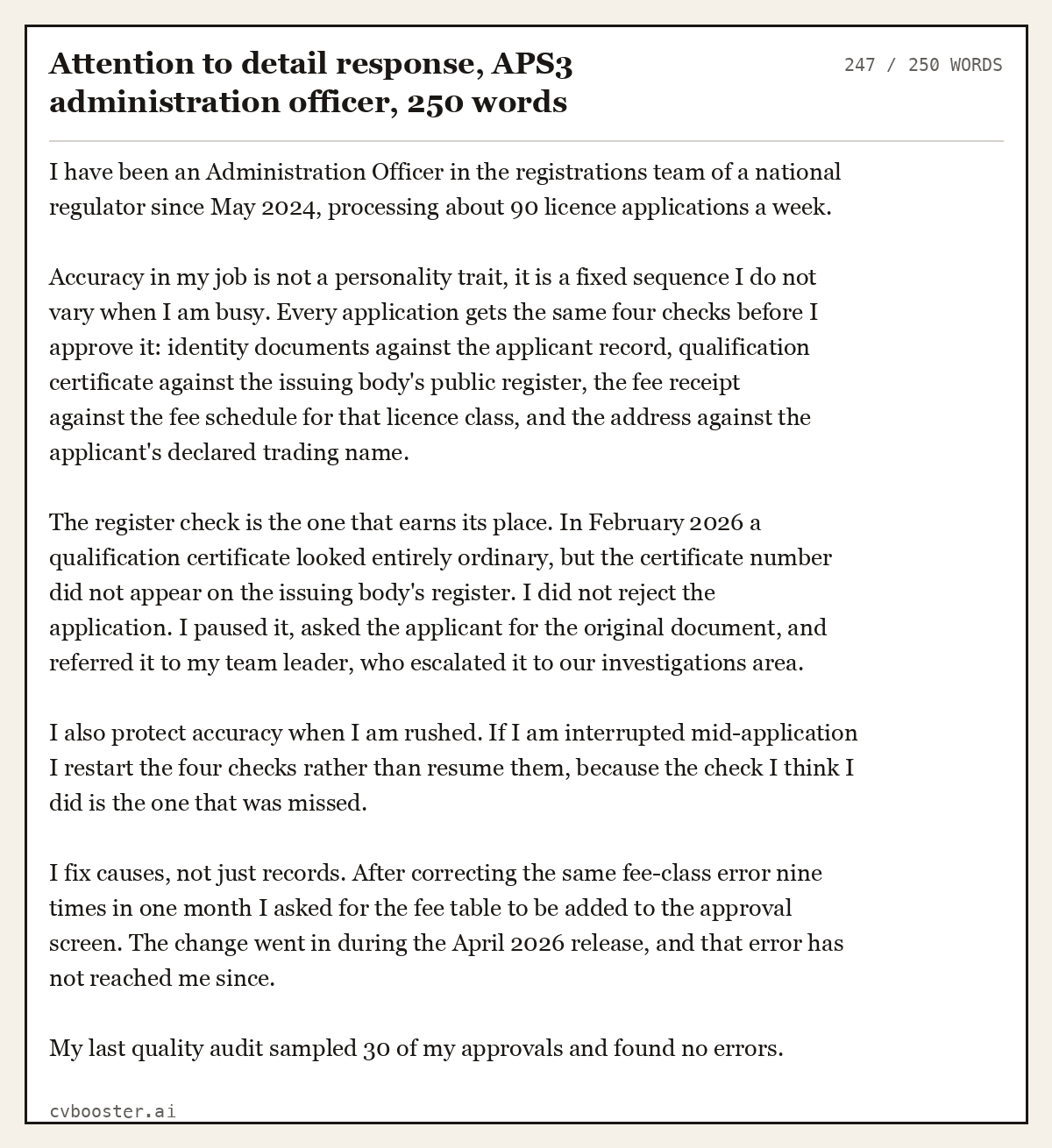
Attention to detail response, APS3 administration officer, 250 words (247 words)
I have been an Administration Officer in the registrations team of a national regulator since May 2024, processing about 90 licence applications a week.
Accuracy in my job is not a personality trait, it is a fixed sequence I do not vary when I am busy. Every application gets the same four checks before I approve it: identity documents against the applicant record, qualification certificate against the issuing body's public register, the fee receipt against the fee schedule for that licence class, and the address against the applicant's declared trading name.
The register check is the one that earns its place. In February 2026 a qualification certificate looked entirely ordinary, but the certificate number did not appear on the issuing body's register. I did not reject the application. I paused it, asked the applicant for the original document, and referred it to my team leader, who escalated it to our investigations area.
I also protect accuracy when I am rushed. If I am interrupted mid-application I restart the four checks rather than resume them, because the check I think I did is the one that was missed.
I fix causes, not just records. After correcting the same fee-class error nine times in one month I asked for the fee table to be added to the approval screen. The change went in during the April 2026 release, and that error has not reached me since.
My last quality audit sampled 30 of my approvals and found no errors.
What the sifter is scoring
- Criterion wording quoted: "accuracy and attention to detail" (iworkfor.SA). Evidence offered: four named checks, run in the same order every time.
- Official instruction quoted: "Share what you did about the challenge" (JobAccess). Evidence offered: pausing the application and referring it, rather than rejecting it alone.
- What lifts the score: the restart rule after an interruption. It shows the applicant knows where their own accuracy breaks down.
Registered nurse, 300 words
Written for a fictional Registered Nurse Level 1 position on a surgical ward. The criterion is the clinical version of "accuracy and attention to detail", covering documentation and medication administration.
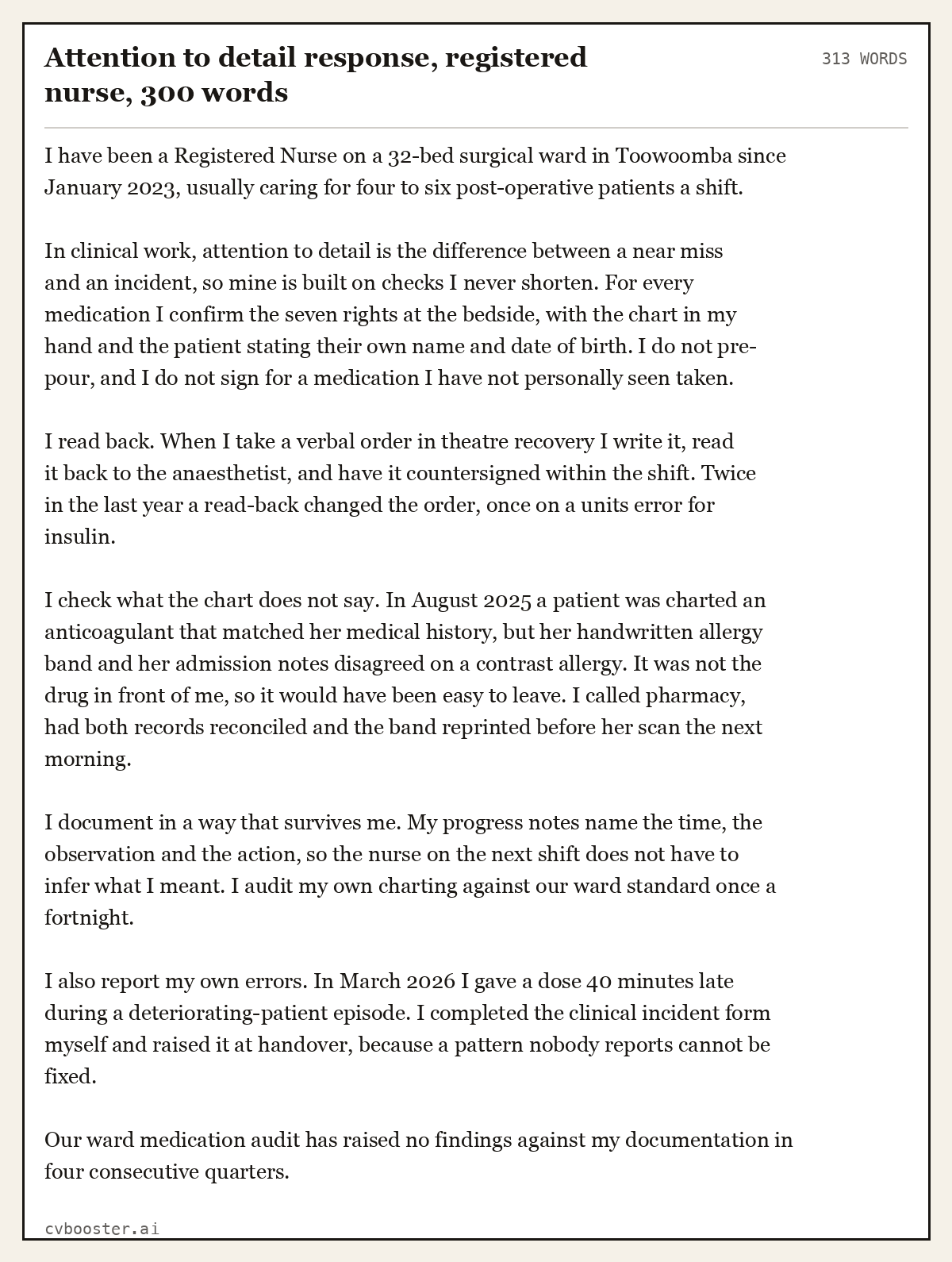
Attention to detail response, registered nurse, 300 words (313 words)
I have been a Registered Nurse on a 32-bed surgical ward in Toowoomba since January 2023, usually caring for four to six post-operative patients a shift.
In clinical work, attention to detail is the difference between a near miss and an incident, so mine is built on checks I never shorten. For every medication I confirm the seven rights at the bedside, with the chart in my hand and the patient stating their own name and date of birth. I do not pre-pour, and I do not sign for a medication I have not personally seen taken.
I read back. When I take a verbal order in theatre recovery I write it, read it back to the anaesthetist, and have it countersigned within the shift. Twice in the last year a read-back changed the order, once on a units error for insulin.
I check what the chart does not say. In August 2025 a patient was charted an anticoagulant that matched her medical history, but her handwritten allergy band and her admission notes disagreed on a contrast allergy. It was not the drug in front of me, so it would have been easy to leave. I called pharmacy, had both records reconciled and the band reprinted before her scan the next morning.
I document in a way that survives me. My progress notes name the time, the observation and the action, so the nurse on the next shift does not have to infer what I meant. I audit my own charting against our ward standard once a fortnight.
I also report my own errors. In March 2026 I gave a dose 40 minutes late during a deteriorating-patient episode. I completed the clinical incident form myself and raised it at handover, because a pattern nobody reports cannot be fixed.
Our ward medication audit has raised no findings against my documentation in four consecutive quarters.
What the sifter is scoring
- Criterion wording quoted: "accuracy and attention to detail" (iworkfor.SA), applied to clinical records. Evidence offered: the seven rights at the bedside, no pre-pouring, read-back with countersignature.
- Official instruction quoted: "Tell the employer about where your example happened" (JobAccess). Evidence offered: a named ward, a city, a start date and dated incidents.
- What lifts the score: the self-reported late dose. Panels in clinical settings score honesty about error as part of this criterion.
Finance officer, 400 words
Written for a fictional Finance Officer role in a local council. The criterion is "accuracy and attention to detail" applied to financial processing and reporting.
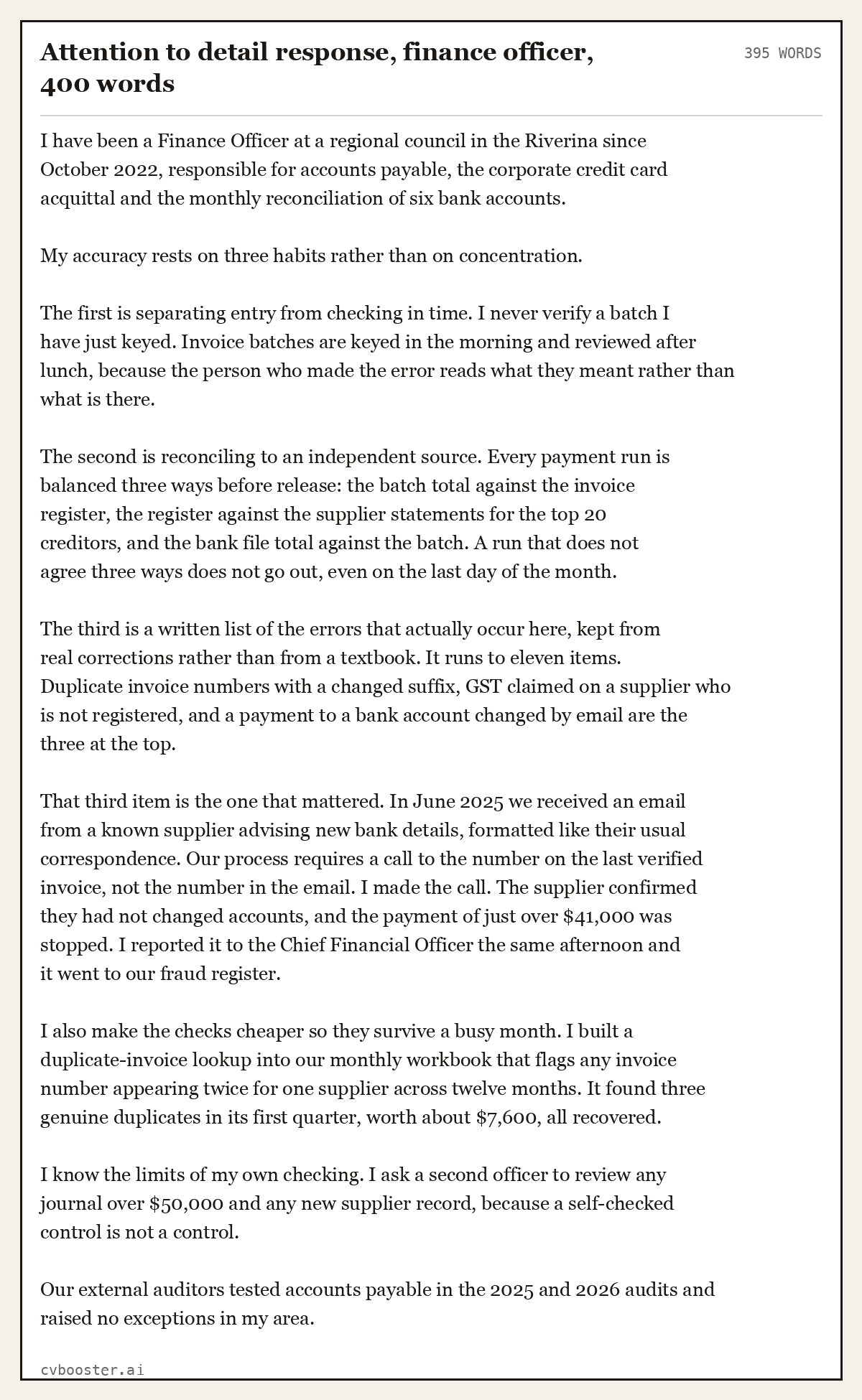
Attention to detail response, finance officer, 400 words (395 words)
I have been a Finance Officer at a regional council in the Riverina since October 2022, responsible for accounts payable, the corporate credit card acquittal and the monthly reconciliation of six bank accounts.
My accuracy rests on three habits rather than on concentration.
The first is separating entry from checking in time. I never verify a batch I have just keyed. Invoice batches are keyed in the morning and reviewed after lunch, because the person who made the error reads what they meant rather than what is there.
The second is reconciling to an independent source. Every payment run is balanced three ways before release: the batch total against the invoice register, the register against the supplier statements for the top 20 creditors, and the bank file total against the batch. A run that does not agree three ways does not go out, even on the last day of the month.
The third is a written list of the errors that actually occur here, kept from real corrections rather than from a textbook. It runs to eleven items. Duplicate invoice numbers with a changed suffix, GST claimed on a supplier who is not registered, and a payment to a bank account changed by email are the three at the top.
That third item is the one that mattered. In June 2025 we received an email from a known supplier advising new bank details, formatted like their usual correspondence. Our process requires a call to the number on the last verified invoice, not the number in the email. I made the call. The supplier confirmed they had not changed accounts, and the payment of just over $41,000 was stopped. I reported it to the Chief Financial Officer the same afternoon and it went to our fraud register.
I also make the checks cheaper so they survive a busy month. I built a duplicate-invoice lookup into our monthly workbook that flags any invoice number appearing twice for one supplier across twelve months. It found three genuine duplicates in its first quarter, worth about $7,600, all recovered.
I know the limits of my own checking. I ask a second officer to review any journal over $50,000 and any new supplier record, because a self-checked control is not a control.
Our external auditors tested accounts payable in the 2025 and 2026 audits and raised no exceptions in my area.
What the sifter is scoring
- Criterion wording quoted: "accuracy and attention to detail" (iworkfor.SA) and "good organisational and administrative skills" (APSC, Applying for an APS job). Evidence offered: the three-way balance, the separation of entry from checking, the eleven-item error list.
- Official instruction quoted: "Tell the employer what happened because of what you did" (JobAccess). Evidence offered: a stopped payment with a figure, a date and a report to the Chief Financial Officer.
- What lifts the score: asking a second officer to review large journals. It answers the unasked question about whether the applicant knows their own blind spot.
Project support officer, 500 words
Written for a fictional Project Support Officer role in a state government infrastructure agency, where the criterion covers accuracy and attention to detail in project records and reporting.
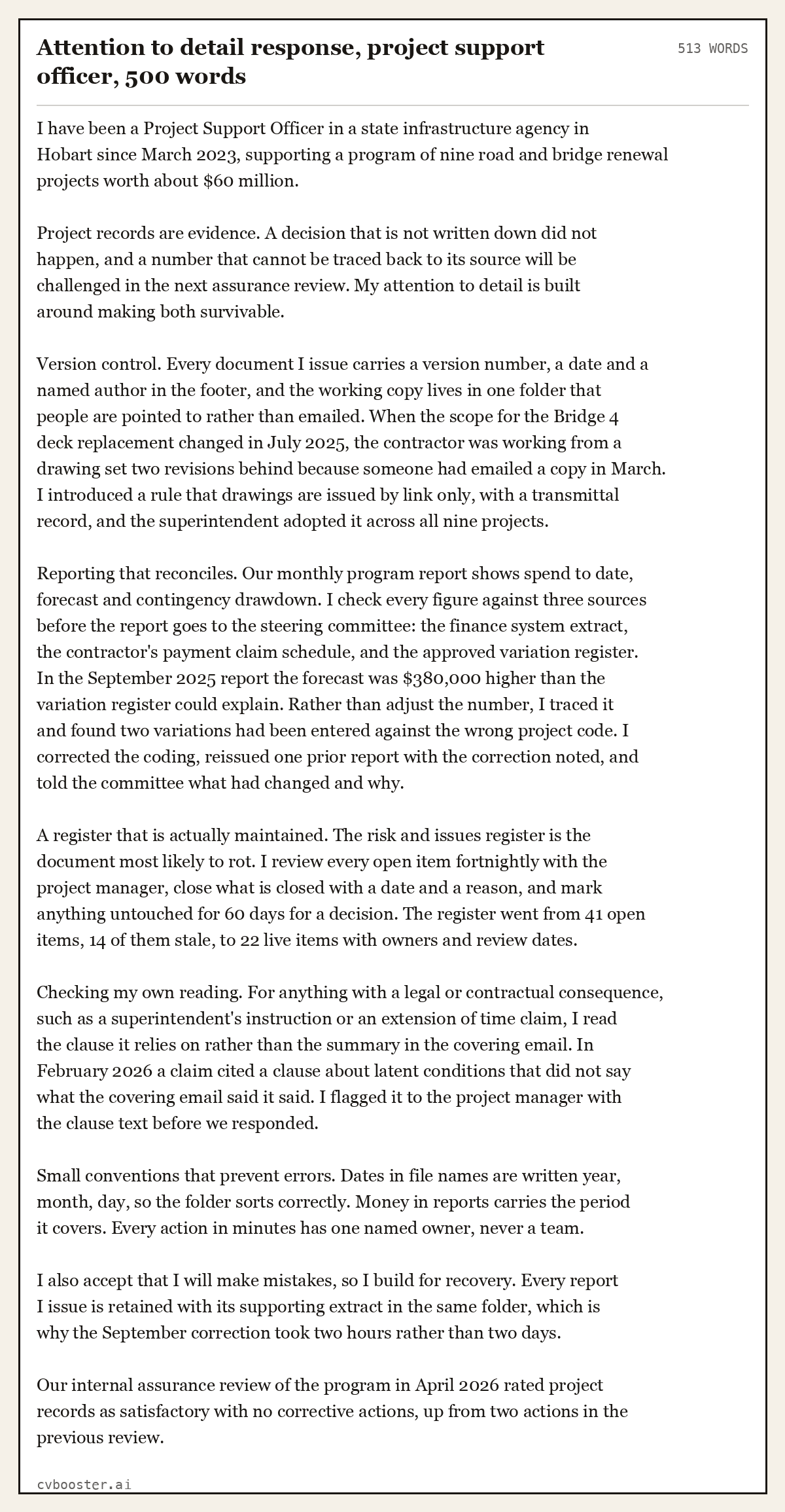
Attention to detail response, project support officer, 500 words (513 words)
I have been a Project Support Officer in a state infrastructure agency in Hobart since March 2023, supporting a program of nine road and bridge renewal projects worth about $60 million.
Project records are evidence. A decision that is not written down did not happen, and a number that cannot be traced back to its source will be challenged in the next assurance review. My attention to detail is built around making both survivable.
Version control. Every document I issue carries a version number, a date and a named author in the footer, and the working copy lives in one folder that people are pointed to rather than emailed. When the scope for the Bridge 4 deck replacement changed in July 2025, the contractor was working from a drawing set two revisions behind because someone had emailed a copy in March. I introduced a rule that drawings are issued by link only, with a transmittal record, and the superintendent adopted it across all nine projects.
Reporting that reconciles. Our monthly program report shows spend to date, forecast and contingency drawdown. I check every figure against three sources before the report goes to the steering committee: the finance system extract, the contractor's payment claim schedule, and the approved variation register. In the September 2025 report the forecast was $380,000 higher than the variation register could explain. Rather than adjust the number, I traced it and found two variations had been entered against the wrong project code. I corrected the coding, reissued one prior report with the correction noted, and told the committee what had changed and why.
A register that is actually maintained. The risk and issues register is the document most likely to rot. I review every open item fortnightly with the project manager, close what is closed with a date and a reason, and mark anything untouched for 60 days for a decision. The register went from 41 open items, 14 of them stale, to 22 live items with owners and review dates.
Checking my own reading. For anything with a legal or contractual consequence, such as a superintendent's instruction or an extension of time claim, I read the clause it relies on rather than the summary in the covering email. In February 2026 a claim cited a clause about latent conditions that did not say what the covering email said it said. I flagged it to the project manager with the clause text before we responded.
Small conventions that prevent errors. Dates in file names are written year, month, day, so the folder sorts correctly. Money in reports carries the period it covers. Every action in minutes has one named owner, never a team.
I also accept that I will make mistakes, so I build for recovery. Every report I issue is retained with its supporting extract in the same folder, which is why the September correction took two hours rather than two days.
Our internal assurance review of the program in April 2026 rated project records as satisfactory with no corrective actions, up from two actions in the previous review.
What the sifter is scoring
- Criterion wording quoted: "Demonstrated capacity to perform duties consistent with established guidelines and frameworks" (careers.vic.gov.au, Education Support advert, criterion SC1), which is the version of this criterion used when records and process matter more than speed. Evidence offered: version control by link, the three-source reconciliation, the fortnightly register review.
- Criterion wording quoted: "accuracy and attention to detail" (iworkfor.SA). Evidence offered: the $380,000 variance traced to a coding error rather than adjusted away.
- Official instruction quoted: "Explain the challenge you had to face" (JobAccess). Evidence offered: a contractor working two revisions behind, with what changed afterwards.
- What lifts the score at this length: the response is organised under labelled sub-points, which is what Jobs and Skills WA suggests when a criterion has more than one part.
The sentences that cost marks
Four before and after pairs, using the same facts each time.
- Before: "I have a keen eye for detail and pride myself on producing error-free work." After: "Every application gets four checks in a fixed order, and the register check stopped a certificate that was not on the issuing body's register."
- Before: "I am meticulous with medication and always follow policy." After: "I confirm the seven rights at the bedside with the chart in hand, and I do not sign for a dose I have not seen taken."
- Before: "I am responsible for ensuring the accuracy of financial data and reporting." After: "A payment run that does not balance three ways does not go out, which is how a $41,000 payment to changed bank details was stopped."
- Before: "I maintain project documentation to a high standard at all times." After: "Drawings are issued by link with a transmittal record, after a contractor worked two revisions behind for four months."
Tip: the word "always" is doing no work in any of those before sentences. Replace it with the date something was caught.
Before you submit
- Use the advert's exact criterion heading, not "Attention to Detail" in your own words.
- Name your checks. Three specific checks beat any adjective.
- Include one thing a check caught, with a date and a consequence that was avoided.
- Say what you do when you are interrupted or rushed, because that is when the criterion is really tested.
- Do not claim perfection. Jobs and Skills WA warns applicants to "avoid sounding 'perfect'".
- Stay inside the word limit. If the advert asks for 250 words, use the APS3 answer above as your shape, not the 500-word one.
- For the other nine criteria, see selection criteria examples. For the method, see how to address selection criteria. For APS-specific formats, see the APS statement of claims example.
Frequently asked questions
What are some examples of selection criteria?
Common criteria include communication, teamwork, problem solving, organisational skills, customer service, attention to detail, leadership, initiative and computer skills. The South Australian public sector publishes an official list that also includes analysis and research, decision making, negotiation, presentation and supervisory skills. Each one needs its own headed response in your application.
What are some good examples of attention to detail?
Good examples name a check and what it caught. A three-way reconciliation that stopped a $41,000 payment to changed bank details, a register check that found a qualification certificate that did not exist, a read-back that corrected an insulin units error, or a variance report that caught doubled hours before payroll went to the bank. Adjectives such as meticulous score nothing.
How to write the selection criteria?
Write one headed response per criterion, in the advert's order, using the exact wording from the advert as your heading. Set the scene briefly, then spend most of the words on what you personally did, and finish with a result that can be measured. Stay inside the stated word limit and mark each criterion essential or desirable.
How to write a response to key selection criteria?
Use one strong example per criterion and the four moves JobAccess sets out: where and when it happened, the challenge, what you did, and what happened as a result. Break a criterion with two parts into two labelled sections. Do not repeat your resume, and do not use a second example unless the criterion clearly asks for a range.
More in this series: Australian Public Service applications
- APS Statement of Claims Example: APS4, APS5 and APS6
- How to Address Selection Criteria: 6 Worked STAR Examples
- Selection Criteria Examples: 10 Full 250-Word Responses
Related articles
- Selection Criteria Examples: 10 Full 250-Word Responses
- How to Address Selection Criteria: 6 Worked STAR Examples
- Selection Criteria Examples Nursing: 3 Full Responses
- Selection Criteria Examples Teaching: 3 Full Responses
More articles
- Australian Graduate Programs: The 2027 Application Calendar
- Best Resume Format: Chronological vs Functional vs Hybrid
- Canadian Resume for Newcomers: NOC Titles and Credentials
Looking for a worked example for your job title? Browse the resume examples by job title.