Selection Criteria Examples Teaching: 3 Full Responses
By Mustafa Tarabya, founder of CVBooster · Published · Updated
13 min read
Three complete teaching selection criteria responses are below, written at 350 words for a graduate teacher, 450 words for an experienced classroom teacher and 600 words for a leading teacher. What decides the difference is not vocabulary, it is scope: a graduate answers for a class, a leading teacher answers for a cohort and for other teachers. Every criterion quoted here is the published wording from two Victorian government school adverts, a classroom teacher position and a leading teacher position. Each answer is annotated criterion by criterion, and three sentences that panels see constantly are rewritten at the end. Written by Mustafa Tarabya, who hired for his own company, read every application himself and now writes CVBooster's guides. Checked September 2026.
The criteria you are actually answering
Victorian government school adverts publish five numbered criteria, SC1 to SC5, and the wording changes with the classification. The classroom teacher advert sets SC1 as follows.
Quoted: "Demonstrated knowledge of the relevant curriculum, including the capacity to incorporate the teaching of literacy and numeracy skills. Demonstrated capacity to respond to student learning needs." (careers.vic.gov.au, classroom teacher, SC1)
SC3 on the same advert is about evidence: "Demonstrated capacity to monitor and assess student learning. Demonstrated capacity to use data to inform teaching practice and to provide feedback on student learning growth and achievement to students and parents."
The leading teacher advert takes the same idea one level up, and the shift is visible in three words: "Demonstrated exemplary ability to monitor and assess student learning at a class, cohort or whole-school level and use this data to lead improvement initiatives."
Write to the wording you were given. A response written against SC3 for a classroom teacher will be marked down for a leading teacher post, because it answers for one room.
Graduate teacher, 350 words
Written for a fictional graduate position in a Victorian primary school, against SC1 as quoted above.
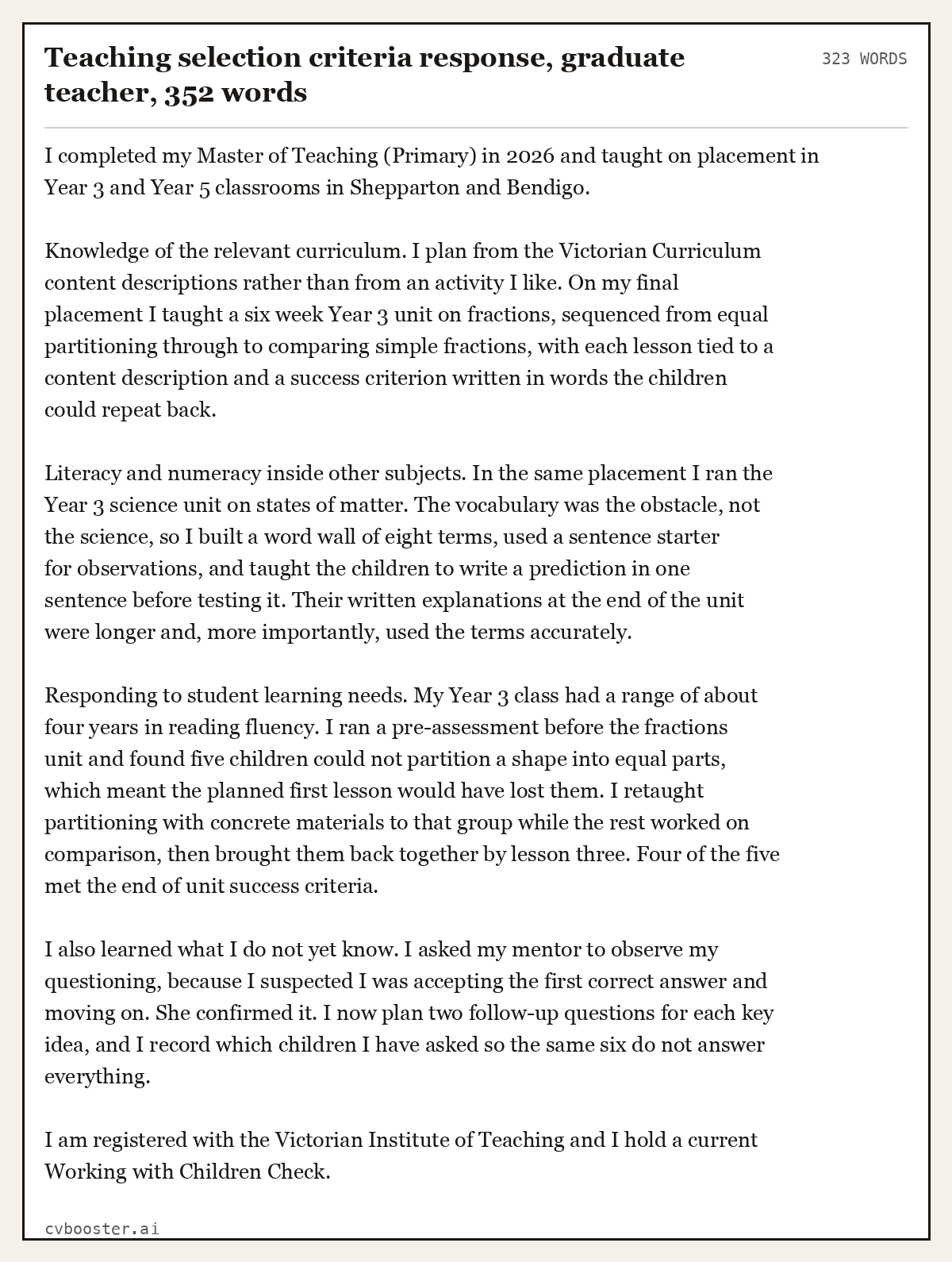
Teaching selection criteria response, graduate teacher, 352 words (323 words)
I completed my Master of Teaching (Primary) in 2026 and taught on placement in Year 3 and Year 5 classrooms in Shepparton and Bendigo.
Knowledge of the relevant curriculum. I plan from the Victorian Curriculum content descriptions rather than from an activity I like. On my final placement I taught a six week Year 3 unit on fractions, sequenced from equal partitioning through to comparing simple fractions, with each lesson tied to a content description and a success criterion written in words the children could repeat back.
Literacy and numeracy inside other subjects. In the same placement I ran the Year 3 science unit on states of matter. The vocabulary was the obstacle, not the science, so I built a word wall of eight terms, used a sentence starter for observations, and taught the children to write a prediction in one sentence before testing it. Their written explanations at the end of the unit were longer and, more importantly, used the terms accurately.
Responding to student learning needs. My Year 3 class had a range of about four years in reading fluency. I ran a pre-assessment before the fractions unit and found five children could not partition a shape into equal parts, which meant the planned first lesson would have lost them. I retaught partitioning with concrete materials to that group while the rest worked on comparison, then brought them back together by lesson three. Four of the five met the end of unit success criteria.
I also learned what I do not yet know. I asked my mentor to observe my questioning, because I suspected I was accepting the first correct answer and moving on. She confirmed it. I now plan two follow-up questions for each key idea, and I record which children I have asked so the same six do not answer everything.
I am registered with the Victorian Institute of Teaching and I hold a current Working with Children Check.
What the sifter is scoring
- Criterion quoted: "Demonstrated knowledge of the relevant curriculum, including the capacity to incorporate the teaching of literacy and numeracy skills." (careers.vic.gov.au, classroom teacher, SC1). Where the response shows it: a sequenced fractions unit and vocabulary taught inside a science unit.
- Criterion quoted: "Demonstrated capacity to respond to student learning needs." (same advert, SC1). Where the response shows it: a pre-assessment that changed the plan, and a named outcome for the five children.
- Criterion structure quoted: "Many selection criteria are made up of several parts and you will need to address each one of these." (Jobs and Skills WA, Responding to selection criteria). Where the response shows it: SC1 is answered in three labelled parts.
- What lifts the score: the questioning paragraph. A graduate who can name a weakness and the change they made reads as coachable, which is what a school is buying.
Classroom teacher, 450 words
Written for a fictional classroom teacher position in a Victorian secondary school, against SC3 as quoted above.
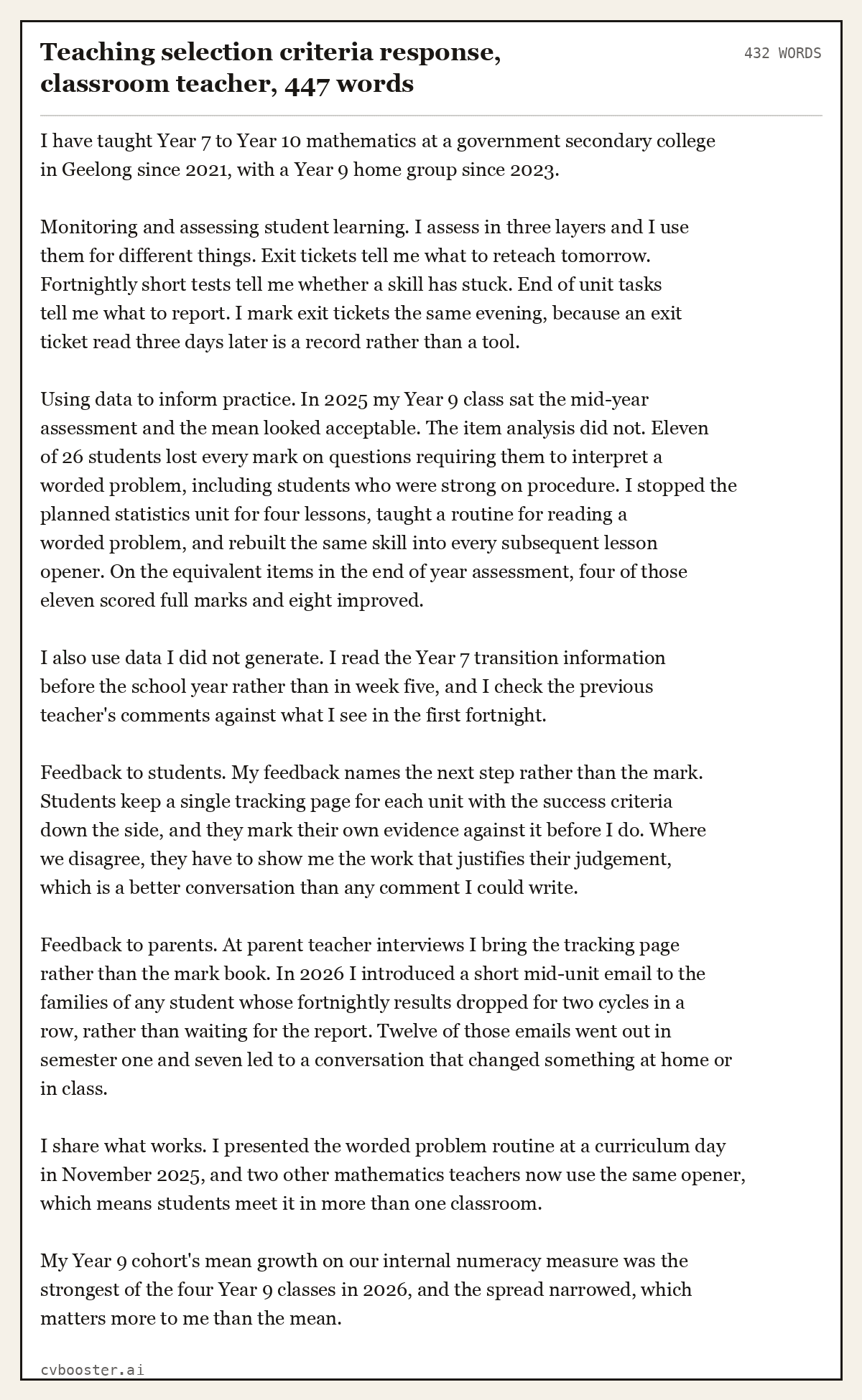
Teaching selection criteria response, classroom teacher, 447 words (432 words)
I have taught Year 7 to Year 10 mathematics at a government secondary college in Geelong since 2021, with a Year 9 home group since 2023.
Monitoring and assessing student learning. I assess in three layers and I use them for different things. Exit tickets tell me what to reteach tomorrow. Fortnightly short tests tell me whether a skill has stuck. End of unit tasks tell me what to report. I mark exit tickets the same evening, because an exit ticket read three days later is a record rather than a tool.
Using data to inform practice. In 2025 my Year 9 class sat the mid-year assessment and the mean looked acceptable. The item analysis did not. Eleven of 26 students lost every mark on questions requiring them to interpret a worded problem, including students who were strong on procedure. I stopped the planned statistics unit for four lessons, taught a routine for reading a worded problem, and rebuilt the same skill into every subsequent lesson opener. On the equivalent items in the end of year assessment, four of those eleven scored full marks and eight improved.
I also use data I did not generate. I read the Year 7 transition information before the school year rather than in week five, and I check the previous teacher's comments against what I see in the first fortnight.
Feedback to students. My feedback names the next step rather than the mark. Students keep a single tracking page for each unit with the success criteria down the side, and they mark their own evidence against it before I do. Where we disagree, they have to show me the work that justifies their judgement, which is a better conversation than any comment I could write.
Feedback to parents. At parent teacher interviews I bring the tracking page rather than the mark book. In 2026 I introduced a short mid-unit email to the families of any student whose fortnightly results dropped for two cycles in a row, rather than waiting for the report. Twelve of those emails went out in semester one and seven led to a conversation that changed something at home or in class.
I share what works. I presented the worded problem routine at a curriculum day in November 2025, and two other mathematics teachers now use the same opener, which means students meet it in more than one classroom.
My Year 9 cohort's mean growth on our internal numeracy measure was the strongest of the four Year 9 classes in 2026, and the spread narrowed, which matters more to me than the mean.
What the sifter is scoring
- Criterion quoted: "Demonstrated capacity to monitor and assess student learning." (careers.vic.gov.au, classroom teacher, SC3). Where the response shows it: three named assessment layers, each with a stated purpose and turnaround.
- Criterion quoted: "Demonstrated capacity to use data to inform teaching practice and to provide feedback on student learning growth and achievement to students and parents." (same advert, SC3). Where the response shows it: the item analysis that changed four lessons, the student tracking page, and the mid-unit email to families.
- Role wording quoted: "The classroom teacher engages in critical reflection and inquiry in order to improve knowledge and skills to effectively engage students and improve their learning." (same advert). Where the response shows it: the mean that looked acceptable and was interrogated anyway.
- What lifts the score: the last sentence. Caring about spread rather than mean is the sentence a curriculum leader reads twice.
Leading teacher, 600 words
Written for a fictional leading teacher position in a Victorian school, against SC4 from the leading teacher advert.
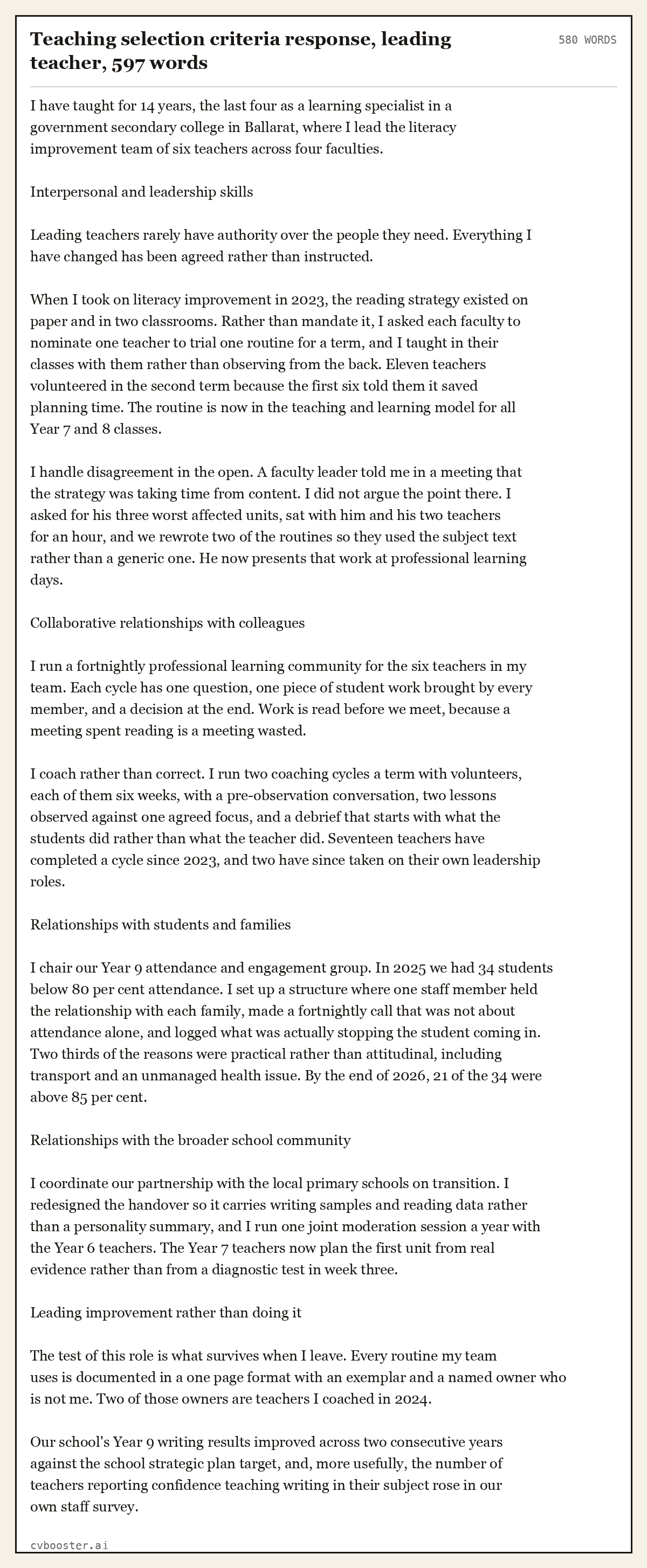
Teaching selection criteria response, leading teacher, 597 words (580 words)
I have taught for 14 years, the last four as a learning specialist in a government secondary college in Ballarat, where I lead the literacy improvement team of six teachers across four faculties.
Interpersonal and leadership skills
Leading teachers rarely have authority over the people they need. Everything I have changed has been agreed rather than instructed.
When I took on literacy improvement in 2023, the reading strategy existed on paper and in two classrooms. Rather than mandate it, I asked each faculty to nominate one teacher to trial one routine for a term, and I taught in their classes with them rather than observing from the back. Eleven teachers volunteered in the second term because the first six told them it saved planning time. The routine is now in the teaching and learning model for all Year 7 and 8 classes.
I handle disagreement in the open. A faculty leader told me in a meeting that the strategy was taking time from content. I did not argue the point there. I asked for his three worst affected units, sat with him and his two teachers for an hour, and we rewrote two of the routines so they used the subject text rather than a generic one. He now presents that work at professional learning days.
Collaborative relationships with colleagues
I run a fortnightly professional learning community for the six teachers in my team. Each cycle has one question, one piece of student work brought by every member, and a decision at the end. Work is read before we meet, because a meeting spent reading is a meeting wasted.
I coach rather than correct. I run two coaching cycles a term with volunteers, each of them six weeks, with a pre-observation conversation, two lessons observed against one agreed focus, and a debrief that starts with what the students did rather than what the teacher did. Seventeen teachers have completed a cycle since 2023, and two have since taken on their own leadership roles.
Relationships with students and families
I chair our Year 9 attendance and engagement group. In 2025 we had 34 students below 80 per cent attendance. I set up a structure where one staff member held the relationship with each family, made a fortnightly call that was not about attendance alone, and logged what was actually stopping the student coming in. Two thirds of the reasons were practical rather than attitudinal, including transport and an unmanaged health issue. By the end of 2026, 21 of the 34 were above 85 per cent.
Relationships with the broader school community
I coordinate our partnership with the local primary schools on transition. I redesigned the handover so it carries writing samples and reading data rather than a personality summary, and I run one joint moderation session a year with the Year 6 teachers. The Year 7 teachers now plan the first unit from real evidence rather than from a diagnostic test in week three.
Leading improvement rather than doing it
The test of this role is what survives when I leave. Every routine my team uses is documented in a one page format with an exemplar and a named owner who is not me. Two of those owners are teachers I coached in 2024.
Our school's Year 9 writing results improved across two consecutive years against the school strategic plan target, and, more usefully, the number of teachers reporting confidence teaching writing in their subject rose in our own staff survey.
What the sifter is scoring
- Criterion quoted: "Demonstrated exemplary interpersonal and leadership skills. Demonstrated ability to lead collaborative relationships with students, colleagues, parents and the broader school community focused on student learning, agency, wellbeing and engagement." (careers.vic.gov.au, leading teacher, SC4). Where the response shows it: each named group in the criterion gets its own labelled section.
- Role wording quoted: "The role of leading teachers is to improve the skill, knowledge and performance of the teaching workforce in a school or group of schools and to improve the curriculum program of a school." (same advert). Where the response shows it: 17 coaching cycles, documented routines with owners, and the teacher confidence measure.
- Values wording quoted: "The department's employees commit to upholding the department's Values: Responsiveness, Integrity, Impartiality, Accountability, Respect, Leadership and Human Rights." (same advert). Where the response shows it: the disagreement with the faculty leader is resolved with his teachers in the room.
- What lifts the score at this length: refusing to mandate. A panel appointing a leading teacher is choosing someone other adults will follow without being made to.
The sentences that cost marks
Three rewrites, holding the evidence steady and moving only the wording. The South Australian guide, Addressing selection criteria, warns what happens without them: "If you do not address all the required criteria, or provide brief and general responses your application may be precluded."
- Before: "I have a sound knowledge of the curriculum and cater for all learning needs in my classroom." After: "A pre-assessment showed five children could not partition a shape equally, so I retaught partitioning before the planned first lesson."
- Before: "I use a range of assessment strategies and provide timely feedback to students and parents." After: "Item analysis showed 11 of 26 lost every mark on worded problems, so I stopped the statistics unit for four lessons."
- Before: "I am an experienced leader who builds strong relationships across the school community." After: "Six teachers trialled one routine for a term. Eleven volunteered the next term because the first six said it saved planning time."
Tip: if a sentence would be true of any competent teacher in the state, it is not evidence. Put a year group, a number and a decision in it.
Before you submit
- Answer SC1 to SC5 in the advert's order, with the criterion number as your heading.
- Split a criterion that contains two verbs into two labelled parts, and answer both.
- Give one class, one cohort or one whole school as your scope, and match it to the classification you are applying for.
- Put student outcomes in every criterion, even the ones that look like they are about adults.
- Name your registration and Working with Children Check once, at the end.
- Do not name students, families or colleagues. Year level and term are enough.
- For the wider criterion set, see selection criteria examples, the attention to detail examples and, for school support roles, the administration selection criteria examples.
Frequently asked questions
What are the selection criteria for teaching jobs?
Victorian government school adverts publish five criteria, SC1 to SC5, covering curriculum knowledge and responding to student needs, high impact teaching strategies, assessment and use of data, interpersonal and communication skills, and behaviours consistent with department values plus reflective practice. Other states use different headings but assess the same evidence. Always write to the wording in the advert in front of you.
How to write the selection criteria?
Take each criterion as published, split it into its separate demands, and answer each one with a classroom example that has a year level, a date and a student outcome attached. Lead with what you did, not with what you believe about teaching. Finish each criterion with evidence someone else could verify, such as an assessment result or an adopted practice.
How long should a teaching selection criteria response be?
Use the limit in the advert. Where none is given, 300 to 400 words per criterion is normal for a classroom teacher and 500 to 600 for a leadership position, because leadership criteria ask about more groups of people. Victorian applications often ask for the whole response in a single document of two to three pages, so budget your words across all five criteria before you write.
How do graduate teachers address selection criteria with no experience?
Use placements, tutoring, coaching and casual relief as evidence, and treat them as real teaching rather than apologising for them. Name the school type, the year level and the unit. One planned sequence, one adjustment made after a pre-assessment and one piece of feedback from a mentor will answer SC1 better than a paragraph about your philosophy of teaching.
What is the difference between a classroom teacher and a leading teacher response?
Scope. A classroom teacher answers for the students in their own room, a leading teacher answers for a cohort or a whole school and for the practice of other teachers. The leading teacher advert asks for exemplary ability to monitor and assess learning at a class, cohort or whole-school level and to use this data to lead improvement initiatives. If your evidence would read identically at both levels, you have written the lower one.
More in this series: Australian Public Service applications
- APS Pitch Example: One Page at APS4, Two Pages at EL1
- APS Statement of Claims Example: APS4, APS5 and APS6
- Attention to Detail Selection Criteria Examples: 4 Answers
- How to Address Selection Criteria: 6 Worked STAR Examples
- Selection Criteria Examples Administration: 3 Answers
- Selection Criteria Examples Nursing: 3 Full Responses
- Selection Criteria Examples: 10 Full 250-Word Responses
Related articles
- Attention to Detail Selection Criteria Examples: 4 Answers
- Selection Criteria Examples: 10 Full 250-Word Responses
- Selection Criteria Examples Nursing: 3 Full Responses
- How to Address Selection Criteria: 6 Worked STAR Examples
More articles
- Short Cover Letter Examples: Get Hired With Less
- Skills to Put on a Job Application Form
- Skills to Put on a Resume (and What to Cut)
Looking for a worked example for your job title? Browse the resume examples by job title.