Selection Criteria Examples Nursing: 3 Full Responses
By Mustafa Tarabya, founder of CVBooster · Published · Updated
13 min read
Three complete nursing selection criteria responses are below, at 250 words for a graduate registered nurse, 400 words for a registered nurse and 500 words for a clinical nurse. The length in the advert is what decides the shape, because a 250 word answer holds one episode of care and a 500 word answer has to hold a pattern. The criterion wording used here is quoted from the South Australian public sector list of selection criteria and from the NSW Government advice on writing your application. Every answer carries an annotation naming the criterion it meets, and the final section rewrites three sentences that score nothing. Written by Mustafa Tarabya, who hired for his own company, read every application himself and now writes CVBooster's guides. Checked September 2026.
What a nursing panel scores in a written response
Health services shortlist from the written response before anyone reads a resume properly. The South Australian public sector guide, Addressing selection criteria, explains why the resume alone is not enough.
Quoted: "Many good applicants are overlooked because they don't clearly address the selection criteria" (iworkfor.SA). The guide's point is that a panel will not read between the lines of a résumé.
The same guide defines what the panel has in front of it: "Selection criteria represent the skills and abilities, knowledge, experience, qualifications and work related qualities a person needs to perform a role effectively. They set out the standards by which each candidate will be assessed."
NSW Government advice in Writing your application tells applicants where to start: "Start by reading the job ad carefully. Highlight what the organisation is looking for, especially any selection criteria or targeted questions."
In nursing that translates into three things a panel wants visible in every answer: what you assessed, what you did about it, and who you told.
Graduate registered nurse, 250 words
Written for a fictional graduate nurse programme position on a general medical ward, against a criterion worded "interpersonal/verbal communication", which is one of the published criteria on the South Australian list.
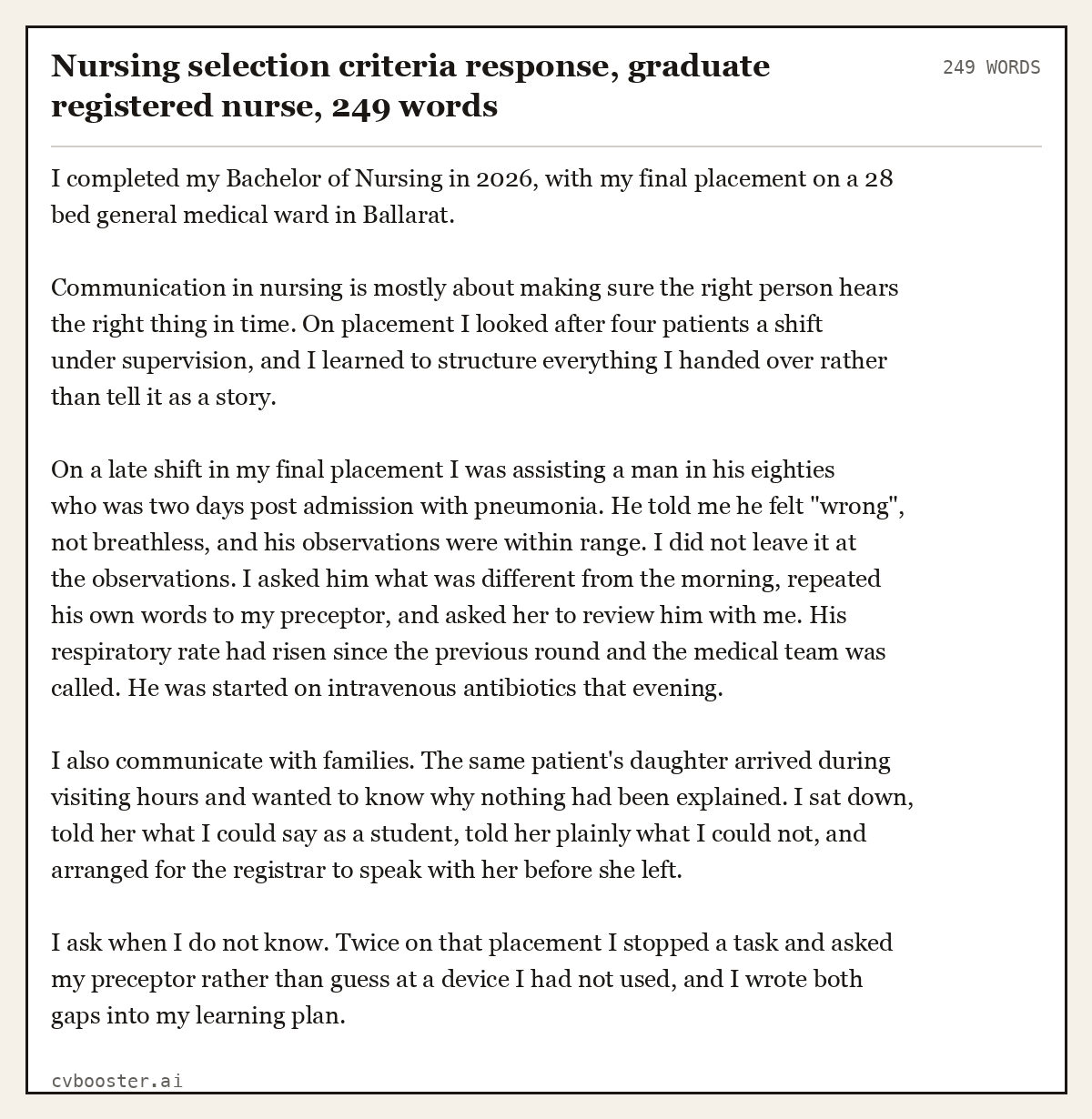
Nursing selection criteria response, graduate registered nurse, 249 words (249 words)
I completed my Bachelor of Nursing in 2026, with my final placement on a 28 bed general medical ward in Ballarat.
Communication in nursing is mostly about making sure the right person hears the right thing in time. On placement I looked after four patients a shift under supervision, and I learned to structure everything I handed over rather than tell it as a story.
On a late shift in my final placement I was assisting a man in his eighties who was two days post admission with pneumonia. He told me he felt "wrong", not breathless, and his observations were within range. I did not leave it at the observations. I asked him what was different from the morning, repeated his own words to my preceptor, and asked her to review him with me. His respiratory rate had risen since the previous round and the medical team was called. He was started on intravenous antibiotics that evening.
I also communicate with families. The same patient's daughter arrived during visiting hours and wanted to know why nothing had been explained. I sat down, told her what I could say as a student, told her plainly what I could not, and arranged for the registrar to speak with her before she left.
I ask when I do not know. Twice on that placement I stopped a task and asked my preceptor rather than guess at a device I had not used, and I wrote both gaps into my learning plan.
What the sifter is scoring
- Criterion quoted: "interpersonal/verbal communication" (iworkfor.SA, published list of selection criteria examples). Where the response shows it: structured handover, a quoted patient concern taken to a preceptor, and a family conversation with a clear boundary.
- Official instruction quoted: "You can include examples from all parts of your life" and "study at school, TAFE or university" (NSW Government, Writing your application). Where the response shows it: a clinical placement is used as the evidence base, which is what a graduate has.
- What lifts the score: asking for a review on a soft cue rather than on a number. Panels read that as escalation behaviour, which is the single thing they worry about with new graduates.
Registered nurse, 400 words
Written for a fictional Registered Nurse position in an emergency department, against a criterion worded "problem-solving", also from the South Australian list, applied to clinical prioritisation.
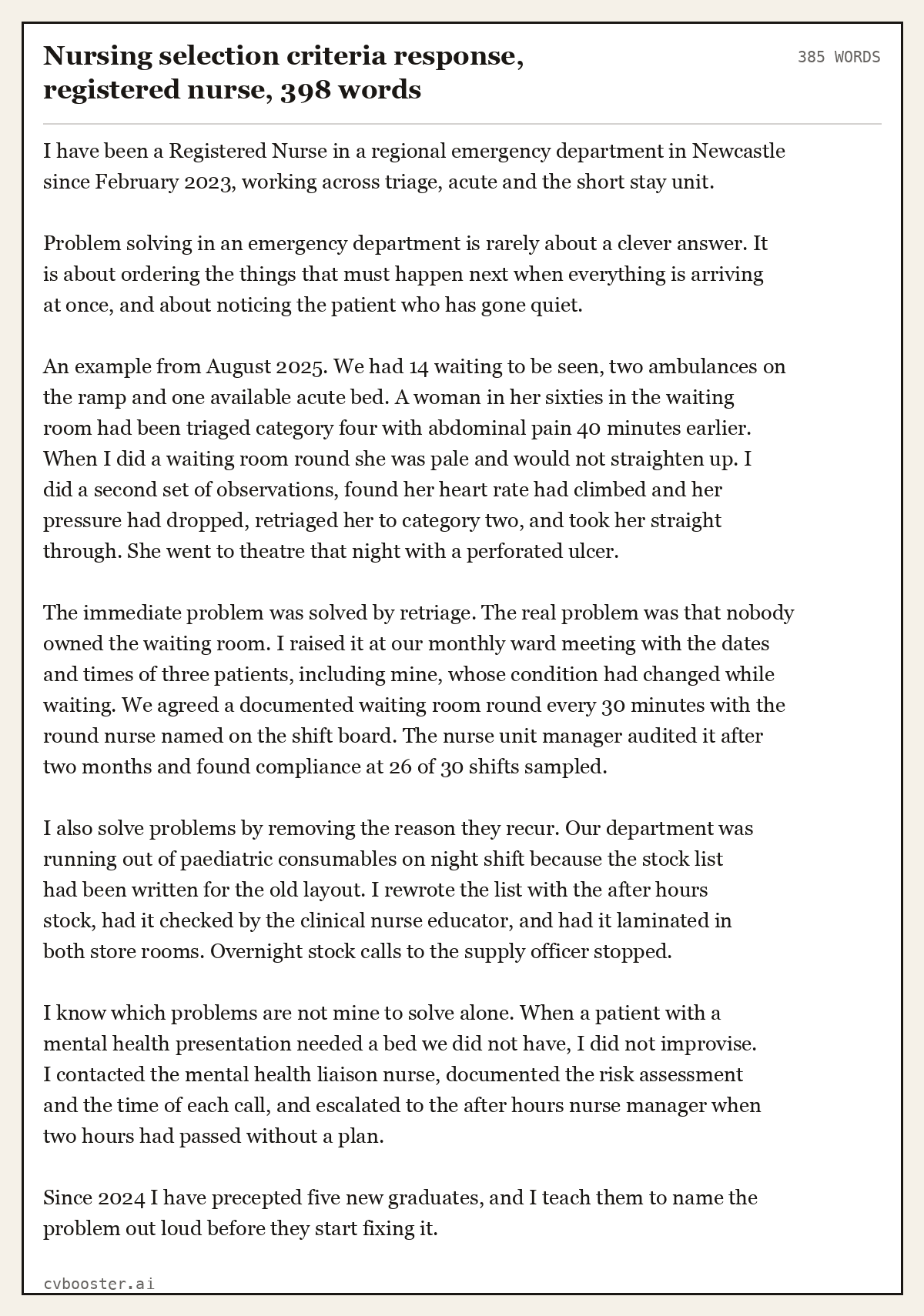
Nursing selection criteria response, registered nurse, 398 words (385 words)
I have been a Registered Nurse in a regional emergency department in Newcastle since February 2023, working across triage, acute and the short stay unit.
Problem solving in an emergency department is rarely about a clever answer. It is about ordering the things that must happen next when everything is arriving at once, and about noticing the patient who has gone quiet.
An example from August 2025. We had 14 waiting to be seen, two ambulances on the ramp and one available acute bed. A woman in her sixties in the waiting room had been triaged category four with abdominal pain 40 minutes earlier. When I did a waiting room round she was pale and would not straighten up. I did a second set of observations, found her heart rate had climbed and her pressure had dropped, retriaged her to category two, and took her straight through. She went to theatre that night with a perforated ulcer.
The immediate problem was solved by retriage. The real problem was that nobody owned the waiting room. I raised it at our monthly ward meeting with the dates and times of three patients, including mine, whose condition had changed while waiting. We agreed a documented waiting room round every 30 minutes with the round nurse named on the shift board. The nurse unit manager audited it after two months and found compliance at 26 of 30 shifts sampled.
I also solve problems by removing the reason they recur. Our department was running out of paediatric consumables on night shift because the stock list had been written for the old layout. I rewrote the list with the after hours stock, had it checked by the clinical nurse educator, and had it laminated in both store rooms. Overnight stock calls to the supply officer stopped.
I know which problems are not mine to solve alone. When a patient with a mental health presentation needed a bed we did not have, I did not improvise. I contacted the mental health liaison nurse, documented the risk assessment and the time of each call, and escalated to the after hours nurse manager when two hours had passed without a plan.
Since 2024 I have precepted five new graduates, and I teach them to name the problem out loud before they start fixing it.
What the sifter is scoring
- Criterion quoted: "problem-solving" (iworkfor.SA, published list of selection criteria examples). Where the response shows it: a retriage decision, a systemic fix with an audit result, and a stock problem solved at its cause.
- Official instruction quoted: "Focus on achievements, not just duties. Use numbers or outcomes where possible." (NSW Government, Writing your application). Where the response shows it: 26 of 30 shifts sampled, three dated patients, five graduates precepted.
- Criterion structure quoted: "Many selection criteria are made up of several parts and you will need to address each one of these." (Jobs and Skills WA). Where the response shows it: the immediate clinical problem and the system problem are answered separately.
- What lifts the score: naming the escalation that was refused. A panel reads improvising a mental health bed as a risk; documenting and escalating is the scoring answer.
Clinical nurse, 500 words
Written for a fictional Clinical Nurse position in a community palliative care service, against a two part criterion worded "leadership" and "decision making" on the South Australian list.
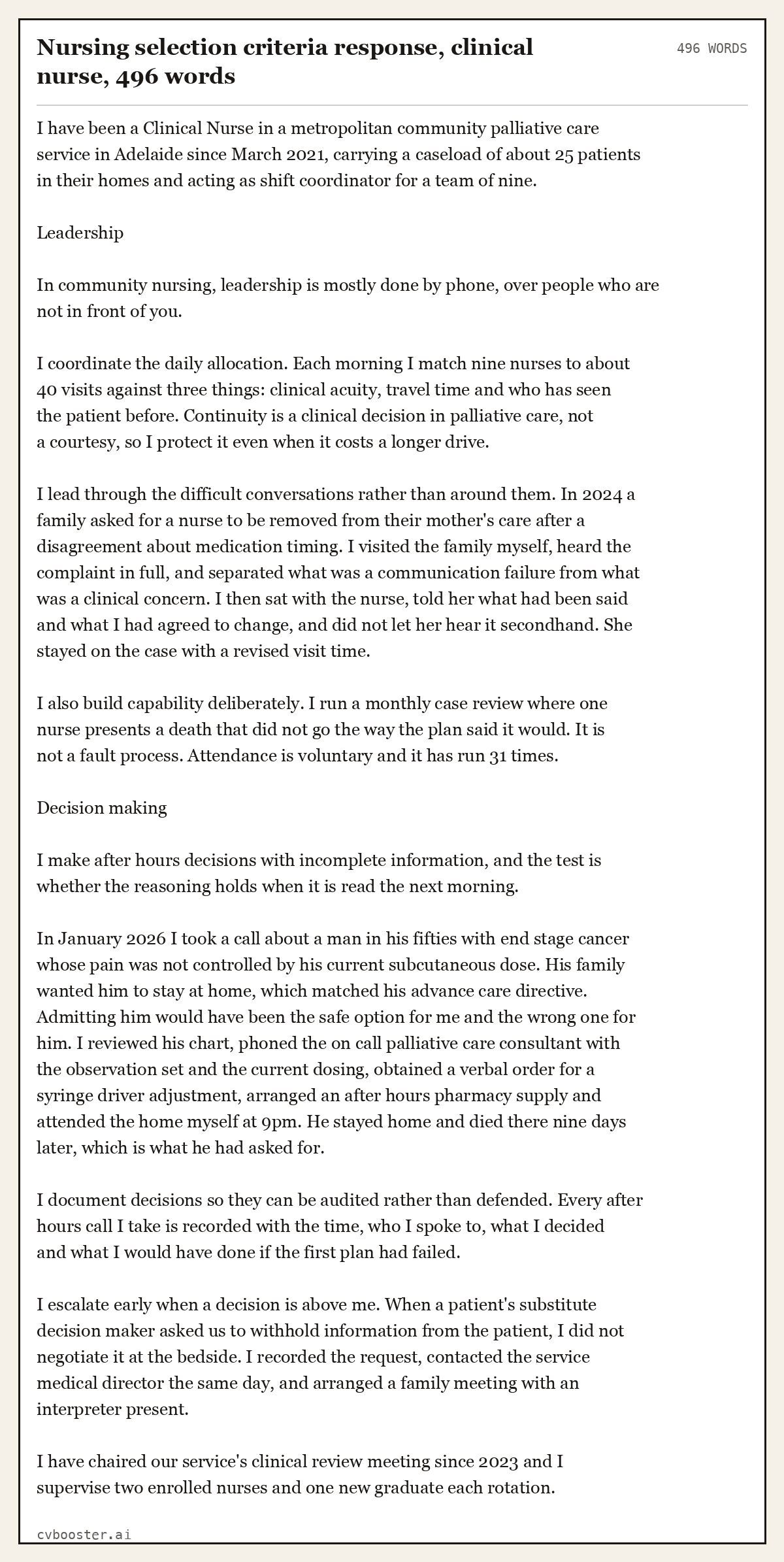
Nursing selection criteria response, clinical nurse, 496 words (496 words)
I have been a Clinical Nurse in a metropolitan community palliative care service in Adelaide since March 2021, carrying a caseload of about 25 patients in their homes and acting as shift coordinator for a team of nine.
Leadership
In community nursing, leadership is mostly done by phone, over people who are not in front of you.
I coordinate the daily allocation. Each morning I match nine nurses to about 40 visits against three things: clinical acuity, travel time and who has seen the patient before. Continuity is a clinical decision in palliative care, not a courtesy, so I protect it even when it costs a longer drive.
I lead through the difficult conversations rather than around them. In 2024 a family asked for a nurse to be removed from their mother's care after a disagreement about medication timing. I visited the family myself, heard the complaint in full, and separated what was a communication failure from what was a clinical concern. I then sat with the nurse, told her what had been said and what I had agreed to change, and did not let her hear it secondhand. She stayed on the case with a revised visit time.
I also build capability deliberately. I run a monthly case review where one nurse presents a death that did not go the way the plan said it would. It is not a fault process. Attendance is voluntary and it has run 31 times.
Decision making
I make after hours decisions with incomplete information, and the test is whether the reasoning holds when it is read the next morning.
In January 2026 I took a call about a man in his fifties with end stage cancer whose pain was not controlled by his current subcutaneous dose. His family wanted him to stay at home, which matched his advance care directive. Admitting him would have been the safe option for me and the wrong one for him. I reviewed his chart, phoned the on call palliative care consultant with the observation set and the current dosing, obtained a verbal order for a syringe driver adjustment, arranged an after hours pharmacy supply and attended the home myself at 9pm. He stayed home and died there nine days later, which is what he had asked for.
I document decisions so they can be audited rather than defended. Every after hours call I take is recorded with the time, who I spoke to, what I decided and what I would have done if the first plan had failed.
I escalate early when a decision is above me. When a patient's substitute decision maker asked us to withhold information from the patient, I did not negotiate it at the bedside. I recorded the request, contacted the service medical director the same day, and arranged a family meeting with an interpreter present.
I have chaired our service's clinical review meeting since 2023 and I supervise two enrolled nurses and one new graduate each rotation.
What the sifter is scoring
- Criterion quoted: "leadership" and "decision making" (iworkfor.SA, published list of selection criteria examples). Where the response shows it: daily allocation with a stated priority rule, a complaint handled face to face, a night decision made against the easy option.
- Criterion structure quoted: "Try to address each section separately - identifying the skills they are looking for." (Jobs and Skills WA). Where the response shows it: the two parts of the criterion carry their own subheadings.
- Official instruction quoted: "If the job involves managing a team, tell us about important things you did before such as how you supported your team to deliver for the business." (NSW Government, Writing your application). Where the response shows it: the case review, the supervision load and the way the complaint was fed back.
- What lifts the score at this length: the advance care directive sentence. It shows the decision was measured against the patient's stated wishes, not against the applicant's comfort.
The sentences that cost marks
Three pairs, each keeping the facts and changing only the sentence. Jobs and Skills WA names the failure directly in Responding to selection criteria: "Employers are often inundated with applications, so anything that makes reading your application easier will be beneficial."
- Before: "I am a compassionate nurse who always puts the patient at the centre of care." After: "A patient told me he felt wrong with normal observations, so I repeated his words to my preceptor and asked for a review."
- Before: "I have excellent problem solving skills and remain calm in high pressure environments." After: "With 14 waiting and one acute bed, I retriaged a category four to category two after a waiting room round, and she went to theatre that night."
- Before: "I am an experienced clinical leader who supports and mentors junior staff." After: "I run a monthly case review where one nurse presents a death that did not follow the plan. It has run 31 times."
Tip: the word "always" is a claim a panel cannot score. Replace it with a date and a patient who is not named.
Before you submit
- Use the advert's criterion heading word for word, including the essential or desirable label.
- Keep one episode of care per criterion at 250 words, and add the pattern or the system change only when you have 400 or more.
- Never name a patient, a family member or a colleague. Age band, ward type and month are enough.
- Say what you escalated and to whom. Panels in health services read escalation as safety.
- Put your registration, your endorsements and your mandatory training in the resume, not in the criterion response.
- Check whether the health service wants responses in the online form or a separate document, because the form usually counts characters.
- For the other criteria in the advert, see selection criteria examples and the attention to detail selection criteria examples. For the drafting method, see addressing selection criteria.
Frequently asked questions
How to answer selection criteria in NSW Health?
Answer each criterion under its own heading, using the advert's wording, with one clinical example structured as situation, task, action and result. NSW Government advice says to address the focus capabilities listed in the job ad and to use the STAR method to structure your work examples. Keep patient details de-identified, name the escalation, and finish with a measurable result.
What to write in selection criteria?
Typical published criteria include interpersonal and verbal communication, problem solving, teamwork, decision making, leadership, and written communication skills, alongside registration and clinical requirements. The South Australian public sector publishes that list in its guide to addressing selection criteria. Health services add role specific criteria such as evidence based practice, quality improvement and working with multidisciplinary teams.
How to write the selection criteria?
Write one response per criterion in the order the advert lists them, using the exact heading from the advert. Spend most of the words on what you personally assessed, decided and did. Close with a result someone else could verify, such as an audit figure or a documented change to practice. Stay inside the stated word or character limit.
How long should a nursing selection criteria response be?
As long as the advert states, and most health services ask for 250 to 500 words per criterion. At 250 words use one episode of care. At 400 to 500 words use one episode plus the change you made afterwards. Where the application is an online form, the limit is usually counted in characters including spaces, so paste and check rather than trusting your word processor.
What are the 7 standards of nursing?
The question refers to the Registered nurse standards for practice published by the Nursing and Midwifery Board of Australia, which describe what a registered nurse is expected to do in practice. Read them on the Board's own site rather than from a summary, because the numbering matters. A selection criteria response is not marked against those standards directly, but an answer that shows assessment, action, escalation and evaluation is speaking their language.
Do graduate nurses need to address selection criteria?
Yes, and placements count as evidence. NSW Government advice tells applicants they can include examples from study at school, TAFE or university as well as from paid work. Choose the placement shift where you noticed something, escalated it and were right to, then say what you learned and how you recorded the gap in your learning plan.
More in this series: Australian Public Service applications
- APS Pitch Example: One Page at APS4, Two Pages at EL1
- APS Statement of Claims Example: APS4, APS5 and APS6
- Attention to Detail Selection Criteria Examples: 4 Answers
- How to Address Selection Criteria: 6 Worked STAR Examples
- Selection Criteria Examples Administration: 3 Answers
- Selection Criteria Examples Teaching: 3 Full Responses
- Selection Criteria Examples: 10 Full 250-Word Responses
Related articles
- Attention to Detail Selection Criteria Examples: 4 Answers
- Selection Criteria Examples: 10 Full 250-Word Responses
- Selection Criteria Examples Teaching: 3 Full Responses
- How to Address Selection Criteria: 6 Worked STAR Examples
More articles
Looking for a worked example for your job title? Browse the resume examples by job title.