Bank Teller Interview Questions and 10 Full Sample Answers
By Mustafa Tarabya, founder of CVBooster · Published · Updated
10 min read
Bank teller interview questions test three things: whether you handle cash accurately, whether you follow procedure when a customer pushes you not to, and whether you can talk to people about products without sounding like a script. The constraint is that a teller works inside federal rules, and interviewers listen for them. Under 31 CFR 1010.311, a bank must report every transaction "in currency of more than $10,000", and a teller is usually the first person to see one. Below are ten bank teller interview questions with full sample answers, checked in October 2026, each tagged for first-time or experienced candidates, plus the questions to ask at the end. Written by Mustafa Tarabya, who hired for his own company, read every application himself and now writes CVBooster's guides.
The interviewer will ask what you would do if your drawer were twenty dollars short. You will want to say "count it again", because that is what anyone would do. It is also the first half of the right answer. The second half is the procedure, and that is the part they are listening for.
1. Tell me about yourself
Keep it to four sentences: what you do now, the cash or customer part of it, why banking, and why this branch.
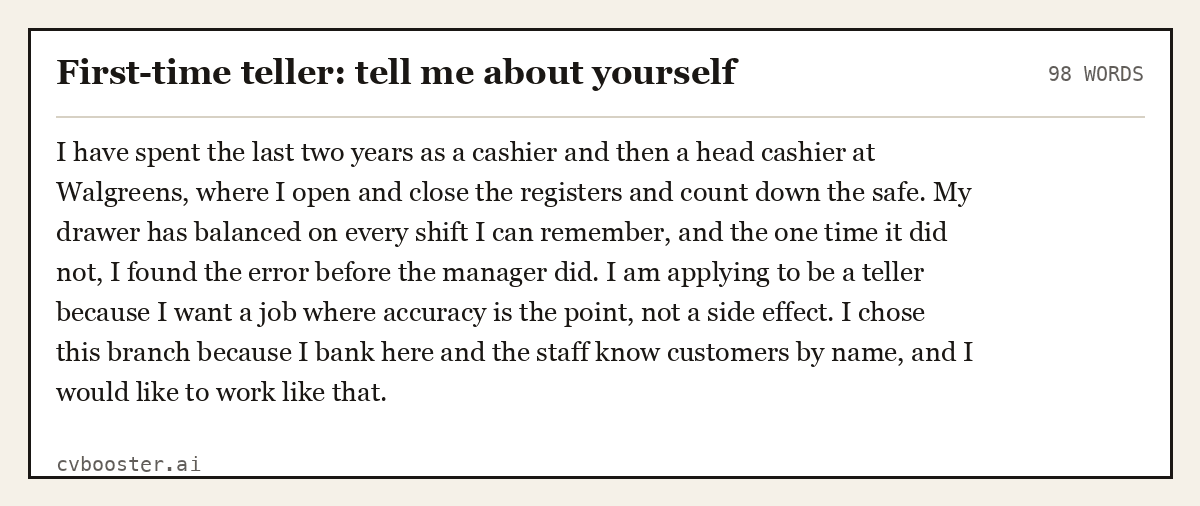
First-time teller: tell me about yourself (98 words)
I have spent the last two years as a cashier and then a head cashier at Walgreens, where I open and close the registers and count down the safe. My drawer has balanced on every shift I can remember, and the one time it did not, I found the error before the manager did. I am applying to be a teller because I want a job where accuracy is the point, not a side effect. I chose this branch because I bank here and the staff know customers by name, and I would like to work like that.
2. What would you do if your cash drawer did not balance?
This is the question every teller interview asks. Show you recount, retrace and report, in that order, and that you never cover a difference with your own money.
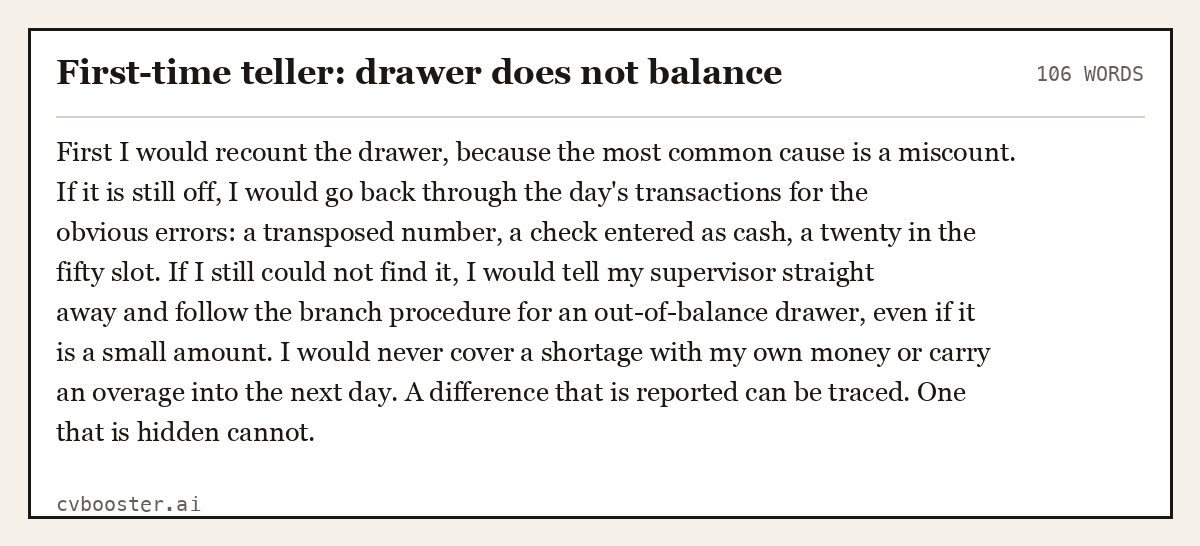
First-time teller: drawer does not balance (106 words)
First I would recount the drawer, because the most common cause is a miscount. If it is still off, I would go back through the day's transactions for the obvious errors: a transposed number, a check entered as cash, a twenty in the fifty slot. If I still could not find it, I would tell my supervisor straight away and follow the branch procedure for an out-of-balance drawer, even if it is a small amount. I would never cover a shortage with my own money or carry an overage into the next day. A difference that is reported can be traced. One that is hidden cannot.
3. A customer wants to deposit $12,000 in cash. What happens?
Experienced tellers should know the report. First-time candidates can still answer well by showing they would follow the procedure without making the customer feel accused.
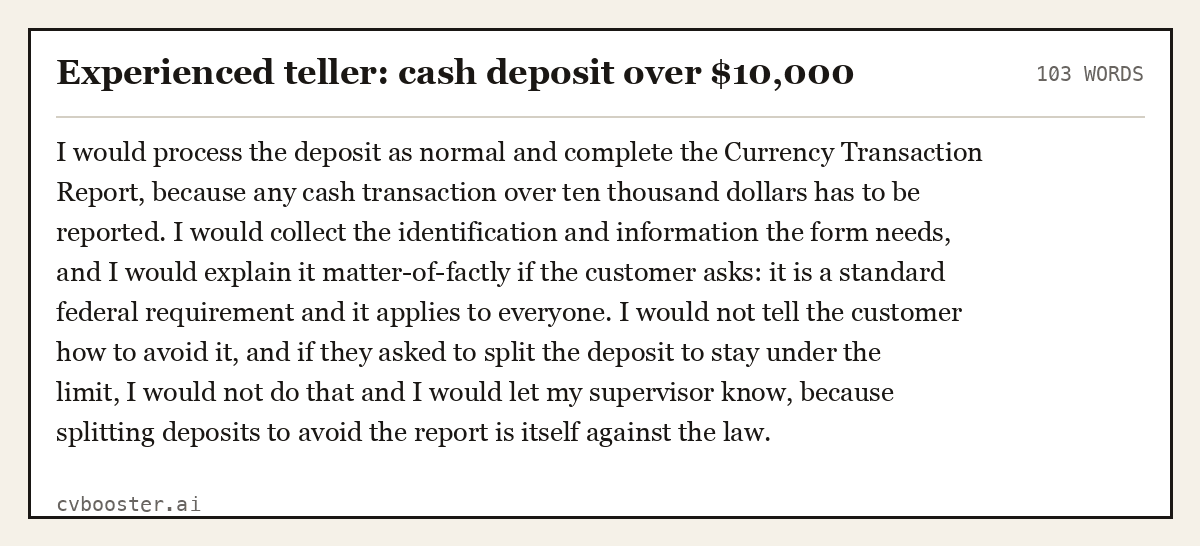
Experienced teller: cash deposit over $10,000 (103 words)
I would process the deposit as normal and complete the Currency Transaction Report, because any cash transaction over ten thousand dollars has to be reported. I would collect the identification and information the form needs, and I would explain it matter-of-factly if the customer asks: it is a standard federal requirement and it applies to everyone. I would not tell the customer how to avoid it, and if they asked to split the deposit to stay under the limit, I would not do that and I would let my supervisor know, because splitting deposits to avoid the report is itself against the law.
That last part is in the regulation. 31 CFR 1010.314 says: "No person shall for the purpose of evading the transactions in currency reporting requirements of this chapter with respect to such transaction" structure a transaction. If you know that phrase exists, the interviewer knows you will not be the teller who helps someone break the rule.
4. How do you handle an angry customer?
Pick a real example. Interviewers want to hear that you listened, fixed what you could, and passed on what you could not.
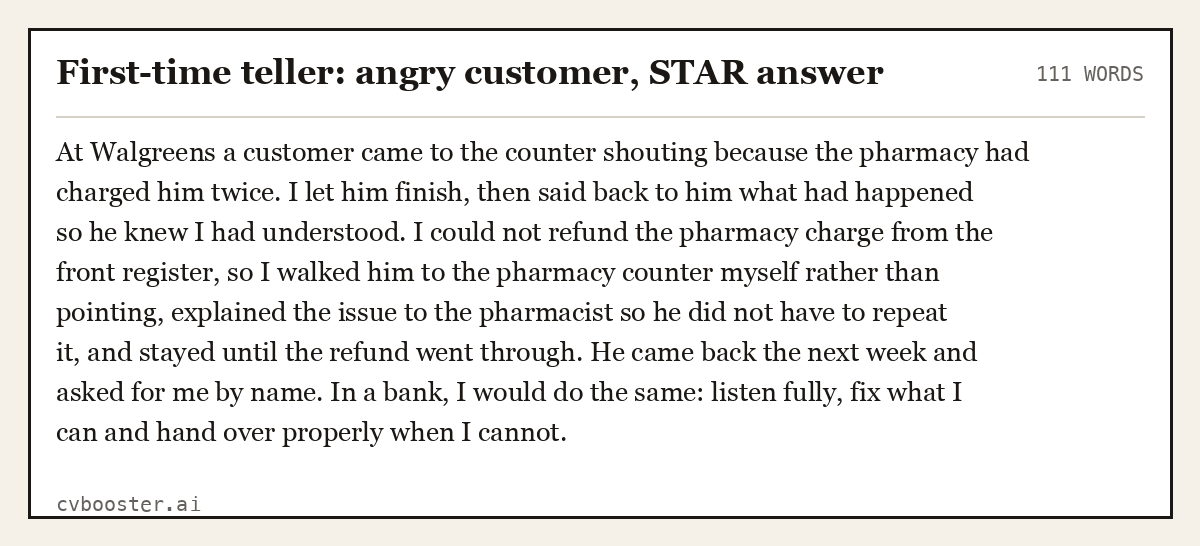
First-time teller: angry customer, STAR answer (111 words)
At Walgreens a customer came to the counter shouting because the pharmacy had charged him twice. I let him finish, then said back to him what had happened so he knew I had understood. I could not refund the pharmacy charge from the front register, so I walked him to the pharmacy counter myself rather than pointing, explained the issue to the pharmacist so he did not have to repeat it, and stayed until the refund went through. He came back the next week and asked for me by name. In a bank, I would do the same: listen fully, fix what I can and hand over properly when I cannot.
5. How would you spot a fraudulent check?
O*NET lists this as a core task: tellers "examine checks for endorsements and to verify other information, such as dates, bank names, identification of the persons receiving payments, and the legality of the documents." Name the checks you would make.
Experienced teller: spotting a fraudulent check (102 words)
I check the basics first: date, payee, the written and numeric amounts matching, and the endorsement. Then the paper itself: security features, a check number that fits the account's history, and a bank routing number that matches the bank named on it. I compare the signature with the one on file. Red flags for me are a new account depositing a large check and asking for cash immediately, or a customer who is nervous and in a hurry. If something is off, I place the item on hold under policy and involve my supervisor rather than accusing the customer at the window.
6. Why do you want to work at a bank?
Avoid "I like money" and "I am good with numbers". Say what you like about the work and give a reason specific to this bank.
First-time teller: why banking (86 words)
I like work where being careful is valued and visible. At my current job, accuracy is something nobody notices until it goes wrong. At a bank it is the whole job, and I would like that. I also like that tellers see the same customers week after week. I want to work here specifically because your branch does a lot of small business banking, and I spent two years helping my aunt with the cash side of her bakery, so I understand what those customers need.
7. How do you feel about sales goals and referrals?
Most tellers have referral targets. Say yes, and show you would refer because it helps the customer, not because there is a target.
Experienced teller: sales goals and referrals (94 words)
I am comfortable with them, as long as the product actually fits the customer. In my last role I met my referral goals most months by listening for real needs at the window. A customer depositing a large check every month into checking might want to know about a savings account. Someone asking about wiring money abroad might need a conversation with a banker about fees. I would rather make one good referral than five that annoy people, because the customer who was helped comes back, and the one who was pushed changes banks.
8. Tell me about a time you made a mistake
Pick a real, small mistake with a clear fix. The interviewer is checking that you own errors and changed something afterwards.
First-time teller: a mistake you made (95 words)
In my first month as a head cashier, I gave a customer change for a fifty when she had handed me a twenty. My register was thirty dollars short at close. I reported it, and the manager and I found it on the camera. After that I started laying the customer's bill across the top of the drawer until the change was counted out, which is what experienced cashiers had told me to do from the start. I have not made that mistake since, and I taught the habit to every new cashier I trained.
9. A customer asks you to break a rule because they are in a hurry
Typical versions: no ID, someone else's account, a withdrawal over the limit. Stay polite, hold the line, and offer an alternative.
Experienced teller: customer wants you to skip ID (100 words)
I would explain politely that I need ID for every withdrawal and that it protects their account as much as the bank. If they are a regular I recognize, I would say so, because people take it better when they know it is not personal. Then I would look for what I can do: if they have ID in the car, I would hold their place; if they need cash urgently, I would remind them about the ATM. What I would not do is make an exception because they are in a hurry, because that is exactly when fraud happens.
10. Where do you see yourself in a few years?
Banks hire tellers who might become personal bankers, lead tellers or branch managers. Say you want to grow inside the branch.
First-time teller: career goals (78 words)
I would like to become a strong teller first, which I expect will take most of the first year. After that, I would like to move towards lead teller and eventually a personal banker role, because I enjoy the conversations about what a customer actually needs. I know your bank promotes from inside, which is one of the reasons I applied. I would rather grow here than move around, because the customers are the part I would miss.
Questions to ask at the end
- How is the teller team scheduled, and how are Saturday shifts shared?
- What does training look like in the first month, and who do new tellers shadow?
- How are referral goals set, and what support do tellers get with them?
- What do your best tellers do that others do not?
- How do tellers usually move into personal banker or lead teller roles here?
The questions to ask in an interview guide has more, sorted by interview stage.
What interviewers are scoring
| Area | What they listen for | Source of the requirement |
|---|---|---|
| Cash handling | Recount, retrace, report; never cover a difference | O*NET teller tasks |
| Compliance | Cash reports over $10,000; never help someone structure | 31 CFR 1010.311 and 1010.314 |
| Fraud | Specific checks on items and on behavior | O*NET teller tasks |
| Customer service | A real example with a calm fix | The interview itself |
| Referrals | Needs first, product second | Branch targets |
O*NET's summary of the job is short: tellers "receive and pay out money" and "keep records of money and negotiable instruments involved in a financial institution's various transactions." Read the full O*NET teller entry before the interview. The reporting rule is 31 CFR 1010.311, and the structuring rule is 31 CFR 1010.314.
When I hired for my own company, the candidates I remembered were the ones who said what they would actually do, step by step, not how they would feel about it. Teller interviews reward that more than most, because every answer has a procedure behind it.
For the method behind the behavioral answers, see the STAR interview questions guide. For the most common general questions, see common interview questions and answers, and for the night before, how to prepare for an interview. The bank teller resume role page has a sample resume for the application itself.
Frequently asked questions
What questions are asked in a bank teller interview?
Expect questions on cash handling, especially what you would do if your drawer did not balance, plus customer service, fraud, sales referrals and following procedure under pressure. Many banks also ask about large cash deposits and identification rules. Behavioral questions like "tell me about a mistake you made" are common and best answered with a real, small example.
How do I answer "why do you want to be a bank teller"?
Give a reason about the work itself, such as liking jobs where accuracy matters, then a reason specific to the bank or branch. Avoid answers about money or being good with numbers. Mention any cash handling experience you already have, such as a cashier or head cashier role.
What is the best answer for a cash drawer that does not balance?
Recount the drawer, retrace the day's transactions for common errors, and report the difference to your supervisor under branch procedure, even if it is small. Say you would never cover a shortage with your own money or carry an overage forward. Interviewers are checking that you report rather than hide.
Do I need banking experience to become a bank teller?
Usually not. Many banks hire tellers from retail, hospitality and cashier jobs because cash handling and customer service transfer directly. In the interview, use examples from those jobs: balancing a register, handling a complaint, spotting a counterfeit bill. Show you understand the procedures even if you have not used them yet.
What should I wear to a bank teller interview?
Business professional or a clean business casual outfit is the safe choice, because tellers face customers all day and the interviewer is picturing you at the counter. A suit is not required at most branches, but a pressed shirt and smart trousers or a dress fits nearly everywhere.
More in this series: Resignation, notice and reference letters
- 2 Week Notice Letter: Five Templates and the US Rules
- Apprenticeship Cover Letter: 6 UK Examples for Every Level
- CNA Resume No Experience: 6 Samples That Lead With Clinicals
- Engineering Cover Letter Examples: 6 Samples by Discipline
- Human Resources Cover Letter: 6 HR Samples From Assistant Up
- Notice Letters Sample: Five Templates and the UK Rules
- Notice Period UK: The Rules and Five Notice Letters
- Recommendation Letter Examples: 8 Reference Letters in Full
- Resume Buzzwords: 150 Action Verbs to Use Instead of Cliches
- Supervisor Resume Examples: 6 Samples From First Shift Lead
- Thank You Letter Examples: 9 Templates and Follow-Up Emails
Related articles
- How to Cancel an Interview: 7 Emails That Keep Doors Open
- Java Interview Questions and Answers: 8 Worked Examples
- Nurse Practitioner Interview Questions With 9 Full Answers
- Pharmacist Interview Questions and Answers: UK Guide
More articles
- Bartender Job Descriptions for a Resume: 8 Examples
- Best Paying Non Degree Jobs in the US: 8 With CV Lines
- Best Resume Format: Chronological vs Functional vs Hybrid
Looking for a worked example for your job title? Browse the resume examples by job title.