Basis Interview Questions and Answers: 7 SAP Examples
By Mustafa Tarabya, founder of CVBooster · Published · Updated
9 min read
Basis interview questions test whether you can keep an SAP system running: work processes and profile parameters, the transport management system, client copies, kernel and support package updates, system refreshes, and what you check first when production slows down. A strong answer names the transaction code, explains why you would use it, and ends with a time you actually did it. The one constraint: a Basis lead can tell in one follow up question whether you have run STMS or only read about it, so every answer below is tied to a real task. Technical points are checked against SAP's own help documentation, and the page has seven complete answers from junior to senior. Written by Mustafa Tarabya, who hired for his own company, read every application himself and now writes CVBooster's guides.
If you have ever been asked "what happens when you press Enter in SAP" and started explaining the keyboard, this page is for you. Start with the question almost every Basis interview opens with.
What does an SAP Basis administrator do?
Interviewers ask this to hear whether you see the whole job or only the tickets you have closed. O*NET's description of systems administrators covers the generic half of it: "Review system and application logs and verify completion of scheduled jobs, including system backups." The SAP specific half is the application server, the transports, the clients and the updates.
Entry level: junior Basis administrator, describing the role (131 words)
Question: What does an SAP Basis administrator do?
Answer: Basis is the technical layer under the SAP applications. The Basis team installs and configures the systems, keeps the application servers and the database healthy, moves changes from development to quality to production through the transport management system, manages clients and system users at the technical level, applies kernel and support package updates, and plans backups and system refreshes.
In my current role I am on the daily checks rota for a three system landscape. Each morning I look at the system log in SM21, short dumps in ST22, failed background jobs in SM37 and stuck update requests in SM13, then log anything unusual for the senior admin. Last month that check caught a failed nightly backup job before the business noticed.
Work process questions in a Basis interview
Work processes are the most common technical topic, because everything else in the application server depends on them. Know the types: dialog (DIA), update (UPD and UPD2), background (BTC), enqueue (ENQ) and spool (SPO), and the profile parameters that set how many of each start.
Junior to mid level: explaining work process types and parameters (142 words)
Question: What work process types are there, and how do you change the number of dialog work processes?
Answer: Dialog processes handle interactive user requests, update processes write changes to the database asynchronously (UPD for the time critical V1 updates, UPD2 for V2), background processes run scheduled jobs, the enqueue process manages the lock table, and spool processes handle printing and output.
The numbers come from instance profile parameters such as rdisp/wp_no_dia for dialog and rdisp/wp_no_btc for background. I would change them in RZ10, check there is enough memory on the host, and restart the instance for the change to take effect. I check the result in SM50, which shows each work process with its type and status.
On our quality system I moved two dialog processes to background during a data migration window and moved them back after the cutover.
SAP's documentation on work processes is worth reading before the interview because some interviewers go one level deeper, into standby and dynamic work processes. It says that "In the process overview (transaction SM50) standby dialog work processes are indicated by status Standby" and that "The maximum number of work processes is 512."
Transport management questions
Expect at least one question on transports, and read SAP's procedure for configuring the transport domain controller before you go in, because a bad transport is the most common way a Basis admin ends up in a meeting with the business.
Mid level: Basis administrator, setting up and running TMS (163 words)
Question: How do you configure the transport management system, and how does a transport move to production?
Answer: You first pick the transport domain controller. According to SAP's procedure you "Log on in client 000 in the SAP system that you want to configure as the transport domain controller" and then call STMS. That creates the TMSADM user and the RFC connections. You then add the other systems to the domain, define transport routes, typically development to quality to production, and distribute the configuration.
The person who made the change releases the request in SE09 or SE10. It lands in the import queue of the quality system, where it is imported and tested. After sign off it is added to the production import queue and imported in the agreed window, in sequence.
At my last company I set up the transport routes for a new four system landscape with a sandbox, and I wrote the change window rules we used for production imports.
Troubleshooting: "the system is slow"
This is the question that separates people who have worked in production from people who have studied for the interview. Answer with an order of checks, not a list of transaction codes.
Mid level: Basis administrator, a production slowdown (154 words)
Question: Users say the production system is slow. What do you do?
Answer: First I check whether it is everyone or one area. Then SM66 for the global work process overview, to see if dialog processes are all busy and what they are running. If one long running report is holding several processes, I find the user and the program. I check SM12 for old locks, SM13 for update requests that failed or are waiting, ST06 or the OS monitor for CPU and memory, and the database for long running statements and space.
Last spring a month end report was started forty times by the same scheduled job because of a wrong variant. Every background process was busy and dialog users queued behind it. I stopped the duplicate jobs in SM37, corrected the variant with the job owner, and added an alert in our monitoring for more than five instances of the same job.
Client copy, kernel and support package questions
These questions test whether you know the tools and the risks. Name the transaction and say what you check before you start.
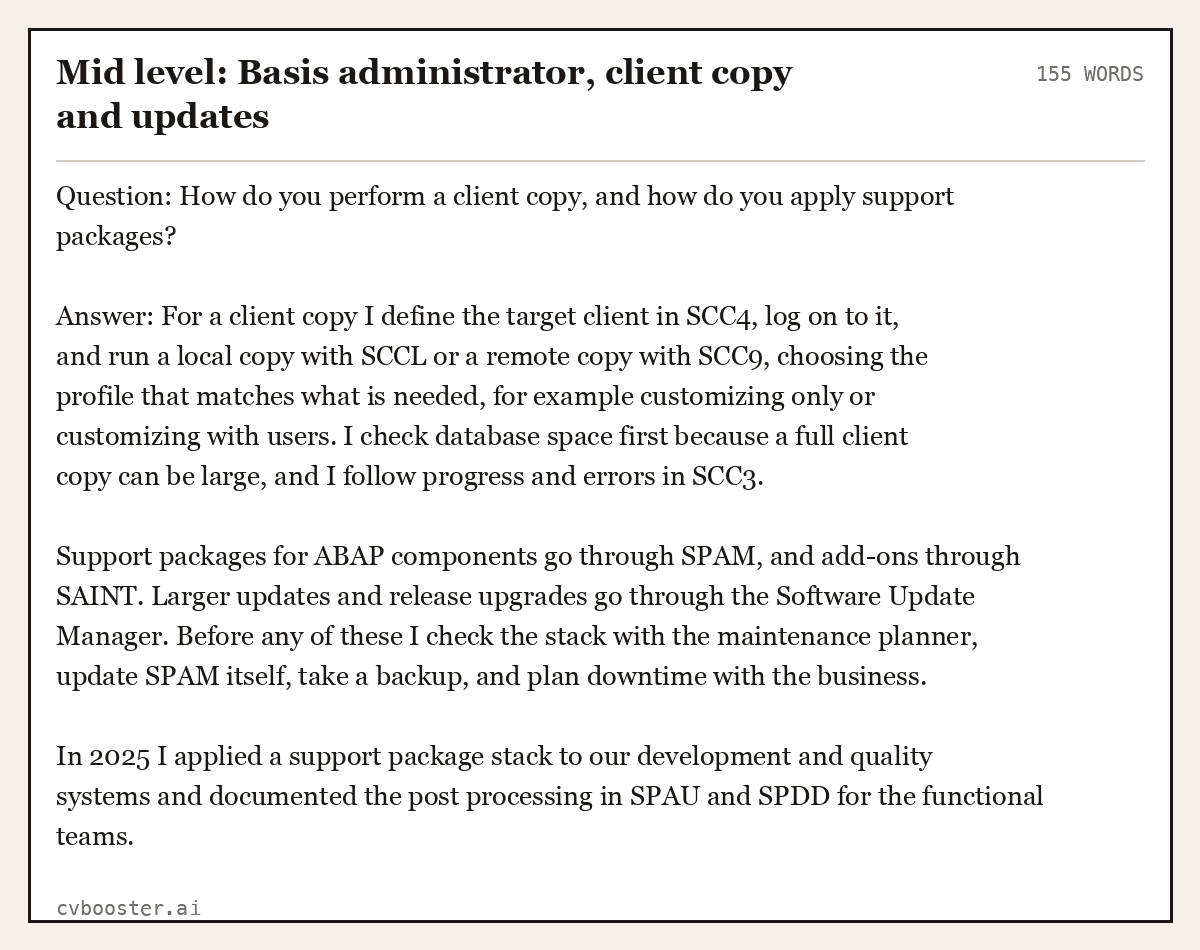
Mid level: Basis administrator, client copy and updates (155 words)
Question: How do you perform a client copy, and how do you apply support packages?
Answer: For a client copy I define the target client in SCC4, log on to it, and run a local copy with SCCL or a remote copy with SCC9, choosing the profile that matches what is needed, for example customizing only or customizing with users. I check database space first because a full client copy can be large, and I follow progress and errors in SCC3.
Support packages for ABAP components go through SPAM, and add-ons through SAINT. Larger updates and release upgrades go through the Software Update Manager. Before any of these I check the stack with the maintenance planner, update SPAM itself, take a backup, and plan downtime with the business.
In 2025 I applied a support package stack to our development and quality systems and documented the post processing in SPAU and SPDD for the functional teams.
Basis interview questions for experienced candidates
Senior roles get a refresh or an upgrade scenario and a leadership question.
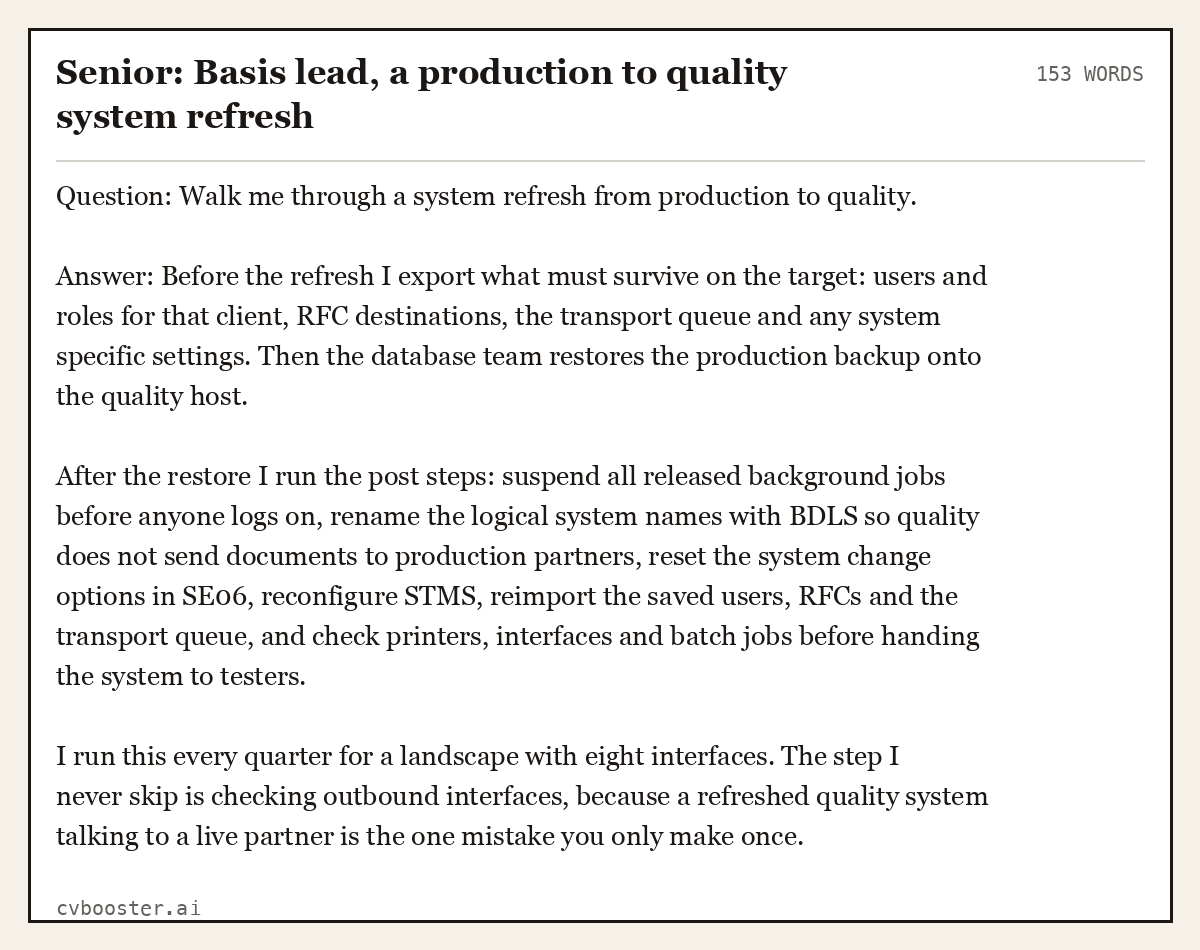
Senior: Basis lead, a production to quality system refresh (153 words)
Question: Walk me through a system refresh from production to quality.
Answer: Before the refresh I export what must survive on the target: users and roles for that client, RFC destinations, the transport queue and any system specific settings. Then the database team restores the production backup onto the quality host.
After the restore I run the post steps: suspend all released background jobs before anyone logs on, rename the logical system names with BDLS so quality does not send documents to production partners, reset the system change options in SE06, reconfigure STMS, reimport the saved users, RFCs and the transport queue, and check printers, interfaces and batch jobs before handing the system to testers.
I run this every quarter for a landscape with eight interfaces. The step I never skip is checking outbound interfaces, because a refreshed quality system talking to a live partner is the one mistake you only make once.
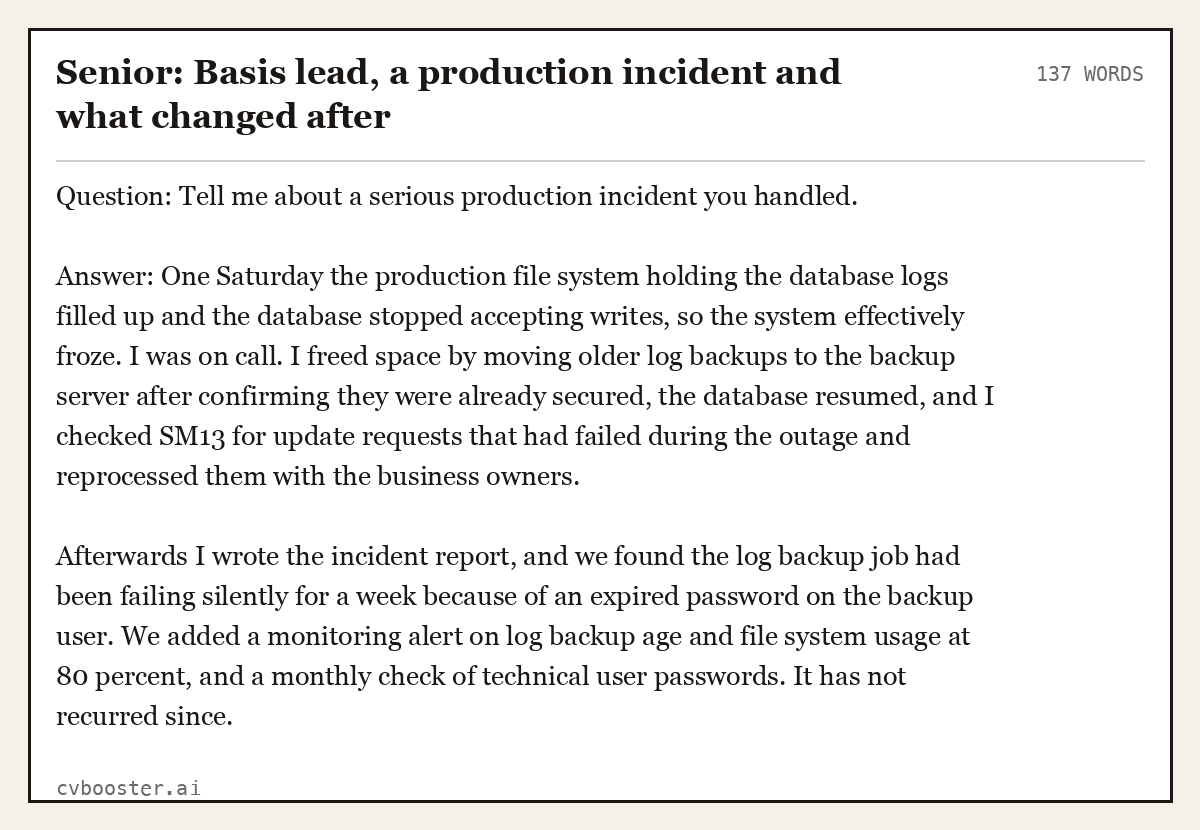
Senior: Basis lead, a production incident and what changed after (137 words)
Question: Tell me about a serious production incident you handled.
Answer: One Saturday the production file system holding the database logs filled up and the database stopped accepting writes, so the system effectively froze. I was on call. I freed space by moving older log backups to the backup server after confirming they were already secured, the database resumed, and I checked SM13 for update requests that had failed during the outage and reprocessed them with the business owners.
Afterwards I wrote the incident report, and we found the log backup job had been failing silently for a week because of an expired password on the backup user. We added a monitoring alert on log backup age and file system usage at 80 percent, and a monthly check of technical user passwords. It has not recurred since.
Other Basis interview questions to prepare
- What happens when a user logs on to SAP, from the SAP GUI to the dispatcher and the work process?
- What is the difference between a central instance and a dialog instance, or in newer terms, the ASCS and the application servers?
- How do you schedule and monitor background jobs (SM36, SM37)?
- What is SAProuter used for?
- How do you lock and unlock users, and who should own user administration in your organization?
- How do you check SAP HANA memory and backup status?
- What is the difference between SPAM, SAINT and SUM?
- How do you handle an import that failed with return code 8?
For the general technical round style, the technical interview questions page shows how to talk through a problem out loud, and the STAR interview questions guide covers the incident and teamwork stories. If the interviewer moves into hypotheticals, the situational interview questions page has the structure. Your resume should name the same tools; the SAP consultant resume page shows how to list them.
Frequently asked questions
What questions are asked in an SAP Basis interview?
Expect questions on the role itself, work process types and profile parameters, the transport management system, client copies, kernel and support package updates, system refreshes, performance troubleshooting with SM50, SM66, ST22 and SM21, and background jobs. Senior interviews add upgrades, database topics such as SAP HANA backups, and a production incident you handled.
How do I prepare for an SAP Basis interview?
List the transaction codes you use and practice explaining why you would use each one. Prepare two or three real stories: a transport problem, a slowdown and a refresh or update. Read SAP's help pages on work processes and the transport management system, and be ready to draw your landscape with its systems, clients and transport routes.
What are basic SAP Basis interview questions for freshers?
Freshers are usually asked what Basis is, what the work process types are, what a client is, how transports move from development to production, and which daily checks an administrator runs, such as SM21 for the system log, ST22 for short dumps, SM37 for background jobs and SM13 for update requests.
How do I answer if I do not know a transaction code?
Say what you would be trying to check and how you would find it, for example the work process overview or the lock table, and say you would confirm the exact transaction. Interviewers care more that you know the order of checks and the risk than that you remember every code under pressure.
What should an experienced SAP Basis administrator highlight in an interview?
Landscape size, the databases and releases you have run, upgrades or conversions you led, refresh and disaster recovery work, and how you handled production incidents. Give numbers where you have them, such as systems supported, users, downtime windows and how long an upgrade took from plan to go live.
Related articles
- Accountancy CV Example: 6 UK Accounts CVs by Career Level
- Accounting Interview Questions and Answers: 7 Full Examples
- Activity Resume Example: 6 Samples for College Applications
- Administration CV Example: 6 Admin CVs from Entry to Senior
More articles
- Best Paying Non Degree Jobs in the US: 8 With CV Lines
- Best Resume Format: Chronological vs Functional vs Hybrid
- Biologist Resume: 6 Examples From Field Tech to Lead
Looking for a worked example for your job title? Browse the resume examples by job title.