Situational Interview Questions: 8 Full Sample Answers
By Mustafa Tarabya, founder of CVBooster · Published · Updated
9 min read
Situational interview questions describe a work problem that has not happened yet and ask what you would do: a teammate who stops pulling their weight, two urgent deadlines, an upset client. The panel is not checking whether you know the right answer by heart; it is scoring your reasoning against a list of behaviours written before you walked in. Below are eight complete sample answers, a four step method you can use on any scenario, and the scoring guide the Government of Canada publishes for its own panels. Written by Mustafa Tarabya, who hired for his own company, read every application himself and now writes CVBooster's guides.
The Public Service Commission of Canada defines the format plainly: "These questions present applicants with a hypothetical situation relevant to the position. These situations are typical of what applicants are likely to encounter on the job." It adds that the method rests on one idea: "people's intentions are predictive of their future behaviour" (Public Service Commission, How to conduct interviews).
A four step method for any situational question
Most strong answers follow the same shape. I call it the clarify, act, involve, check method:
- Clarify. Say what you would want to find out first. Real problems have missing facts, and naming them shows judgment.
- Act. Say what you would do yourself, in order, in plain verbs.
- Involve. Say who you would bring in, and when. Not everyone, and not your supervisor as a first move.
- Check. Say how you would know it worked and what you would do if it did not.
Keep each answer to about ninety seconds. If the question has follow up parts, such as "Why?" or "Who would you involve?", answer each one by name so the panel can tick it.
Teamwork: a colleague does not do their share
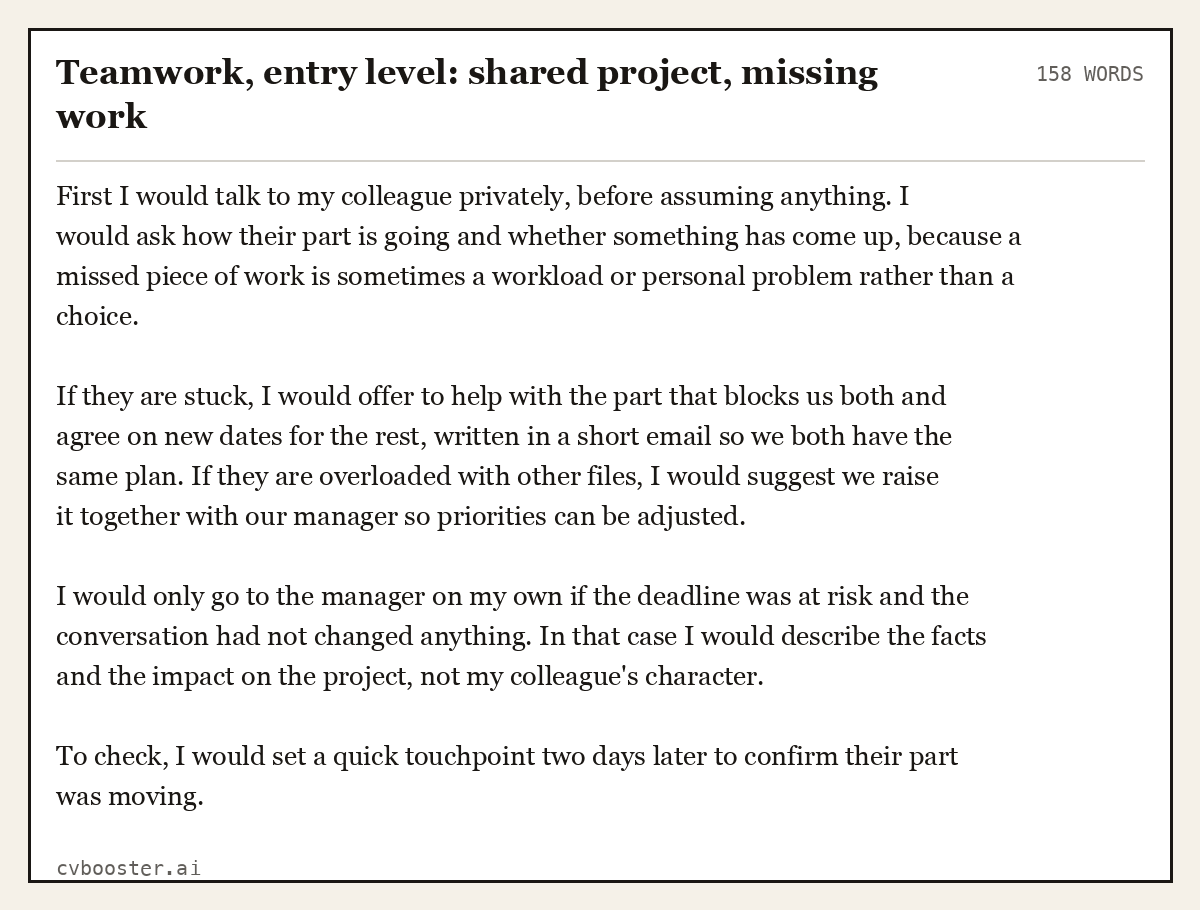
This scenario comes straight from the Commission's own list of teamwork questions: "Consider a situation where you and a co-worker are working on a project together. You both agreed on how the work was to be divided up. However, your co-worker fails to do their share of the work."
Teamwork, entry level: shared project, missing work (158 words)
First I would talk to my colleague privately, before assuming anything. I would ask how their part is going and whether something has come up, because a missed piece of work is sometimes a workload or personal problem rather than a choice.
If they are stuck, I would offer to help with the part that blocks us both and agree on new dates for the rest, written in a short email so we both have the same plan. If they are overloaded with other files, I would suggest we raise it together with our manager so priorities can be adjusted.
I would only go to the manager on my own if the deadline was at risk and the conversation had not changed anything. In that case I would describe the facts and the impact on the project, not my colleague's character.
To check, I would set a quick touchpoint two days later to confirm their part was moving.
Teamwork: proposing a change your team resists
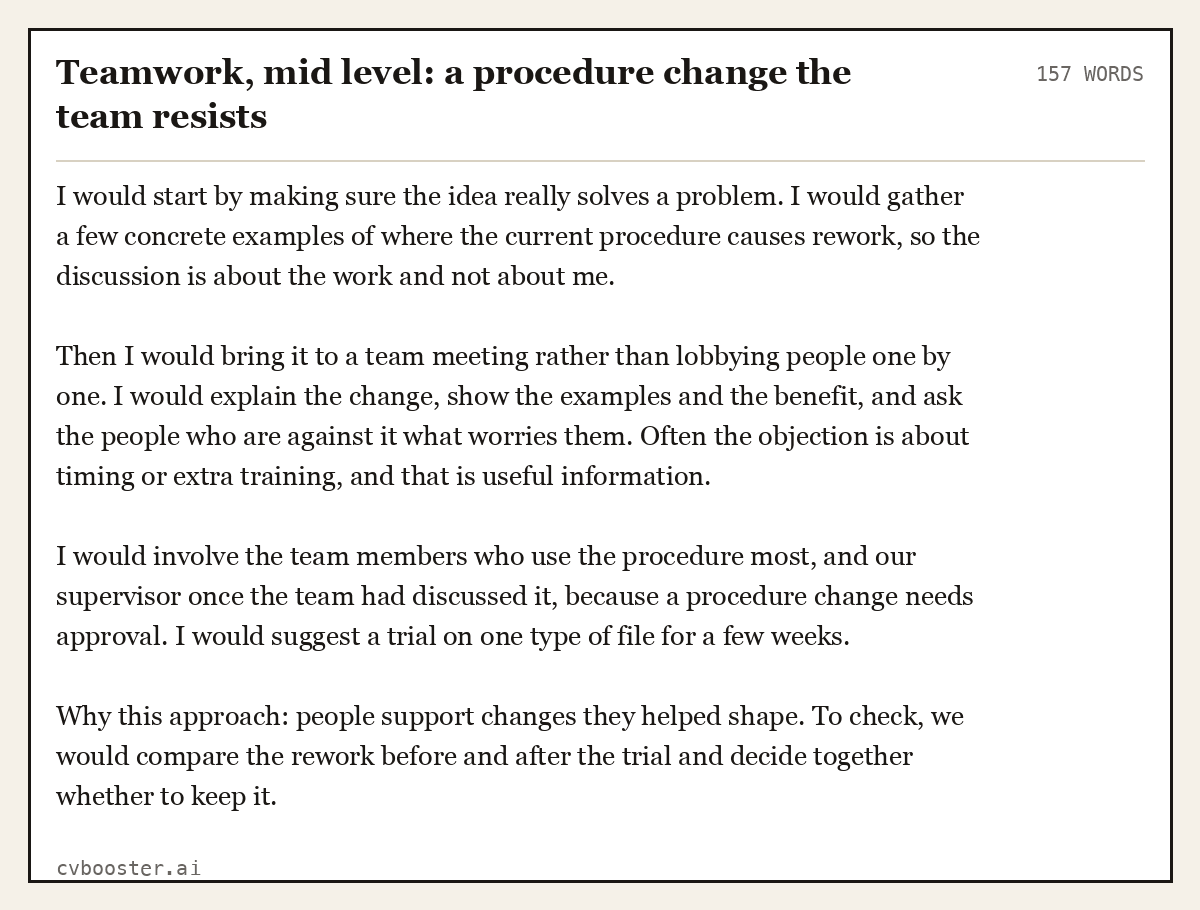
The Commission publishes this question with its scoring guide, which makes it the best practice question there is: "Suppose you had an idea for a change in procedure to enhance work quality, but some members of your work team were against any type of change."
Teamwork, mid level: a procedure change the team resists (157 words)
I would start by making sure the idea really solves a problem. I would gather a few concrete examples of where the current procedure causes rework, so the discussion is about the work and not about me.
Then I would bring it to a team meeting rather than lobbying people one by one. I would explain the change, show the examples and the benefit, and ask the people who are against it what worries them. Often the objection is about timing or extra training, and that is useful information.
I would involve the team members who use the procedure most, and our supervisor once the team had discussed it, because a procedure change needs approval. I would suggest a trial on one type of file for a few weeks.
Why this approach: people support changes they helped shape. To check, we would compare the rework before and after the trial and decide together whether to keep it.
How the panel scores it: in the Commission's example, the excellent answer is "Explain the change and try to show the benefits. Discuss it openly in a meeting." A good answer is "Ask them why they are against change. Try to convince them." The unacceptable answer is "Tell the supervisor." Notice that escalating first scores lowest.
Customer service: a client who is angry about a delay
Customer service, entry level: an upset client at the counter (135 words)
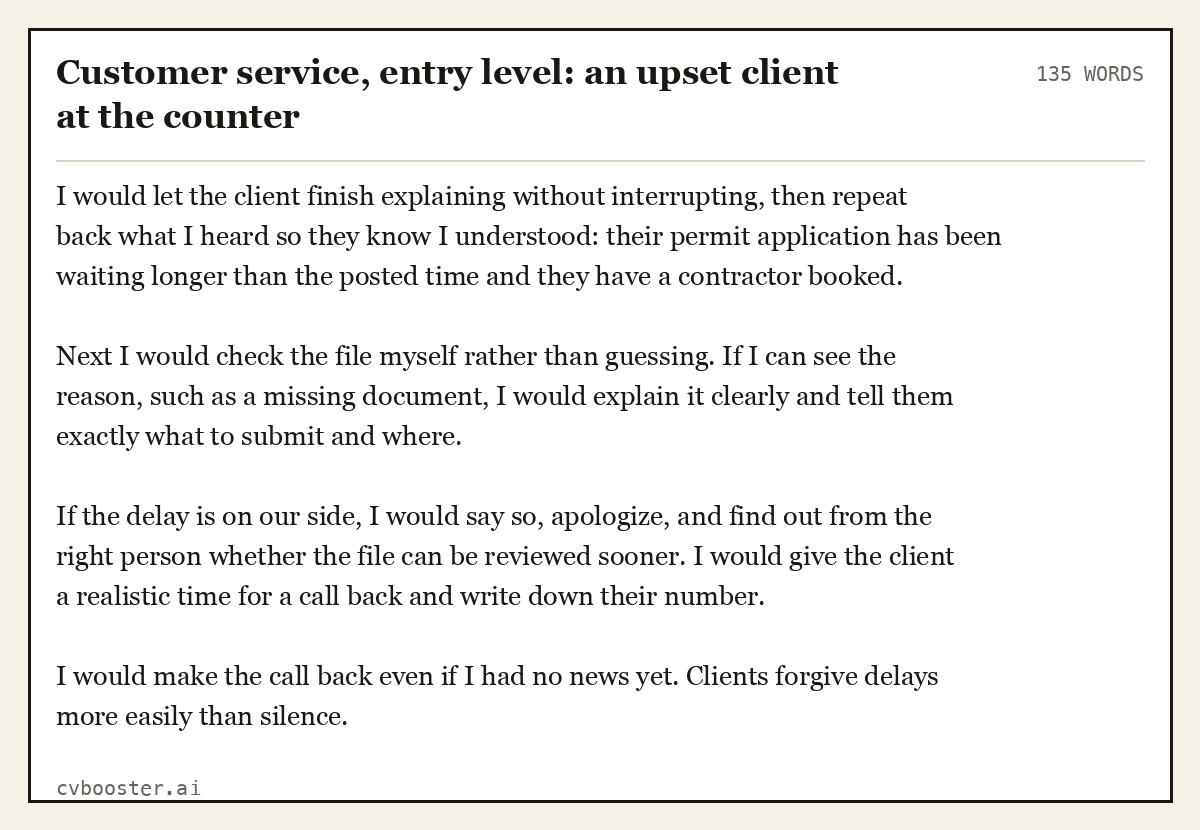
I would let the client finish explaining without interrupting, then repeat back what I heard so they know I understood: their permit application has been waiting longer than the posted time and they have a contractor booked.
Next I would check the file myself rather than guessing. If I can see the reason, such as a missing document, I would explain it clearly and tell them exactly what to submit and where.
If the delay is on our side, I would say so, apologize, and find out from the right person whether the file can be reviewed sooner. I would give the client a realistic time for a call back and write down their number.
I would make the call back even if I had no news yet. Clients forgive delays more easily than silence.
Priorities: two urgent requests at once
Organization, mid level: two managers, two deadlines (138 words)
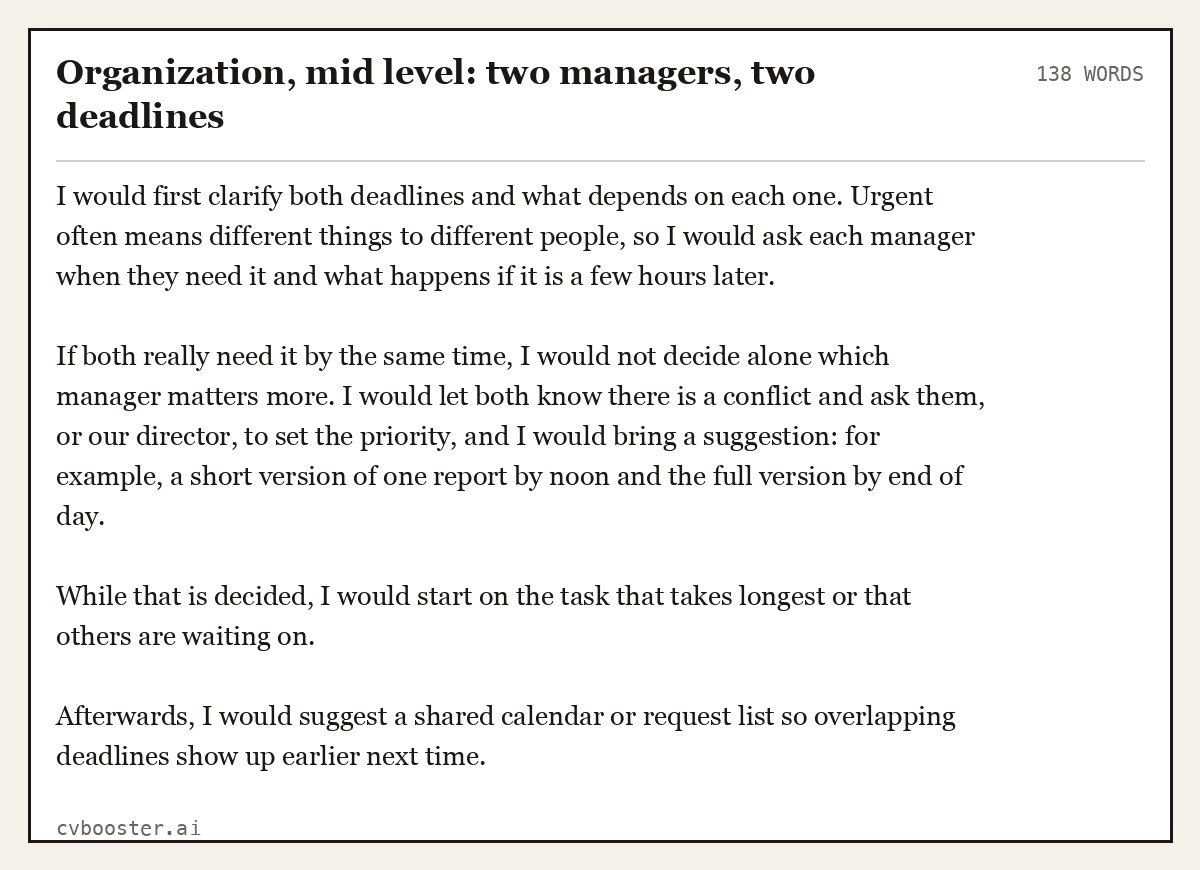
I would first clarify both deadlines and what depends on each one. Urgent often means different things to different people, so I would ask each manager when they need it and what happens if it is a few hours later.
If both really need it by the same time, I would not decide alone which manager matters more. I would let both know there is a conflict and ask them, or our director, to set the priority, and I would bring a suggestion: for example, a short version of one report by noon and the full version by end of day.
While that is decided, I would start on the task that takes longest or that others are waiting on.
Afterwards, I would suggest a shared calendar or request list so overlapping deadlines show up earlier next time.
Integrity: you notice a colleague breaking a rule
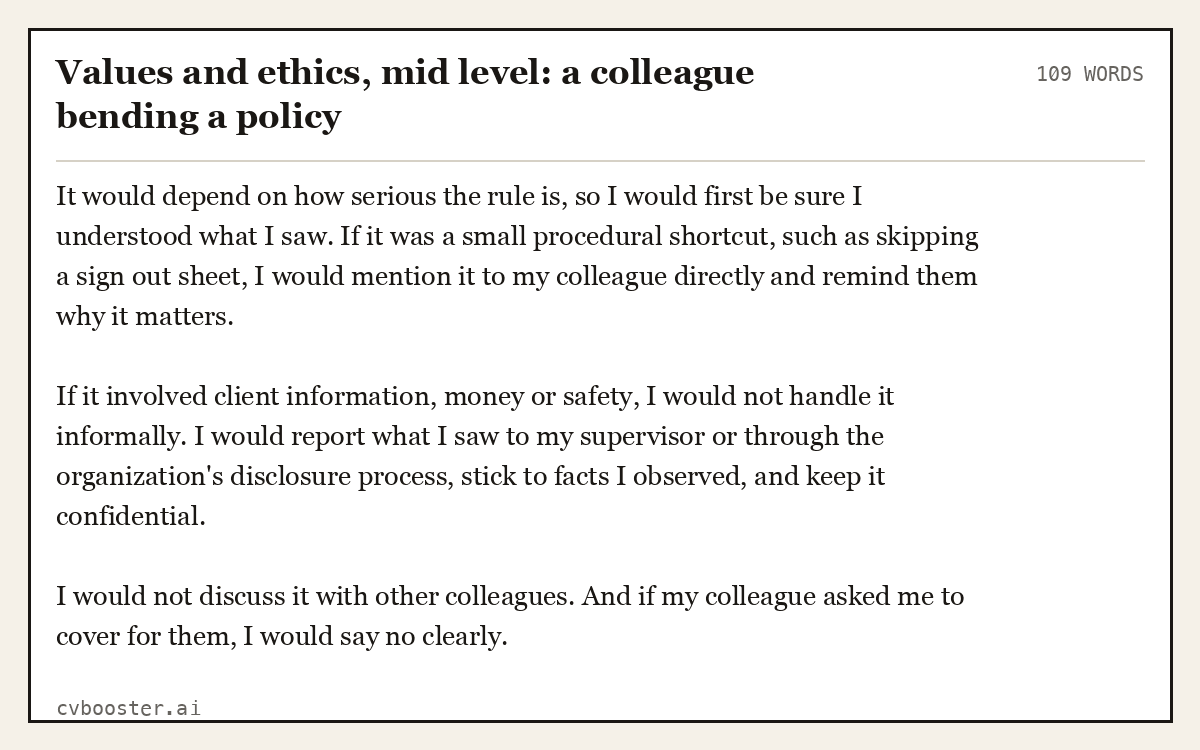
Values and ethics, mid level: a colleague bending a policy (109 words)
It would depend on how serious the rule is, so I would first be sure I understood what I saw. If it was a small procedural shortcut, such as skipping a sign out sheet, I would mention it to my colleague directly and remind them why it matters.
If it involved client information, money or safety, I would not handle it informally. I would report what I saw to my supervisor or through the organization's disclosure process, stick to facts I observed, and keep it confidential.
I would not discuss it with other colleagues. And if my colleague asked me to cover for them, I would say no clearly.
Leadership: a new team member is struggling
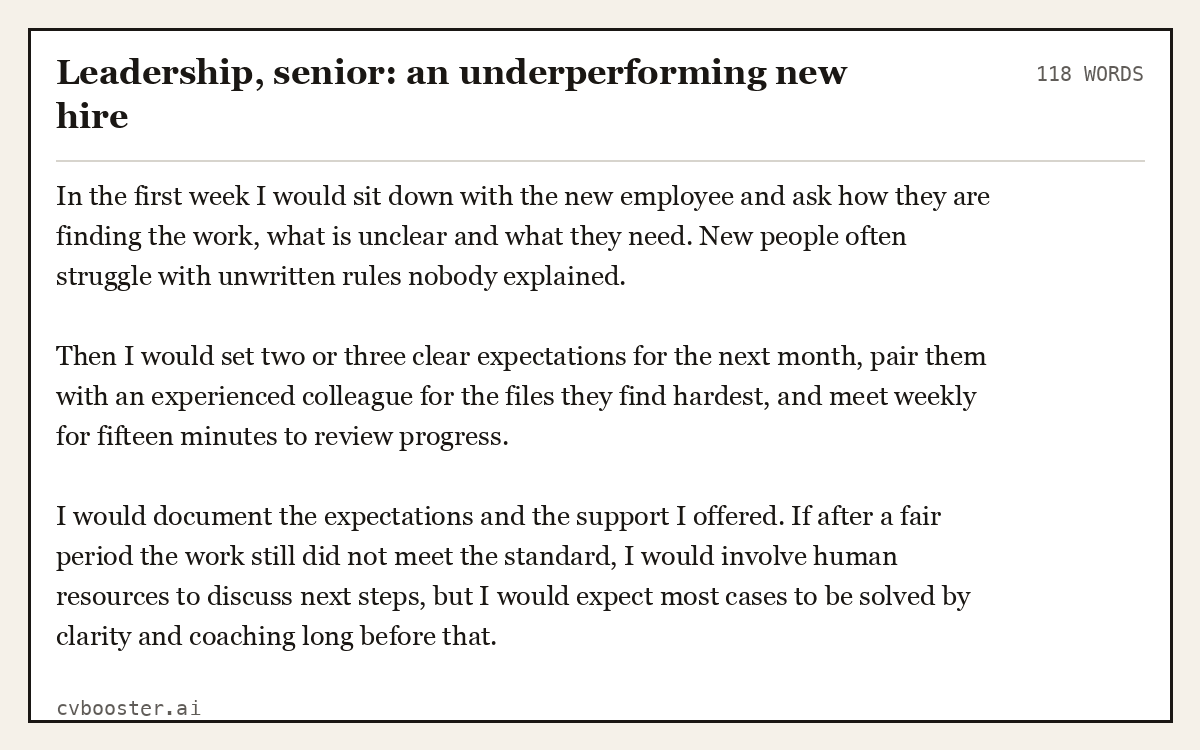
Leadership, senior: an underperforming new hire (118 words)
In the first week I would sit down with the new employee and ask how they are finding the work, what is unclear and what they need. New people often struggle with unwritten rules nobody explained.
Then I would set two or three clear expectations for the next month, pair them with an experienced colleague for the files they find hardest, and meet weekly for fifteen minutes to review progress.
I would document the expectations and the support I offered. If after a fair period the work still did not meet the standard, I would involve human resources to discuss next steps, but I would expect most cases to be solved by clarity and coaching long before that.
Safety: a hazard nobody has reported
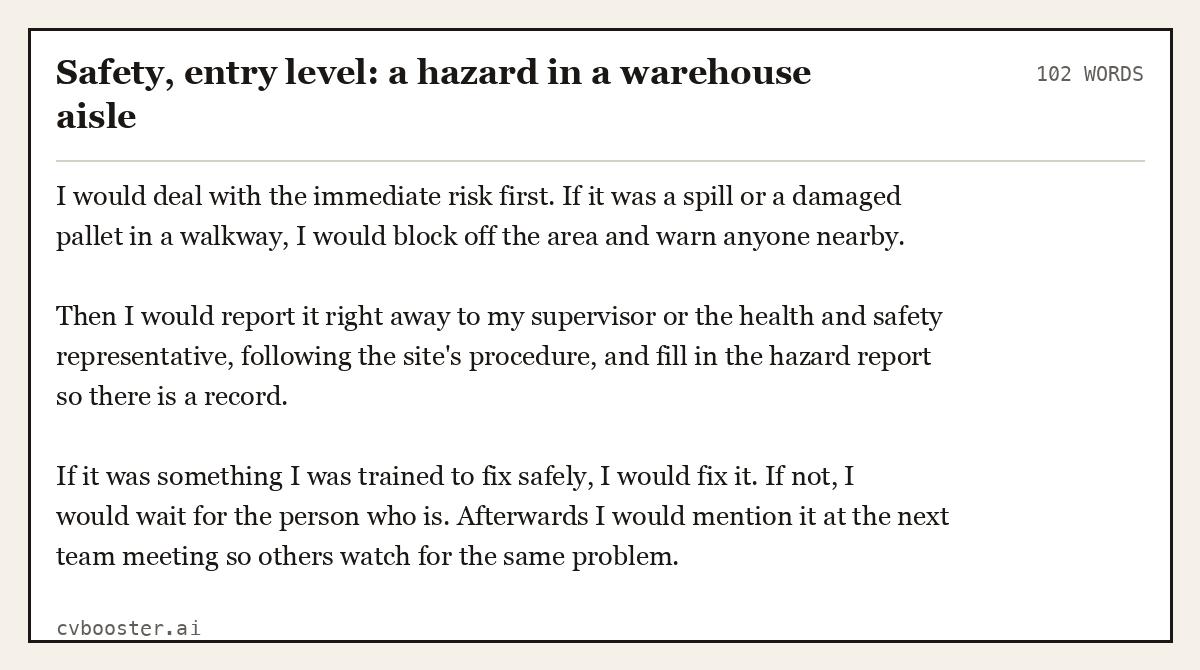
Safety, entry level: a hazard in a warehouse aisle (102 words)
I would deal with the immediate risk first. If it was a spill or a damaged pallet in a walkway, I would block off the area and warn anyone nearby.
Then I would report it right away to my supervisor or the health and safety representative, following the site's procedure, and fill in the hazard report so there is a record.
If it was something I was trained to fix safely, I would fix it. If not, I would wait for the person who is. Afterwards I would mention it at the next team meeting so others watch for the same problem.
Adaptability: your plan changes at the last minute
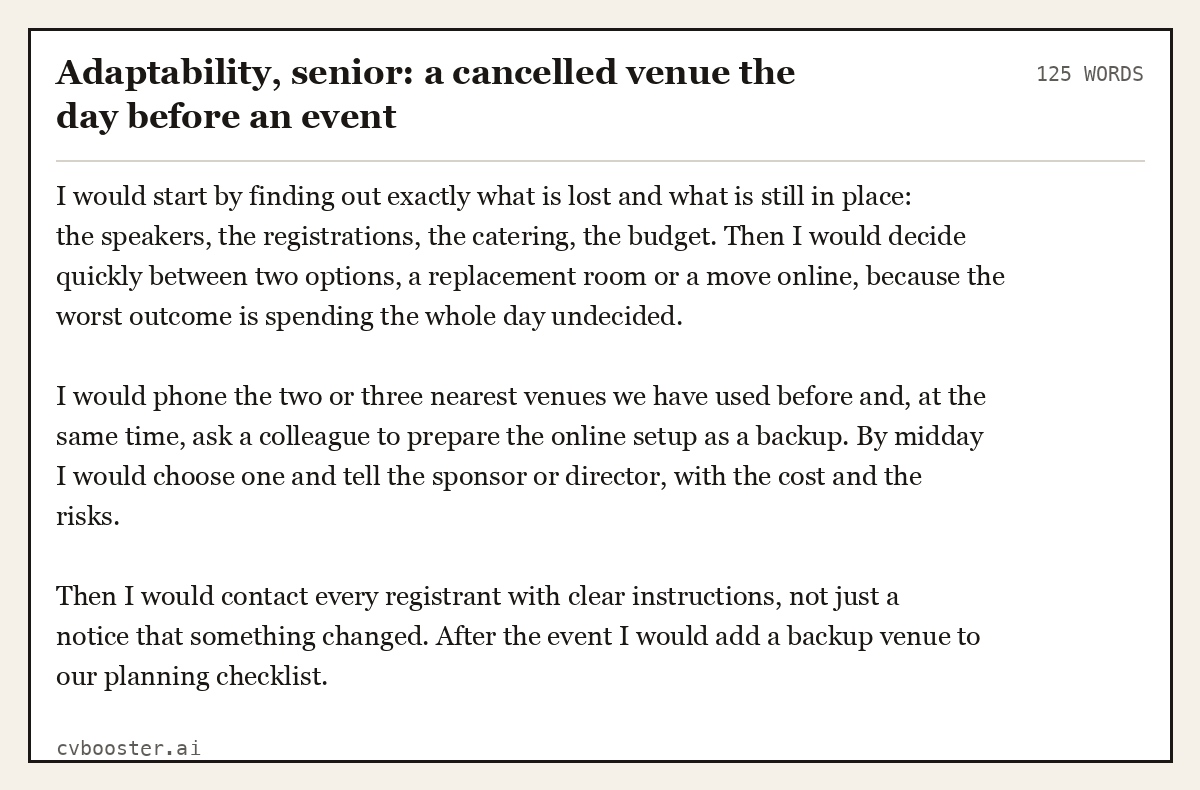
Adaptability, senior: a cancelled venue the day before an event (125 words)
I would start by finding out exactly what is lost and what is still in place: the speakers, the registrations, the catering, the budget. Then I would decide quickly between two options, a replacement room or a move online, because the worst outcome is spending the whole day undecided.
I would phone the two or three nearest venues we have used before and, at the same time, ask a colleague to prepare the online setup as a backup. By midday I would choose one and tell the sponsor or director, with the cost and the risks.
Then I would contact every registrant with clear instructions, not just a notice that something changed. After the event I would add a backup venue to our planning checklist.
Situational vs behavioural questions
Behavioural questions ask what you did in the past and usually open with tell me about a time when. Situational questions ask what you would do. Panels often pair them on the same competency; the BC Public Service publishes its own sample behavioural questions by competency, which make good practice material for both types. The Commission notes that situational questions let candidates answer without relying on a past job, "thus not placing anyone at a disadvantage", which is why they suit new graduates and career changers.
For behavioural questions, the STAR structure in our STAR interview questions guide works best. For competency interviews more generally, see competency based interview questions and answers. If the scenarios come as a written test rather than in person, look at the Commission's Situational Judgement Test sample questions, and our judgement test examples show how multiple choice versions are scored. Read the Commission's own explanation of how panels rate answers in The structured selection interview, and for general preparation read our common interview questions and answers. For manager and general manager roles, business management interview questions has seven full answers on budgets, people and change.
Frequently asked questions
What are situational interview questions?
They are interview questions that describe a hypothetical work situation, usually one typical of the job, and ask what you would do. Panels score the answer against behaviours agreed in advance, such as gathering facts, involving the right people and following up.
How do you answer situational interview questions?
Clarify what you would need to know, describe the actions you would take in order, say who you would involve and when, and explain how you would check the result. Answer each follow up part of the question by name and keep it to about ninety seconds.
What is the difference between situational and behavioural interview questions?
Behavioural questions ask about something you did in the past. Situational questions ask what you would do in a scenario. Many Canadian employers, including the federal public service, use both in the same interview.
Should I use the STAR method for situational questions?
Not exactly, because there is no past result to report. Use a forward version instead: what you would find out, what you would do, who you would involve and how you would know it worked. If you have a real example of a similar situation, you can add it briefly at the end.
Is going to my manager a bad answer?
Going to your manager first usually scores poorly, because panels want to see that you can handle a problem at your level. Involving your manager is right when the issue is serious, beyond your authority, or not solved by a direct conversation.
Related articles
- Accountancy CV Example: 6 UK Accounts CVs by Career Level
- Accounting Interview Questions and Answers: 7 Full Examples
- Activity Resume Example: 6 Samples for College Applications
- Administration CV Example: 6 Admin CVs from Entry to Senior
More articles
- Skills Based CV Template and Format: 6 UK Examples
- Skills to Put on a Job Application Form
- Skills to Put on a Resume (and What to Cut)
Looking for a worked example for your job title? Browse the resume examples by job title.