Care Assistant Interview Questions and 15 Full Answers
By Mustafa Tarabya, founder of CVBooster · Published · Updated
19 min read
Care assistant interviews are decided on three answers: a safeguarding answer that names the policy, a dignity answer with a real person in it, and a reason for wanting care work that is not "I like helping people". Most panels use the same fifteen questions, and almost all of them are behavioural, so an answer without a situation in it scores nothing. The standards below are the CQC fundamental standards, last updated 3 March 2026, and the Skills for Care Code of Conduct, quoted by name. Fifteen full answers follow, each with what the panel is scoring and the wording that loses marks. Written by Mustafa Tarabya, a qualified care worker who has hired care staff and been hired as one. Reviewed September 2026.
There is no download here. All fifteen interview questions and answers are on this page in full. The page prints cleanly, so a care worker interview questions and answers pdf is not needed.
Opening questions
What do you think a care assistant does?
*What the panel is testing:* whether you understand that observation and recording are the job, not an add-on to washing and dressing.
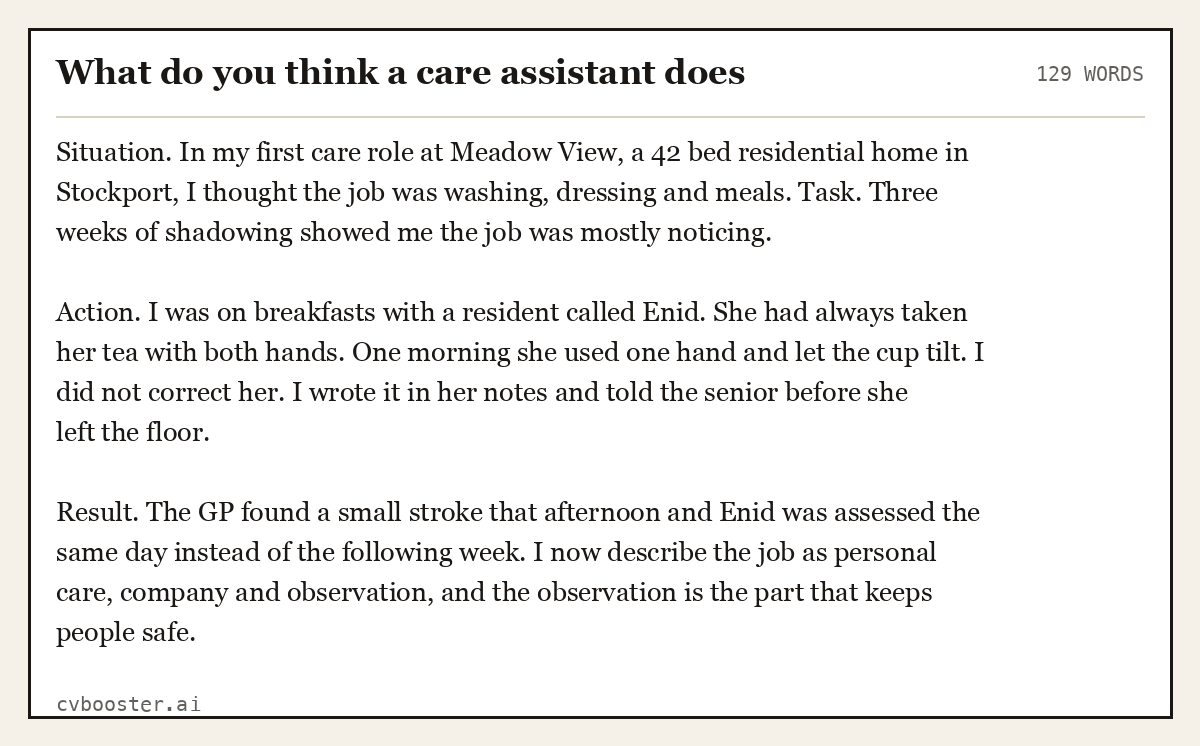
Situation. In my first care role at Meadow View, a 42 bed residential home in Stockport, I thought the job was washing, dressing and meals. Task. Three weeks of shadowing showed me the job was mostly noticing.
Action. I was on breakfasts with a resident called Enid. She had always taken her tea with both hands. One morning she used one hand and let the cup tilt. I did not correct her. I wrote it in her notes and told the senior before she left the floor.
Result. The GP found a small stroke that afternoon and Enid was assessed the same day instead of the following week. I now describe the job as personal care, company and observation, and the observation is the part that keeps people safe.
Panel is listening for: "be alert to any changes that could affect a person's needs or progress and report your observations in line with your employer's agreed ways of working". Source: Skills for Care, Code of Conduct, guidance statement 2.7.
*The wrong answer:* a task list. Anyone can read a job advert back.
Why do you want to work in care?
*What the panel is testing:* whether the reason will survive a hard week, so they want a person, not a sentiment.
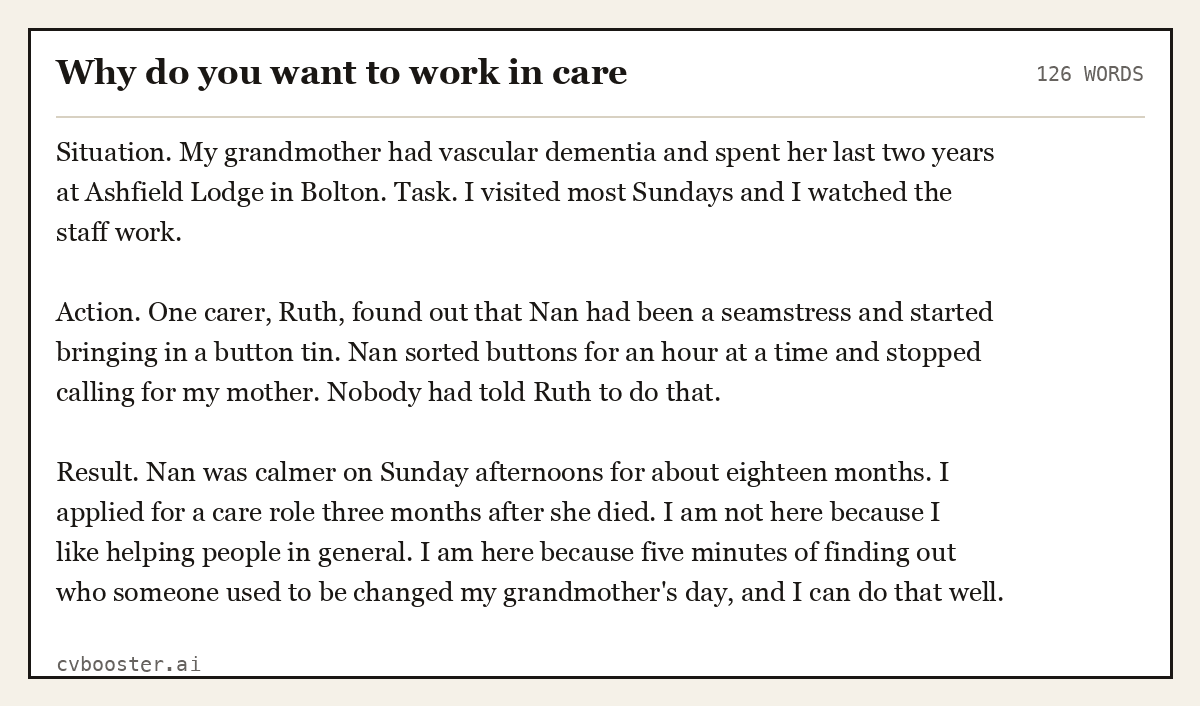
Situation. My grandmother had vascular dementia and spent her last two years at Ashfield Lodge in Bolton. Task. I visited most Sundays and I watched the staff work.
Action. One carer, Ruth, found out that Nan had been a seamstress and started bringing in a button tin. Nan sorted buttons for an hour at a time and stopped calling for my mother. Nobody had told Ruth to do that.
Result. Nan was calmer on Sunday afternoons for about eighteen months. I applied for a care role three months after she died. I am not here because I like helping people in general. I am here because five minutes of finding out who someone used to be changed my grandmother's day, and I can do that well.
Panel is listening for: "You must have care or treatment that is tailored to you and meets your needs and preferences". Source: CQC, person-centred care.
*The wrong answer:* "I am a people person." It tells the manager nothing she can score.
Tell me about yourself and your care experience.
*What the panel is testing:* whether you can give setting, size and dates in under a minute without rambling.
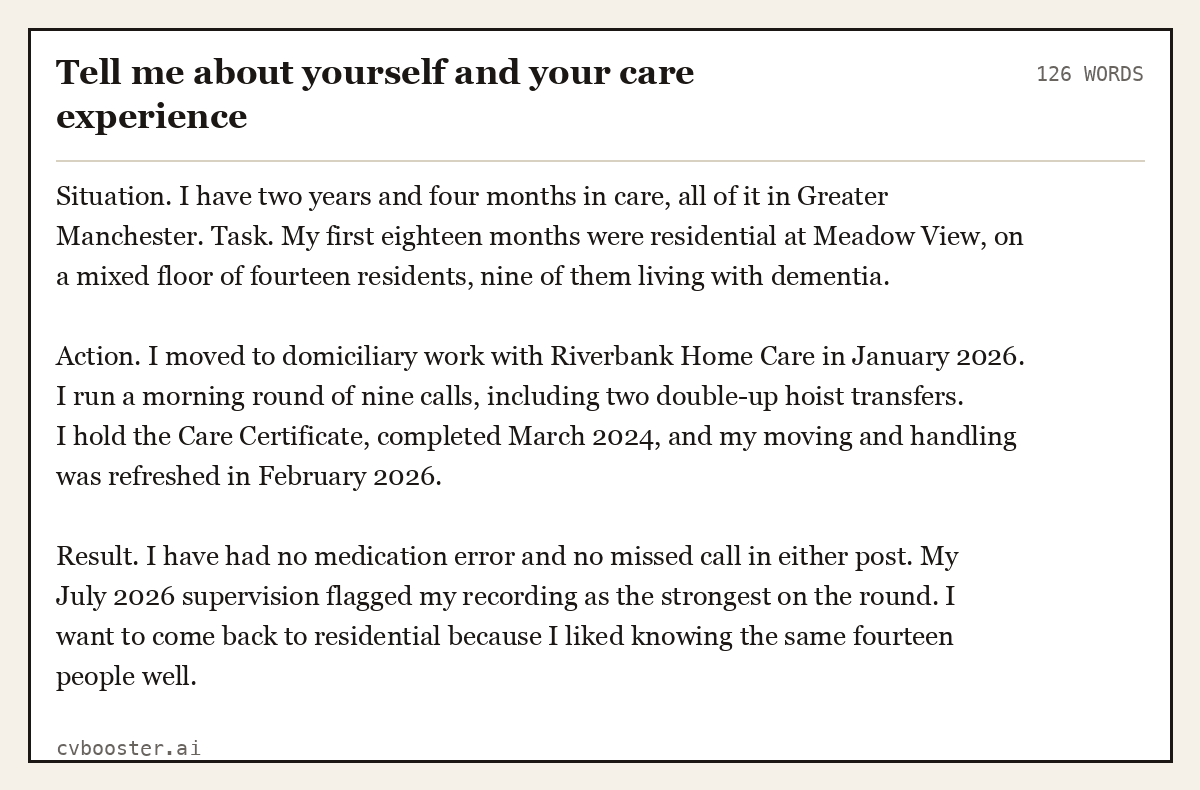
Situation. I have two years and four months in care, all of it in Greater Manchester. Task. My first eighteen months were residential at Meadow View, on a mixed floor of fourteen residents, nine of them living with dementia.
Action. I moved to domiciliary work with Riverbank Home Care in January 2026. I run a morning round of nine calls, including two double-up hoist transfers. I hold the Care Certificate, completed March 2024, and my moving and handling was refreshed in February 2026.
Result. I have had no medication error and no missed call in either post. My July 2026 supervision flagged my recording as the strongest on the round. I want to come back to residential because I liked knowing the same fourteen people well.
Panel is listening for: "ensure up to date compliance with all statutory and mandatory training, in agreement with your supervisor". Source: Skills for Care, Code of Conduct, guidance statement 6.1.
*The wrong answer:* your life story from school onwards. Start at your first care post.
Values questions
What does dignity mean to you in practice?
*What the panel is testing:* whether dignity is a poster word to you or a set of habits they can picture.
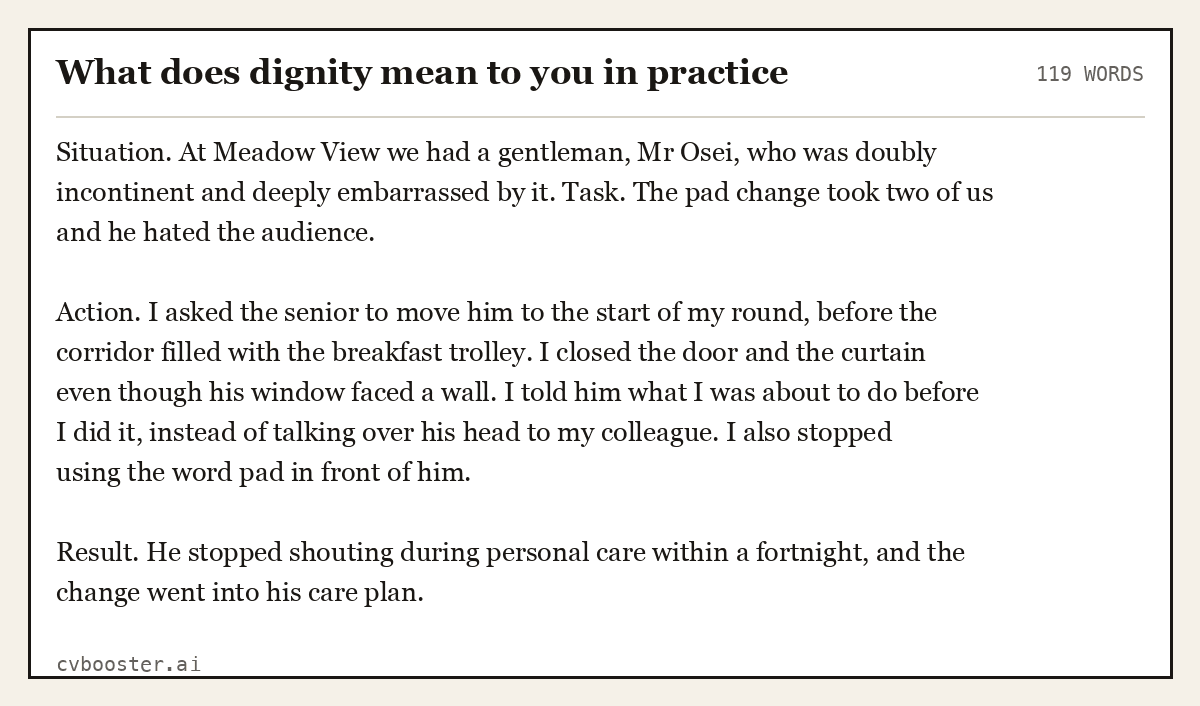
Situation. At Meadow View we had a gentleman, Mr Osei, who was doubly incontinent and deeply embarrassed by it. Task. The pad change took two of us and he hated the audience.
Action. I asked the senior to move him to the start of my round, before the corridor filled with the breakfast trolley. I closed the door and the curtain even though his window faced a wall. I told him what I was about to do before I did it, instead of talking over his head to my colleague. I also stopped using the word pad in front of him.
Result. He stopped shouting during personal care within a fortnight, and the change went into his care plan.
Panel is listening for: "You must be treated with dignity and respect at all times while you're receiving care and treatment". Also: "You have privacy when you need and want it". Source: CQC, dignity and respect.
*The wrong answer:* "I treat everyone how I would want to be treated." It has no door, no curtain, no person.
How do you build trust with someone who does not want your help?
*What the panel is testing:* whether you can hold a refusal without either forcing care or walking away.
Situation. On my Riverbank round I picked up a new client, Mrs Farrell, 81, who had refused the previous two carers at the door. Task. Her plan said prompt medication and a light breakfast, and I had thirty minutes.
Action. For three visits I did not go past the hallway. I asked if she wanted the kettle on, made two teas, sat down and let her talk about her late husband's allotment. I logged each refusal honestly and told the coordinator I thought it was groundwork, not yet a safeguarding concern. On visit four she asked me to fetch her tablets.
Result. By week three she accepted a strip wash and had stopped ringing the office to cancel.
Panel is listening for: "You (or anybody legally acting on your behalf) must give your consent before any care or treatment is given to you". Source: CQC, consent.
*The wrong answer:* "I would explain why she needs it until she agrees." That is pressure, not consent.
How do you keep someone independent when doing it yourself is faster?
*What the panel is testing:* whether you protect a person's remaining ability when the shift is short-staffed.
Situation. Mr Doyle at Meadow View could dress his top half in about twelve minutes, or I could do it in three. Task. On a short-staffed morning the three minute version is tempting.
Action. I moved his shirt and his chair to the side his stronger arm reached and laid the sleeves out in order. Then I gave myself a rule: I do the buttons, he does the arms. When we ran behind I told the senior we were behind, rather than taking his arms off him to catch up.
Result. He dressed his own top half for the fourteen months I worked that floor, and the occupational therapist wrote it into his plan.
Panel is listening for: "promote people's independence and ability to self-care, assisting those who use health and care services to exercise their rights and make informed choices". Source: Skills for Care, guidance statement 2.4.
*The wrong answer:* "I would do it for him so he is not left waiting". Every task you take permanently, you give back with a hoist.
Scenario questions
A resident refuses their medication. What do you do?
*What the panel is testing:* whether you know that covert administration is not yours to decide.
Situation. Mrs Callaghan, who had early Alzheimer's, pushed her morning pot away and said the tablets were poison. Task. Two of the four were her blood pressure medication.
Action. I did not argue and I did not put them in her yoghurt, which would have been covert administration without authorisation. I left the pot, came back fifteen minutes later with her post and offered again in a different order, the paracetamol first. She took two of the four. I recorded exactly which ones she took and which she refused, and told the senior before she left the floor.
Result. The GP reviewed her blood pressure dose that week. She took the full pot most mornings once the count dropped from four to two.
Panel is listening for: "always gain valid consent before providing healthcare, care and support. You must also respect a person's right to refuse to receive healthcare, care and support if they are capable of doing so". Source: Skills for Care, guidance statement 2.5.
*The wrong answer:* hiding tablets in food, or writing "refused" without telling anyone that shift.
You find a resident on the floor of their room. Walk me through it.
*What the panel is testing:* whether you check and call before you lift.
Situation. I opened Mr Whitfield's door at 07:20. He was on his side between the bed and the wardrobe, awake, saying he had slipped getting to the commode. Task. Check, do not move him, get help.
Action. I stayed with him and used the pull cord rather than leaving the room. I asked where it hurt and looked for head injury and obvious deformity. His right leg looked shortened and turned out, so I did not attempt any transfer. I kept him warm with his own duvet and kept talking to him while the senior called 999. I wrote the incident record and the body map before my break, while the times were exact.
Result. He had a fractured neck of femur and was in surgery that evening.
Panel is listening for: "You must not be given unsafe care or treatment or be put at risk of harm that could be avoided". Source: CQC, safety.
*The wrong answer:* "I would help him up." A hip fracture is made worse by a well-meaning lift.
A family member says a cardigan has gone missing and blames staff.
*What the panel is testing:* whether a complaint goes into the system or dies in the corridor.
Situation. Mrs Iqbal's daughter stopped me at Meadow View and said a cashmere cardigan had been stolen. Task. Do not get defensive, do not promise anything, get it logged.
Action. I took her into the quiet lounge and apologised that a valued item was missing. I wrote down the description and the date she last saw it. I said plainly that I could not tell her what had happened, but that the manager would look at it properly. I checked the laundry and the two rooms either side myself, and told the senior within the hour as a formal complaint.
Result. It turned up in another resident's wardrobe two days later. The manager wrote to the daughter with an apology and a change to the name-taping routine.
Panel is listening for: "You must be able to complain about your care and treatment" . Source: CQC, complaints. Also: "always take comments and complaints seriously, respond to them in line with agreed ways of working and inform a senior member of staff". Source: Skills for Care, guidance statement 2.10.
*The wrong answer:* defending the team on the spot. The daughter wants it taken seriously in writing.
You are running forty minutes late on your round. What do you do?
*What the panel is testing:* whether you escalate early or quietly cut corners on a transfer.
Situation. In March 2026 a double-up call in Felling overran because the hoist sling was damaged and I would not use it. Task. I had four calls behind me, one of them a lunch call for a client with diabetes.
Action. I rang the coordinator from the doorstep rather than at the end of the round. I gave her the exact delay and said which call worried me most, and asked her to move the diabetes lunch call to another carer. I completed the transfer safely with the spare sling from the car. I then rang the last two clients myself so they were not sitting waiting.
Result. The lunch call was covered on time and the damaged sling was taken out of service that day.
Panel is listening for: "Providers must assess the risks to your health and safety during any care or treatment and make sure their staff have the qualifications, competence, skills and experience to keep you safe". Source: CQC, safety.
*The wrong answer:* "I would work faster." Late is a rota problem. A rushed hoist is a harm problem.
Safeguarding and dignity questions
You see a colleague speaking harshly to a resident with dementia.
*What the panel is testing:* whether you will report a colleague, and how quickly.
Situation. A bank carer told a resident who was calling out to shut up and wait her turn, loudly, in the corridor. Task. Settle the resident first, then report.
Action. I went to the resident and sat with her until she was calm. Afterwards I told the carer privately that the way she spoke was not acceptable and that I would be reporting it. I wrote a safeguarding concern the same shift. It went to the deputy manager with the time, the words used and who else was present. I did not wait to see whether it happened again.
Result. The bank carer was not booked again, and the concern went through the local authority safeguarding process.
Panel is listening for: "You must not suffer any form of abuse or improper treatment while receiving care" . Source: CQC, safeguarding from abuse. Also: "challenge and report dangerous, abusive, discriminatory or exploitative behaviour or practice". Source: Skills for Care, guidance statement 2.9.
*The wrong answer:* "I would have a quiet word and keep an eye on it." That is a pattern waiting to grow.
A resident tells you something and asks you not to write it down.
*What the panel is testing:* whether you know confidentiality has a limit and can say so out loud.
Situation. Mrs Pryce told me her son had taken her bank card, and asked me to tell nobody because he would stop visiting. Task. I could not promise secrecy, and I had to say so before she said more.
Action. I stopped her gently. I explained that I keep things private within the team, but I cannot keep a secret if it means she may be at risk. I said I would have to tell the manager. She was upset and I sat with that. I recorded what she said in her own words, not my interpretation. I handed it to the manager the same afternoon as a financial abuse concern.
Result. The local authority became involved and a third party was appointed to manage her account.
Panel is listening for: "Respect a person's right to confidentiality". Also: "only discuss or disclose information about people who use health and care services and their carers in accordance with legislation and agreed ways of working". Source: Skills for Care, standard 5 and guidance statement 5.2.
*The wrong answer:* "I would keep her trust." The kind promise is the one that gets residents hurt.
How do you support someone at the end of their life?
*What the panel is testing:* whether you can name the practical comfort tasks and remember the family.
Situation. I was on nights when Mr Brennan was on an end of life care plan with anticipatory medication in place. Task. Mouth care, position changes, and his daughter.
Action. I did mouth care with the sponges every half hour because his lips cracked quickly. I repositioned him two hourly with a second carer. I kept Radio 3 on because his daughter said he had listened to it every evening. I made sure she had a blanket and a hot drink without being asked twice. I recorded his comfort and his breathing each time, and called the nurse when the breathing changed.
Result. He died at 04:40 with his daughter there, and she wrote to the home about the mouth care.
Panel is listening for: "always treat people with respect and compassion" . Source: Skills for Care, guidance statement 2.2. Also: "You must have care or treatment that is tailored to you and meets your needs and preferences". Source: CQC, person-centred care.
*The wrong answer:* talking only about feelings. Name the mouth care and the repositioning.
Closing questions
What if you were asked to do a task you had not been trained for?
*What the panel is testing:* whether you can say no to a senior without making it a confrontation.
Situation. In my second month a senior asked me to apply compression stockings to a resident with a leg ulcer dressing. Task. I had not been trained on that, and the dressing was a district nurse task.
Action. I said so plainly and without making a scene. I offered to do the parts I was signed off for while she called the nurse. I then asked to be put on the next stockings training, and wrote the request in my supervision notes so it did not get forgotten.
Result. The nurse came the following morning, and I was trained and signed off six weeks later.
Panel is listening for: "always ask your supervisor or employer for guidance if you do not feel able or adequately prepared to carry out any aspect of your work, or if you are unsure how to effectively deliver a task". Source: Skills for Care, guidance statement 1.4.
*The wrong answer:* "I would give it a go and ask afterwards."
Why should we hire you?
*What the panel is testing:* whether you listened to the problem they described at the start of the interview.
Situation. You are recruiting for a dementia floor of fourteen residents, and you told me handover quality is your current problem. Task. That is the part of the job I am strongest at.
Action. At Meadow View a colleague missed that a resident had refused two meals in a row, so I rebuilt my own handover habit. I started giving handover in the same order every time, by resident, with intake, mood, skin and anything refused. I wrote the notes in the same order. Two other carers copied it, and the deputy asked me to show new starters.
Result. Refusals started being picked up on day two instead of day four. One dietitian referral went in a week earlier than it would have.
Panel is listening for: "Work in collaboration with your colleagues to ensure the delivery of high quality, safe and compassionate healthcare, care and support". Source: Skills for Care, standard 3.
*The wrong answer:* listing your qualities. Answer the problem they named.
Your one-screen prep table and three questions to ask back
Read this in the car park. One line per question, the point to land, the evidence to bring.
| Question | The point to land | The evidence to bring |
|---|---|---|
| What does a care assistant do? | Observation is the job | A change you spotted and reported |
| Why care? | One person, not a sentiment | The story that made you apply |
| Tell me about yourself | Setting, size, training dates | Care Certificate and manual handling dates |
| Dignity | Door, curtain, voice, timing | A routine you changed for one person |
| Building trust | Consent beats pressure | A refusal you held without forcing |
| Independence | Protect what they can still do | A task you refused to take over |
| Medication refusal | Record and escalate, never conceal | What you wrote in the MAR notes |
| Found on the floor | Check, call, cover, record | An incident record you wrote |
| Family complaint | Logged, not argued | A complaint you escalated |
| Running late | Call the coordinator early | A call you had reassigned |
| Poor practice | Resident first, report same shift | A safeguarding concern you raised |
| Confidences | You cannot promise secrecy | A disclosure you passed on |
| End of life | Mouth care, repositioning, family | A night shift you remember |
| Untrained task | Say so, then get trained | A written training request |
| Why you | Their stated problem, your fix | A change other staff copied |
Tip: Bring the dates. A panel hears a hundred vague stories a year. The candidate who says March 2026 and fourteen residents sounds like they were there.
Ask these three at the end. Each one tells you something the advert will not.
- What is your staffing on this floor at 07:00. How often do you use agency? This predicts whether you will be rushing personal care. A manager who knows the number watches it.
- How do you handle it when staff raise a concern about a colleague? Listen for a named person and a timescale, not the words open door.
- What does supervision look like, and when would my first one be? The Skills for Care Code of Conduct expects practice to improve "with the help of your supervisor".
The standards above are quoted from the CQC fundamental standards, page last updated 3 March 2026. The STAR structure comes from the National Careers Service STAR method page. For the written stage, the care worker supporting statement guide shows a full statement against a real person specification. The hour before you walk in is covered in how to prepare for an interview. For supported living and mental health roles, see support worker interview questions and answers. For the generic set, see competency based interview questions and answers. For the twenty every panel asks, see common interview questions and answers.
Frequently asked questions
What are the 10 main interview questions and answers?
For care roles the ten are: what a care assistant does, why care, tell me about yourself, what dignity means, and building trust. Then: protecting independence, a medication refusal, finding someone on the floor, poor practice by a colleague, and why we should hire you. All ten are answered in full above. Answer each with one named person and a dated event, not a principle.
What are the 7 most common interview questions and answers in healthcare?
Seven recur across care and NHS support roles. They are: why this role, a difficult situation, confidentiality, teamwork, working outside your training, responding to poor practice, and your questions for us. Each is answered above with the standard behind it, quoted from the CQC fundamental standards and the Skills for Care Code of Conduct.
What are the main duties of a care assistant?
Personal care, medication support where trained, mobility and transfers, food and fluid support and recording, observation and record keeping, and company. The Care Quality Commission describes outcomes rather than tasks. Care must be "tailored to you and meets your needs and preferences". People must have "enough to eat and drink to keep you in good health". Nobody must "suffer any form of abuse or improper treatment while receiving care".
How do you introduce yourself in a care assistant interview?
In three sentences: where you have worked and for how long, the setting and its size, and one thing you are known for. For example, two years in a 42 bed residential home and a domiciliary round of nine calls, dementia and double-up transfers, known for handover recording. Then stop. The panel will ask for the story, and the story carries the marks.
What questions are asked for an interview for care work, and is there a PDF?
The fifteen above are the set, and there is no PDF here on purpose. Every answer is on this page in full, in the order a panel asks them. The page prints or saves to your phone as it is. A sheet with half the answers cut out is worse preparation than fifteen complete ones with your own names in them.
More in this series: Interview answers
- Competency Based Interview Questions and 20 Answers
- Interview Questions and Answers: the 20 You Will Be Asked
- Support Worker Interview Questions and 15 Model Answers
Related articles
- Civil Service Interview Questions and 15 Full Answers
- Civil Service Strengths Examples: 10 Worked Answers
- Competency Based Interview Questions and 20 Answers
- Competency-Based Interview Questions and 15 Answers, Ireland
More articles
- Care Worker Supporting Statement Example: 3 Full Statements
- Career Breaks on a UK CV: What to Say and Where
- Career Change Resume: How to Make the Switch Successfully
Looking for a worked example for your job title? Browse the resume examples by job title.