Care Worker Supporting Statement Example: 3 Full Statements
By Mustafa Tarabya, founder of CVBooster · Published · Updated
13 min read
Every care worker supporting statement example on this page is complete, and each one is written against a real advert that was live in September 2026. The constraint that decides the outcome is short: care adverts list four or five essential criteria, and a shortlister reads your statement with that list beside them. The standards behind those criteria are published in the Skills for Care Code of Conduct and the Care Quality Commission fundamental standards, both quoted below. Three statements follow, at 350 to 500 words, for an applicant with no formal experience, a care home care assistant and a senior carer. Written by Mustafa Tarabya, a qualified care worker who has hired care staff and been hired as one.
What a care employer is scoring
Care adverts are short. The essential criteria are often one paragraph. That paragraph is the whole marking scheme, so answer it line by line.
Behind it sit two published standards. The Code of Conduct for Healthcare Support Workers and Adult Social Care Workers in England sets out seven duties. The CQC fundamental standards are, in the CQC's words, "the standards below which your care must never fall".
Tip: name the specific thing you did, then the standard it meets. Never the other way round.
Statement 1: no formal care experience
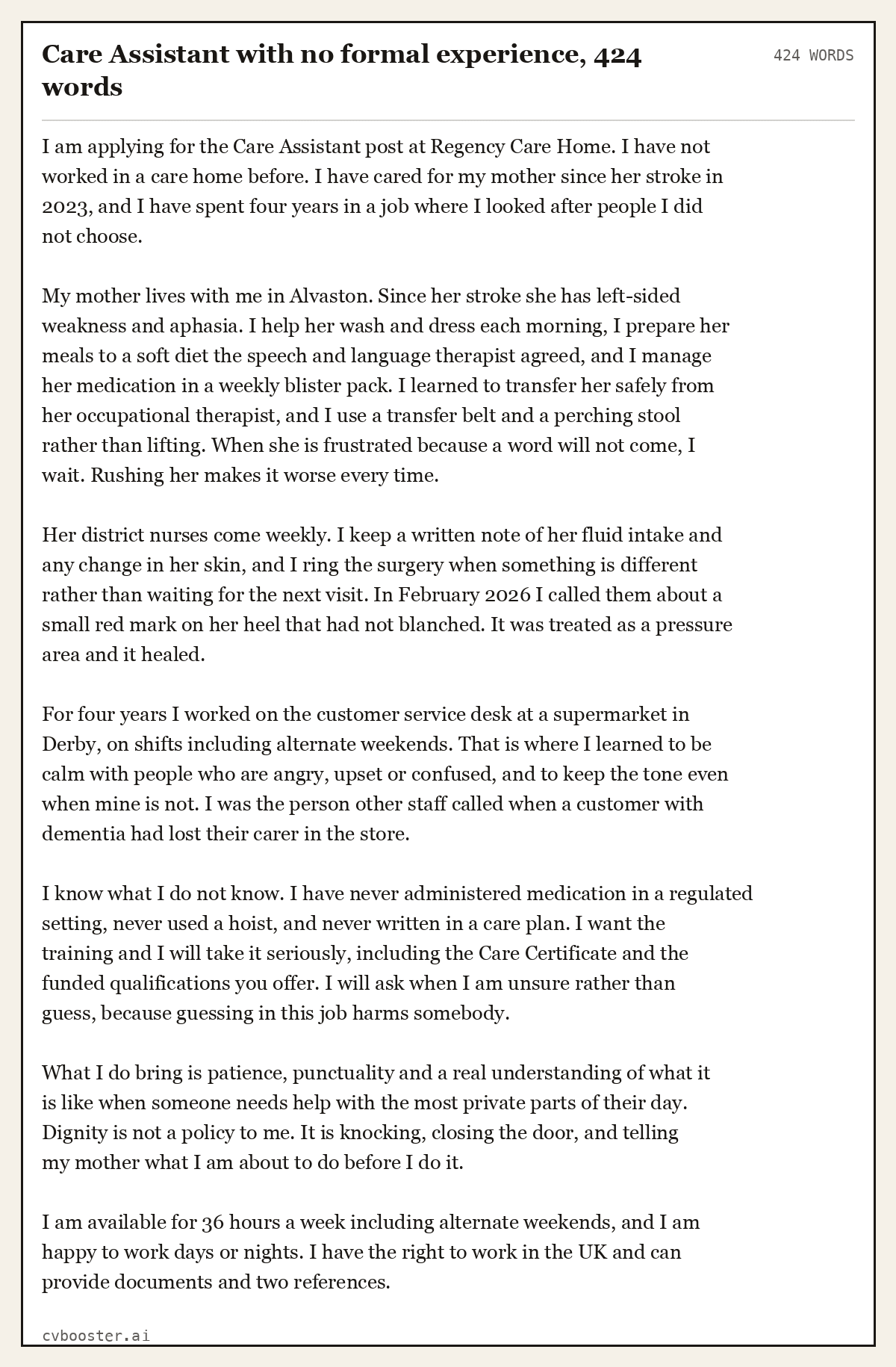
Written against the Care Assistant post at Regency Care Home, Allenton, Derby, advertised by Agincare, reference 1537099609, posted 14 August 2026. Its essential criterion is one line: "No experience needed full training provided."
Care Assistant with no formal experience, 424 words (424 words)
I am applying for the Care Assistant post at Regency Care Home. I have not worked in a care home before. I have cared for my mother since her stroke in 2023, and I have spent four years in a job where I looked after people I did not choose.
My mother lives with me in Alvaston. Since her stroke she has left-sided weakness and aphasia. I help her wash and dress each morning, I prepare her meals to a soft diet the speech and language therapist agreed, and I manage her medication in a weekly blister pack. I learned to transfer her safely from her occupational therapist, and I use a transfer belt and a perching stool rather than lifting. When she is frustrated because a word will not come, I wait. Rushing her makes it worse every time.
Her district nurses come weekly. I keep a written note of her fluid intake and any change in her skin, and I ring the surgery when something is different rather than waiting for the next visit. In February 2026 I called them about a small red mark on her heel that had not blanched. It was treated as a pressure area and it healed.
For four years I worked on the customer service desk at a supermarket in Derby, on shifts including alternate weekends. That is where I learned to be calm with people who are angry, upset or confused, and to keep the tone even when mine is not. I was the person other staff called when a customer with dementia had lost their carer in the store.
I know what I do not know. I have never administered medication in a regulated setting, never used a hoist, and never written in a care plan. I want the training and I will take it seriously, including the Care Certificate and the funded qualifications you offer. I will ask when I am unsure rather than guess, because guessing in this job harms somebody.
What I do bring is patience, punctuality and a real understanding of what it is like when someone needs help with the most private parts of their day. Dignity is not a policy to me. It is knocking, closing the door, and telling my mother what I am about to do before I do it.
I am available for 36 hours a week including alternate weekends, and I am happy to work days or nights. I have the right to work in the UK and can provide documents and two references.
What the sifter is scoring
- Criterion quoted (Qualifications, Essential): "No experience needed full training provided." Where the statement shows it: the honest list of what she has never done, with a commitment to the Care Certificate and funded qualifications.
- Advert requirement quoted: "Kind, compassionate and great with people". Where the statement shows it: waiting for a word rather than finishing it, and being the person called to a distressed customer.
- Advert requirement quoted: "Able to work alternate weekends". Where the statement shows it: the closing line answers hours, pattern and right to work directly.
- Code of Conduct duty quoted: "be honest with yourself and others about what you can do, recognise your abilities and the limitations of your competence". Where the statement shows it: the paragraph naming what she has not done.
Statement 2: care home care assistant
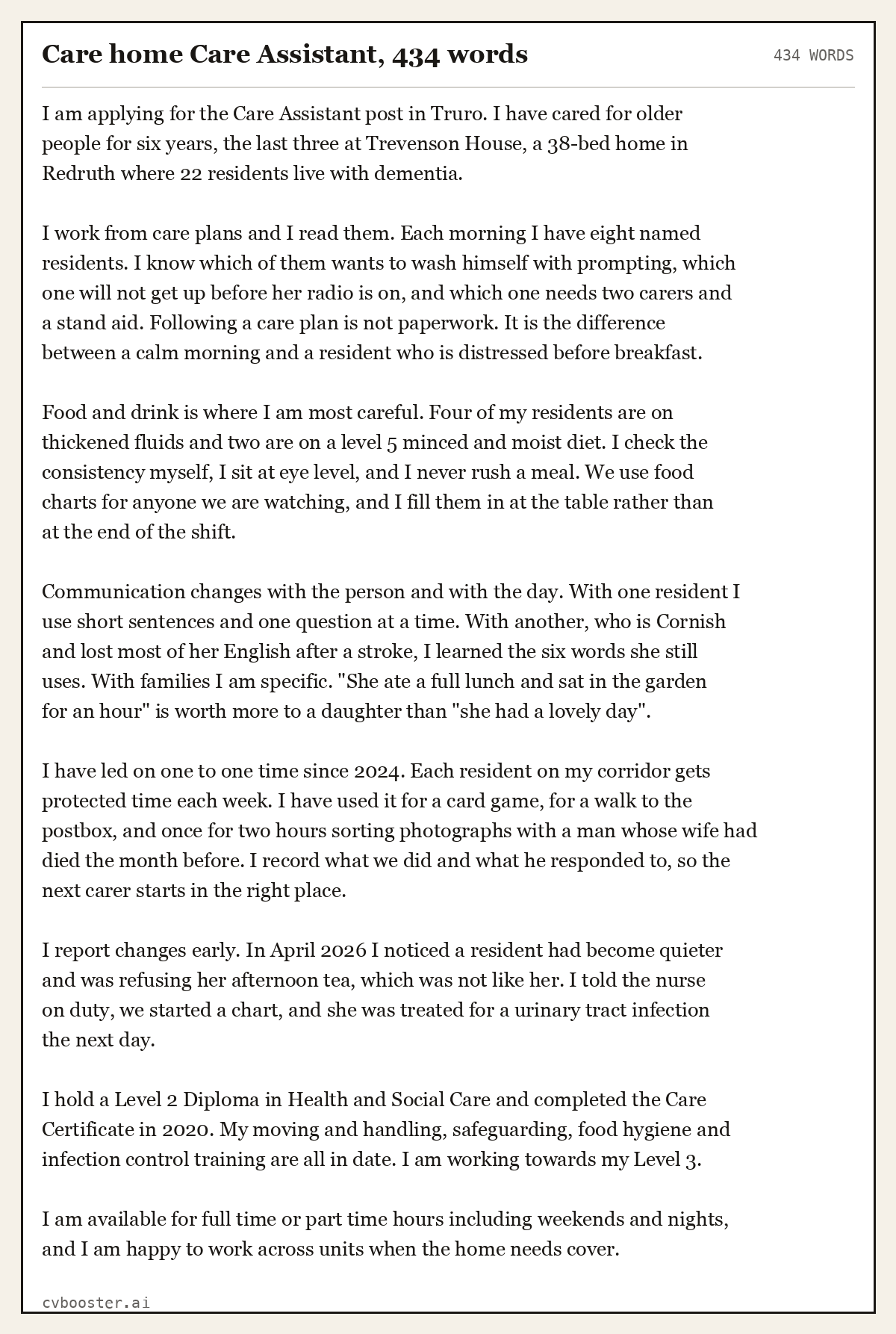
Written against the Care Assistant post at a Barchester care home in Truro, reference 1535819886, posted 10 August 2026. Its essential criterion is quoted in full in the annotation.
Care home Care Assistant, 434 words (434 words)
I am applying for the Care Assistant post in Truro. I have cared for older people for six years, the last three at Trevenson House, a 38-bed home in Redruth where 22 residents live with dementia.
I work from care plans and I read them. Each morning I have eight named residents. I know which of them wants to wash himself with prompting, which one will not get up before her radio is on, and which one needs two carers and a stand aid. Following a care plan is not paperwork. It is the difference between a calm morning and a resident who is distressed before breakfast.
Food and drink is where I am most careful. Four of my residents are on thickened fluids and two are on a level 5 minced and moist diet. I check the consistency myself, I sit at eye level, and I never rush a meal. We use food charts for anyone we are watching, and I fill them in at the table rather than at the end of the shift.
Communication changes with the person and with the day. With one resident I use short sentences and one question at a time. With another, who is Cornish and lost most of her English after a stroke, I learned the six words she still uses. With families I am specific. "She ate a full lunch and sat in the garden for an hour" is worth more to a daughter than "she had a lovely day".
I have led on one to one time since 2024. Each resident on my corridor gets protected time each week. I have used it for a card game, for a walk to the postbox, and once for two hours sorting photographs with a man whose wife had died the month before. I record what we did and what he responded to, so the next carer starts in the right place.
I report changes early. In April 2026 I noticed a resident had become quieter and was refusing her afternoon tea, which was not like her. I told the nurse on duty, we started a chart, and she was treated for a urinary tract infection the next day.
I hold a Level 2 Diploma in Health and Social Care and completed the Care Certificate in 2020. My moving and handling, safeguarding, food hygiene and infection control training are all in date. I am working towards my Level 3.
I am available for full time or part time hours including weekends and nights, and I am happy to work across units when the home needs cover.
What the sifter is scoring
- Criterion quoted (Qualifications, Essential): "Experience in caring for older people is preferred, along with a can-do approach and excellent communication skills. Empathy and compassion are essential, and Barchester provides all necessary training." Where the statement shows it: six years with older people, three named communication approaches, and the training already held.
- Advert duty quoted: "supporting residents with their food and drink and following care plans". Where the statement shows it: the thickened fluids and level 5 diet paragraph, and the named eight residents from care plans.
- Advert duty quoted: "ensuring that each of our residents has one-to-one time". Where the statement shows it: protected weekly time since 2024, with what was done recorded for the next carer.
- CQC standard quoted: "You must have care or treatment that is tailored to you and meets your needs and preferences." Where the statement shows it: the radio before getting up, and the six remaining words.
Statement 3: senior carer
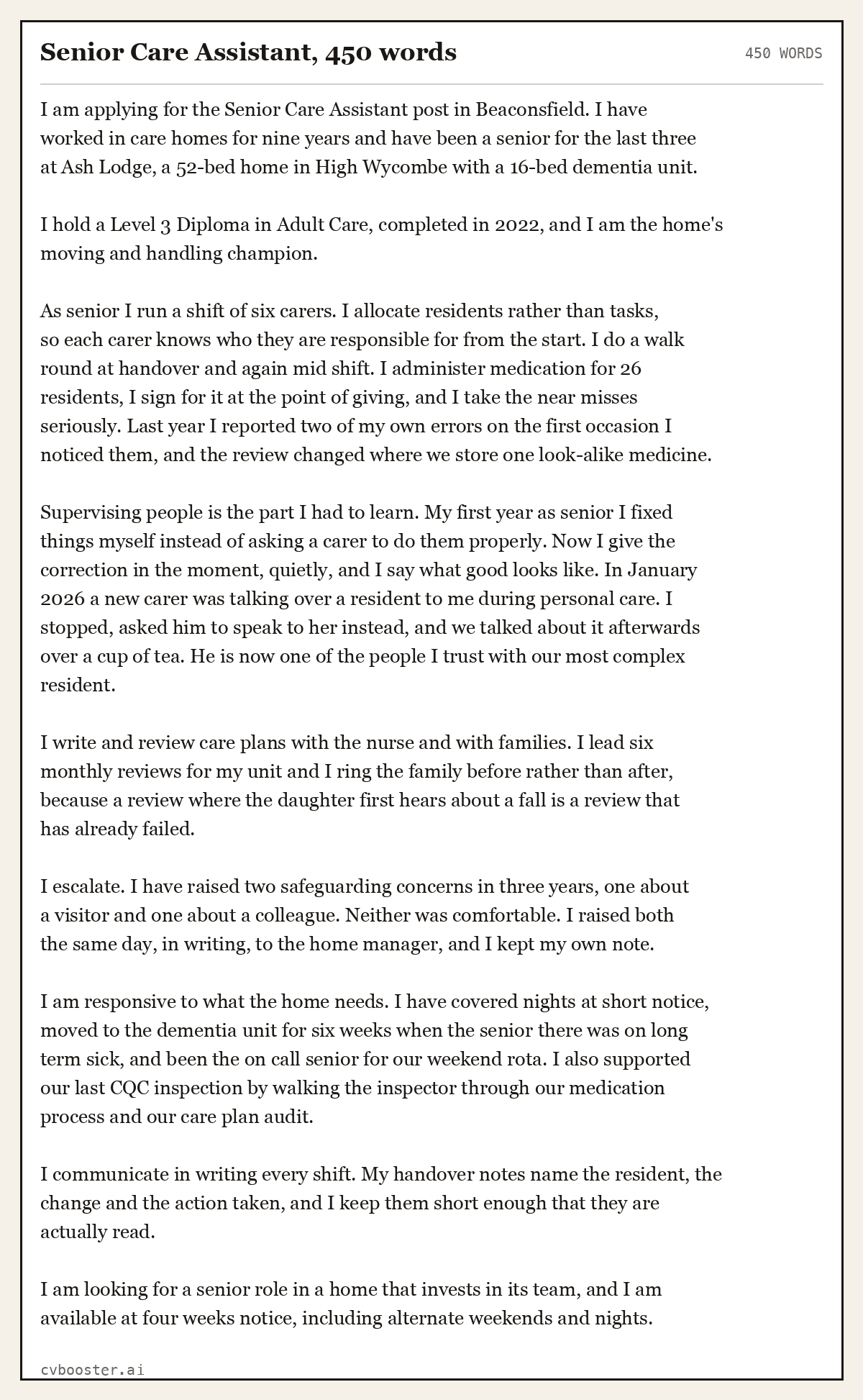
Written against the Senior Care Assistant post at Avery Healthcare, Beaconsfield, reference 1538559078, posted 18 August 2026.
Senior Care Assistant, 450 words (450 words)
I am applying for the Senior Care Assistant post in Beaconsfield. I have worked in care homes for nine years and have been a senior for the last three at Ash Lodge, a 52-bed home in High Wycombe with a 16-bed dementia unit.
I hold a Level 3 Diploma in Adult Care, completed in 2022, and I am the home's moving and handling champion.
As senior I run a shift of six carers. I allocate residents rather than tasks, so each carer knows who they are responsible for from the start. I do a walk round at handover and again mid shift. I administer medication for 26 residents, I sign for it at the point of giving, and I take the near misses seriously. Last year I reported two of my own errors on the first occasion I noticed them, and the review changed where we store one look-alike medicine.
Supervising people is the part I had to learn. My first year as senior I fixed things myself instead of asking a carer to do them properly. Now I give the correction in the moment, quietly, and I say what good looks like. In January 2026 a new carer was talking over a resident to me during personal care. I stopped, asked him to speak to her instead, and we talked about it afterwards over a cup of tea. He is now one of the people I trust with our most complex resident.
I write and review care plans with the nurse and with families. I lead six monthly reviews for my unit and I ring the family before rather than after, because a review where the daughter first hears about a fall is a review that has already failed.
I escalate. I have raised two safeguarding concerns in three years, one about a visitor and one about a colleague. Neither was comfortable. I raised both the same day, in writing, to the home manager, and I kept my own note.
I am responsive to what the home needs. I have covered nights at short notice, moved to the dementia unit for six weeks when the senior there was on long term sick, and been the on call senior for our weekend rota. I also supported our last CQC inspection by walking the inspector through our medication process and our care plan audit.
I communicate in writing every shift. My handover notes name the resident, the change and the action taken, and I keep them short enough that they are actually read.
I am looking for a senior role in a home that invests in its team, and I am available at four weeks notice, including alternate weekends and nights.
What the sifter is scoring
- Criterion quoted (Qualifications, Essential): "Have an NVQ 3 or equivalent in care for care homes." Where the statement shows it: the Level 3 Diploma in Adult Care, with the year.
- Criterion quoted (Qualifications, Essential): "Have 2 years experience working in similar care environment." Where the statement shows it: nine years in care homes, three as a senior in a 52-bed home.
- Criterion quoted (Qualifications, Essential): "Have the ability to communicate effectively both verbally and in writing." Where the statement shows it: the correction given in the moment, and the handover notes paragraph.
- Criterion quoted (Qualifications, Essential): "Have a positive attitude to both supporting and nurturing residents and staff." Where the statement shows it: the new carer who is now trusted with the most complex resident.
- Criterion quoted (Qualifications, Essential): "Be responsive and flexible to cover a range of responsibilities." Where the statement shows it: the six weeks on the dementia unit and the on call weekends.
The standards behind the criteria
Quote one of these only if your example earns it. The wording is taken from the two official sources.
| Standard | Quoted wording | What a shortlister accepts as evidence |
|---|---|---|
| Code of Conduct 1 | "Be accountable by making sure you can answer for your actions or omissions." | Reporting your own medication error. |
| Code of Conduct 2 | "Promote and uphold the privacy, dignity, rights, health and wellbeing of people who use health and care services and their carers at all times." | Knocking, closing the door, explaining before doing. |
| Code of Conduct 3 | "Work in collaboration with your colleagues to ensure the delivery of high quality, safe and compassionate healthcare, care and support." | Paired moving and handling, and calling a pause. |
| Code of Conduct 4 | "Communicate in an open, and effective way to promote the health, safety and wellbeing of people who use health and care services and their carers." | Telling a family what actually happened today. |
| Code of Conduct 6 | "Strive to improve the quality of healthcare, care and support through continuing professional development." | A qualification in progress with units named. |
| CQC, person-centred care | "You must have care or treatment that is tailored to you and meets your needs and preferences." | The radio before getting up. |
| CQC, safeguarding from abuse | "You must not suffer any form of abuse or improper treatment while receiving care." | A safeguarding concern raised the same day. |
The sentences that cost you the interview
| Before | After |
|---|---|
| "I am a caring and compassionate person who loves working with the elderly." | "She will not get up before her radio is on, so I turn it on first." |
| "I have excellent communication skills." | "She lost most of her English after a stroke, so I learned the six words she still uses." |
| "I always follow policies and procedures and put residents first." | "I reported two of my own medication errors the first time I noticed them, and we moved a look-alike medicine." |
| "I have no experience but I am a fast learner and very willing." | "I have never used a hoist or written in a care plan. I will ask rather than guess, because guessing in this job harms somebody." |
Before you send it
- Copy the essential criteria into a blank document and write under each one. Delete the headings at the end.
- Give a date, a place and a number in every example. Undated claims read as invented.
- Say plainly what you have not done. Honesty about a gap is a Code of Conduct duty, not a weakness.
- Answer the practical lines: hours, weekends, nights, right to work, notice period, driving.
- Keep it to 350 to 500 words. Care managers read these between shifts.
- Take the same examples into the care assistant interview questions and the support worker interview questions, because the panel will ask you to expand them.
- Applying to a trust instead of a private provider? The form and the criteria differ, so use the NHS supporting statement examples.
Frequently asked questions
How do I write a good care worker supporting statement?
Use the advert's essential criteria as your plan and answer each one with something you have actually done. Name the setting, the month and the person's need, without naming the person. Cover hours, weekends and right to work at the end, because care managers screen on those first. Keep it to 350 to 500 words and cut every adjective about yourself.
What should I write in a supporting statement for a care job?
Write one paragraph per essential criterion, then a short paragraph on training you hold and training you want. Include at least one example of noticing a change and reporting it, because that is the skill care managers most want to see. Include your availability. Leave out hobbies, unrelated jobs and anything already on the application form.
Can you give a care worker supporting statement example in PDF format?
All three statements are on this page in full and the page is print friendly, so there is no download and nothing is gated. Copying one would fail you, because a care manager checks your statement against your application form and your references. Use the structure and the level of detail, and replace every fact with your own.
How many words should a care worker supporting statement be?
Between 350 and 500 words for a care assistant or senior carer post, unless the advert sets a limit, in which case follow the advert. Care adverts usually list four or five essential criteria, which is roughly 80 words each. Anything longer and the criteria start to hide behind the prose.
Can I apply for care work with no experience?
Yes, and many adverts say so outright. The Regency Care Home advert quoted above lists "No experience needed full training provided" as its essential criterion. What replaces experience is evidence of the behaviour: caring for a relative, a job where you stayed calm with distressed people, and a clear statement of what you have not yet done and want to be trained in.
Related articles
- How to Write a Supporting Statement: One Built Step by Step
- Supporting Statement Example: 4 Full Statements, Annotated
- NHS Supporting Statement Examples: Band 3, Band 5, Band 6
- Teaching Assistant Supporting Statement: 3 Full Examples
More articles
- Career Breaks on a UK CV: What to Say and Where
- Career Change Resume: How to Make the Switch Successfully
- Changing and Improving Civil Service Example: AO to G7
Looking for a worked example for your job title? Browse the resume examples by job title.