NHS Supporting Statement Examples: Band 3, Band 5, Band 6
By Mustafa Tarabya, founder of CVBooster · Published · Updated
15 min read
The nhs supporting statement examples below are three complete statements, written against three real NHS Jobs adverts live in September 2026. The constraint that decides everything is the person specification: the form asks you to answer its criteria, not to describe yourself. Kent Community Health NHS Foundation Trust puts it plainly in its advert, quoted below. Each statement runs 450 to 600 words, is followed by the essential criteria it answers word for word, and ends with a before and after section. Written by Mustafa Tarabya, a qualified care worker who has hired care staff and been hired as one.
What the NHS Jobs form actually asks
The supporting information box is not a personal statement. Kent Community Health NHS Foundation Trust states the task in its Healthcare Assistant advert on NHS Jobs.
Quoted from the advert: "The job description and person specification gives you all the information you need about this role. Please look carefully at the criteria in the person specification and tell us what you have done that shows you meet this in your application."
Two things follow. First, the criteria are your headings. Second, "tell us what you have done" rules out ambition, adjectives and future promises.
NHS Jobs and Trac do not publish a word limit for the box. The practical range that fits one screen for a shortlister is 450 to 600 words for a Band 3 to Band 6 post. Longer than that and the criteria start to hide.
Band 3 healthcare assistant, annotated
Written against the Band 3 Healthcare Assistant post at Blackpool Teaching Hospitals NHS Foundation Trust, Clifton Hospital, reference 382-NBC112-26, posted 2 September 2026.
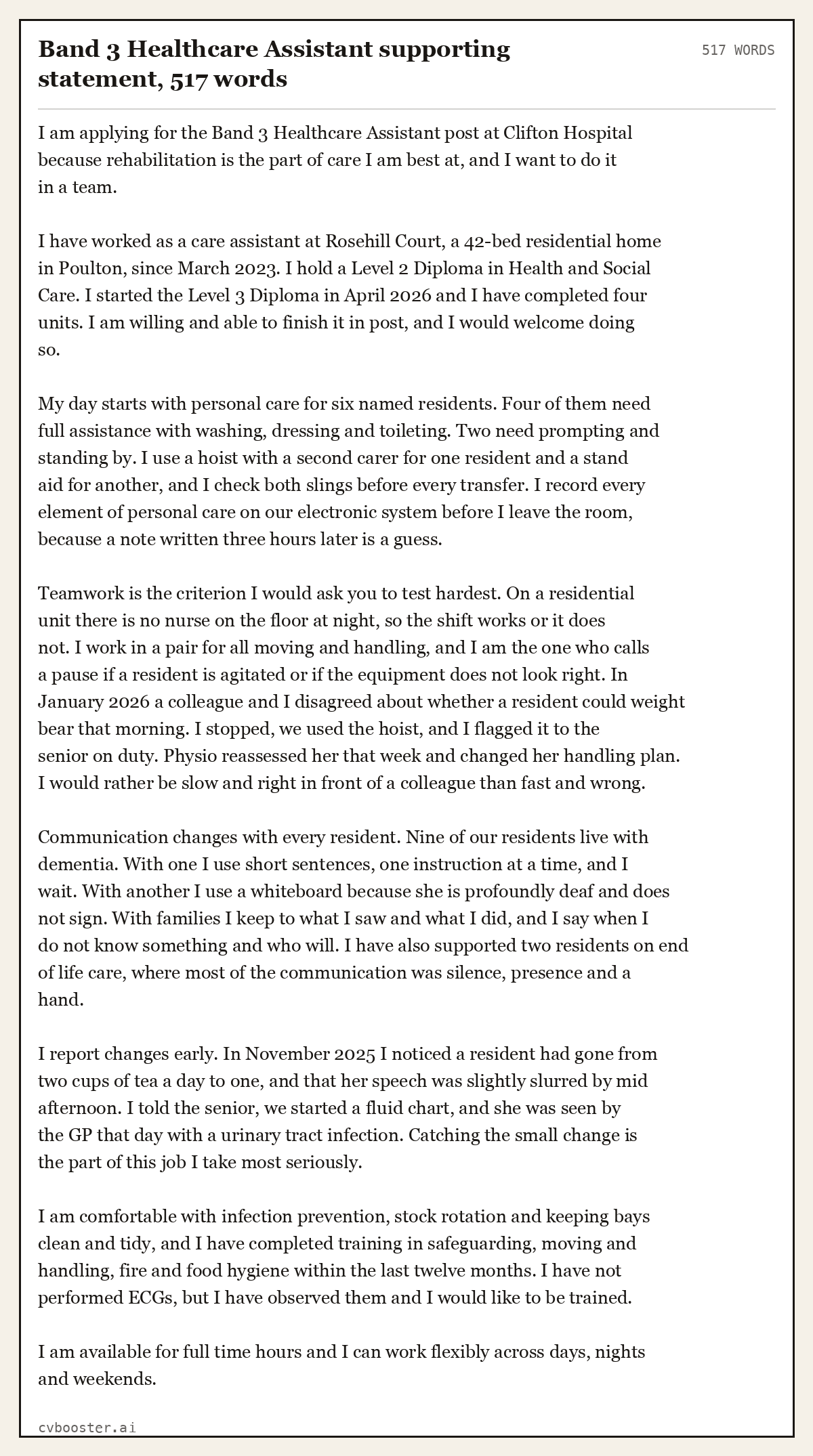
Band 3 Healthcare Assistant supporting statement, 517 words (517 words)
I am applying for the Band 3 Healthcare Assistant post at Clifton Hospital because rehabilitation is the part of care I am best at, and I want to do it in a team.
I have worked as a care assistant at Rosehill Court, a 42-bed residential home in Poulton, since March 2023. I hold a Level 2 Diploma in Health and Social Care. I started the Level 3 Diploma in April 2026 and I have completed four units. I am willing and able to finish it in post, and I would welcome doing so.
My day starts with personal care for six named residents. Four of them need full assistance with washing, dressing and toileting. Two need prompting and standing by. I use a hoist with a second carer for one resident and a stand aid for another, and I check both slings before every transfer. I record every element of personal care on our electronic system before I leave the room, because a note written three hours later is a guess.
Teamwork is the criterion I would ask you to test hardest. On a residential unit there is no nurse on the floor at night, so the shift works or it does not. I work in a pair for all moving and handling, and I am the one who calls a pause if a resident is agitated or if the equipment does not look right. In January 2026 a colleague and I disagreed about whether a resident could weight bear that morning. I stopped, we used the hoist, and I flagged it to the senior on duty. Physio reassessed her that week and changed her handling plan. I would rather be slow and right in front of a colleague than fast and wrong.
Communication changes with every resident. Nine of our residents live with dementia. With one I use short sentences, one instruction at a time, and I wait. With another I use a whiteboard because she is profoundly deaf and does not sign. With families I keep to what I saw and what I did, and I say when I do not know something and who will. I have also supported two residents on end of life care, where most of the communication was silence, presence and a hand.
I report changes early. In November 2025 I noticed a resident had gone from two cups of tea a day to one, and that her speech was slightly slurred by mid afternoon. I told the senior, we started a fluid chart, and she was seen by the GP that day with a urinary tract infection. Catching the small change is the part of this job I take most seriously.
I am comfortable with infection prevention, stock rotation and keeping bays clean and tidy, and I have completed training in safeguarding, moving and handling, fire and food hygiene within the last twelve months. I have not performed ECGs, but I have observed them and I would like to be trained.
I am available for full time hours and I can work flexibly across days, nights and weekends.
What the sifter is scoring
- Criterion quoted (QUALIFICATIONS, Essential): "Willingness & ability to undertake NVQ Level 3 in care if required". Where the statement shows it: the Level 3 Diploma started in April 2026, four units complete, and an explicit offer to finish in post.
- Criterion quoted (EXPERIENCE, Essential): "Experience of working within a team". Where the statement shows it: the paired moving and handling, the disagreement in January 2026, and the escalation to the senior on duty.
- Criterion quoted (SKILLS/ATTRIBUTES, Essential): "Ability to communicate in a variety of settings with patients of varying levels of understanding." Where the statement shows it: the three named approaches for dementia, deafness and end of life care.
- Criterion quoted (SKILLS/ATTRIBUTES, Desirable): "Ability to perform ECGs". Where the statement shows it: answered honestly as not yet held, with a willingness to train. Never claim a desirable you do not have.
Band 5 staff nurse, annotated
Written against the Band 5 Staff Nurse post on Langdale Ward at Black Country Healthcare NHS Foundation Trust, Dorothy Pattison Hospital, Walsall, reference 285-8810-MH, posted 11 September 2026.
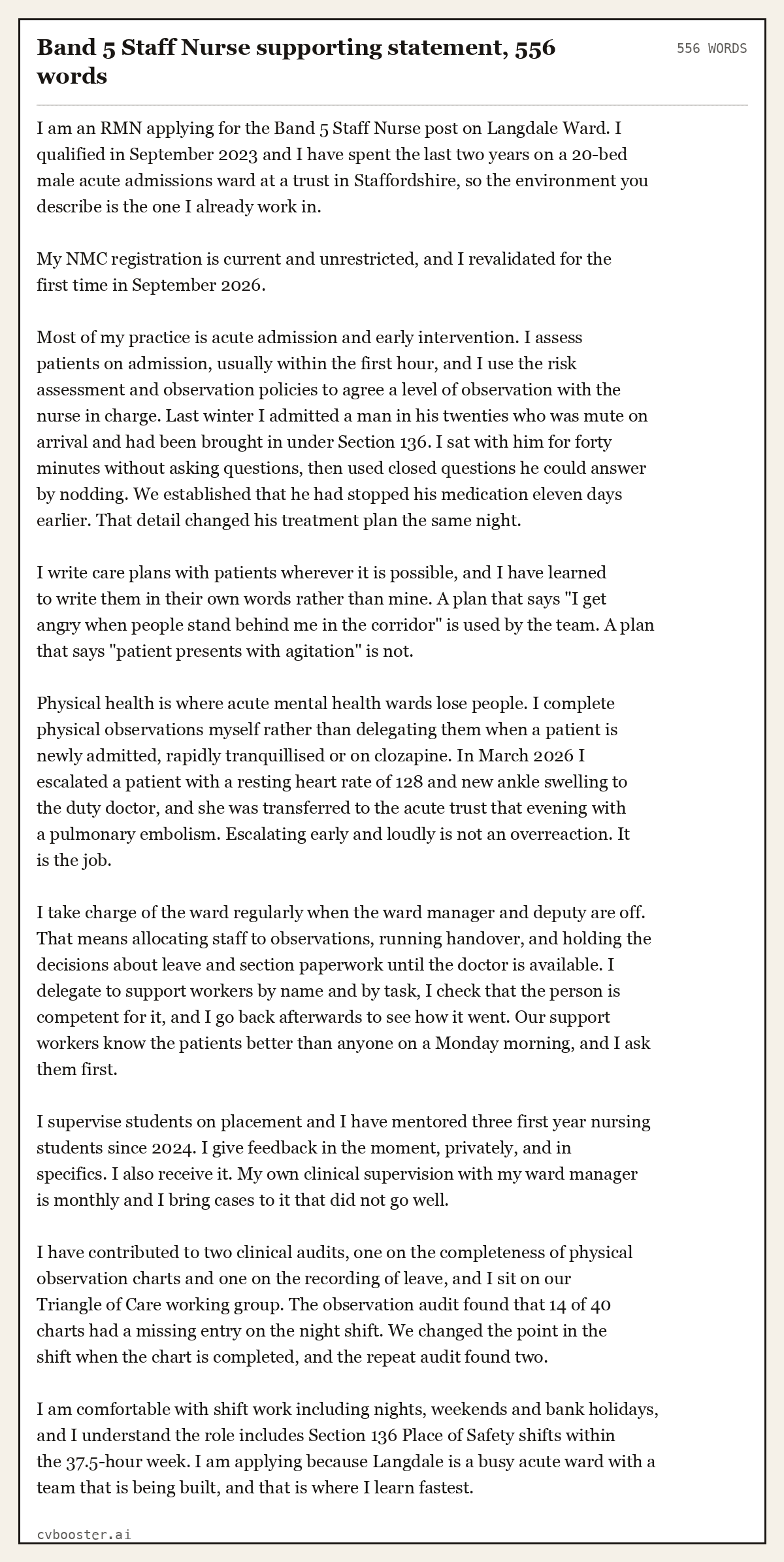
Band 5 Staff Nurse supporting statement, 556 words (556 words)
I am an RMN applying for the Band 5 Staff Nurse post on Langdale Ward. I qualified in September 2023 and I have spent the last two years on a 20-bed male acute admissions ward at a trust in Staffordshire, so the environment you describe is the one I already work in.
My NMC registration is current and unrestricted, and I revalidated for the first time in September 2026.
Most of my practice is acute admission and early intervention. I assess patients on admission, usually within the first hour, and I use the risk assessment and observation policies to agree a level of observation with the nurse in charge. Last winter I admitted a man in his twenties who was mute on arrival and had been brought in under Section 136. I sat with him for forty minutes without asking questions, then used closed questions he could answer by nodding. We established that he had stopped his medication eleven days earlier. That detail changed his treatment plan the same night.
I write care plans with patients wherever it is possible, and I have learned to write them in their own words rather than mine. A plan that says "I get angry when people stand behind me in the corridor" is used by the team. A plan that says "patient presents with agitation" is not.
Physical health is where acute mental health wards lose people. I complete physical observations myself rather than delegating them when a patient is newly admitted, rapidly tranquillised or on clozapine. In March 2026 I escalated a patient with a resting heart rate of 128 and new ankle swelling to the duty doctor, and she was transferred to the acute trust that evening with a pulmonary embolism. Escalating early and loudly is not an overreaction. It is the job.
I take charge of the ward regularly when the ward manager and deputy are off. That means allocating staff to observations, running handover, and holding the decisions about leave and section paperwork until the doctor is available. I delegate to support workers by name and by task, I check that the person is competent for it, and I go back afterwards to see how it went. Our support workers know the patients better than anyone on a Monday morning, and I ask them first.
I supervise students on placement and I have mentored three first year nursing students since 2024. I give feedback in the moment, privately, and in specifics. I also receive it. My own clinical supervision with my ward manager is monthly and I bring cases to it that did not go well.
I have contributed to two clinical audits, one on the completeness of physical observation charts and one on the recording of leave, and I sit on our Triangle of Care working group. The observation audit found that 14 of 40 charts had a missing entry on the night shift. We changed the point in the shift when the chart is completed, and the repeat audit found two.
I am comfortable with shift work including nights, weekends and bank holidays, and I understand the role includes Section 136 Place of Safety shifts within the 37.5-hour week. I am applying because Langdale is a busy acute ward with a team that is being built, and that is where I learn fastest.
What the sifter is scoring
- Criterion quoted (Qualification, Essential): "RMN/RLDN". Where the statement shows it: the opening line names the registration and its date, and the second paragraph confirms it is current and unrestricted.
- Criterion quoted (Qualifications, Essential): "All applicants will require at least 1 years experience within a mental health impatient ward. This should be within the NHS or private sector only". Where the statement shows it: two years on a 20-bed male acute admissions ward, named as an NHS trust.
- Criterion quoted (Skills, Essential): "Ability to demonstrate good verbal and written communication skills". Where the statement shows it: the Section 136 admission for verbal skill, and the care plan written in the patient's own words for written skill.
- Advert duty quoted: "Regularly take charge of the ward, assuming responsibility for the clinical area in the absence of the Ward Manager or Deputy Ward Manager." Where the statement shows it: the paragraph on allocation, handover and delegation by name.
Band 6 specialist practitioner, annotated
Written against the Band 6 MHST Specialist Practitioner post at Nottinghamshire Healthcare NHS Foundation Trust, Mansfield and Ashfield, reference 186-789-26-GH, posted 10 September 2026.
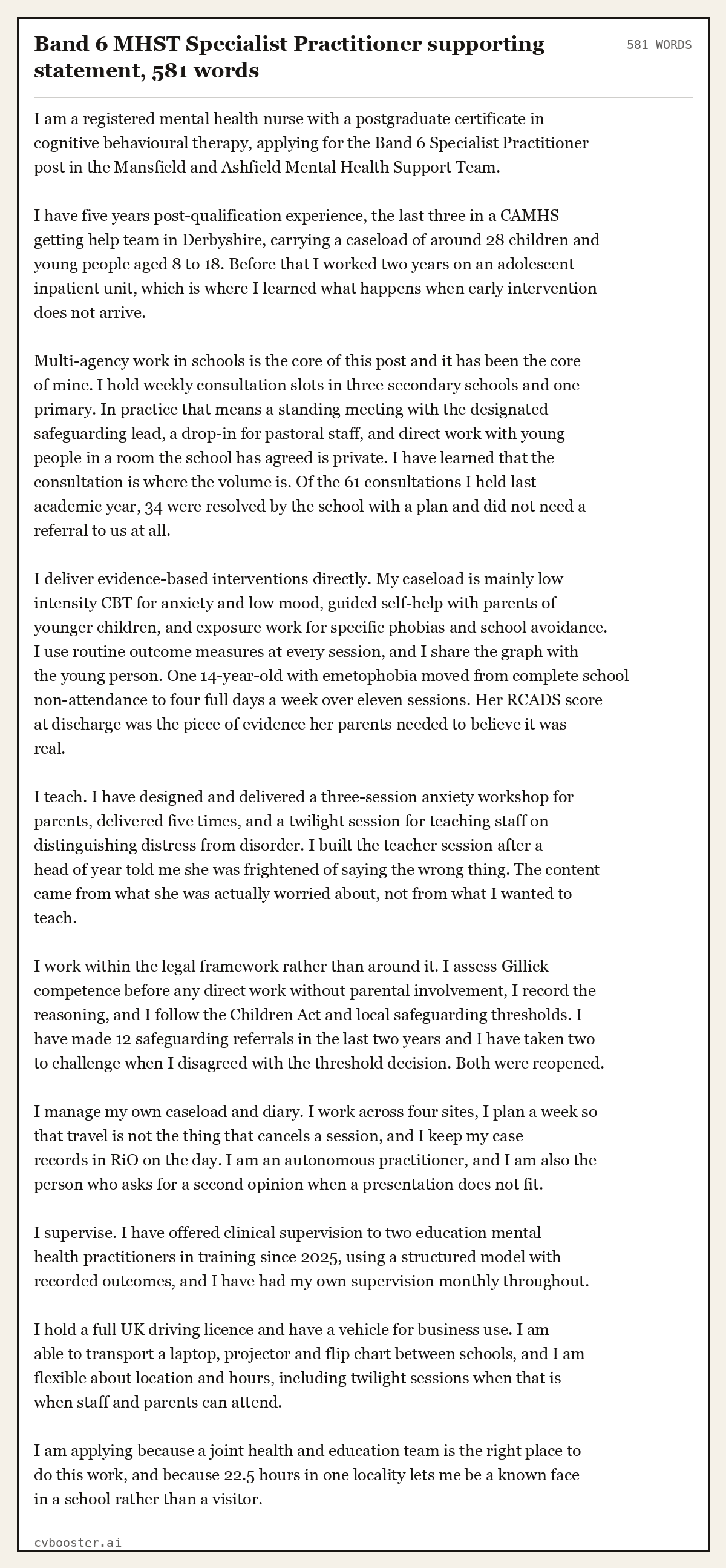
Band 6 MHST Specialist Practitioner supporting statement, 581 words (581 words)
I am a registered mental health nurse with a postgraduate certificate in cognitive behavioural therapy, applying for the Band 6 Specialist Practitioner post in the Mansfield and Ashfield Mental Health Support Team.
I have five years post-qualification experience, the last three in a CAMHS getting help team in Derbyshire, carrying a caseload of around 28 children and young people aged 8 to 18. Before that I worked two years on an adolescent inpatient unit, which is where I learned what happens when early intervention does not arrive.
Multi-agency work in schools is the core of this post and it has been the core of mine. I hold weekly consultation slots in three secondary schools and one primary. In practice that means a standing meeting with the designated safeguarding lead, a drop-in for pastoral staff, and direct work with young people in a room the school has agreed is private. I have learned that the consultation is where the volume is. Of the 61 consultations I held last academic year, 34 were resolved by the school with a plan and did not need a referral to us at all.
I deliver evidence-based interventions directly. My caseload is mainly low intensity CBT for anxiety and low mood, guided self-help with parents of younger children, and exposure work for specific phobias and school avoidance. I use routine outcome measures at every session, and I share the graph with the young person. One 14-year-old with emetophobia moved from complete school non-attendance to four full days a week over eleven sessions. Her RCADS score at discharge was the piece of evidence her parents needed to believe it was real.
I teach. I have designed and delivered a three-session anxiety workshop for parents, delivered five times, and a twilight session for teaching staff on distinguishing distress from disorder. I built the teacher session after a head of year told me she was frightened of saying the wrong thing. The content came from what she was actually worried about, not from what I wanted to teach.
I work within the legal framework rather than around it. I assess Gillick competence before any direct work without parental involvement, I record the reasoning, and I follow the Children Act and local safeguarding thresholds. I have made 12 safeguarding referrals in the last two years and I have taken two to challenge when I disagreed with the threshold decision. Both were reopened.
I manage my own caseload and diary. I work across four sites, I plan a week so that travel is not the thing that cancels a session, and I keep my case records in RiO on the day. I am an autonomous practitioner, and I am also the person who asks for a second opinion when a presentation does not fit.
I supervise. I have offered clinical supervision to two education mental health practitioners in training since 2025, using a structured model with recorded outcomes, and I have had my own supervision monthly throughout.
I hold a full UK driving licence and have a vehicle for business use. I am able to transport a laptop, projector and flip chart between schools, and I am flexible about location and hours, including twilight sessions when that is when staff and parents can attend.
I am applying because a joint health and education team is the right place to do this work, and because 22.5 hours in one locality lets me be a known face in a school rather than a visitor.
What the sifter is scoring
- Criterion quoted (Qualifications, Essential): "Relevant Professional qualification e.g. RMN. RN, HV, OT, clinical psychology, Social Worker at degree level or higher" and "Registration with relevant professional body." Where the statement shows it: the first line names the RMN registration and the CBT postgraduate certificate.
- Criterion quoted (Experience, Essential): "Experience of Multi agency work, in particular in schools". Where the statement shows it: the weekly consultation slots, the designated safeguarding lead meetings, and the 61 consultations figure.
- Criterion quoted (Experience, Essential): "Experience of teaching groups of professionals and parents". Where the statement shows it: the parent workshop delivered five times and the twilight session for teaching staff.
- Criterion quoted (Knowledge, Essential): "Knowledge of relevant legislation and documents pertaining to children (e.g., Children's Act, Mental Health Act, NSF, Every Child Matters, Future in Mind)". Where the statement shows it: Gillick competence, the Children Act and the safeguarding threshold challenges.
- Criterion quoted (Skills, Essential): "Ability to offer individual and group therapeutic interventions." Where the statement shows it: low intensity CBT, guided self-help, exposure work and the parent group.
- Criterion quoted (Contractual and Physical Requirements, Essential): "A full UK driving licence and vehicle for business use is required for this post" and the ability to "transport needed equipment". Where the statement shows it: the closing paragraph answers both directly.
The six NHS values, and one line of evidence each
The NHS Constitution for England names six values. Shortlisters look for them behind your examples, not as a list you recite. The wording below is quoted from the Constitution.
| Value | Quoted from the NHS Constitution | Evidence a shortlister accepts |
|---|---|---|
| Working together for patients | "Patients come first in everything we do." | The Band 6 consultation slots with school staff. |
| Respect and dignity | "We value every person... as an individual, respect their aspirations and commitments in life." | The Band 3 whiteboard for a deaf resident. |
| Commitment to quality of care | "We earn the trust placed in us by insisting on quality and striving to get the basics of quality of care... right every time." | The Band 5 observation chart audit and its repeat. |
| Compassion | "We ensure that compassion is central to the care we provide and respond with humanity and kindness." | Forty minutes sitting in silence with a Section 136 admission. |
| Improving lives | "We strive to improve health and wellbeing and people's experiences of the NHS." | Eleven sessions from non-attendance to four school days. |
| Everyone counts | "We... make sure nobody is excluded, discriminated against or left behind." | Challenging two safeguarding threshold decisions. |
Tip: name the value once, then spend the words on the example. A statement that lists all six and evidences none scores lower than one that evidences two.
The sentences that cost marks
Four real patterns, rewritten. The left column is what candidates write. The right column is what the criterion asks for.
| Before | After |
|---|---|
| "I am a caring, compassionate person who is passionate about patient care." | "Nine of our residents live with dementia. With one I use short sentences, one instruction at a time, and I wait." |
| "I have excellent communication skills and work well as part of a team." | "In January 2026 a colleague and I disagreed about whether a resident could weight bear. I stopped, we used the hoist, and I flagged it to the senior on duty." |
| "I always escalate concerns appropriately and follow policy at all times." | "In March 2026 I escalated a patient with a resting heart rate of 128 and new ankle swelling to the duty doctor. She was transferred that evening." |
| "I am keen to develop and would welcome further training in this role." | "I started the Level 3 Diploma in April 2026 and I have completed four units. I am willing and able to finish it in post." |
The pattern is the same every time. Replace the adjective with the thing you did, the month it happened, and the number you would remember.
Before you submit
- Put the criteria in the order the person specification uses them. The shortlister is scoring down a list.
- Answer every essential criterion. A blank is scored as not met, not as modest.
- Answer desirables honestly. "I have observed them and I would like to be trained" costs you nothing.
- Give a date and a place for each example. Undated claims read as invented.
- Read it once as the shortlister. If you cannot point at the sentence that meets criterion three, neither can they.
- If you are applying for a care post outside the NHS, use the care worker supporting statement examples instead, because the standards quoted are different.
- Prepare the same examples for the NHS interview questions, which are the person specification asked out loud, and see the personal statement examples for non-NHS roles.
Frequently asked questions
How do I write a good NHS supporting statement?
Use the person specification as your headings and answer each criterion with something you have done. Name the place, the month and a number. Cover every essential criterion in the order the specification lists them, then the desirables you genuinely hold. Keep it between 450 and 600 words. Do not describe your character, because the form asks what you have done.
What should I write in a supporting statement?
Write one short paragraph per essential criterion, each containing a specific example with a date, a setting and an outcome. Add a line on the desirable criteria you meet and an honest line on any you do not. Finish with your availability and why this post specifically. Leave out hobbies, general enthusiasm and anything already on the application form.
Can you provide me with an example NHS supporting statement in a PDF format?
The three complete statements are on this page in full, at Band 3, Band 5 and Band 6, and the page is print friendly. There is no PDF to download and nothing is gated. Copying a statement would fail you, because the shortlister is checking your examples against your own application form, so read these for structure and replace every detail with yours.
How many words should a supporting statement be in NHS?
NHS Jobs and Trac do not publish a word limit for the supporting information box, so check your own advert first. In practice 450 to 600 words works for Band 2 to Band 6 posts, which is roughly one screen for a shortlister. Band 7 and above often needs more because there are more essential criteria to answer.
Related articles
- How to Write a Supporting Statement: One Built Step by Step
- Supporting Statement Example: 4 Full Statements, Annotated
- Cover Letter vs Supporting Statement: UK Rules
- Care Worker Supporting Statement Example: 3 Full Statements
More articles
- NMC PIN and HCPC Numbers: Where They Go on a UK CV
- Notice Letters Sample: Five Templates and the UK Rules
- Notice Period UK: The Rules and Five Notice Letters