Supporting Statement Example: 4 Full Statements, Annotated
By Mustafa Tarabya, founder of CVBooster · Published · Updated
19 min read
Each supporting statement example on this page is complete and written against a live advert, because a statement that is not aimed at a person specification cannot be scored. The constraint is simple: the essential criteria are the marking scheme, so they decide your paragraphs. Fife Council tells applicants to "Group the criteria if possible", and jobs.ac.uk tells them to use "sub-headings, ideally linked to those used in the person specification". Four statements follow, for an NHS Band 4 administrator, a council housing officer, a school teaching assistant and a charity coordinator, each with the criteria quoted word for word underneath. Written by Mustafa Tarabya, who hired for his own company, read every application himself and now writes CVBooster's guides.
What the shortlister is doing while they read
They have your statement on one side of the desk and the person specification on the other, and they are looking for a place to tick. That is the whole exercise.
Fife Council's supporting statement guidance states what should be in it.
Quoted from fife.gov.uk: "Why you are interested in the vacancy. How your knowledge, skills and experience meet the essential criteria. Include some relevant examples to demonstrate the match between your experience, skills and knowledge and the job criteria. Tell us what YOU did."
The last three words carry most of the marks. Teams achieve things. Statements that only say "we" leave the reader unable to tick anything.
Word length is set by the box, not by a rule. Where no limit is given, 400 to 550 words covers four to six criteria without the reader losing the thread.
NHS Band 4 administrator, annotated
Written against the Band 4 Clinical Pathway Administrator post at Royal Free London NHS Foundation Trust, Barnet Hospital, reference 391-RFL-8198887, posted 7 September 2026, a 12-month maternity cover in the Nephrology and Renal team.
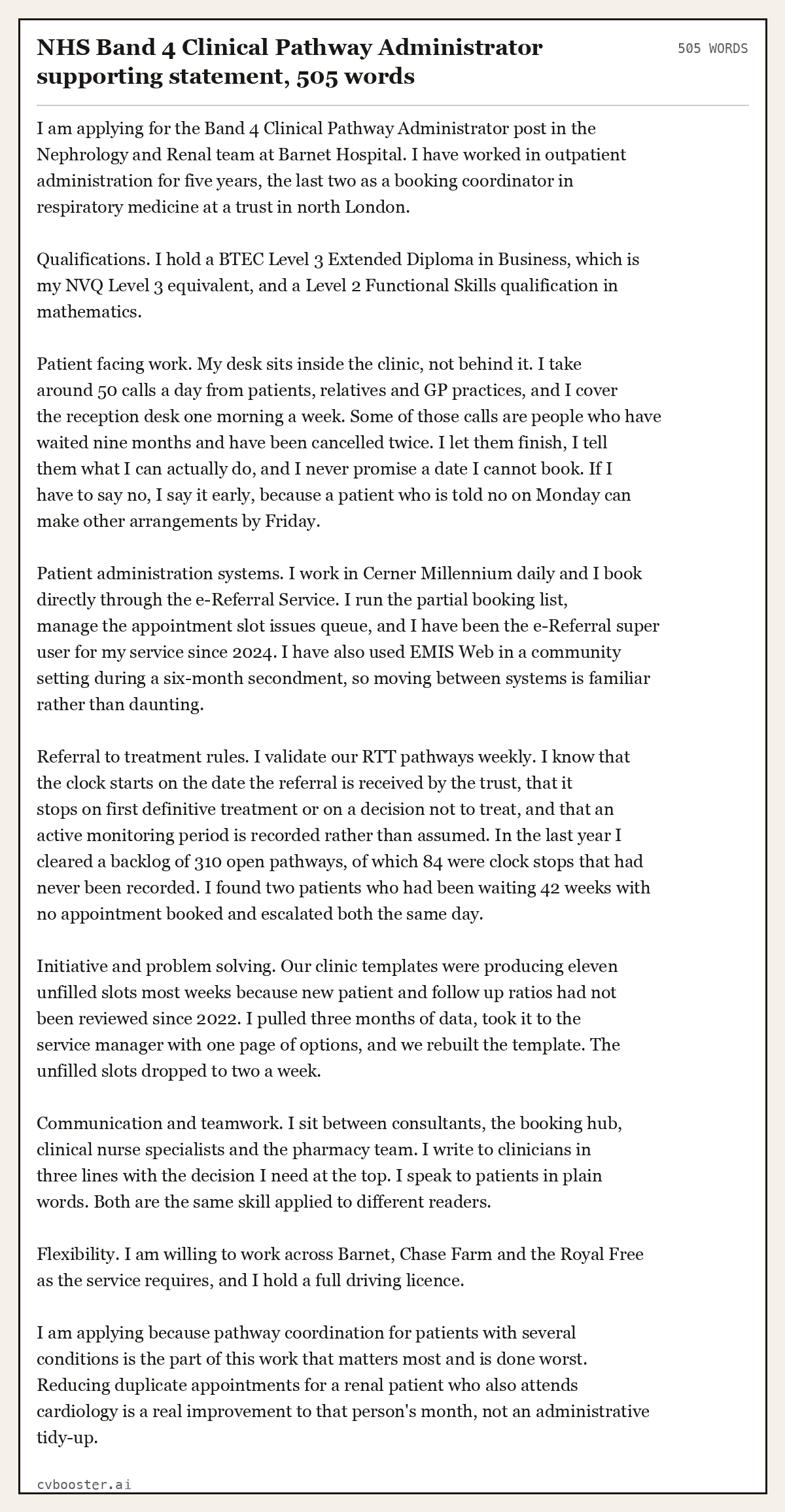
NHS Band 4 Clinical Pathway Administrator supporting statement, 505 words (505 words)
I am applying for the Band 4 Clinical Pathway Administrator post in the Nephrology and Renal team at Barnet Hospital. I have worked in outpatient administration for five years, the last two as a booking coordinator in respiratory medicine at a trust in north London.
Qualifications. I hold a BTEC Level 3 Extended Diploma in Business, which is my NVQ Level 3 equivalent, and a Level 2 Functional Skills qualification in mathematics.
Patient facing work. My desk sits inside the clinic, not behind it. I take around 50 calls a day from patients, relatives and GP practices, and I cover the reception desk one morning a week. Some of those calls are people who have waited nine months and have been cancelled twice. I let them finish, I tell them what I can actually do, and I never promise a date I cannot book. If I have to say no, I say it early, because a patient who is told no on Monday can make other arrangements by Friday.
Patient administration systems. I work in Cerner Millennium daily and I book directly through the e-Referral Service. I run the partial booking list, manage the appointment slot issues queue, and I have been the e-Referral super user for my service since 2024. I have also used EMIS Web in a community setting during a six-month secondment, so moving between systems is familiar rather than daunting.
Referral to treatment rules. I validate our RTT pathways weekly. I know that the clock starts on the date the referral is received by the trust, that it stops on first definitive treatment or on a decision not to treat, and that an active monitoring period is recorded rather than assumed. In the last year I cleared a backlog of 310 open pathways, of which 84 were clock stops that had never been recorded. I found two patients who had been waiting 42 weeks with no appointment booked and escalated both the same day.
Initiative and problem solving. Our clinic templates were producing eleven unfilled slots most weeks because new patient and follow up ratios had not been reviewed since 2022. I pulled three months of data, took it to the service manager with one page of options, and we rebuilt the template. The unfilled slots dropped to two a week.
Communication and teamwork. I sit between consultants, the booking hub, clinical nurse specialists and the pharmacy team. I write to clinicians in three lines with the decision I need at the top. I speak to patients in plain words. Both are the same skill applied to different readers.
Flexibility. I am willing to work across Barnet, Chase Farm and the Royal Free as the service requires, and I hold a full driving licence.
I am applying because pathway coordination for patients with several conditions is the part of this work that matters most and is done worst. Reducing duplicate appointments for a renal patient who also attends cardiology is a real improvement to that person's month, not an administrative tidy-up.
What the sifter is scoring
- Criterion quoted (Education & professional Qualifications, Essential): "NVQ Level 3 or Equivalent". Where the statement shows it: the BTEC Level 3 Extended Diploma, named as the equivalent rather than left for the reader to work out.
- Criterion quoted (Experience, Essential): "Experience of working in a public/patient facing role". Where the statement shows it: 50 calls a day, a weekly reception morning, and a described approach to a patient who has been cancelled twice.
- Criterion quoted (Experience, Essential): "Experience of working with ERS, EMIS, or similar electronic Patient Administration Systems". Where the statement shows it: Cerner Millennium daily, e-Referral Service super user since 2024, EMIS Web on secondment. All three named systems in the criterion are addressed.
- Criterion quoted (Others, Essential): "Awareness of NHS RTT rules". Where the statement shows it: clock start, clock stop and active monitoring stated as rules, then evidenced with 310 pathways and 84 unrecorded clock stops.
- Criterion quoted (Skills and aptitudes, Essential): "Ability to use initiative and problem solve, in a busy clinical environment". Where the statement shows it: the clinic template rebuild, with the before and after figure.
- Criterion quoted (Others, Essential): "Willingness and flexibility to work across multiple sites as required". Where the statement shows it: the three named sites and the driving licence, answered in one sentence rather than ignored.
Local government officer, annotated
Written against the Housing Hub Officer post at Sandwell Metropolitan Borough Council, Band D, reference SAND9456, posted 9 September 2026, a six-month fixed term contract at Sandwell Council House in Oldbury. The advert asks for a CV and a supporting statement.
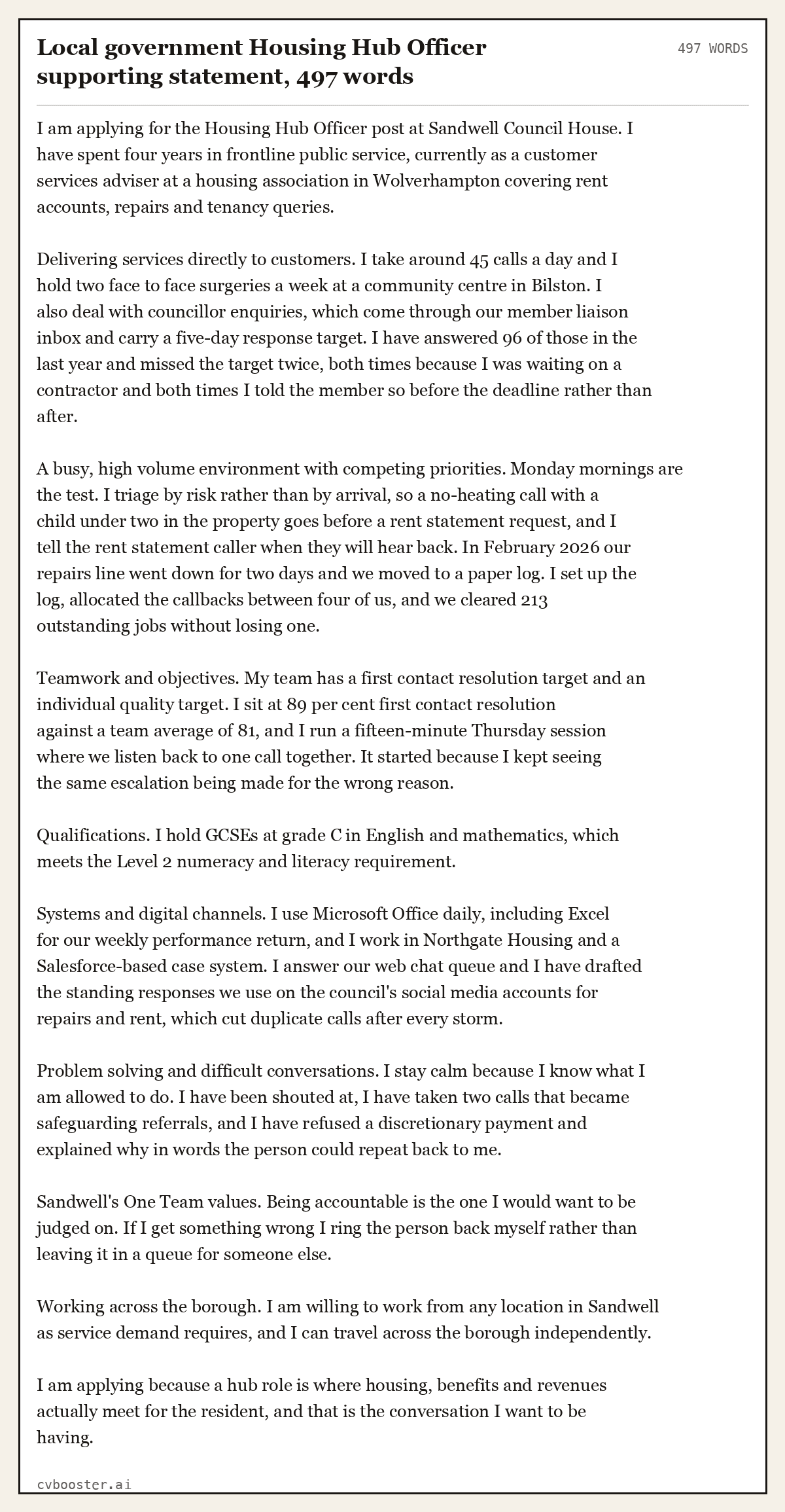
Local government Housing Hub Officer supporting statement, 497 words (497 words)
I am applying for the Housing Hub Officer post at Sandwell Council House. I have spent four years in frontline public service, currently as a customer services adviser at a housing association in Wolverhampton covering rent accounts, repairs and tenancy queries.
Delivering services directly to customers. I take around 45 calls a day and I hold two face to face surgeries a week at a community centre in Bilston. I also deal with councillor enquiries, which come through our member liaison inbox and carry a five-day response target. I have answered 96 of those in the last year and missed the target twice, both times because I was waiting on a contractor and both times I told the member so before the deadline rather than after.
A busy, high volume environment with competing priorities. Monday mornings are the test. I triage by risk rather than by arrival, so a no-heating call with a child under two in the property goes before a rent statement request, and I tell the rent statement caller when they will hear back. In February 2026 our repairs line went down for two days and we moved to a paper log. I set up the log, allocated the callbacks between four of us, and we cleared 213 outstanding jobs without losing one.
Teamwork and objectives. My team has a first contact resolution target and an individual quality target. I sit at 89 per cent first contact resolution against a team average of 81, and I run a fifteen-minute Thursday session where we listen back to one call together. It started because I kept seeing the same escalation being made for the wrong reason.
Qualifications. I hold GCSEs at grade C in English and mathematics, which meets the Level 2 numeracy and literacy requirement.
Systems and digital channels. I use Microsoft Office daily, including Excel for our weekly performance return, and I work in Northgate Housing and a Salesforce-based case system. I answer our web chat queue and I have drafted the standing responses we use on the council's social media accounts for repairs and rent, which cut duplicate calls after every storm.
Problem solving and difficult conversations. I stay calm because I know what I am allowed to do. I have been shouted at, I have taken two calls that became safeguarding referrals, and I have refused a discretionary payment and explained why in words the person could repeat back to me.
Sandwell's One Team values. Being accountable is the one I would want to be judged on. If I get something wrong I ring the person back myself rather than leaving it in a queue for someone else.
Working across the borough. I am willing to work from any location in Sandwell as service demand requires, and I can travel across the borough independently.
I am applying because a hub role is where housing, benefits and revenues actually meet for the resident, and that is the conversation I want to be having.
What the sifter is scoring
- Criterion quoted: "At least 12 months' experience of delivering services directly to customers, stakeholders, elected members or partner organisations, either face-to-face or over the telephone." Where the statement shows it: four years, calls, face to face surgeries, and the councillor enquiries with a hit rate. The criterion names elected members, so the statement answers elected members.
- Criterion quoted: "Experience of working in a busy, high-volume environment while managing competing priorities." Where the statement shows it: the triage rule, then the two-day system outage and 213 jobs.
- Criterion quoted: "Experience of working as part of a team to achieve individual and service objectives." Where the statement shows it: both an individual figure and a team figure, plus something the applicant started.
- Criterion quoted: "Numeracy and Literacy Level 2 qualification or equivalent." Where the statement shows it: one line, stated as meeting the requirement. Never leave a qualification criterion to be inferred from your CV.
- Criterion quoted: "Knowledge of digital communication channels, including web-based services and social media platforms." Where the statement shows it: web chat and the drafted social responses, with the effect they had.
- Criterion quoted: "Commitment to Sandwell's One Team values and behaviours, including being Customer Focused, Inclusive, Ambitious and Accountable." Where the statement shows it: one named value with a behaviour attached. Picking one and proving it beats listing all four.
School teaching assistant, annotated
Written against the Teaching Assistant (SEND) post at Hazel Wood High School in Bury, part of the Oak Learning Partnership, listed 3 July 2026, 32.5 hours term time plus five days. The person specification in the attached job description says candidates will demonstrate the criteria "In their statement of suitability", so the statement is assessed directly.
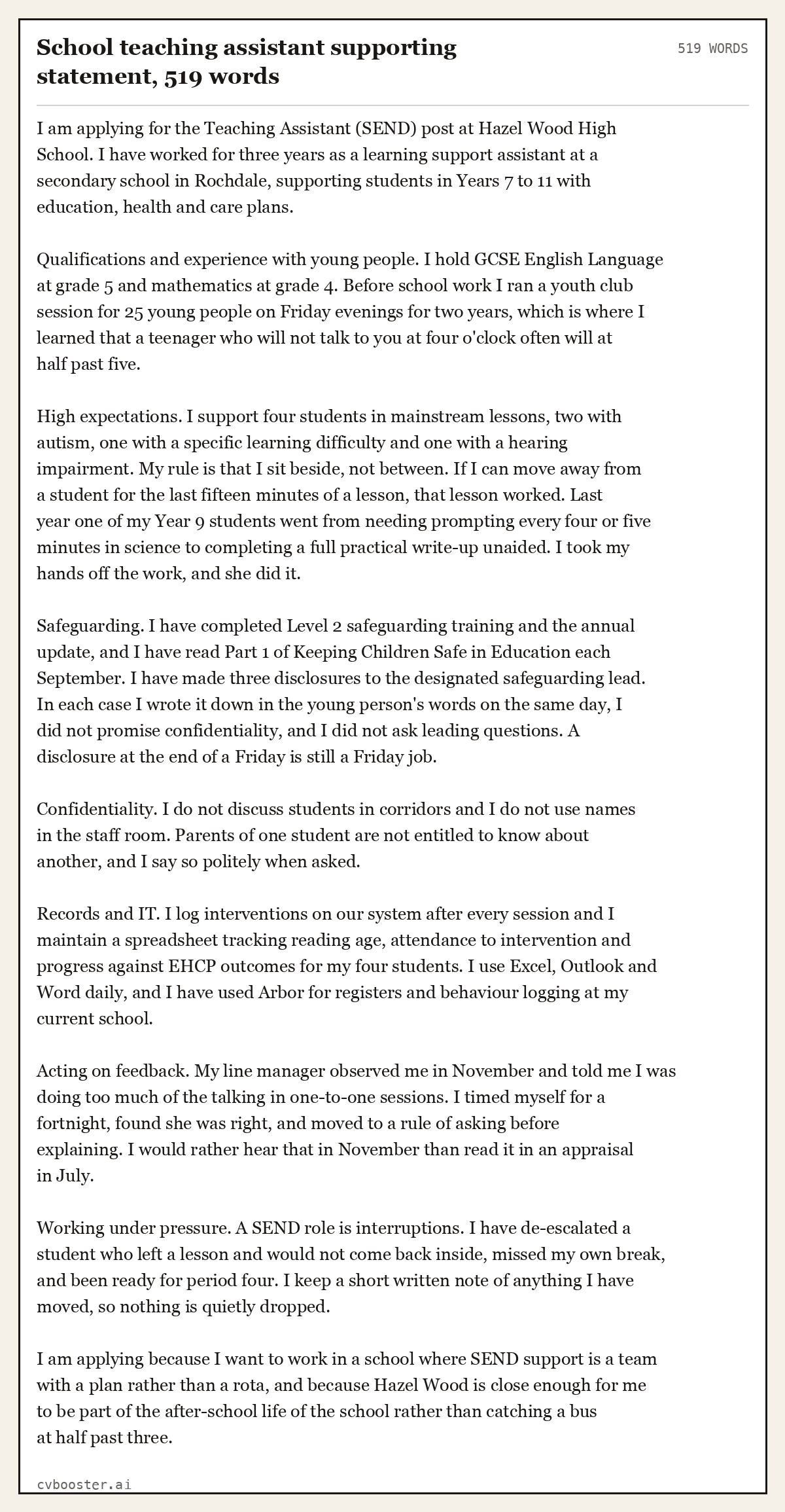
School teaching assistant supporting statement, 519 words (519 words)
I am applying for the Teaching Assistant (SEND) post at Hazel Wood High School. I have worked for three years as a learning support assistant at a secondary school in Rochdale, supporting students in Years 7 to 11 with education, health and care plans.
Qualifications and experience with young people. I hold GCSE English Language at grade 5 and mathematics at grade 4. Before school work I ran a youth club session for 25 young people on Friday evenings for two years, which is where I learned that a teenager who will not talk to you at four o'clock often will at half past five.
High expectations. I support four students in mainstream lessons, two with autism, one with a specific learning difficulty and one with a hearing impairment. My rule is that I sit beside, not between. If I can move away from a student for the last fifteen minutes of a lesson, that lesson worked. Last year one of my Year 9 students went from needing prompting every four or five minutes in science to completing a full practical write-up unaided. I took my hands off the work, and she did it.
Safeguarding. I have completed Level 2 safeguarding training and the annual update, and I have read Part 1 of Keeping Children Safe in Education each September. I have made three disclosures to the designated safeguarding lead. In each case I wrote it down in the young person's words on the same day, I did not promise confidentiality, and I did not ask leading questions. A disclosure at the end of a Friday is still a Friday job.
Confidentiality. I do not discuss students in corridors and I do not use names in the staff room. Parents of one student are not entitled to know about another, and I say so politely when asked.
Records and IT. I log interventions on our system after every session and I maintain a spreadsheet tracking reading age, attendance to intervention and progress against EHCP outcomes for my four students. I use Excel, Outlook and Word daily, and I have used Arbor for registers and behaviour logging at my current school.
Acting on feedback. My line manager observed me in November and told me I was doing too much of the talking in one-to-one sessions. I timed myself for a fortnight, found she was right, and moved to a rule of asking before explaining. I would rather hear that in November than read it in an appraisal in July.
Working under pressure. A SEND role is interruptions. I have de-escalated a student who left a lesson and would not come back inside, missed my own break, and been ready for period four. I keep a short written note of anything I have moved, so nothing is quietly dropped.
I am applying because I want to work in a school where SEND support is a team with a plan rather than a rota, and because Hazel Wood is close enough for me to be part of the after-school life of the school rather than catching a bus at half past three.
What the sifter is scoring
- Criterion quoted (Experience, Qualifications and Training, Essential): "Grade C / 4 or above in GCSE English and Mathematics." Where the statement shows it: both grades given in one line.
- Criterion quoted (Experience, Qualifications and Training, Essential): "Experience of working with young people." Where the statement shows it: three years in school plus two years of youth club work, which counts and is often left out.
- Criterion quoted (Ability, Skills and Knowledge, Essential): "High expectations which motivate and challenge students." Where the statement shows it: the sit beside rather than between rule, and one student moving to unaided work.
- Criterion quoted (Ability, Skills and Knowledge, Essential): "Commitment to safeguarding" and "Understanding of Safeguarding procedures." Where the statement shows it: the training, Keeping Children Safe in Education Part 1, and three disclosures handled by the correct process.
- Criterion quoted (Ability, Skills and Knowledge, Essential): "Ability to receive and act on feedback." Where the statement shows it: a named piece of critical feedback, what was measured afterwards, and what changed.
- Criterion quoted (Ability, Skills and Knowledge, Desirable): "Use of data management system/s e.g. Arbor." Where the statement shows it: Arbor named for registers and behaviour logging. Desirable criteria are free marks when you genuinely hold them.
Charity coordinator, annotated
Written against the Service Coordinator post at Link Age Southwark, posted 9 September 2026, 35 hours a week at £37,500, based in SE22 with a minimum of three days office or community based. This advert asks for a CV and a cover letter rather than a supporting statement, and it says applications without both "cannot be considered", so the statement below is written to be that letter.
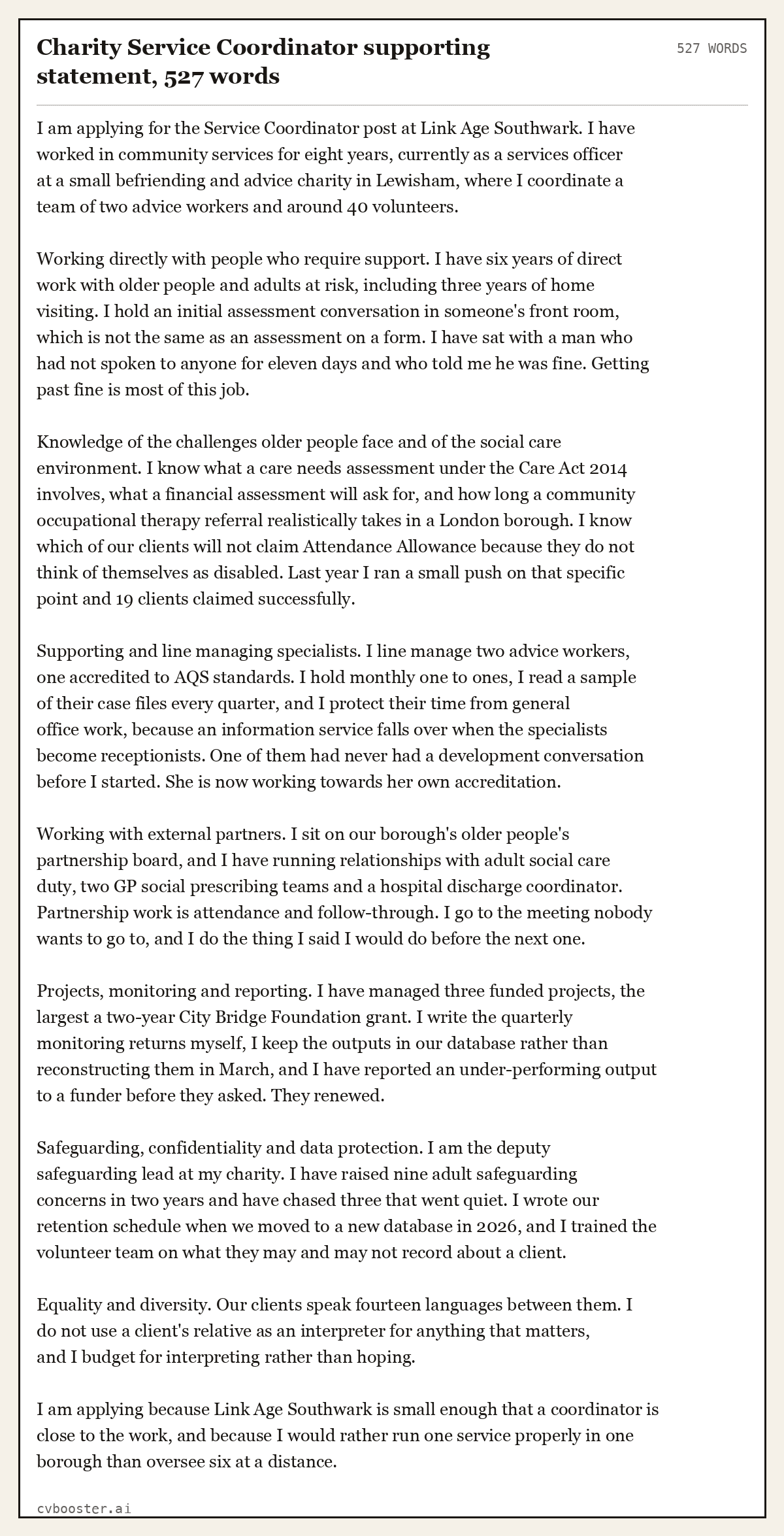
Charity Service Coordinator supporting statement, 527 words (527 words)
I am applying for the Service Coordinator post at Link Age Southwark. I have worked in community services for eight years, currently as a services officer at a small befriending and advice charity in Lewisham, where I coordinate a team of two advice workers and around 40 volunteers.
Working directly with people who require support. I have six years of direct work with older people and adults at risk, including three years of home visiting. I hold an initial assessment conversation in someone's front room, which is not the same as an assessment on a form. I have sat with a man who had not spoken to anyone for eleven days and who told me he was fine. Getting past fine is most of this job.
Knowledge of the challenges older people face and of the social care environment. I know what a care needs assessment under the Care Act 2014 involves, what a financial assessment will ask for, and how long a community occupational therapy referral realistically takes in a London borough. I know which of our clients will not claim Attendance Allowance because they do not think of themselves as disabled. Last year I ran a small push on that specific point and 19 clients claimed successfully.
Supporting and line managing specialists. I line manage two advice workers, one accredited to AQS standards. I hold monthly one to ones, I read a sample of their case files every quarter, and I protect their time from general office work, because an information service falls over when the specialists become receptionists. One of them had never had a development conversation before I started. She is now working towards her own accreditation.
Working with external partners. I sit on our borough's older people's partnership board, and I have running relationships with adult social care duty, two GP social prescribing teams and a hospital discharge coordinator. Partnership work is attendance and follow-through. I go to the meeting nobody wants to go to, and I do the thing I said I would do before the next one.
Projects, monitoring and reporting. I have managed three funded projects, the largest a two-year City Bridge Foundation grant. I write the quarterly monitoring returns myself, I keep the outputs in our database rather than reconstructing them in March, and I have reported an under-performing output to a funder before they asked. They renewed.
Safeguarding, confidentiality and data protection. I am the deputy safeguarding lead at my charity. I have raised nine adult safeguarding concerns in two years and have chased three that went quiet. I wrote our retention schedule when we moved to a new database in 2026, and I trained the volunteer team on what they may and may not record about a client.
Equality and diversity. Our clients speak fourteen languages between them. I do not use a client's relative as an interpreter for anything that matters, and I budget for interpreting rather than hoping.
I am applying because Link Age Southwark is small enough that a coordinator is close to the work, and because I would rather run one service properly in one borough than oversee six at a distance.
What the sifter is scoring
- Criterion quoted (Knowledge and Experience, Essential): "Substantial experience (typically gained over three years or more) of working directly with people who require support, including vulnerable adults." Where the statement shows it: six years direct work, three of them home visiting, with one specific visit described.
- Criterion quoted (Knowledge and Experience, Essential): "Knowledge of the challenges older people experience and the social care environment." Where the statement shows it: the Care Act assessment, the financial assessment, waiting times, and the Attendance Allowance point with a number.
- Criterion quoted (Knowledge and Experience, Essential): "Ability to support and line manage specialists delivering an information service." Where the statement shows it: two named reports, a supervision pattern, file sampling, and a stated principle about protecting specialist time.
- Criterion quoted (Knowledge and Experience, Essential): "Experience of managing projects, including planning, monitoring and reporting." Where the statement shows it: three funded projects, the largest named, and a disclosure to a funder that was made early.
- Criterion quoted (Knowledge and Experience, Essential): "Experience of safeguarding, including identifying and raising concerns." Where the statement shows it: deputy safeguarding lead, nine concerns raised and three chased. Chasing is the part that shows the role is real.
- Criterion quoted (Skills/Attributes): "Flexible attitude to the demands of the post and the needs of a small charity." Where the statement shows it: the closing paragraph, which gives a reason for this size of organisation rather than flattery.
The sentences that cost you the shortlist
| Before | Why it scores nothing | After |
|---|---|---|
| "I have excellent communication skills and can adapt my style to any audience." | A claim with no reader, no situation and nothing to tick. | "I write to clinicians in three lines with the decision I need at the top, and I speak to patients in plain words." |
| "We reduced waiting times significantly across the department." | The criterion asks what you did. "We" is unscorable. | "I cleared 310 open pathways, 84 of which were clock stops that had never been recorded." |
| "I am passionate about supporting vulnerable people and making a difference." | Motivation without evidence. Every applicant writes it. | "I have raised nine adult safeguarding concerns in two years and chased three that went quiet." |
| "I am a fast learner and I am confident using a variety of IT systems." | Names no system, so it cannot be matched to the criterion. | "I work in Cerner Millennium daily, book through the e-Referral Service, and used EMIS Web on a six-month secondment." |
The pattern is the same each time. Delete the adjective, name the place, add the number, and say what you personally did.
Before you submit
- Put the criteria list beside your statement and tick each one. Anything untickable is not written clearly enough.
- Use the employer's own words for your paragraph headings, including their spelling and capitals.
- Answer the desirable criteria you hold, and say plainly when you do not hold one.
- Check for "we" and change it to "I" wherever you were the person acting.
- Write it in a document and paste it in. Fife Council's guidance reminds smartphone applicants to save the file before attaching it, which is a real source of lost work.
More complete statements: NHS supporting statement examples, care worker supporting statement examples, teaching supporting statement and the method behind all of them in how to write a supporting statement.
Frequently asked questions
How to write a statement of support?
Take the essential criteria from the person specification, group them into three or four headings, and write one dated example under each saying what you personally did. Start by naming the post. Finish with practical facts such as notice period and travel. Fife Council's guidance sets the same order: read the advert, read the role profile, group the criteria, then write.
What is an example of a good NHS supporting statement?
The Band 4 administrator statement above is one. It names the post in the first line, uses the trust's own person specification headings, answers every essential criterion including the RTT rules, and answers a desirable criterion honestly. Longer NHS statements at Band 3, Band 5 and Band 6 are on NHS supporting statement examples.
What is a good opening line for a personal statement?
One that names the post and your current role, with no adjective in it. "I am applying for the Housing Hub Officer post at Sandwell Council House" works because the reader knows immediately they are in the right document. "I am a highly motivated and dedicated professional" works for nobody, because it describes a category of person rather than a specific one.
What to write in support of your application?
Write why you want the job, then your evidence against each essential criterion, then the practical facts. Fife Council lists it as your interest in the vacancy, how your knowledge, skills and experience meet the essential criteria, and relevant examples, with the instruction "Tell us what YOU did". Anything that does not answer a criterion is taking space from something that would.
How long should a supporting statement be?
Follow the advert. Where a word limit is given, use at least 90 per cent of it, because unused words read as missing evidence. Where no limit is given, 400 to 550 words is enough for four to six criteria. The four statements on this page run from 497 to 527 words. Longer than roughly 700 words and the criteria start to hide from the reader.
Is a supporting statement the same as a cover letter?
Not quite. A cover letter is a letter, structured how you like, and it can be a page of general persuasion. A supporting statement is an answer to a published list of criteria, and it is usually marked against that list by two people. Some employers, including the charity advert above, ask for a cover letter but describe it as evidence against the person specification. When they do, write the statement.
More in this series: Supporting statements
- CV Personal Statement Examples: 12 Written for Real Jobs
- Care Worker Supporting Statement Example: 3 Full Statements
- How to Write a Personal Statement for a Job Application
- How to Write a Supporting Statement: One Built Step by Step
- NHS Supporting Statement Examples: Band 3, Band 5, Band 6
Related articles
- How to Write a Supporting Statement: One Built Step by Step
- NHS Supporting Statement Examples: Band 3, Band 5, Band 6
- Cover Letter vs Supporting Statement: UK Rules
- Care Worker Supporting Statement Example: 3 Full Statements
More articles
- How to Tailor Your Resume for Every Job Application (in 5 Minutes)
- Teaching Interview Questions and 15 Full STAR Answers
- Teacher Resume: Certification, Grades, Evidence
Looking for a worked example for your job title? Browse the resume examples by job title.