How to Write a Supporting Statement: One Built Step by Step
By Mustafa Tarabya, founder of CVBooster · Published · Updated
13 min read
If you want to know how to write a supporting statement, the answer is that you do not write it, you assemble it from the person specification. The constraint that decides the shape is the criteria list, because two people will mark your statement against that list and nothing else. Fife Council's guidance sets the order out plainly: read the advert, read the role profile, group the criteria, think of examples, then write. Below, one statement is built in front of you against a council advert that closed in September 2026, section by section, with each draft shown as it is written. Written by Mustafa Tarabya, who hired for his own company, read every application himself and now writes CVBooster's guides.
The five steps, in order
- Strip the advert down to its criteria and nothing else.
- Group the criteria into three or four headings you can write under.
- Set a word budget per heading before drafting anything.
- Write one dated example per heading, saying what you did.
- Write the opening and the closing last, when you know what they introduce.
Most applicants start at step four. The Fife Council guidance puts grouping first: "Group the criteria if possible - you can structure your supporting statement around it."
The advert we are building against
The post is Environmental Services Support Officer, advertised as Food Waste Coordinator by Bromsgrove and Redditch Councils, Grade 7, reference BR/TP/264/664, closing 27 September 2026.
Quoted from the advert: "Hold a full Class 2 (Category C) HGV driving licence." "Be confident managing day-to-day operational issues within a busy frontline service." "Proven ability in leading and developing a team, including managing conflict and contrasting team dynamics." "The ability to liaise effectively with operational staff, residents, and management." "The ability to work under pressure whilst maintaining service standards and integrity."
Step one: the criteria list, grouped
Every criterion falls into one of four buckets. That is the document structure, fixed before a word is written.
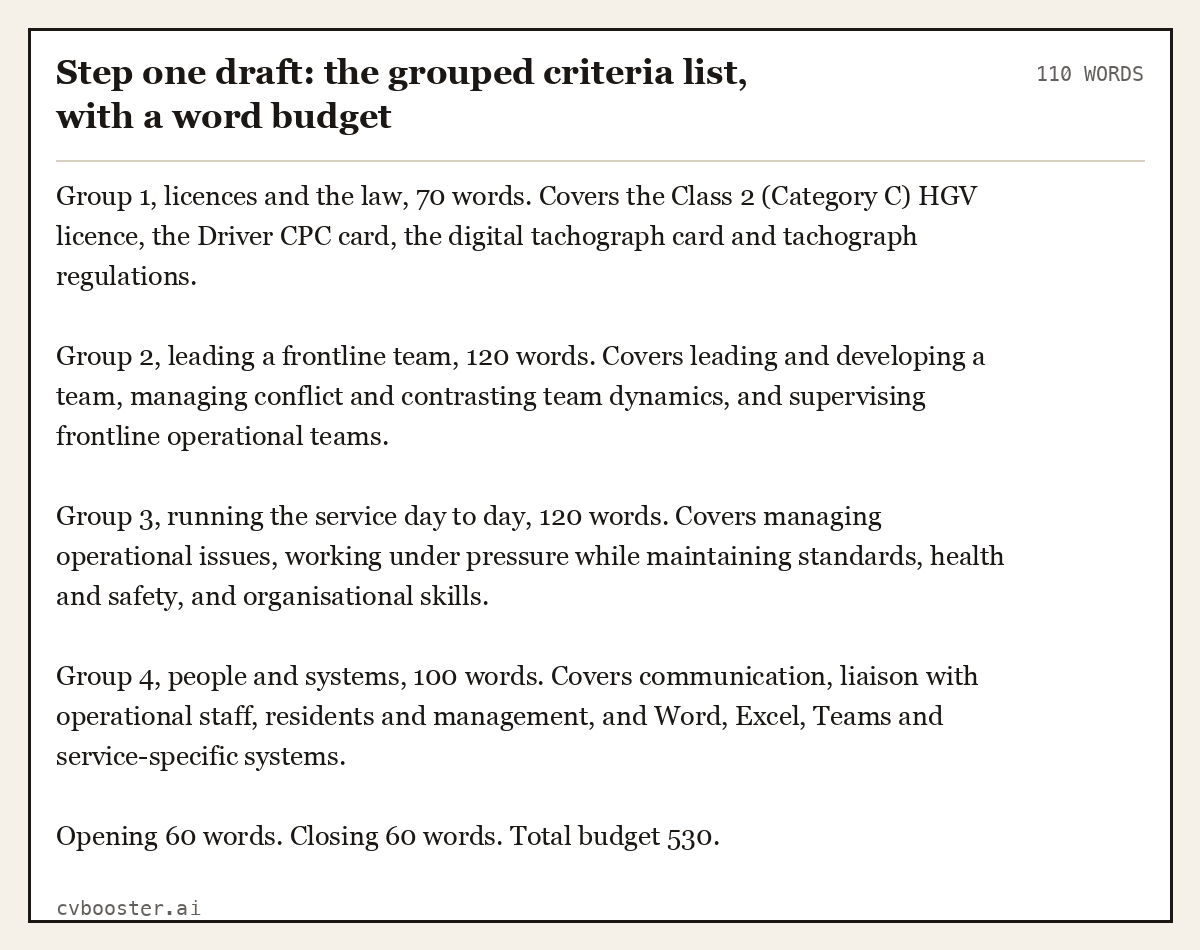
Step one draft: the grouped criteria list, with a word budget (110 words)
Group 1, licences and the law, 70 words. Covers the Class 2 (Category C) HGV licence, the Driver CPC card, the digital tachograph card and tachograph regulations.
Group 2, leading a frontline team, 120 words. Covers leading and developing a team, managing conflict and contrasting team dynamics, and supervising frontline operational teams.
Group 3, running the service day to day, 120 words. Covers managing operational issues, working under pressure while maintaining standards, health and safety, and organisational skills.
Group 4, people and systems, 100 words. Covers communication, liaison with operational staff, residents and management, and Word, Excel, Teams and service-specific systems.
Opening 60 words. Closing 60 words. Total budget 530.
The advert sets no limit, so 530 is a judgement: long enough to evidence four groups, short enough that a manager reads it all before the panel meets.
Step two: the opening, drafted
The opening has two jobs. Name the post, and state what you currently are. Nothing else earns its place.
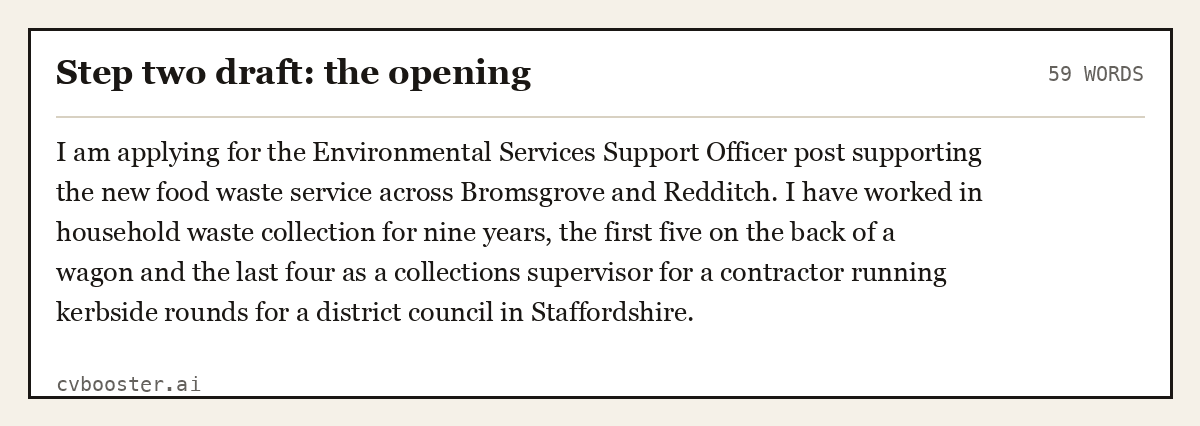
Step two draft: the opening (59 words)
I am applying for the Environmental Services Support Officer post supporting the new food waste service across Bromsgrove and Redditch. I have worked in household waste collection for nine years, the first five on the back of a wagon and the last four as a collections supervisor for a contractor running kerbside rounds for a district council in Staffordshire.
Notice what is absent. No adjective about the applicant. No sentence about being excited by the opportunity. The reader now knows the sector, the years and the level, which is what they were going to check first anyway.
Step three: the licence and legal group, drafted
This group is a compliance check, not a story. Answer it in facts and move on. Where a criterion names a card, name the card.
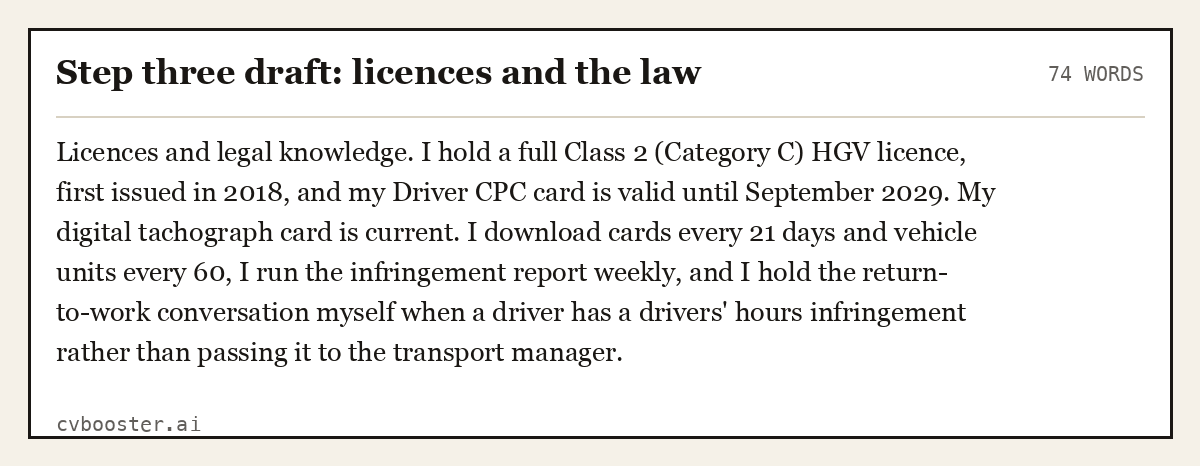
Step three draft: licences and the law (74 words)
Licences and legal knowledge. I hold a full Class 2 (Category C) HGV licence, first issued in 2018, and my Driver CPC card is valid until September 2029. My digital tachograph card is current. I download cards every 21 days and vehicle units every 60, I run the infringement report weekly, and I hold the return-to-work conversation myself when a driver has a drivers' hours infringement rather than passing it to the transport manager.
Seventy-four words against a 70-word budget. The last sentence is the only one carrying an opinion, and it earns its place because it shows what the applicant does with the regulation, not just that they have heard of it.
Step four: the two evidence groups, drafted
These two are where the marks are. Each one gets a dated example with a number in it. The jobs.ac.uk guidance recommends building these with STAR, and describes the action step as "focus on you and the action you took in the given example".
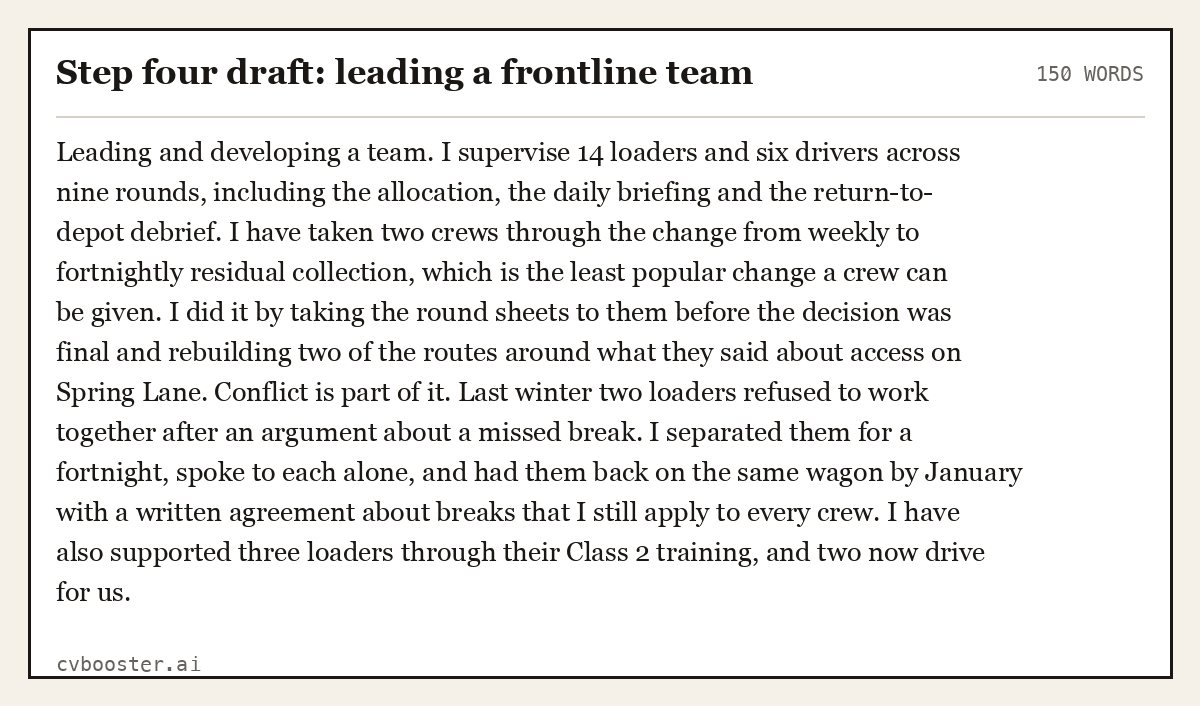
Step four draft: leading a frontline team (150 words)
Leading and developing a team. I supervise 14 loaders and six drivers across nine rounds, including the allocation, the daily briefing and the return-to-depot debrief. I have taken two crews through the change from weekly to fortnightly residual collection, which is the least popular change a crew can be given. I did it by taking the round sheets to them before the decision was final and rebuilding two of the routes around what they said about access on Spring Lane. Conflict is part of it. Last winter two loaders refused to work together after an argument about a missed break. I separated them for a fortnight, spoke to each alone, and had them back on the same wagon by January with a written agreement about breaks that I still apply to every crew. I have also supported three loaders through their Class 2 training, and two now drive for us.
Step four draft: running the service day to day (133 words)
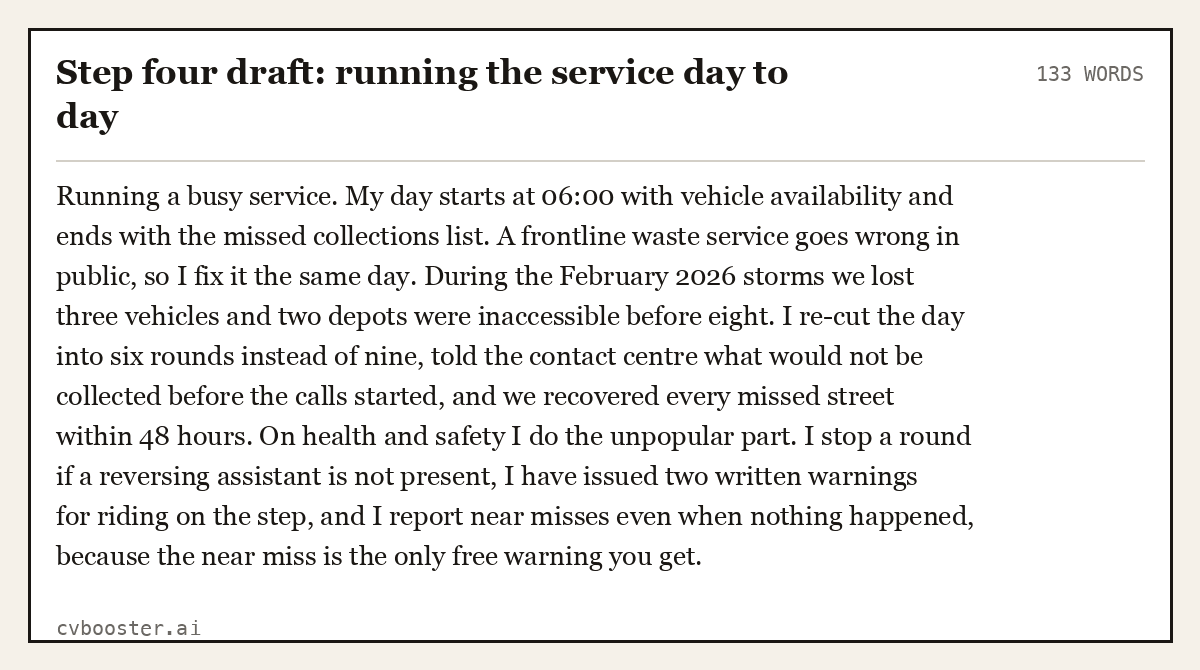
Running a busy service. My day starts at 06:00 with vehicle availability and ends with the missed collections list. A frontline waste service goes wrong in public, so I fix it the same day. During the February 2026 storms we lost three vehicles and two depots were inaccessible before eight. I re-cut the day into six rounds instead of nine, told the contact centre what would not be collected before the calls started, and we recovered every missed street within 48 hours. On health and safety I do the unpopular part. I stop a round if a reversing assistant is not present, I have issued two written warnings for riding on the step, and I report near misses even when nothing happened, because the near miss is the only free warning you get.
What the sifter is scoring
- Criterion quoted: "Proven ability in leading and developing a team, including managing conflict and contrasting team dynamics." Where the draft shows it: the route rebuild, the two loaders separated and returned, and three crew members put through Class 2 training.
- Criterion quoted: "The ability to work under pressure whilst maintaining service standards and integrity." Where the draft shows it: the storm week, with the number of vehicles lost, the decision made and the recovery time.
- Criterion quoted: "Have a good understanding of health and safety practices and how these apply to the role and service area and their impact." Where the draft shows it: three concrete actions, including one that made the applicant unpopular. Stopping a round is the evidence, not a sentence about valuing safety.
- Criterion quoted (Desirable): "Experience within a local authority waste management environment." Where the draft shows it: contractor rounds delivered for a district council, stated honestly as contractor rather than direct employment.
Step five: people, systems, and the closing
The fourth group and the closing can share a paragraph if the closing is doing real work. Practical facts belong here: flexibility, travel, notice.
Step five draft: people, systems and the closing (137 words)
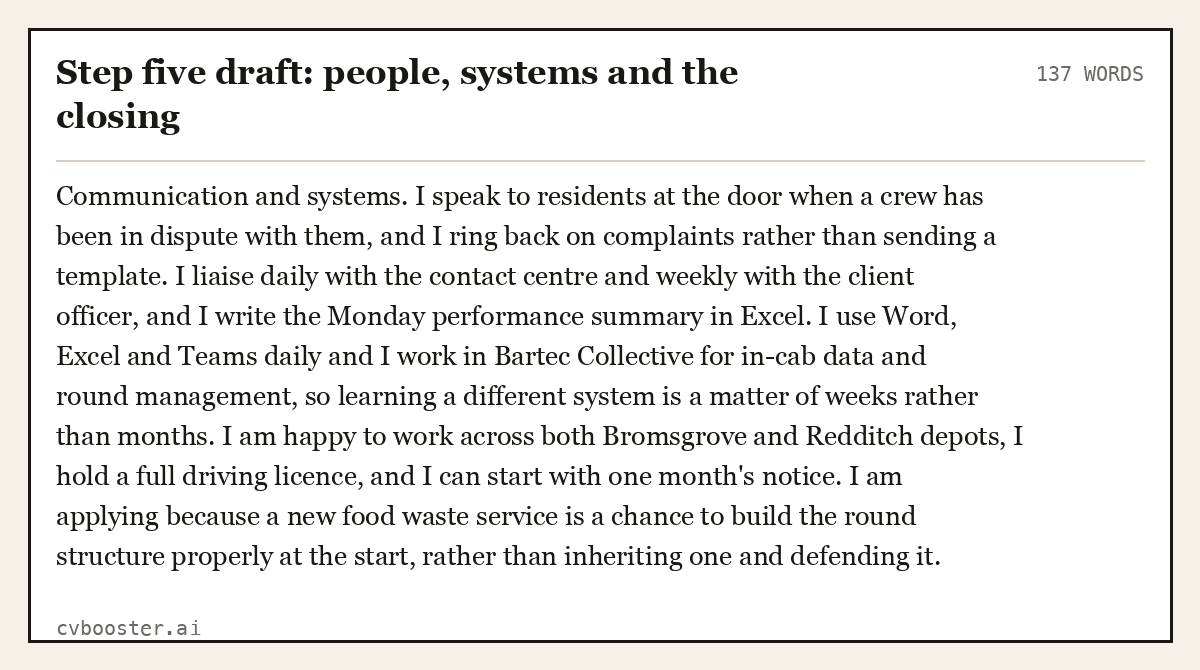
Communication and systems. I speak to residents at the door when a crew has been in dispute with them, and I ring back on complaints rather than sending a template. I liaise daily with the contact centre and weekly with the client officer, and I write the Monday performance summary in Excel. I use Word, Excel and Teams daily and I work in Bartec Collective for in-cab data and round management, so learning a different system is a matter of weeks rather than months. I am happy to work across both Bromsgrove and Redditch depots, I hold a full driving licence, and I can start with one month's notice. I am applying because a new food waste service is a chance to build the round structure properly at the start, rather than inheriting one and defending it.
The finished statement
Put the five drafts in order and this is what the reader gets.
Finished supporting statement, Environmental Services Support Officer, 553 words (553 words)
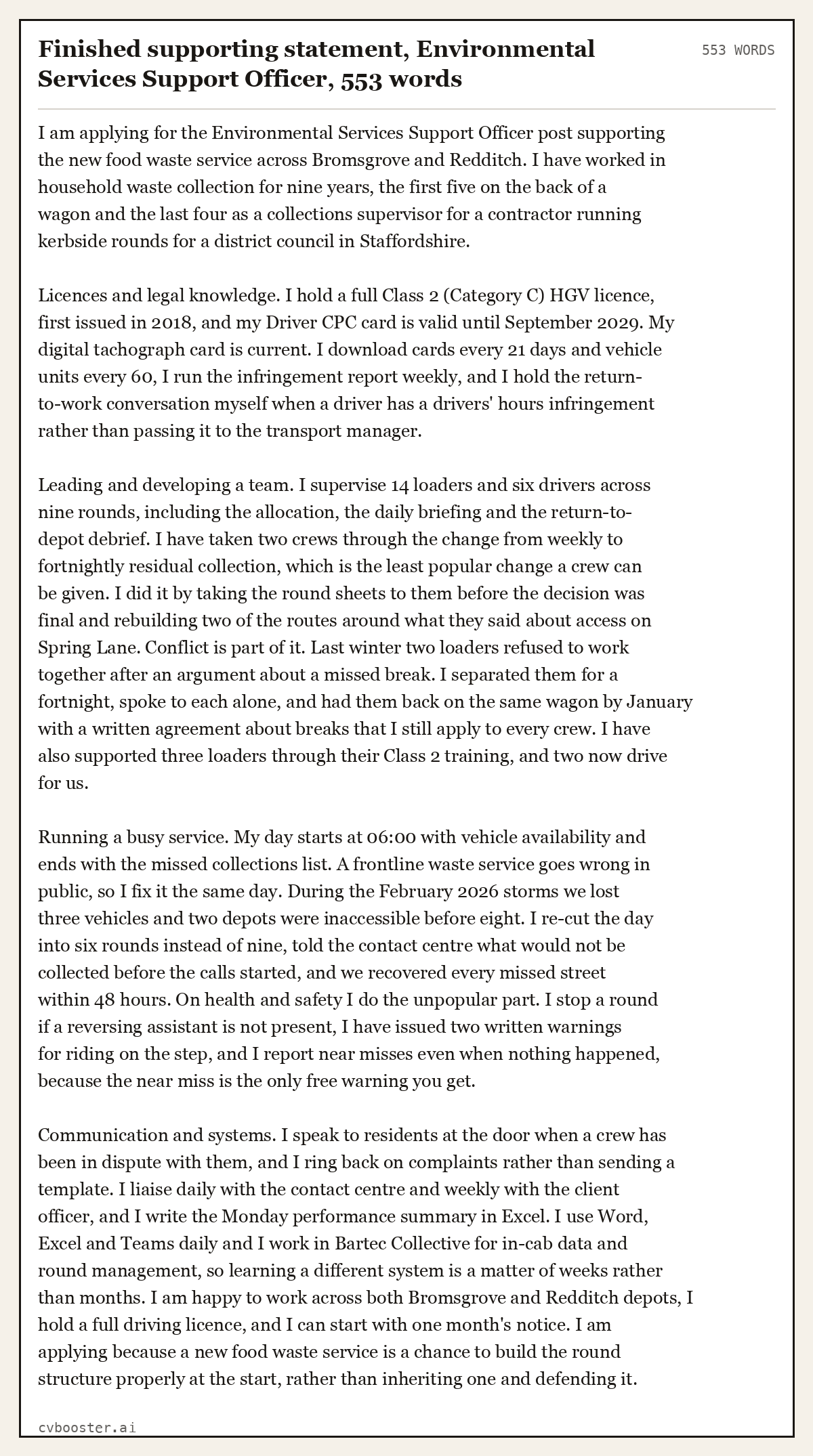
I am applying for the Environmental Services Support Officer post supporting the new food waste service across Bromsgrove and Redditch. I have worked in household waste collection for nine years, the first five on the back of a wagon and the last four as a collections supervisor for a contractor running kerbside rounds for a district council in Staffordshire.
Licences and legal knowledge. I hold a full Class 2 (Category C) HGV licence, first issued in 2018, and my Driver CPC card is valid until September 2029. My digital tachograph card is current. I download cards every 21 days and vehicle units every 60, I run the infringement report weekly, and I hold the return-to-work conversation myself when a driver has a drivers' hours infringement rather than passing it to the transport manager.
Leading and developing a team. I supervise 14 loaders and six drivers across nine rounds, including the allocation, the daily briefing and the return-to-depot debrief. I have taken two crews through the change from weekly to fortnightly residual collection, which is the least popular change a crew can be given. I did it by taking the round sheets to them before the decision was final and rebuilding two of the routes around what they said about access on Spring Lane. Conflict is part of it. Last winter two loaders refused to work together after an argument about a missed break. I separated them for a fortnight, spoke to each alone, and had them back on the same wagon by January with a written agreement about breaks that I still apply to every crew. I have also supported three loaders through their Class 2 training, and two now drive for us.
Running a busy service. My day starts at 06:00 with vehicle availability and ends with the missed collections list. A frontline waste service goes wrong in public, so I fix it the same day. During the February 2026 storms we lost three vehicles and two depots were inaccessible before eight. I re-cut the day into six rounds instead of nine, told the contact centre what would not be collected before the calls started, and we recovered every missed street within 48 hours. On health and safety I do the unpopular part. I stop a round if a reversing assistant is not present, I have issued two written warnings for riding on the step, and I report near misses even when nothing happened, because the near miss is the only free warning you get.
Communication and systems. I speak to residents at the door when a crew has been in dispute with them, and I ring back on complaints rather than sending a template. I liaise daily with the contact centre and weekly with the client officer, and I write the Monday performance summary in Excel. I use Word, Excel and Teams daily and I work in Bartec Collective for in-cab data and round management, so learning a different system is a matter of weeks rather than months. I am happy to work across both Bromsgrove and Redditch depots, I hold a full driving licence, and I can start with one month's notice. I am applying because a new food waste service is a chance to build the round structure properly at the start, rather than inheriting one and defending it.
Five hundred and fifty-three words against a 530-word budget, four headings taken from the advert, and every essential criterion answered with something a manager could verify.
The sentences that cost marks
| Before | What is missing | After |
|---|---|---|
| "I have extensive experience of managing teams in a fast paced environment." | No headcount, no sector, no time span. Unscorable. | "I supervise 14 loaders and six drivers across nine rounds." |
| "I am fully compliant with all relevant transport legislation." | Names no regulation and no action. | "I download cards every 21 days and vehicle units every 60, and I run the infringement report weekly." |
| "We worked hard as a team to recover the service after severe weather." | The criterion asks what you did. "We" cannot be ticked. | "I re-cut the day into six rounds instead of nine and told the contact centre before the calls started." |
| "I am proficient in a wide range of IT packages and can pick up new systems quickly." | No system named, so nothing matches the criterion. | "I work in Bartec Collective for in-cab data and round management, and I write the Monday summary in Excel." |
Careers Wales makes the same point about evidence, advising applicants to "Use examples from your life that prove you have the right skills". A claim is not an example.
Word counts, and what to do when there is no limit
- A limit is given. Use at least 90 per cent of it. Short answers are read as thin evidence, not as brevity.
- A character limit is given. Draft in a document with a character count, because a 2,000-character box is roughly 330 words, not 2,000.
- No limit is given. Budget 100 to 130 words per criteria group and keep the total between 400 and 700.
- The box is tiny and the criteria are many. Group harder. Four headings at 90 words beats nine headings at 40.
Before you submit
- Read only the first sentence of each paragraph. Together they should look like the person specification.
- Search your draft for "we" and change it wherever you were the one acting.
- Check that every essential criterion appears. Tick them off against the advert on paper.
- Name the systems, the qualifications and the legislation exactly as the advert names them.
- Say plainly where you fall short of a desirable criterion. It costs a line and it protects you at interview.
Four complete statements in other sectors are on supporting statement examples. For health and care specifically, see NHS supporting statement examples and care worker supporting statement examples. If the advert asks for a personal statement instead, the rules differ slightly and are set out in how to write a personal statement for a job.
Frequently asked questions
How do I start my supporting statement?
Name the post and say what you currently are, in two sentences with no adjectives. "I am applying for the Environmental Services Support Officer post" followed by "I have worked in household waste collection for nine years" tells the reader they are in the right document and roughly where you sit. Write this last, once the evidence underneath it exists.
What is the format of a supporting statement?
A short opening, one bold or underlined heading per criteria group taken from the person specification, one dated example under each, then a closing of practical facts. No address block, no "Dear Sir or Madam", no sign-off. It is prose with headings, not a letter, and most online forms will strip any formatting beyond plain paragraphs.
Can you provide an example of a strong supporting statement?
The 553-word statement above is one, built section by section against a live council advert so you can see each draft as it was written. Four more complete statements, for NHS, local government, school and charity posts, are on supporting statement examples, each with the advert's essential criteria quoted underneath.
Should a supporting statement use headings?
Yes, and take them from the person specification. The jobs.ac.uk guidance recommends "sub-headings, ideally linked to those used in the person specification", so the reader can cross-reference your evidence against their list. Bold text at the start of each paragraph does the same job when the form strips formatting, which is why the worked statement above uses that pattern.
Can I reuse a supporting statement for another job?
Reuse the examples, never the document. The evidence you have does not change between applications, but the grouping, the headings and the emphasis are set by each advert's criteria. The jobs.ac.uk guidance warns against copying and pasting from previous applications and advises referencing the specific role. A recycled statement is obvious because it answers criteria the advert never listed.
More in this series: Supporting statements
- CV Personal Statement Examples: 12 Written for Real Jobs
- Care Worker Supporting Statement Example: 3 Full Statements
- How to Write a Personal Statement for a Job Application
- NHS Supporting Statement Examples: Band 3, Band 5, Band 6
- Supporting Statement Example: 4 Full Statements, Annotated
Related articles
- Supporting Statement Example: 4 Full Statements, Annotated
- NHS Supporting Statement Examples: Band 3, Band 5, Band 6
- Cover Letter vs Supporting Statement: UK Rules
- Care Worker Supporting Statement Example: 3 Full Statements
More articles
- How to Write an Internship Cover Letter (With Examples)
- Irish CV Conventions: Referees, Garda Vetting and Permits
- Job Description Template: A Structure That Works
Looking for a worked example for your job title? Browse the resume examples by job title.