Dear Sir or Madam: When to Use It, Better Options, 6 Letters
By Mustafa Tarabya, founder of CVBooster · Published · Updated
7 min read
Use "Dear Sir or Madam" to open a formal letter or email only when you cannot find the name or job title of the person who will read it, and close that letter with "Yours faithfully". The one constraint is effort: for a job application, a name or a role such as "Dear Hiring Manager" almost always beats it, because it shows you looked. Cambridge Dictionary defines the phrase as "used to begin a formal letter when you do not know if the person you are writing to is a man or a woman". Six complete letters follow, with the right greeting for each. Written by Mustafa Tarabya, who hired for his own company, read every application himself and now writes CVBooster's guides.
"Dear Sir or Madam" has opened letters to tax offices, gas companies and the Queen. It also opens job applications to a company whose HR manager has her name on the careers page, two clicks away. The first use is fine. The second one is the one people notice.
A letter where Dear Sir or Madam is the right greeting
A formal enquiry to an office with no named contact is the classic case.
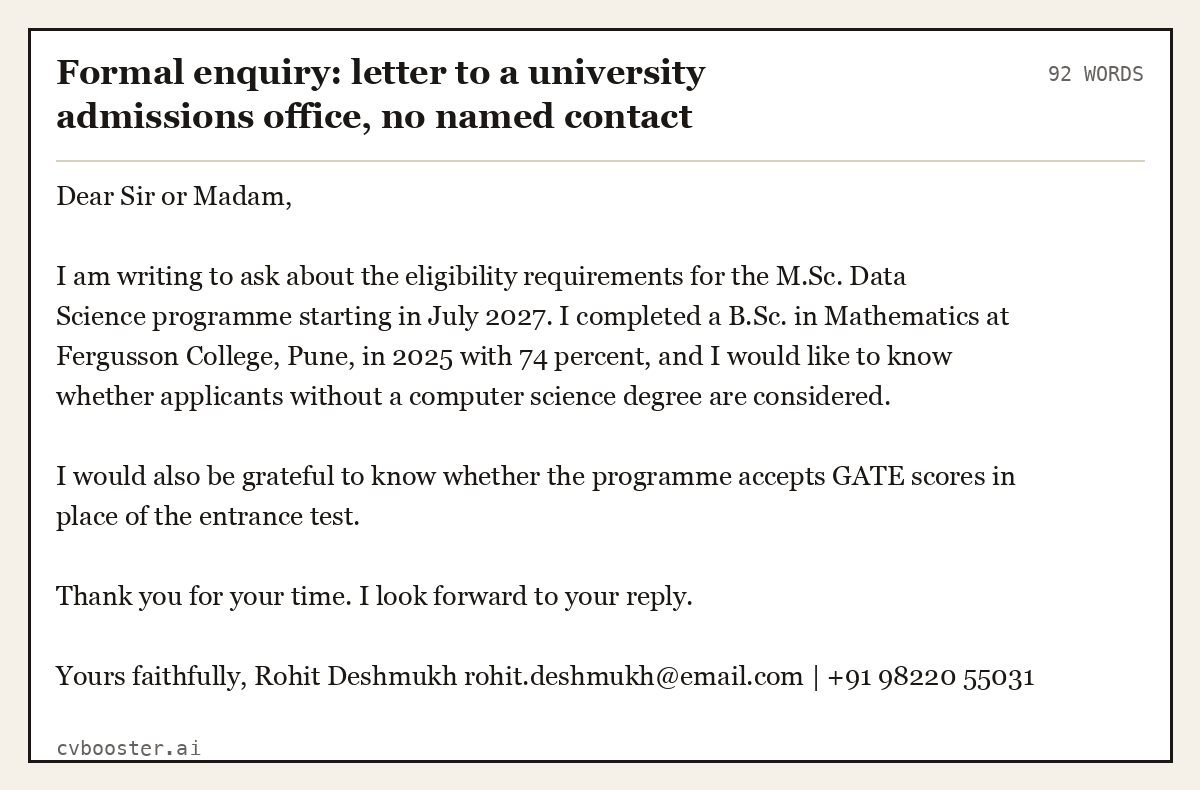
Formal enquiry: letter to a university admissions office, no named contact (92 words)
Dear Sir or Madam,
I am writing to ask about the eligibility requirements for the M.Sc. Data Science programme starting in July 2027. I completed a B.Sc. in Mathematics at Fergusson College, Pune, in 2025 with 74 percent, and I would like to know whether applicants without a computer science degree are considered.
I would also be grateful to know whether the programme accepts GATE scores in place of the entrance test.
Thank you for your time. I look forward to your reply.
Yours faithfully, Rohit Deshmukh rohit.deshmukh@email.com | +91 98220 55031
There was no name to find: the email address on the website was a shared admissions inbox. That is when the phrase belongs.
When to use Dear Sir or Madam, and when not to
Use it when:
- You are writing to an office, department or shared inbox with no named person.
- The website, the advert and a phone call to reception give no name or role.
- The letter is formal: an enquiry, a complaint, a request to a government office or a bank.
Do not use it when:
- The job advert names a contact. Use the name.
- You can find the hiring manager on the company website or LinkedIn.
- You know the reader's role but not their name. Use the role: "Dear Hiring Manager", "Dear Admissions Committee".
Purdue's Online Writing Lab, on addressing cover letters, states the rule for job letters: "Whenever possible, address your letter to a specific individual, usually the person in charge of interviewing and hiring."
The closing that goes with Dear Sir or Madam
In British and Indian English the greeting decides the closing:
- Dear Sir or Madam goes with Yours faithfully. The Oxford Learner's Dictionary explains that Yours faithfully is "used at the end of a formal letter before you sign your name, when you have addressed somebody as ‘Dear Sir/Dear Madam, etc.’ and not by their name".
- Dear Mr Sharma or Dear Ms Iyer goes with Yours sincerely. Cambridge gives it as "used to end a formal letter that is sent to a particular person".
- In American English, "Sincerely" works after either greeting.
Write the greeting out in full as "Dear Sir or Madam" rather than "Dear Sir/Madam" in formal letters; the slash version is common in Indian offices, but the full form reads cleaner.
Better options for a job application
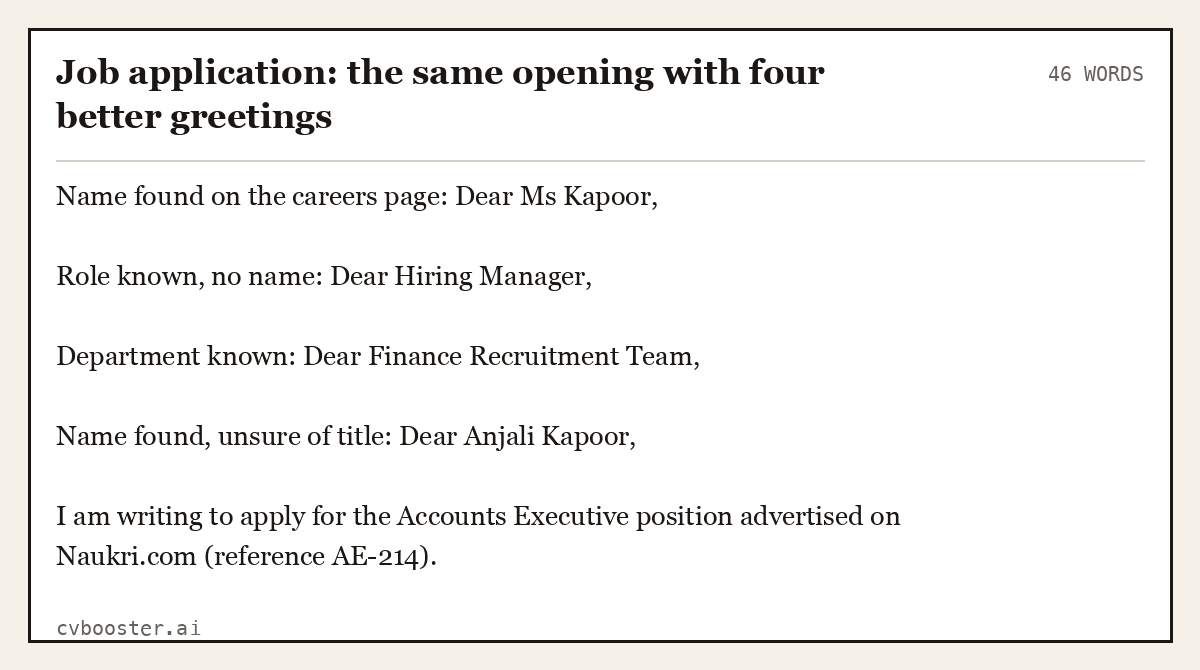
Job application: the same opening with four better greetings (46 words)
Name found on the careers page: Dear Ms Kapoor,
Role known, no name: Dear Hiring Manager,
Department known: Dear Finance Recruitment Team,
Name found, unsure of title: Dear Anjali Kapoor,
I am writing to apply for the Accounts Executive position advertised on Naukri.com (reference AE-214).
Each of these tells the reader you read the advert. "Dear Sir or Madam" tells them you did not need to.
Job application email using Dear Sir or Madam
Sometimes an advert gives only a shared email address and no company name, which is common with recruitment agencies. Then the phrase is acceptable.
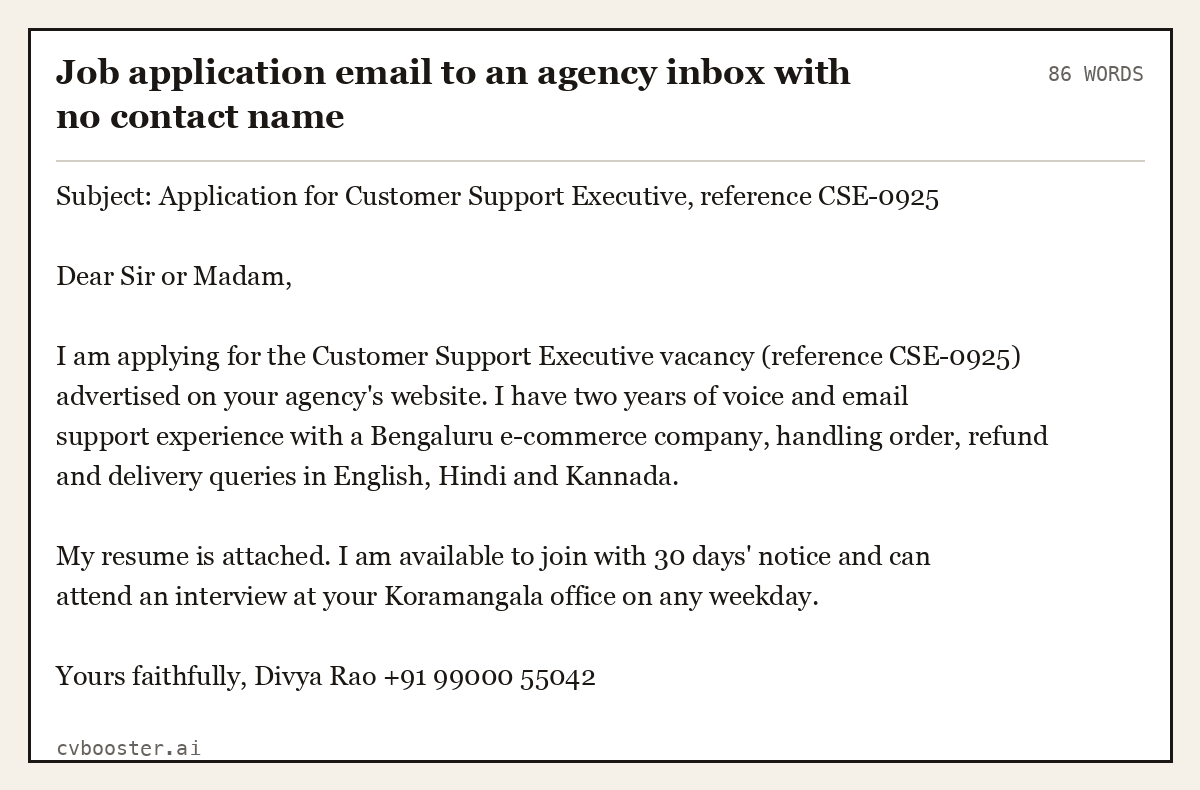
Job application email to an agency inbox with no contact name (86 words)
Subject: Application for Customer Support Executive, reference CSE-0925
Dear Sir or Madam,
I am applying for the Customer Support Executive vacancy (reference CSE-0925) advertised on your agency's website. I have two years of voice and email support experience with a Bengaluru e-commerce company, handling order, refund and delivery queries in English, Hindi and Kannada.
My resume is attached. I am available to join with 30 days' notice and can attend an interview at your Koramangala office on any weekday.
Yours faithfully, Divya Rao +91 99000 55042
Complaint letter using Dear Sir or Madam
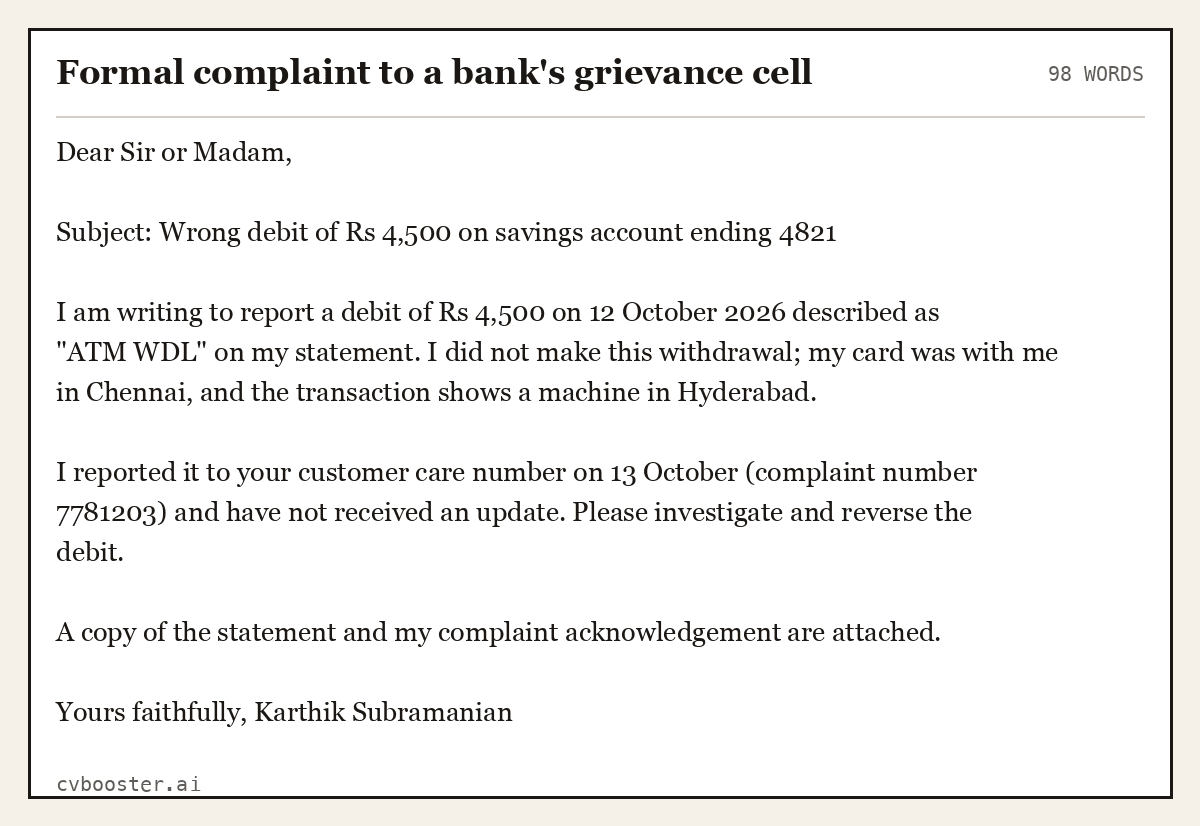
Formal complaint to a bank's grievance cell (98 words)
Dear Sir or Madam,
Subject: Wrong debit of Rs 4,500 on savings account ending 4821
I am writing to report a debit of Rs 4,500 on 12 October 2026 described as "ATM WDL" on my statement. I did not make this withdrawal; my card was with me in Chennai, and the transaction shows a machine in Hyderabad.
I reported it to your customer care number on 13 October (complaint number 7781203) and have not received an update. Please investigate and reverse the debit.
A copy of the statement and my complaint acknowledgement are attached.
Yours faithfully, Karthik Subramanian
Request letter to a college office
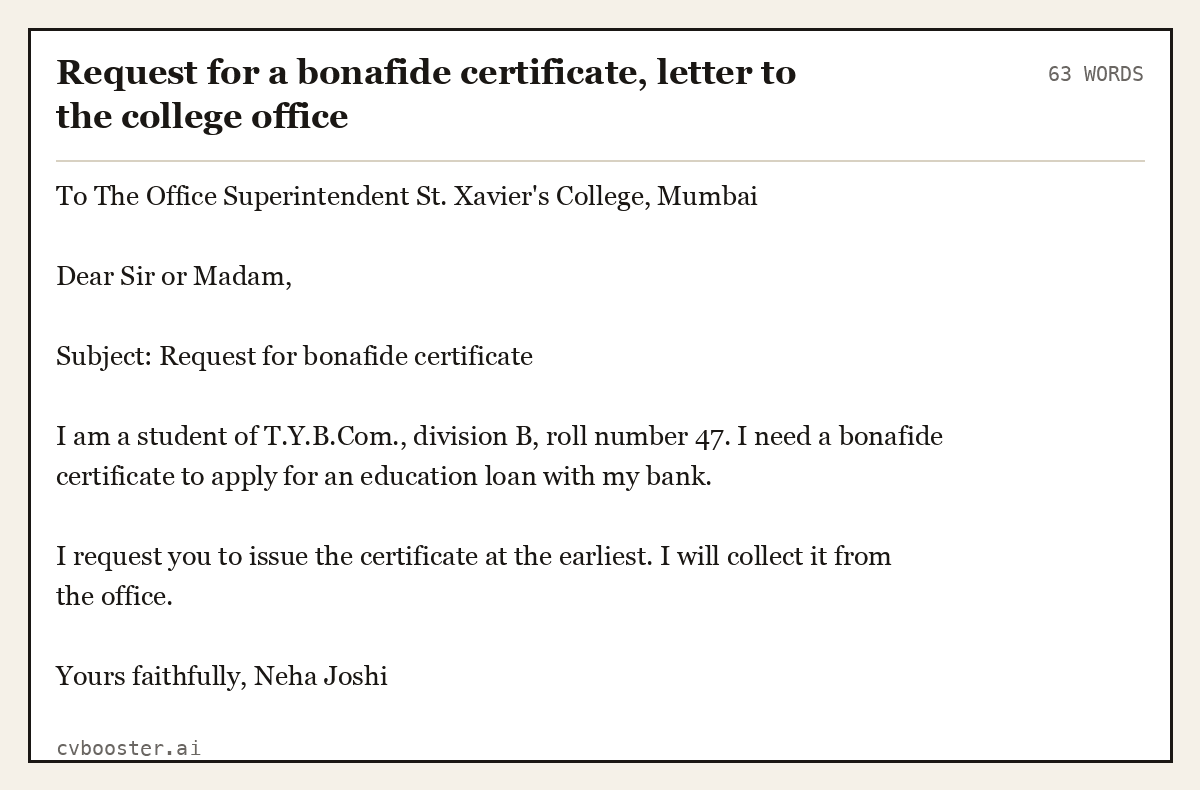
Request for a bonafide certificate, letter to the college office (63 words)
To The Office Superintendent St. Xavier's College, Mumbai
Dear Sir or Madam,
Subject: Request for bonafide certificate
I am a student of T.Y.B.Com., division B, roll number 47. I need a bonafide certificate to apply for an education loan with my bank.
I request you to issue the certificate at the earliest. I will collect it from the office.
Yours faithfully, Neha Joshi
Internship request when you know the department only
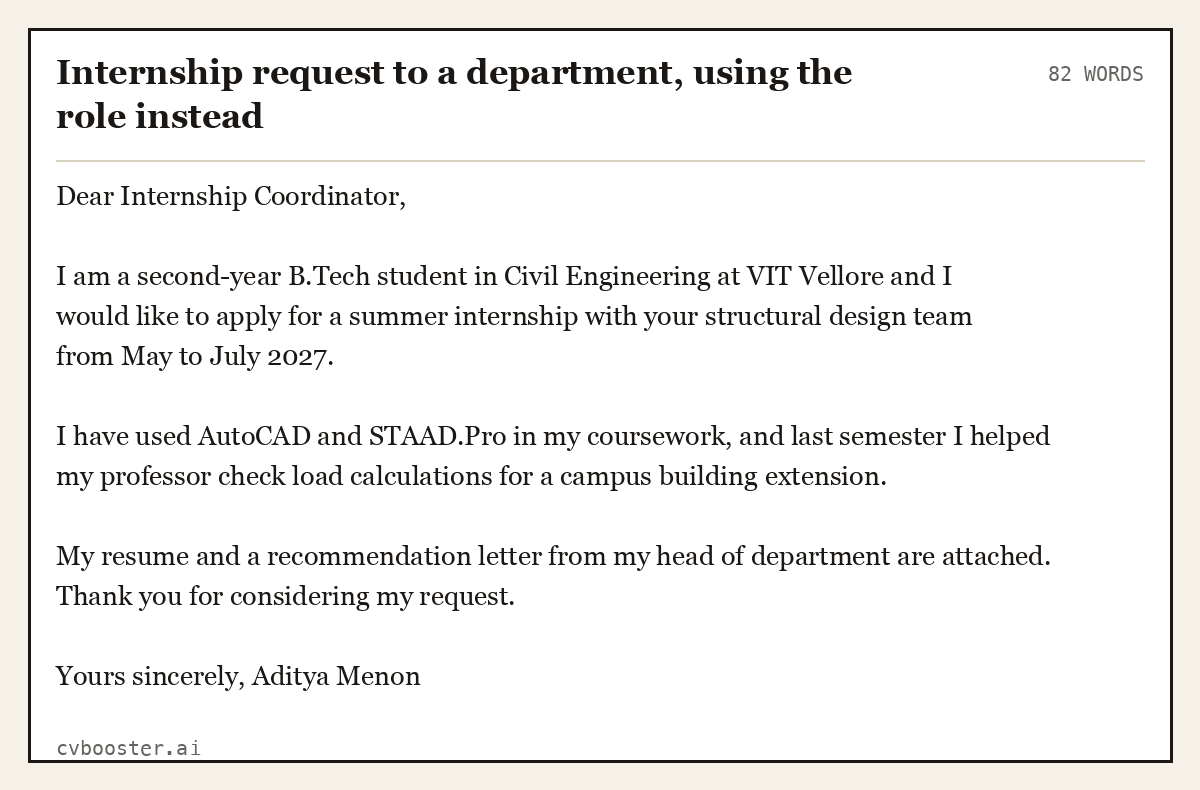
Internship request to a department, using the role instead (82 words)
Dear Internship Coordinator,
I am a second-year B.Tech student in Civil Engineering at VIT Vellore and I would like to apply for a summer internship with your structural design team from May to July 2027.
I have used AutoCAD and STAAD.Pro in my coursework, and last semester I helped my professor check load calculations for a campus building extension.
My resume and a recommendation letter from my head of department are attached. Thank you for considering my request.
Yours sincerely, Aditya Menon
Using the role keeps the letter formal and shows you know who handles internships, which is better than "Dear Sir or Madam" when the website tells you that much.
Common mistakes with Dear Sir or Madam
- "Dear Sir" alone. It assumes the reader is a man. Use "Dear Sir or Madam" or a role.
- "Respected Sir/Madam" in an English job application to a private company. It is common in Indian school and government letters, but it reads as old-fashioned in a corporate application.
- "Yours sincerely" after "Dear Sir or Madam". In British and Indian English, use "Yours faithfully" with an unnamed reader.
- Using it when a name is in the advert. Read the advert to the end; the contact is often in the last line.
For the other unnamed-reader opening, see our guide to the to whom it may concern letter. For complete application letters, see our application letter samples and Dear HR Manager cover letter. If you are sending a resume with the letter, CVBooster checks it against the advert: filling any of the 99 templates is free after you sign in, with the ATS score and gap list; the PDF and Word download is Pro.
Frequently asked questions
Is it OK to write Dear Sir or Madam?
Yes, in a formal letter or email when you cannot find the name or role of the person who will read it, such as a shared inbox or a government office. For job applications, a name or a role like "Dear Hiring Manager" is better, because it shows you made the effort to find out who is hiring.
What is the closing for Dear Sir or Madam?
In British and Indian English, end with "Yours faithfully" followed by your full name. Use "Yours sincerely" when the letter starts with the reader's name. In American English, "Sincerely" is fine after either greeting. Keep the closing formal, because the greeting already signals a formal letter.
What can I use instead of Dear Sir or Madam?
Use the reader's name if you can find it, such as "Dear Ms Kapoor". If you know only the role, use it: "Dear Hiring Manager", "Dear Recruitment Team" or "Dear Admissions Committee". "To Whom It May Concern" is the other option for very formal letters with no known reader.
Should I write Dear Sir/Madam or Dear Sir or Madam?
Both are understood, and "Dear Sir/Madam" is common in Indian offices. In a formal letter or job application, "Dear Sir or Madam" written in full reads more polished. Whichever you choose, follow it with a comma, start the letter on the next line, and close with "Yours faithfully".
More in this series: related guides
- Application Letter Sample: 7 Full Letters for Real Job Ads
- High School Cover Letter: 6 Examples With No Experience
- Salary Requirements: How to State Them, With 7 Wordings
Related articles
- Application Letter Sample: 7 Full Letters for Real Job Ads
- Cover Letter Template Word: Where to Find It and 6 Letters
- Google Docs Cover Letter Template: 6 Filled Letters to Paste
- High School Cover Letter: 6 Examples With No Experience
More articles
- Delivering at Pace: 4 Civil Service Examples, EO to G7
- Developing Self and Others: 4 Civil Service Examples
- Double Major on Resume: How to List It, With 6 Examples
Looking for a worked example for your job title? Browse the resume examples by job title.