Developing Self and Others: 4 Civil Service Examples
By Mustafa Tarabya, founder of CVBooster · Published · Updated
14 min read
A developing self and others civil service example has to carry both halves, and it is the self half that candidates drop. Within the usual 250-word limit you need a gap you admitted in your own skills as well as somebody you developed. The wording quoted throughout comes from Success Profiles: Civil Service behaviours, published by the Cabinet Office on gov.uk and read on 12 September 2026. Four full statements follow at EO, HEO, SEO and Grade 7, each annotated against its grade band. Written by Mustafa Tarabya, who hired for his own company, read every application himself and now writes CVBooster's guides.
What the scoring actually rewards
The definition is the shortest of the nine.
The behaviour, quoted: "Focus on continuous learning and development for self, others and the organisation as a whole" (gov.uk, Developing self and others).
Three objects: self, others, the organisation. A statement that only coaches a colleague answers one third of it.
The bullets are unusually concrete. At EO the framework asks you to "set and consistently meet development objectives", which means naming the objective and saying you finished it. From HEO the word is succession planning, so the person you developed should be visibly readier for a job than they were.
Two things a sifter almost never finds. A skill gap you admitted in yourself with the fix attached, and development offered to someone who was not the obvious high performer. The Grade 7 bullet is explicit that opportunities should be available "regardless of their background or desire to achieve promotion".
The word budget: 40 / 40 / 120 / 50
The split most people use is forty words of context, forty on the gap, one hundred and twenty on your actions and fifty on evidence. For this behaviour, protect the last fifty.
Development claims die without proof. An accreditation passed, a person promoted, a rota that no longer depends on one specialist: each is worth more than three sentences about culture.
Tip: write your own learning as one sentence inside the action block, never as a closing afterthought. It reads as an excuse when it sits at the end.
Example at EO, annotated
Written for an EO post advertised by a Welsh council, where the behaviour is used in the same form.
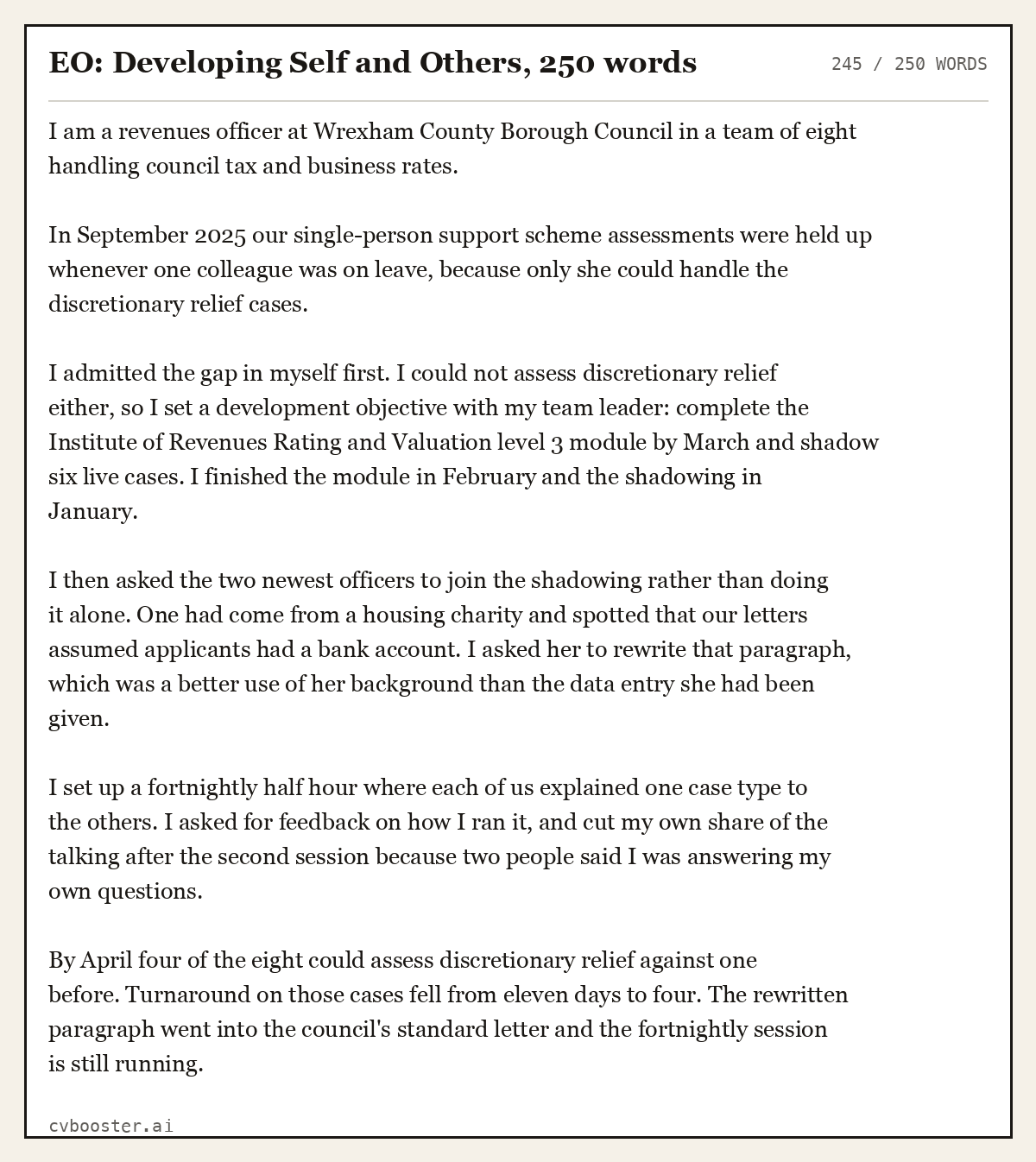
EO: Developing Self and Others, 250 words (245 words)
I am a revenues officer at Wrexham County Borough Council in a team of eight handling council tax and business rates.
In September 2025 our single-person support scheme assessments were held up whenever one colleague was on leave, because only she could handle the discretionary relief cases.
I admitted the gap in myself first. I could not assess discretionary relief either, so I set a development objective with my team leader: complete the Institute of Revenues Rating and Valuation level 3 module by March and shadow six live cases. I finished the module in February and the shadowing in January.
I then asked the two newest officers to join the shadowing rather than doing it alone. One had come from a housing charity and spotted that our letters assumed applicants had a bank account. I asked her to rewrite that paragraph, which was a better use of her background than the data entry she had been given.
I set up a fortnightly half hour where each of us explained one case type to the others. I asked for feedback on how I ran it, and cut my own share of the talking after the second session because two people said I was answering my own questions.
By April four of the eight could assess discretionary relief against one before. Turnaround on those cases fell from eleven days to four. The rewritten paragraph went into the council's standard letter and the fortnightly session is still running.
What the sifter is scoring
- Indicator quoted: "identify gaps in own and team's skills and knowledge" (gov.uk, EO). Where it shows: a single point of failure named, including the writer's own inability to assess the cases.
- Indicator quoted: "set and consistently meet development objectives" (gov.uk, EO). Where it shows: a named qualification module and six shadowed cases, both completed early.
- Indicator quoted: "support the development plans of all colleagues, recognising how diversity of experience/background can help to build an inclusive team culture" (gov.uk, EO). Where it shows: the charity background used to fix a letter rather than parked on data entry.
- Indicator quoted: "encourage and listen to developmental feedback from colleagues" (gov.uk, EO). Where it shows: asking how the session ran and talking less after being told to.
Example at HEO, annotated
At HEO the framework introduces coaching and succession planning, so one named person should be measurably readier at the end.
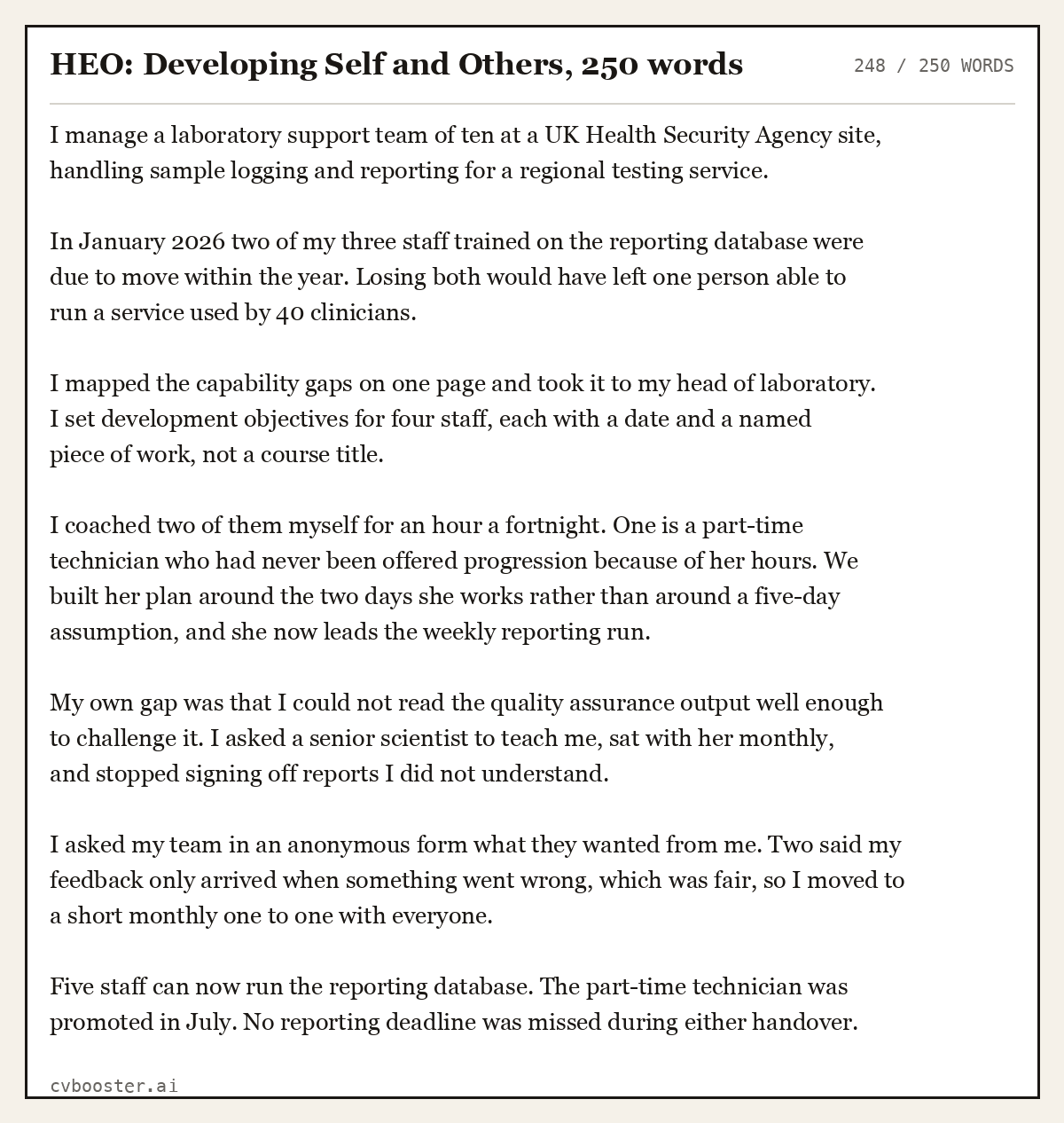
HEO: Developing Self and Others, 250 words (248 words)
I manage a laboratory support team of ten at a UK Health Security Agency site, handling sample logging and reporting for a regional testing service.
In January 2026 two of my three staff trained on the reporting database were due to move within the year. Losing both would have left one person able to run a service used by 40 clinicians.
I mapped the capability gaps on one page and took it to my head of laboratory. I set development objectives for four staff, each with a date and a named piece of work, not a course title.
I coached two of them myself for an hour a fortnight. One is a part-time technician who had never been offered progression because of her hours. We built her plan around the two days she works rather than around a five-day assumption, and she now leads the weekly reporting run.
My own gap was that I could not read the quality assurance output well enough to challenge it. I asked a senior scientist to teach me, sat with her monthly, and stopped signing off reports I did not understand.
I asked my team in an anonymous form what they wanted from me. Two said my feedback only arrived when something went wrong, which was fair, so I moved to a short monthly one to one with everyone.
Five staff can now run the reporting database. The part-time technician was promoted in July. No reporting deadline was missed during either handover.
What the sifter is scoring
- Indicator quoted: "identify capability gaps for yourself and your team" (gov.uk, HEO and SEO). Where it shows: the one-page map, plus the writer's own inability to challenge the quality assurance output.
- Indicator quoted: "take time to coach, mentor and develop other colleagues to support succession planning" (gov.uk, HEO and SEO). Where it shows: fortnightly coaching that took the database from three trained staff to five.
- Indicator quoted: "promote inclusiveness by respecting different personal needs in the team and use these to develop others" (gov.uk, HEO and SEO). Where it shows: a progression plan built around two working days instead of five.
- Indicator quoted: "reflect on your own work, continuously seek and act on feedback to improve own and team's performance" (gov.uk, HEO and SEO). Where it shows: the anonymous form, and monthly one to ones replacing feedback that only came after mistakes.
Example at SEO, annotated
SEO uses the same bullets as HEO. The difference the panel expects is capability built across teams you do not manage.
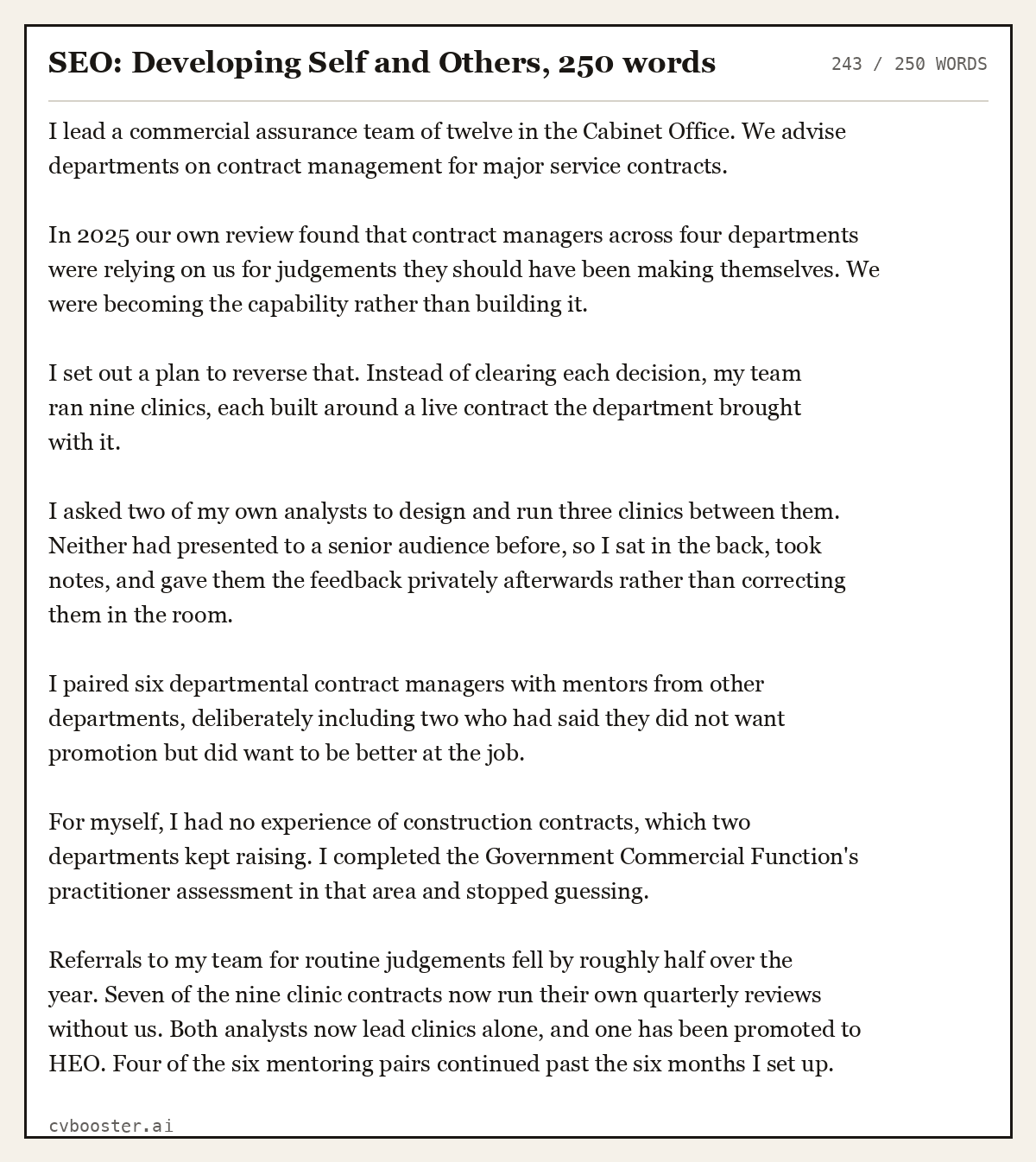
SEO: Developing Self and Others, 250 words (243 words)
I lead a commercial assurance team of twelve in the Cabinet Office. We advise departments on contract management for major service contracts.
In 2025 our own review found that contract managers across four departments were relying on us for judgements they should have been making themselves. We were becoming the capability rather than building it.
I set out a plan to reverse that. Instead of clearing each decision, my team ran nine clinics, each built around a live contract the department brought with it.
I asked two of my own analysts to design and run three clinics between them. Neither had presented to a senior audience before, so I sat in the back, took notes, and gave them the feedback privately afterwards rather than correcting them in the room.
I paired six departmental contract managers with mentors from other departments, deliberately including two who had said they did not want promotion but did want to be better at the job.
For myself, I had no experience of construction contracts, which two departments kept raising. I completed the Government Commercial Function's practitioner assessment in that area and stopped guessing.
Referrals to my team for routine judgements fell by roughly half over the year. Seven of the nine clinic contracts now run their own quarterly reviews without us. Both analysts now lead clinics alone, and one has been promoted to HEO. Four of the six mentoring pairs continued past the six months I set up.
What the sifter is scoring
- Indicator quoted: "ensure development objectives are set and achieved to address any gaps and enable delivery of current and future work" (gov.uk, HEO and SEO). Where it shows: nine clinics built on live contracts, with routine referrals halved as the measure.
- Indicator quoted: "take time to coach, mentor and develop other colleagues to support succession planning" (gov.uk, HEO and SEO). Where it shows: two analysts given their first senior audience and coached privately afterwards.
- Indicator quoted: "promote inclusiveness by respecting different personal needs in the team and use these to develop others" (gov.uk, HEO and SEO). Where it shows: mentoring offered to people who wanted to improve without wanting promotion.
- Indicator quoted: "identify capability gaps for yourself and your team" (gov.uk, HEO and SEO). Where it shows: the construction contract gap, closed with a named practitioner assessment.
Example at Grade 7, annotated
The Grade 7 bullets ask you to role-model your own learning and to make opportunities available to everybody, including people with no interest in promotion.
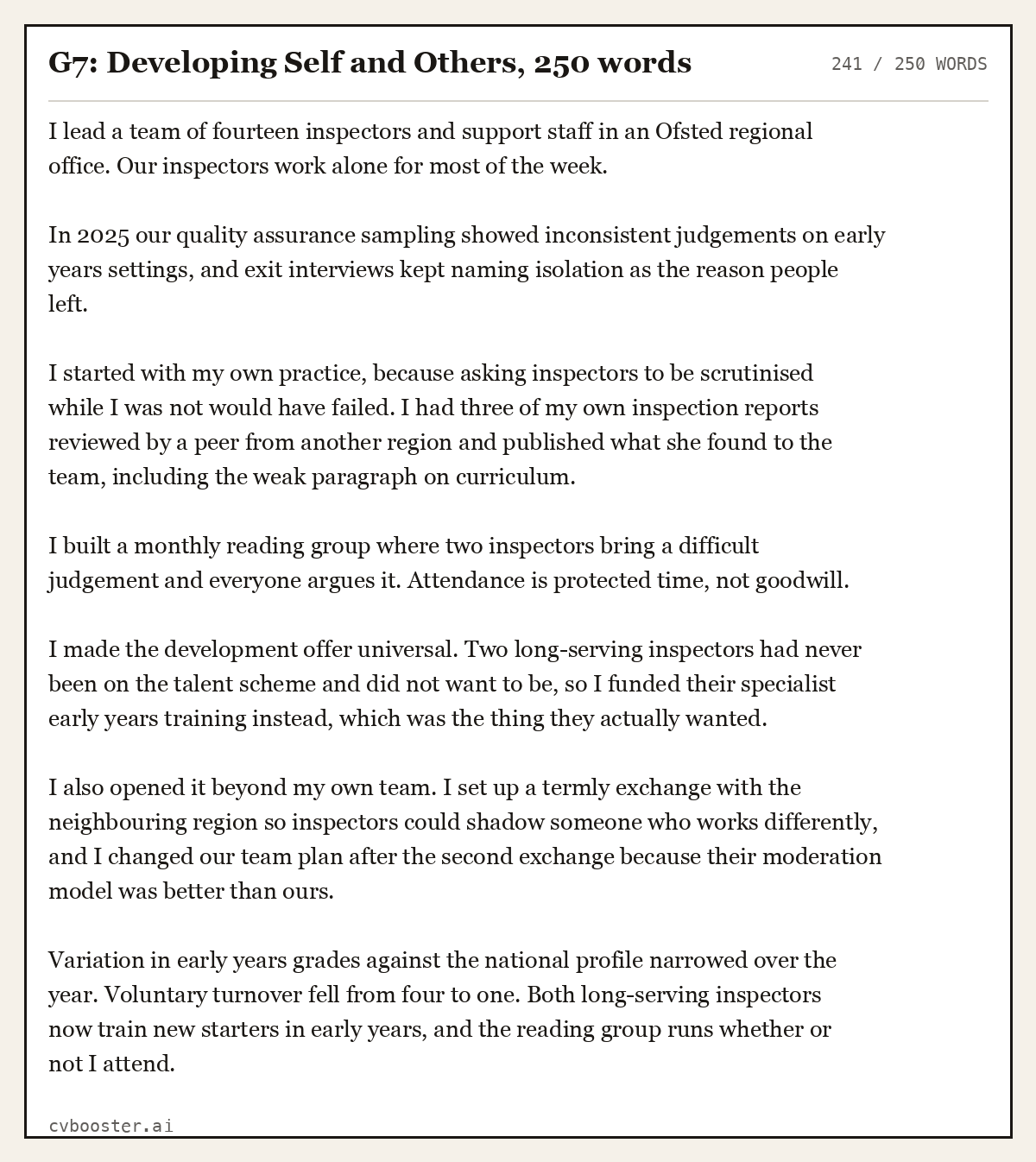
G7: Developing Self and Others, 250 words (241 words)
I lead a team of fourteen inspectors and support staff in an Ofsted regional office. Our inspectors work alone for most of the week.
In 2025 our quality assurance sampling showed inconsistent judgements on early years settings, and exit interviews kept naming isolation as the reason people left.
I started with my own practice, because asking inspectors to be scrutinised while I was not would have failed. I had three of my own inspection reports reviewed by a peer from another region and published what she found to the team, including the weak paragraph on curriculum.
I built a monthly reading group where two inspectors bring a difficult judgement and everyone argues it. Attendance is protected time, not goodwill.
I made the development offer universal. Two long-serving inspectors had never been on the talent scheme and did not want to be, so I funded their specialist early years training instead, which was the thing they actually wanted.
I also opened it beyond my own team. I set up a termly exchange with the neighbouring region so inspectors could shadow someone who works differently, and I changed our team plan after the second exchange because their moderation model was better than ours.
Variation in early years grades against the national profile narrowed over the year. Voluntary turnover fell from four to one. Both long-serving inspectors now train new starters in early years, and the reading group runs whether or not I attend.
What the sifter is scoring
- Indicator quoted: "prioritise and role-model continuous self-learning and development" (gov.uk, Grade 6 and Grade 7). Where it shows: the writer's own reports peer reviewed first, with the weak paragraph shared openly.
- Indicator quoted: "ensure that development opportunities are available for all individuals regardless of their background or desire to achieve promotion" (gov.uk, Grade 6 and Grade 7). Where it shows: specialist training funded for two inspectors who declined the talent scheme.
- Indicator quoted: "encourage discussions within and between teams to learn from each other's experiences and change organisational plans and processes accordingly" (gov.uk, Grade 6 and Grade 7). Where it shows: the termly exchange, and the team plan rewritten around another region's moderation model.
- Indicator quoted: "identify areas individuals and teams need to develop in order to achieve future objectives" (gov.uk, Grade 6 and Grade 7). Where it shows: quality assurance sampling and exit interviews used together to pick the target.
What changed between the four
All four statements name a gap, admit one of the writer's own, and finish with a person who can now do something they could not. Grade decides how far the capability spreads.
| Level | The writer's own gap | Who was developed | Proof at the end |
|---|---|---|---|
| EO | Could not assess discretionary relief | Two new officers, whole team | Four assessors instead of one, letters rewritten |
| HEO | Could not challenge quality assurance output | Four staff, one part-time technician | Five trained on the database, one promotion |
| SEO | No construction contract knowledge | Two analysts, six contract managers | Referrals halved, seven contracts self-sufficient |
| G7 | Own reports peer reviewed and shared | Fourteen staff and a neighbouring region | Grade variation narrowed, turnover four to one |
At EO you close a gap and bring two people with you. At HEO you plan succession for a named post. At SEO you build capability in teams that do not report to you. At Grade 7 you expose your own work first and make the offer universal. A draft where only the writer improves is not this behaviour.
The sentences that cost marks
The first line of each pair is the version that arrives in most applications. The second is the same event, evidenced.
- Before: I am passionate about developing my team and helping people reach their potential. After: Four of eight could assess discretionary relief by April, against one in September.
- Before: I completed several training courses to develop my own skills. After: I finished the level 3 module in February and shadowed six live cases by January.
- Before: I mentored a junior colleague who benefited greatly from my support. After: The part-time technician now leads the weekly reporting run and was promoted in July.
- Before: I welcome feedback and use it to improve. After: Two people said my feedback only came after mistakes, so I started monthly one to ones.
- Before: I created a culture of learning within the directorate. After: Two inspectors bring a contested judgement to a protected hour every month.
- Before: I supported staff with their personal development plans. After: I funded specialist training for two inspectors who did not want the talent scheme.
Before you submit
- Put your own gap in the action block, with the fix and the date you finished it.
- Name one person, their starting point and where they got to.
- From HEO, show succession: a job that no longer depends on one individual.
- Offer development to someone who is not chasing promotion, and say so.
- End with proof that outlived you. A course attended is not a result.
- civil-service-careers.gov.uk tells applicants to "keep to the word limit", warning that a brief statement "will not provide the required depth of detail and evidence to be assessed fully".
- Check the band in the Success Profiles: Civil Service Behaviours PDF before drafting, because HEO and SEO share one list and Grade 6 shares with Grade 7.
- The published sift scale, including the descriptor "Substantial positive evidence of the behaviour" for a 5, is on the Crown Office and Procurator Fiscal Service site.
- Worked out in the same way: Leadership and Changing and Improving.
- Four more grades of each: Making Effective Decisions and Working Together.
- All nine behaviours sit in the behaviours framework guide; the other elements are in the Success Profiles guide.
Frequently asked questions
What is a good example of developing self and others?
A good example contains a capability gap, a development objective with a date, one named person who improved, and something you learned yourself. The EO statement above is the pattern at its simplest: a single point of failure in a revenues team, a qualification module finished in February, two new officers brought into the shadowing, and four assessors where there had been one.
How do you demonstrate developing self and others at interview?
Bring one story and three numbers: where the person started, where they got to, and how long it took. Panels commonly ask what you did when the development did not work. Prepare that answer honestly. Saying you moved a colleague off a plan that was wrong for her scores better than claiming everyone you coached succeeded.
What is the difference between developing self and others at HEO and SEO?
The published bullets are identical, because gov.uk runs HEO and SEO together in one list. The panel separates them by scope. At HEO the expectation is your own team and a named successor. At SEO it is capability in teams you do not manage, and development delegated to people who then develop others.
Does developing self and others require line management experience?
No. The AA, AO and EO bullets are about identifying gaps, meeting your own development objectives, sharing what you learn and listening to feedback. None of them needs a direct report. Running a fortnightly session where colleagues teach each other a case type evidences the behaviour without any management responsibility at all.
How long should a civil service behaviour statement be?
The advert decides. Two hundred and fifty words per behaviour is the most common limit, 500 appears on some senior posts, and a few adverts replace the boxes with a single personal statement of 750 or 1,250 words. The online form usually cuts you off at the limit, so write to it rather than to a general rule.
More in this series: Civil Service applications
- Changing and Improving Civil Service Example: AO to G7
- Civil Service Behaviours Framework: All 9, Level by Level
- Civil Service Behaviours: 9 Examples, One Per Behaviour
- Civil Service Interview Questions and 15 Full Answers
- Civil Service Judgement Test: 8 Questions and Answers
- Civil Service Strengths Examples: 10 Worked Answers
- Civil Service Success Profiles: the Five Elements, Explained
- Communicating and Influencing: 4 Civil Service Examples
- Delivering at Pace: 4 Civil Service Examples, EO to G7
- Leadership Civil Service Example: 4 Statements, EO to G7
- Making Effective Decisions: 4 Civil Service Examples
- Managing a Quality Service: 4 Worked Examples, EO to G7
- Seeing the Big Picture Civil Service Example: AO to G7
- Statement of Suitability Civil Service Example: EO and HEO
- Working Together Civil Service Example: AO to Grade 7
Related articles
- Changing and Improving Civil Service Example: AO to G7
- Civil Service Behaviours Framework: All 9, Level by Level
- Civil Service Judgement Test: 8 Questions and Answers
- Civil Service Success Profiles: the Five Elements, Explained
More articles
- Education Interview Questions and 15 Full STAR Answers
- How to Explain Employment Gaps on Your Resume
- European CV vs American Resume: What Actually Changes, Country by Country
Looking for a worked example for your job title? Browse the resume examples by job title.