Delivering at Pace: 4 Civil Service Examples, EO to G7
By Mustafa Tarabya, founder of CVBooster · Published · Updated
14 min read
A delivering at pace civil service example proves two things at once. The date held, and the quality held with it. Long hours are not evidence of either. Adverts normally allow 250 words for the behaviour, so the deadline, the plan and the checkpoints share about 120 words of action. Indicators come from the Cabinet Office framework named Success Profiles: Civil Service behaviours, in the version published on 12 September 2026. Full statements for the EO, HEO, SEO and Grade 7 grades follow, each mapped to its own bullets. Written by Mustafa Tarabya, who hired for his own company, read every application himself and now writes CVBooster's guides.
What the panel is actually scoring
The definition on Success Profiles: Civil Service behaviours puts two demands in one sentence.
The behaviour, quoted: "Take responsibility for delivering timely and quality results with focus and drive" (gov.uk, Delivering at pace).
"Timely and quality" is a single test. Hit the date by skipping checks and the score drops. Protect the checks and miss the date and it drops again. The bullets also ask for milestones, corrective action and support for people doing hard work. A statement where you personally saved the day loses marks.
The Success Profiles: Civil Service Behaviours PDF removes the pressure to tick every line. It says: "There is no expectation that all individuals will need to demonstrate every part of each example to be successful". Higher Executive Officer and Senior Executive Officer sit in one grade group, so those two statements answer identical bullets at different spans.
Example at EO, annotated
Written against an EO advert in an NHS administrative team. If your advert pairs pace with decisions, see the Making Effective Decisions example.
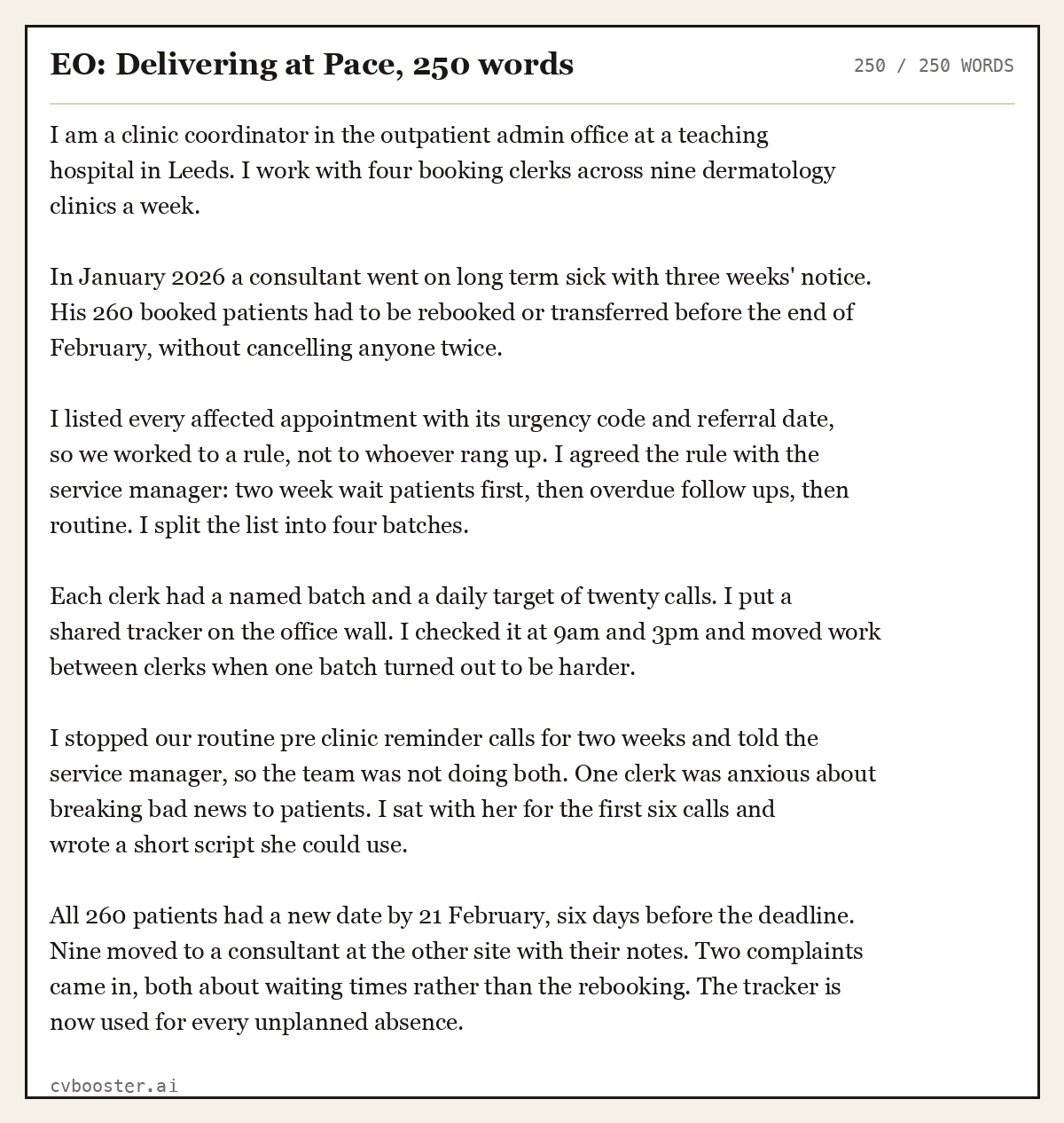
EO: Delivering at Pace, 250 words (250 words)
I am a clinic coordinator in the outpatient admin office at a teaching hospital in Leeds. I work with four booking clerks across nine dermatology clinics a week.
In January 2026 a consultant went on long term sick with three weeks' notice. His 260 booked patients had to be rebooked or transferred before the end of February, without cancelling anyone twice.
I listed every affected appointment with its urgency code and referral date, so we worked to a rule, not to whoever rang up. I agreed the rule with the service manager: two week wait patients first, then overdue follow ups, then routine. I split the list into four batches.
Each clerk had a named batch and a daily target of twenty calls. I put a shared tracker on the office wall. I checked it at 9am and 3pm and moved work between clerks when one batch turned out to be harder.
I stopped our routine pre clinic reminder calls for two weeks and told the service manager, so the team was not doing both. One clerk was anxious about breaking bad news to patients. I sat with her for the first six calls and wrote a short script she could use.
All 260 patients had a new date by 21 February, six days before the deadline. Nine moved to a consultant at the other site with their notes. Two complaints came in, both about waiting times rather than the rebooking. The tracker is now used for every unplanned absence.
What the sifter is scoring
- Indicator: "identify who and what is required to ensure success, set clear goals and areas of responsibility and continually assess workloads considering individual needs" (gov.uk, EO). In the statement: named batches, a daily target of twenty calls, work moved when a batch was harder.
- Indicator: "regularly check performance against objectives, making suggestions for improvement or taking corrective action where necessary" (gov.uk, EO). In the statement: the 9am and 3pm tracker checks.
- Indicator: "ensure that colleagues are supported where tasks are challenging" (gov.uk, EO). In the statement: sitting with the anxious clerk for six calls and writing a script.
- Indicator: "ensure colleagues have the correct tools and resources available to them to do their jobs" (gov.uk, EO). In the statement: the shared tracker and the call script.
- Indicator: "have a positive and focused attitude to achieving outcomes, despite any setbacks" (gov.uk, EO). In the statement: the reminder calls paused so the team could finish the rebooking.
Example at HEO, annotated
An HEO statement shows a team held to priorities.
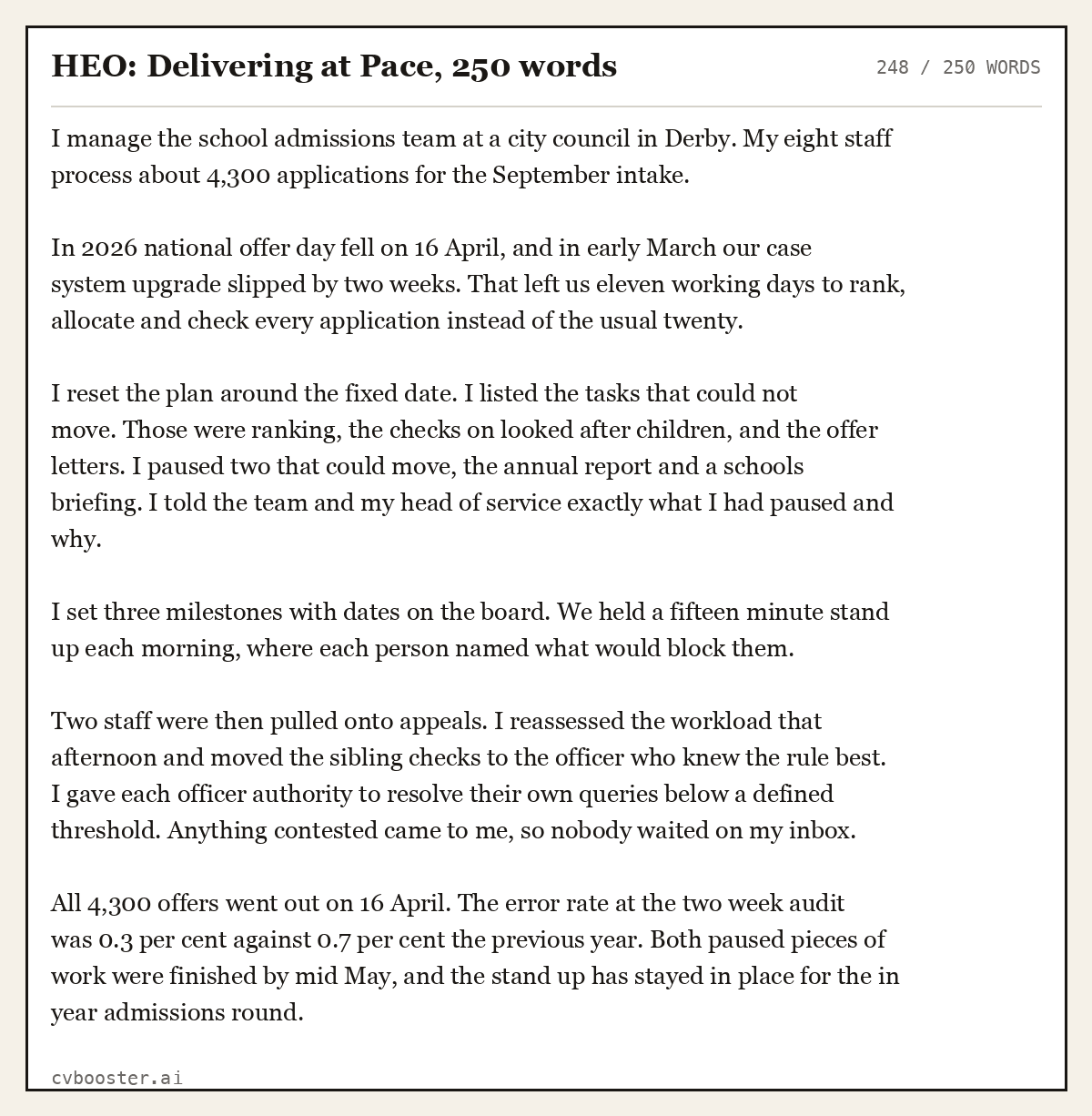
HEO: Delivering at Pace, 250 words (248 words)
I manage the school admissions team at a city council in Derby. My eight staff process about 4,300 applications for the September intake.
In 2026 national offer day fell on 16 April, and in early March our case system upgrade slipped by two weeks. That left us eleven working days to rank, allocate and check every application instead of the usual twenty.
I reset the plan around the fixed date. I listed the tasks that could not move. Those were ranking, the checks on looked after children, and the offer letters. I paused two that could move, the annual report and a schools briefing. I told the team and my head of service exactly what I had paused and why.
I set three milestones with dates on the board. We held a fifteen minute stand up each morning, where each person named what would block them.
Two staff were then pulled onto appeals. I reassessed the workload that afternoon and moved the sibling checks to the officer who knew the rule best. I gave each officer authority to resolve their own queries below a defined threshold. Anything contested came to me, so nobody waited on my inbox.
All 4,300 offers went out on 16 April. The error rate at the two week audit was 0.3 per cent against 0.7 per cent the previous year. Both paused pieces of work were finished by mid May, and the stand up has stayed in place for the in year admissions round.
What the sifter is scoring
- Indicator: "show a positive approach to keeping the whole team's efforts focused on the top priorities" (gov.uk, HEO and SEO). In the statement: two pieces of work paused and named, three milestones on the board.
- Indicator: "act promptly to reassess workloads and priorities when there are conflicting demands to maintain performance" (gov.uk, HEO and SEO). In the statement: the same afternoon reallocation when two staff moved to appeals.
- Indicator: "regularly monitor your own and team's work against milestones ensuring individual needs are considered when setting tasks" (gov.uk, HEO and SEO). In the statement: the daily stand up and the sibling checks given to the officer who knew the rule.
- Indicator: "allow individuals the space and authority to meet objectives, providing additional support where necessary, whilst keeping overall responsibility" (gov.uk, HEO and SEO). In the statement: the query threshold, with contested cases kept by the manager.
Example at SEO, annotated
At SEO pace is expected across teams, with the procedures kept rather than quietly dropped.
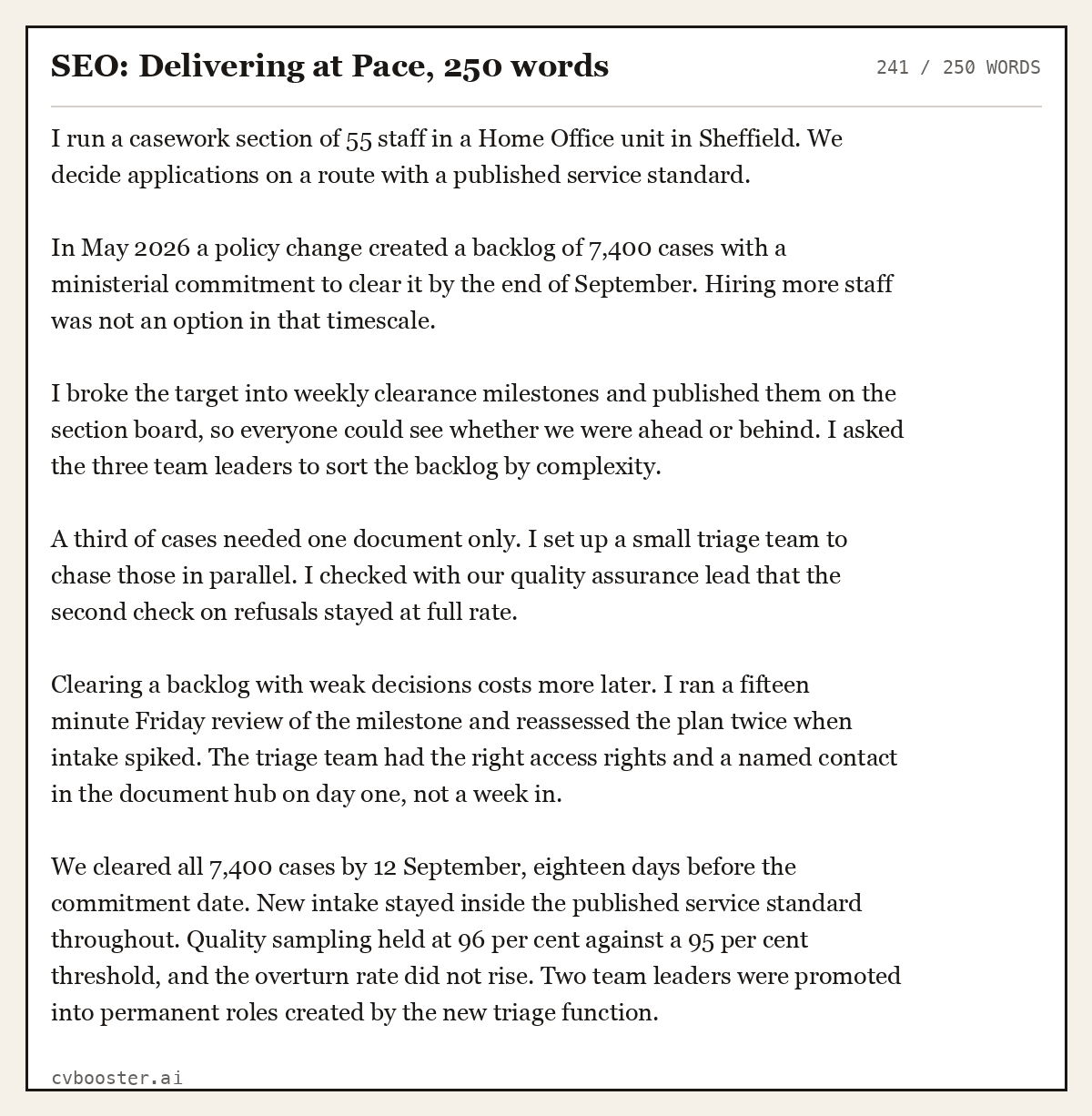
SEO: Delivering at Pace, 250 words (241 words)
I run a casework section of 55 staff in a Home Office unit in Sheffield. We decide applications on a route with a published service standard.
In May 2026 a policy change created a backlog of 7,400 cases with a ministerial commitment to clear it by the end of September. Hiring more staff was not an option in that timescale.
I broke the target into weekly clearance milestones and published them on the section board, so everyone could see whether we were ahead or behind. I asked the three team leaders to sort the backlog by complexity.
A third of cases needed one document only. I set up a small triage team to chase those in parallel. I checked with our quality assurance lead that the second check on refusals stayed at full rate.
Clearing a backlog with weak decisions costs more later. I ran a fifteen minute Friday review of the milestone and reassessed the plan twice when intake spiked. The triage team had the right access rights and a named contact in the document hub on day one, not a week in.
We cleared all 7,400 cases by 12 September, eighteen days before the commitment date. New intake stayed inside the published service standard throughout. Quality sampling held at 96 per cent against a 95 per cent threshold, and the overturn rate did not rise. Two team leaders were promoted into permanent roles created by the new triage function.
What the sifter is scoring
- Indicator: "promote a culture of following the appropriate procedures to ensure results are achieved on time whilst still enabling innovation" (gov.uk, HEO and SEO). In the statement: the full rate second check kept while a triage team was created.
- Indicator: "regularly monitor your own and team's work against milestones ensuring individual needs are considered when setting tasks" (gov.uk, HEO and SEO). In the statement: weekly milestones on the board and a Friday review.
- Indicator: "ensure the most appropriate resources are available for colleagues to use to do their job effectively" (gov.uk, HEO and SEO). In the statement: access rights and a named document hub contact on day one.
- Indicator: "act promptly to reassess workloads and priorities when there are conflicting demands to maintain performance" (gov.uk, HEO and SEO). In the statement: the plan reassessed twice when intake spiked.
Example at Grade 7, annotated
Grade 7 bullets add compliance and performance standards. They also expect you to hold your own performance up in front of other people.
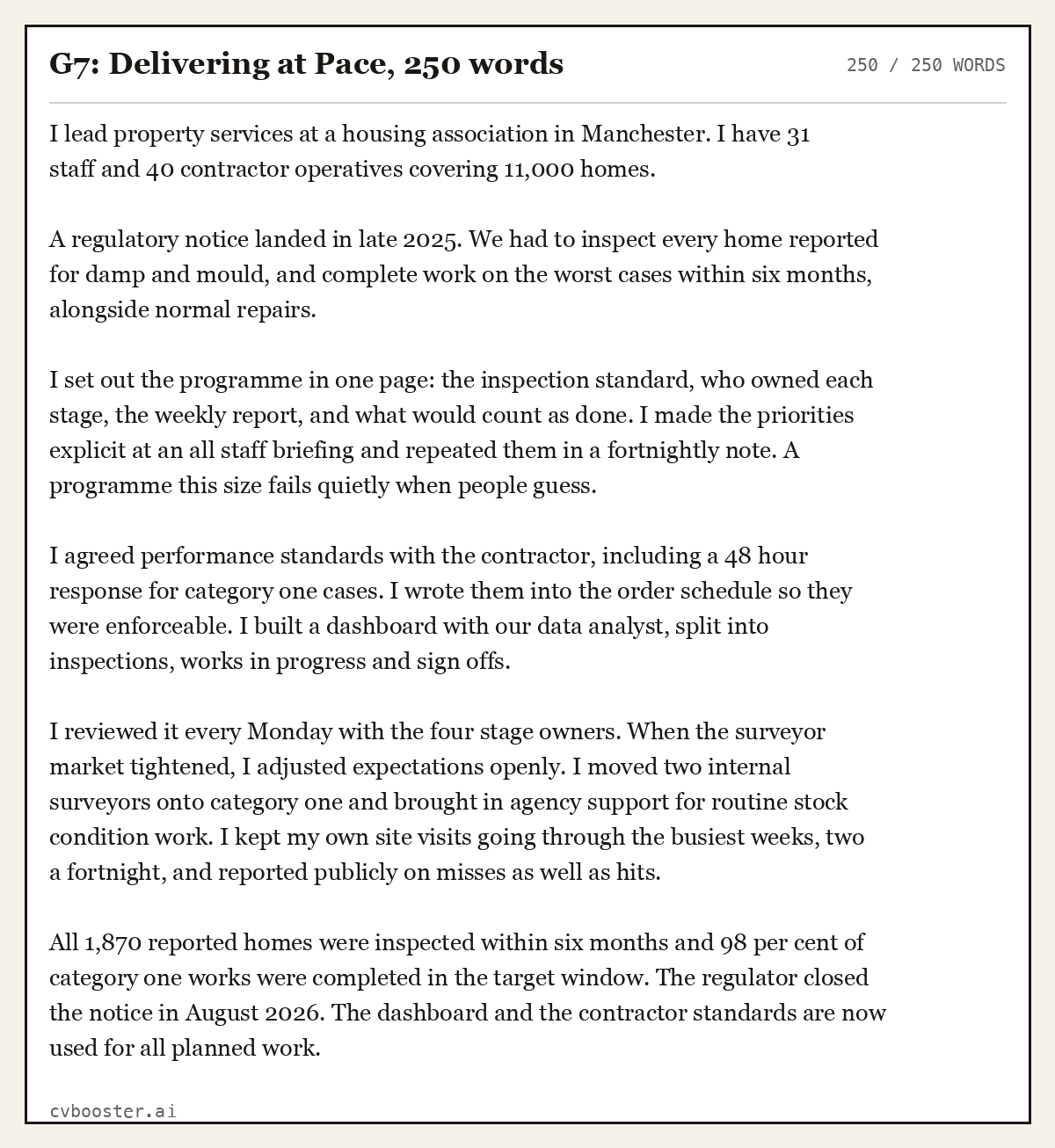
G7: Delivering at Pace, 250 words (250 words)
I lead property services at a housing association in Manchester. I have 31 staff and 40 contractor operatives covering 11,000 homes.
A regulatory notice landed in late 2025. We had to inspect every home reported for damp and mould, and complete work on the worst cases within six months, alongside normal repairs.
I set out the programme in one page: the inspection standard, who owned each stage, the weekly report, and what would count as done. I made the priorities explicit at an all staff briefing and repeated them in a fortnightly note. A programme this size fails quietly when people guess.
I agreed performance standards with the contractor, including a 48 hour response for category one cases. I wrote them into the order schedule so they were enforceable. I built a dashboard with our data analyst, split into inspections, works in progress and sign offs.
I reviewed it every Monday with the four stage owners. When the surveyor market tightened, I adjusted expectations openly. I moved two internal surveyors onto category one and brought in agency support for routine stock condition work. I kept my own site visits going through the busiest weeks, two a fortnight, and reported publicly on misses as well as hits.
All 1,870 reported homes were inspected within six months and 98 per cent of category one works were completed in the target window. The regulator closed the notice in August 2026. The dashboard and the contractor standards are now used for all planned work.
What the sifter is scoring
- Indicator: "ensure everyone clearly understands and owns their roles, responsibilities and business priorities" (gov.uk, Grade 6 and Grade 7). In the statement: the one page programme with a named owner for each stage.
- Indicator: "set out clear processes and standards for managing performance at all levels" (gov.uk, Grade 6 and Grade 7). In the statement: the 48 hour contractor standard written into the order schedule.
- Indicator: "ensure delivery of timely quality outcomes, through providing the right resources to do the job, reviewing and adjusting performance expectations and rewarding success" (gov.uk, Grade 6 and Grade 7). In the statement: surveyors moved, agency support brought in, expectations adjusted openly.
- Indicator: "maintain your own levels of performance in challenging circumstances and encourage others to do the same" (gov.uk, Grade 6 and Grade 7). In the statement: site visits kept up and misses reported alongside hits.
Scoring pace from 1 to 7
Every stage uses the same rating scale. The Crown Office and Procurator Fiscal Service puts it this way. "Behaviours, experience and technical skills are scored on the same 1-7 rating scale used at Sift".
| Score | Label and descriptor as published | What that means in a pace statement |
|---|---|---|
| 1 | Not Demonstrated: "No positive evidence and/ or substantial negative evidence demonstrated" | Busy work with no deadline in it |
| 2 | Minimal Demonstration: "Limited positive evidence and/ or mainly negative evidence demonstrated" | A deadline met, nothing about how |
| 3 | Moderate Demonstration: "Moderate positive evidence but some negative evidence demonstrated" | A plan, but no checkpoint and no quality evidence |
| 4 | Acceptable Demonstration: "Adequate positive evidence and any negative evidence would not cause concern" | Plan, milestones, date met, quality stated |
| 5 | Good Demonstration: "Substantial positive evidence of the behaviour" | Plus something you paused, and the person you told |
| 6 | Strong Demonstration: "Substantial positive evidence; includes some evidence of exceeding expectations at this level" | Plus corrective action taken before the miss happened |
| 7 | Outstanding Demonstration: "The evidence provided wholly exceeds expectation at this level" | All of it, with quality measured and published |
Some adverts set a higher bar than a 4. COPFS gives this example of a benchmark. "Candidates must score a 5 on the lead behaviours noted in the pack or an overall score of 20 must be scored across the 4 behaviours".
Splitting 250 words: 40 / 40 / 120 / 50
Give the situation 40 words and put the volume in it. Give the task 40 and put the date in it. Actions take 120, result takes 50. The action block needs the plan, one checkpoint with a time on it, the work you paused, and the colleague you backed.
Tip: say what you stopped doing. Prioritising is what separates pace from overtime, and almost no statement shows it.
What the four levels do differently
Every statement holds a date without dropping standards. What rises is the number of people held to the plan and how formal the performance standards become.
| Level | Deadline | What was planned | What was dropped or protected | Result |
|---|---|---|---|---|
| EO | 260 patients in three weeks | Batches, daily targets, a wall tracker | Reminder calls paused | Done six days early |
| HEO | 4,300 offers on a fixed date | Three milestones, daily stand up | Report and briefing paused | Offers out on 16 April |
| SEO | 7,400 cases in four months | Weekly milestones, a triage team | Second check kept at full rate | Cleared eighteen days early |
| G7 | 1,870 homes in six months | One page programme, dashboard | Category one work protected | Notice closed in August 2026 |
The sentences that cost marks
The first version of each pair is the one that scores a 3.
- Before: I work well under pressure and always meet my deadlines. After: All 260 patients had a new date by 21 February, six days before the deadline.
- Before: I prioritised my workload effectively. After: I paused the pre clinic reminder calls for two weeks and told the service manager.
- Before: I kept the team motivated during a difficult period. After: One clerk dreaded the calls, so I sat with her for six and wrote a script.
- Before: I monitored progress closely throughout. After: I checked the tracker at 9am and 3pm and moved work when a batch was harder.
- Before: Despite the tight timescale, quality was maintained. After: Quality sampling held at 96 per cent against a 95 per cent threshold.
- Before: I worked long hours to get the job done. After: I moved two surveyors to category one and brought in agency cover for the rest.
Before you submit
- Put the deadline and the volume in the first eighty words.
- Show the plan as a plan: milestones, owners, and a checkpoint with a time on it.
- Name one thing you stopped or paused, and who you told.
- Show one person you supported, not just tasks you allocated.
- Prove quality held, with a check, an audit or an error rate.
- Every one of the nine behaviours is broken down on the civil service behaviours framework page.
- How pace is tested at interview, alongside strengths and experience, is in the Success Profiles guide.
- The two behaviours usually sifted with this one: Making Effective Decisions and Managing a Quality Service.
- Further full statements sit on the Working Together and Seeing the Big Picture pages.
- Influence at four grades is on the Communicating and Influencing page.
- Everything is listed on the hub of behaviour statement examples.
Frequently asked questions
Can you provide a good example of delivering at pace?
A good example has a fixed deadline, a volume of work, a plan with checkpoints, and proof that quality held. The EO statement above is one. It rebooks 260 outpatient appointments in three weeks after a consultant goes off sick. It has daily targets, twice daily checks, and every patient rebooked six days early.
What does delivering at pace mean in civil service?
It means, in the gov.uk wording, to "take responsibility for delivering timely and quality results with focus and drive". In practice a panel is asking three things. Can you hold a date without dropping standards? Can you keep a team focused on the top priorities? Do you take corrective action early, rather than explain a miss afterwards?
Can you give an example of when you gave excellent customer service?
Use a service you changed, not a single kind act. Say who the customer was, what they needed, what you did differently, and how you knew it worked. That evidence belongs under Managing a Quality Service, and four full examples of it are on the Managing a Quality Service page.
Can you give me some examples of communicating and influencing in the civil service?
Examples that score include moving a senior person from one position to another. Others are explaining a complex rule to a customer who then acted, and delivering unwelcome news that was accepted. Four full 250-word statements at EO, HEO, SEO and Grade 7 are on the Communicating and Influencing page.
How do you write a Delivering at Pace 250 word example?
Write to a 40 / 40 / 120 / 50 budget: situation, task with the deadline, your actions, result. Put the volume and the date early. Spend the action words on the plan, the checkpoint, the thing you paused and the person you supported. Finish with a number that proves both the date and the quality.
More in this series: Civil Service applications
- Civil Service Behaviours Framework: All 9, Level by Level
- Civil Service Behaviours: 9 Examples, One Per Behaviour
- Civil Service Judgement Test: 8 Questions and Answers
- Civil Service Success Profiles: the Five Elements, Explained
- Communicating and Influencing: 4 Civil Service Examples
- Making Effective Decisions: 4 Civil Service Examples
- Managing a Quality Service: 4 Worked Examples, EO to G7
- Seeing the Big Picture Civil Service Example: AO to G7
- Working Together Civil Service Example: AO to Grade 7
Related articles
- Communicating and Influencing: 4 Civil Service Examples
- Making Effective Decisions: 4 Civil Service Examples
- Managing a Quality Service: 4 Worked Examples, EO to G7
- Changing and Improving Civil Service Example: AO to G7
More articles
- Developing Self and Others: 4 Civil Service Examples
- Education Interview Questions and 15 Full STAR Answers
- How to Explain Employment Gaps on Your Resume
Looking for a worked example for your job title? Browse the resume examples by job title.