Employment Gaps on a Resume: 6 Examples, Written Out
By Mustafa Tarabya, founder of CVBooster · Published · Updated
9 min read
Employment gaps on a resume are handled the same way every time: keep the real dates, give the gap its own line with a plain reason, and put what you did during it underneath if it helps the job. The constraint is that the dates must stay honest, because federal applications and background checks ask for them in full; the USAJOBS Help Center tells applicants to list "Start and end dates (include the month and year)." Below are six complete examples of resumes with gaps in employment, for caregiving, a layoff, health, parenting, retraining and contract work, plus the one sentence for the cover letter and the interview. Written by Mustafa Tarabya, who hired for his own company, read every application himself and now writes CVBooster's guides.
Leave eighteen months blank and the hiring manager fills them in for you. They never guess "looked after my mother". They guess something that needs a background check.
How to show an employment gap on a resume
There are three honest ways to show a gap, and the right one depends on its length.
- Under six months: list the jobs with month and year and say nothing. Short gaps between jobs are normal and rarely asked about.
- Six months to two years: add one line in the work history, in date order, with the dates and a neutral reason, such as "Career break: family caregiving".
- Over two years: the same line, plus one or two bullets for anything you kept current: a course, volunteering, freelance work, a certification.
What does not work is hiding the gap. Years without months, a functional resume with no dates, or stretching one job over the gap all fall apart at the background check, and a found gap looks worse than a stated one. I read every application for my own company. A gap with one honest line next to it was a question answered before I had to ask it.
Example 1: two-year caregiving gap
The gap sits in the work history like a job, in date order. The reason is four words. The bullet shows the skills did not go stale.
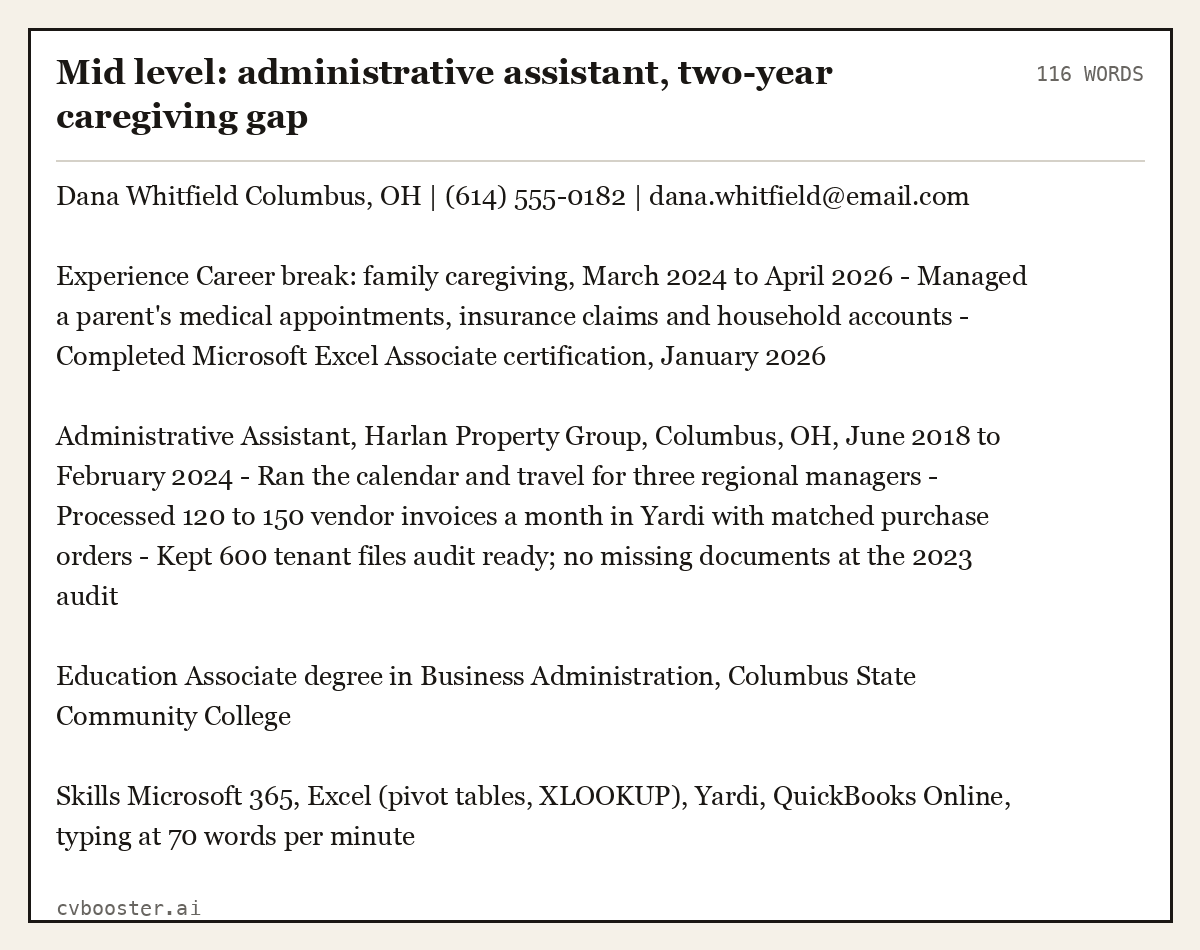
Mid level: administrative assistant, two-year caregiving gap (116 words)
Dana Whitfield Columbus, OH | (614) 555-0182 | dana.whitfield@email.com
Experience Career break: family caregiving, March 2024 to April 2026 - Managed a parent's medical appointments, insurance claims and household accounts - Completed Microsoft Excel Associate certification, January 2026
Administrative Assistant, Harlan Property Group, Columbus, OH, June 2018 to February 2024 - Ran the calendar and travel for three regional managers - Processed 120 to 150 vendor invoices a month in Yardi with matched purchase orders - Kept 600 tenant files audit ready; no missing documents at the 2023 audit
Education Associate degree in Business Administration, Columbus State Community College
Skills Microsoft 365, Excel (pivot tables, XLOOKUP), Yardi, QuickBooks Online, typing at 70 words per minute
The one line for the cover letter: "I took two years out to care for a parent; that has ended and I am returning full time."
Example 2: eight months after a layoff
A layoff is the easiest gap to explain because it is about the company, not you. Say it was a layoff, name the size if it was public, and show what you did with the time. If your employer gave advance notice, the Department of Labor's WARN page explains the law behind it: "The Worker Adjustment and Retraining Notification (WARN) Act helps ensure advance notice in cases of qualified plant closings and mass layoffs."
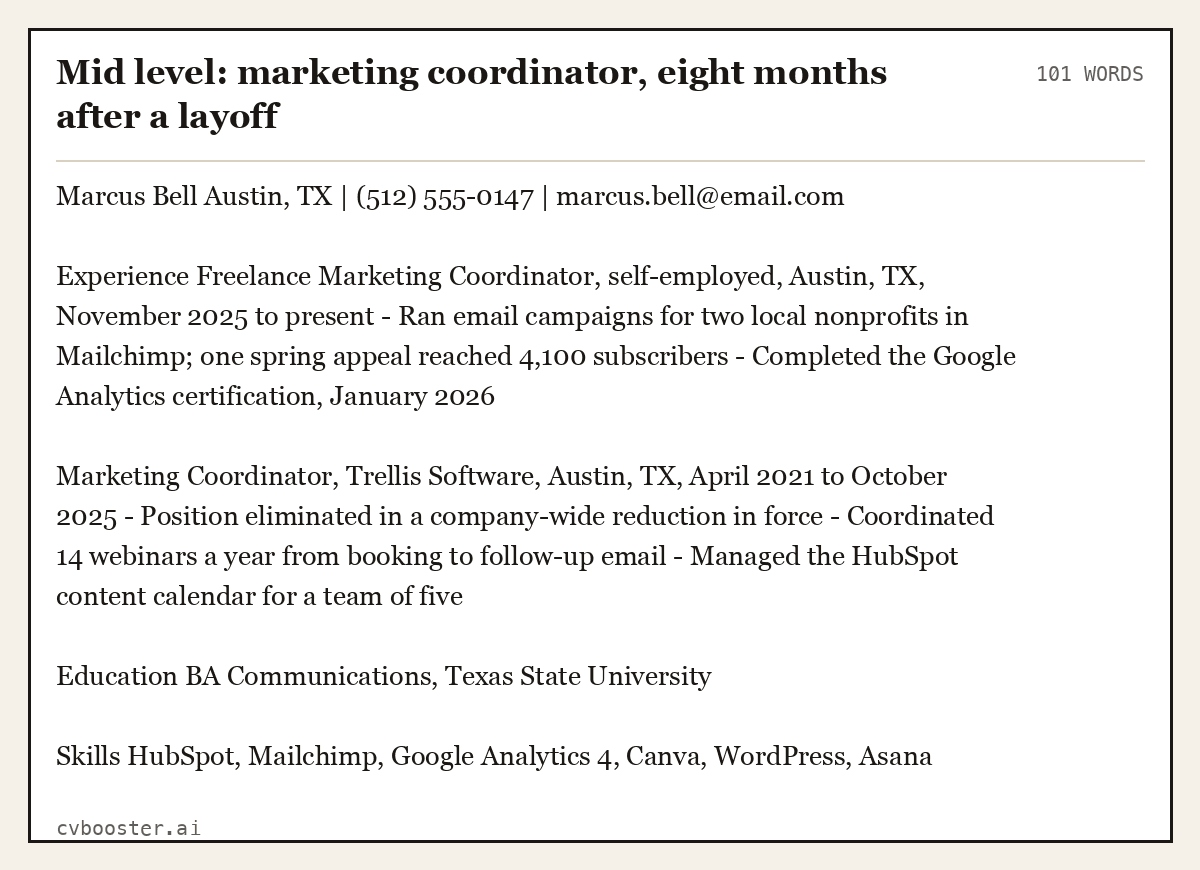
Mid level: marketing coordinator, eight months after a layoff (101 words)
Marcus Bell Austin, TX | (512) 555-0147 | marcus.bell@email.com
Experience Freelance Marketing Coordinator, self-employed, Austin, TX, November 2025 to present - Ran email campaigns for two local nonprofits in Mailchimp; one spring appeal reached 4,100 subscribers - Completed the Google Analytics certification, January 2026
Marketing Coordinator, Trellis Software, Austin, TX, April 2021 to October 2025 - Position eliminated in a company-wide reduction in force - Coordinated 14 webinars a year from booking to follow-up email - Managed the HubSpot content calendar for a team of five
Education BA Communications, Texas State University
Skills HubSpot, Mailchimp, Google Analytics 4, Canva, WordPress, Asana
The bullet "Position eliminated in a company-wide reduction" does the explaining inside the old job, so the gap needs no line of its own.
Example 3: one year out for health
Health is private. You do not have to name a condition, and you should not. "Health reasons, fully resolved" or "Personal medical leave" is the whole explanation.
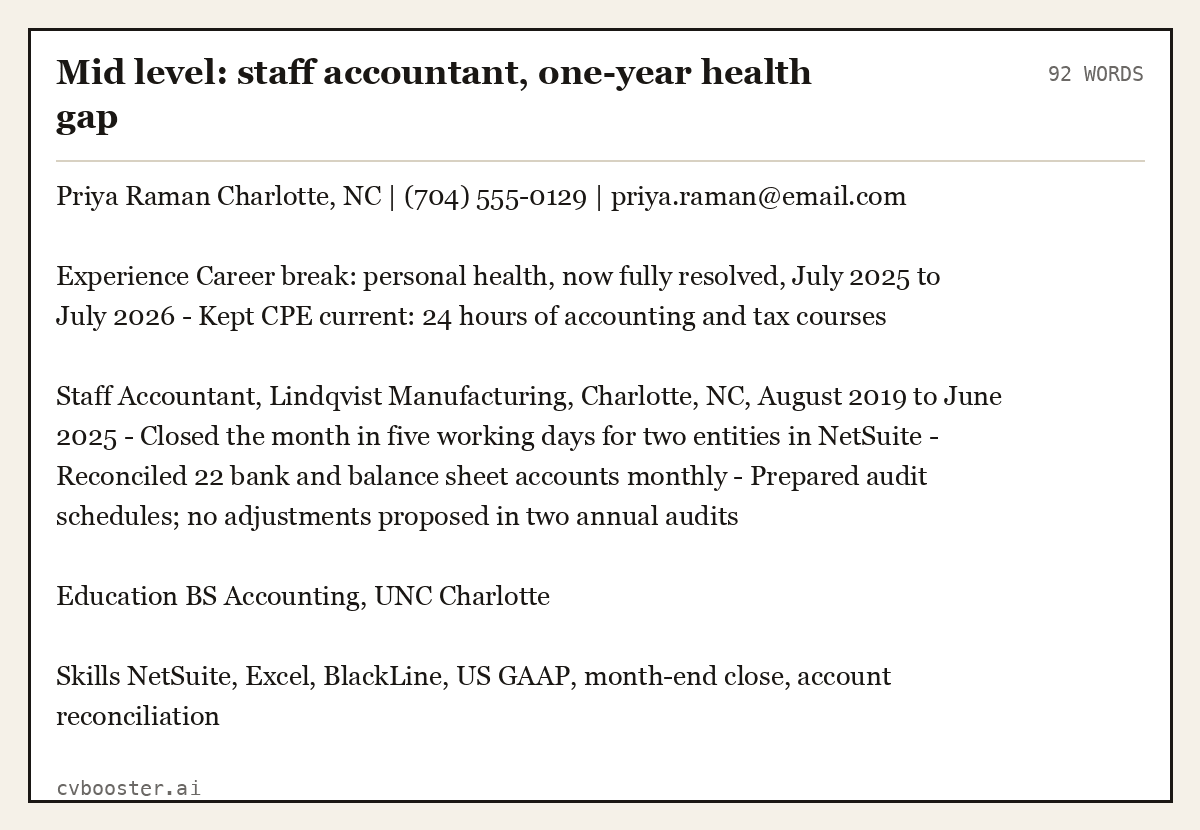
Mid level: staff accountant, one-year health gap (92 words)
Priya Raman Charlotte, NC | (704) 555-0129 | priya.raman@email.com
Experience Career break: personal health, now fully resolved, July 2025 to July 2026 - Kept CPE current: 24 hours of accounting and tax courses
Staff Accountant, Lindqvist Manufacturing, Charlotte, NC, August 2019 to June 2025 - Closed the month in five working days for two entities in NetSuite - Reconciled 22 bank and balance sheet accounts monthly - Prepared audit schedules; no adjustments proposed in two annual audits
Education BS Accounting, UNC Charlotte
Skills NetSuite, Excel, BlackLine, US GAAP, month-end close, account reconciliation
If the leave was protected by the Family and Medical Leave Act and you went back to the same employer, there is no gap at all. Keep the job as one continuous entry.
Example 4: six years as a stay-at-home parent
Long parenting gaps worry people more than they worry readers. State it, show one current skill, and put the strongest old job straight underneath. Volunteering counts: the USAJOBS guidance says to "Include relevant volunteer work and roles in community organizations that demonstrate how you qualify for the job."
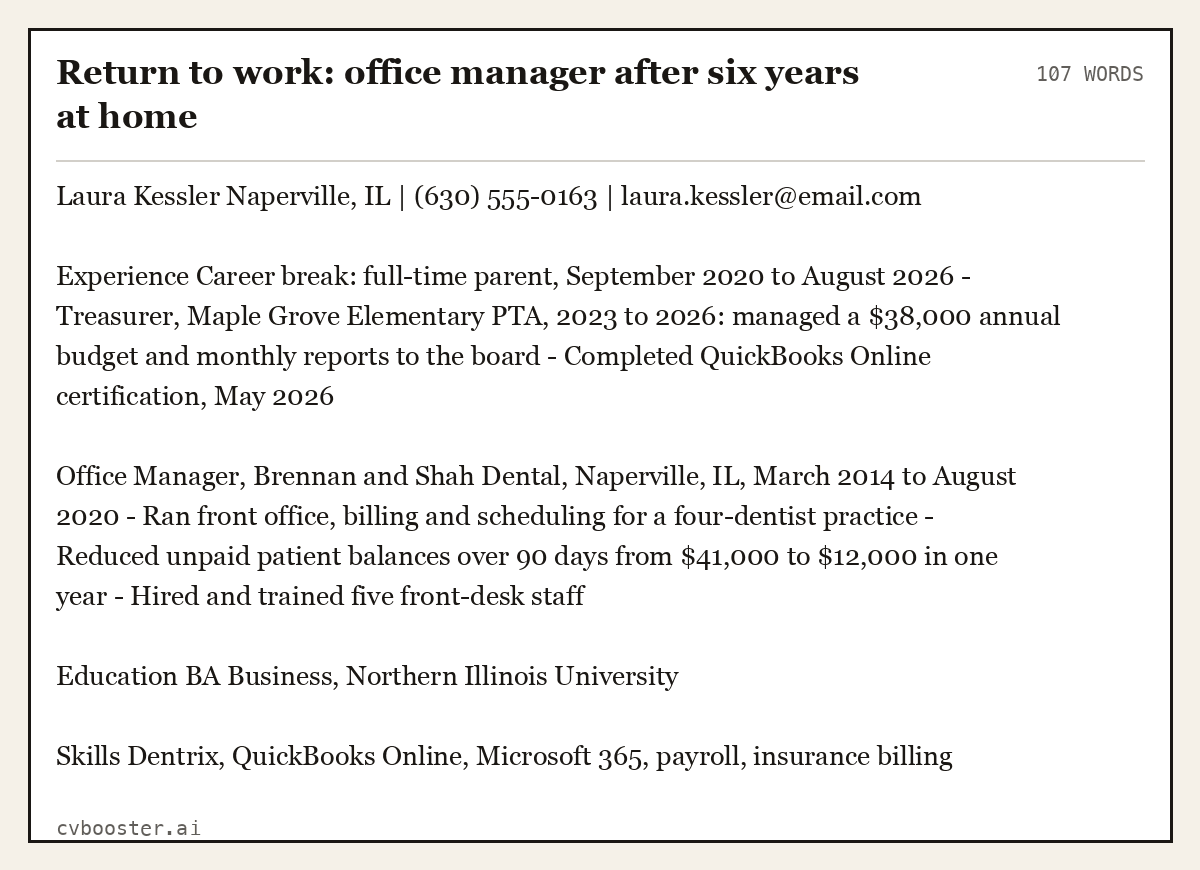
Return to work: office manager after six years at home (107 words)
Laura Kessler Naperville, IL | (630) 555-0163 | laura.kessler@email.com
Experience Career break: full-time parent, September 2020 to August 2026 - Treasurer, Maple Grove Elementary PTA, 2023 to 2026: managed a $38,000 annual budget and monthly reports to the board - Completed QuickBooks Online certification, May 2026
Office Manager, Brennan and Shah Dental, Naperville, IL, March 2014 to August 2020 - Ran front office, billing and scheduling for a four-dentist practice - Reduced unpaid patient balances over 90 days from $41,000 to $12,000 in one year - Hired and trained five front-desk staff
Education BA Business, Northern Illinois University
Skills Dentrix, QuickBooks Online, Microsoft 365, payroll, insurance billing
The PTA treasurer line is doing more work than any sentence about being organized. It is a budget, a board and a monthly report, which is the office manager job in miniature.
Example 5: gap to retrain for a new career
A retraining gap is not a gap, it is a qualification. Put the course where a job would go, with dates and what you built.
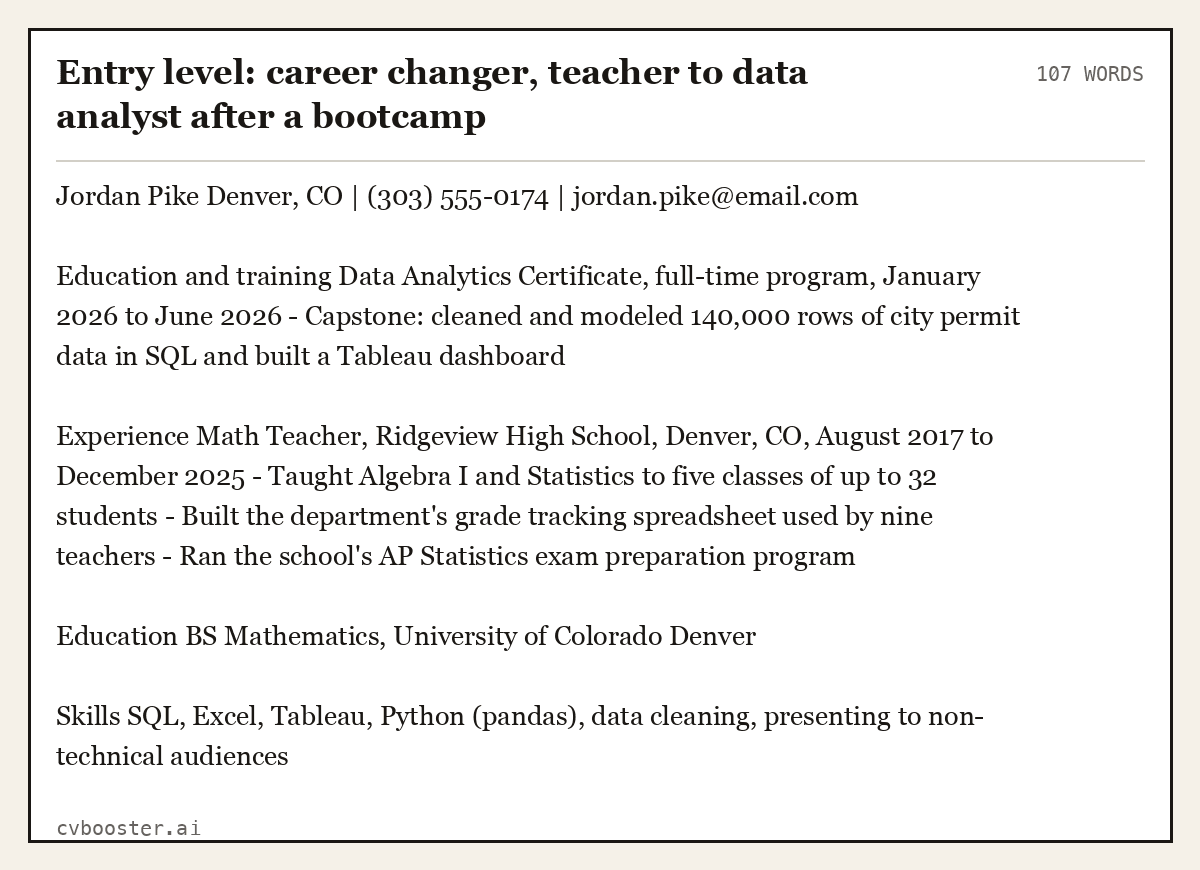
Entry level: career changer, teacher to data analyst after a bootcamp (107 words)
Jordan Pike Denver, CO | (303) 555-0174 | jordan.pike@email.com
Education and training Data Analytics Certificate, full-time program, January 2026 to June 2026 - Capstone: cleaned and modeled 140,000 rows of city permit data in SQL and built a Tableau dashboard
Experience Math Teacher, Ridgeview High School, Denver, CO, August 2017 to December 2025 - Taught Algebra I and Statistics to five classes of up to 32 students - Built the department's grade tracking spreadsheet used by nine teachers - Ran the school's AP Statistics exam preparation program
Education BS Mathematics, University of Colorado Denver
Skills SQL, Excel, Tableau, Python (pandas), data cleaning, presenting to non-technical audiences
The career change resume guide covers the rest of this layout, including the summary at the top.
Example 6: several short gaps between contracts
Contract and seasonal work leaves a resume full of holes that are not really holes. Group the contracts under one heading so the reader sees a career, not a string of exits.
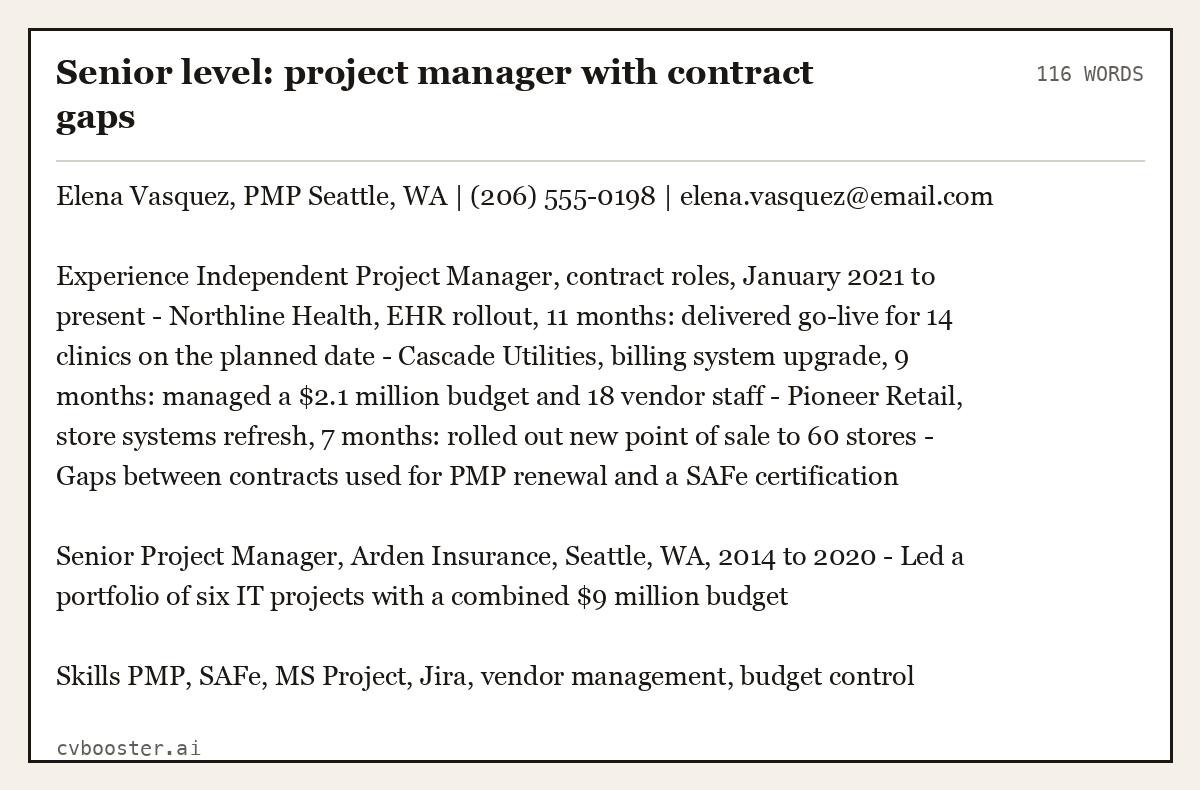
Senior level: project manager with contract gaps (116 words)
Elena Vasquez, PMP Seattle, WA | (206) 555-0198 | elena.vasquez@email.com
Experience Independent Project Manager, contract roles, January 2021 to present - Northline Health, EHR rollout, 11 months: delivered go-live for 14 clinics on the planned date - Cascade Utilities, billing system upgrade, 9 months: managed a $2.1 million budget and 18 vendor staff - Pioneer Retail, store systems refresh, 7 months: rolled out new point of sale to 60 stores - Gaps between contracts used for PMP renewal and a SAFe certification
Senior Project Manager, Arden Insurance, Seattle, WA, 2014 to 2020 - Led a portfolio of six IT projects with a combined $9 million budget
Skills PMP, SAFe, MS Project, Jira, vendor management, budget control
What to say about a gap in the cover letter and the interview
One sentence, then move on. The pattern is the same for every reason: what happened, that it is finished, and that you are ready now.
- Caregiving: "I took time out to care for a family member. That has ended and I am back full time."
- Layoff: "My role was eliminated in a company-wide reduction, and I used the time to finish a certification."
- Health: "I took a year out for health reasons, which are fully resolved."
- Parenting: "I spent six years at home with my children, who are now both in school."
If an interviewer asks a follow-up, give the same answer in slightly more words. You do not owe anyone medical details or family history. If you were let go and claimed benefits, that is a normal part of losing a job: the Department of Labor's termination page explains that "Workers who are unemployed through no fault of their own (as determined under state law), and meet other eligibility requirements, may be eligible to receive unemployment benefits."
Mistakes that make a gap look worse
- Years only, no months. It hides nothing, because the application form or background check asks for the months anyway.
- A functional resume with no dates. Readers know why people use them.
- An invented job or a stretched end date. Nobody should invent experience. A gap is a question; a fake date is a reason to withdraw an offer.
- Three paragraphs of explanation. Over-explaining invites the questions you wanted to avoid.
For the page around the gap, the resume format guide shows the order of sections, and the resume skills section shows how to list the courses you took during the break. If the gap is the main thing a reader needs explained, an objective line at the top can do it; the return after a care gap objective shows one. There is also a ready career gap resume template, and for UK applications the career break on a CV guide covers British conventions.
Frequently asked questions
How do you show employment gaps on a resume?
Keep every job with its month and year, then give any gap over six months its own line in date order, such as "Career break: family caregiving, March 2024 to April 2026". Add one or two bullets underneath for courses, volunteering or freelance work that relates to the job you want.
What is a good example of a resume with gaps in employment?
A good example lists the gap like a job: a short heading with the reason and dates, then one current skill or certification below it, then the last real job with numbers. Example 1 above, an administrative assistant back after two years of caregiving, shows the full layout.
Should I explain an employment gap on my resume or in my cover letter?
Both, briefly. The resume gets a one-line entry with the dates and a neutral reason. The cover letter gets one sentence saying what happened and that it is finished. Gaps under six months need neither, because short breaks between jobs are normal.
How long a gap is too long on a resume?
No gap is too long if it is dated and explained. A six-year parenting gap with a current certification and a volunteer role reads better than a hidden six months. Longer gaps simply need one more line of proof that your skills are current.
Can I leave months off my resume to hide a gap?
You can, but it rarely helps. Federal applications ask for start and end months, many online forms do too, and a background check shows the real dates. A gap that is found looks worse than one you stated yourself, so list the months.
Related articles
- Career Breaks on a UK CV: What to Say and Where
- Sample MBA Recommendation Letters: 6 Examples That Work
- Nanny Reference Letter: 7 Samples for Parents and Employers
- Recommendation Letter in Spanish: 5 Full Samples to Copy
More articles
- Employment History for Resume: Format and 6 Full Examples
- How to End a Cover Letter: 8 Closing Paragraph Examples
- Engineer Curriculum Vitae Example: 6 Full UK Engineering CVs
Looking for a worked example for your job title? Browse the resume examples by job title.