Employment History for Resume: Format and 6 Full Examples
By Mustafa Tarabya, founder of CVBooster · Published · Updated
8 min read
Employment history for a resume is a list of your jobs, newest first, where each entry gives the job title, the employer, the city and state, the start and end dates, and three to five lines about what you did and what changed because you did it. That is the whole format. The hard part is choosing what to leave out. The CareerOneStop resume guide, run by the US Department of Labor, sets the boundary: "Start with your current or most recent job and work backwards in order by date. Include relevant jobs from the previous 10-15 years." Below are the entry format, the rules for dates, gaps and promotions, and six complete employment history sections you can copy. Written by Mustafa Tarabya, who hired for his own company, read every application himself and now writes CVBooster's guides.
The employment history format, line by line
Every entry has two parts: a header line a reader can scan in one glance, and bullets a reader actually reads once you have passed the scan. Keep the header identical in shape for every job so the eye can run down the left margin and see your path.
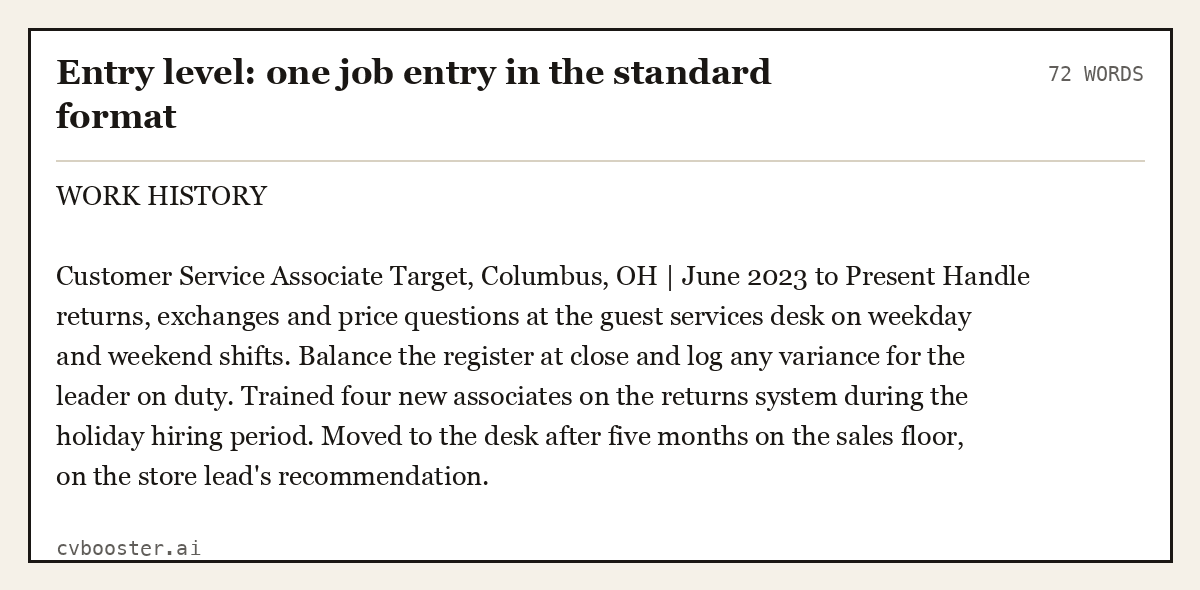
Entry level: one job entry in the standard format (72 words)
WORK HISTORY
Customer Service Associate Target, Columbus, OH | June 2023 to Present Handle returns, exchanges and price questions at the guest services desk on weekday and weekend shifts. Balance the register at close and log any variance for the leader on duty. Trained four new associates on the returns system during the holiday hiring period. Moved to the desk after five months on the sales floor, on the store lead's recommendation.
- Title first, because the title is what a recruiter is matching to the posting.
- Employer, city and state on the next line, then month and year for both dates.
- Bullets start with a verb, have no "I", and say what you did plus one detail that proves it.
The Harvard career services resume guide gives the ordering rule in one line: "Within headings, list information in reverse chronological order (most recent first)". If you want the whole page built around this section, our chronological resume format guide shows the layout.
How far back should employment history go on a resume
Ten to fifteen years is the default, and it comes from the CareerOneStop line quoted above. In practice that means three to six jobs for most people. Older roles do not vanish; they shrink. Either list them as a single line with no bullets, or group them under a heading such as "Earlier experience" with titles and employers only.
Go further back only when the old job is the reason you are qualified: a nursing license earned twenty years ago, a trade apprenticeship, the first role in the industry you are now returning to. Then keep it, and give it one bullet that says why it matters now.
Dates on a resume: month and year, every time
Use month and year for start and end dates. Years alone hide short jobs, and recruiters know that, so a page with only years makes them wonder what you are hiding. If you are still in the job, write "Present". Write months the same way throughout, either "June 2023" or "06/2023", never a mix. Applicant tracking systems read both, but a mix looks careless to the person reading after the software.
Promotions, several jobs at one company and contract work
Promotions are the most underused line on most resumes. Put the company once as a header, then each title with its own dates underneath. A reader sees growth without you having to say it.
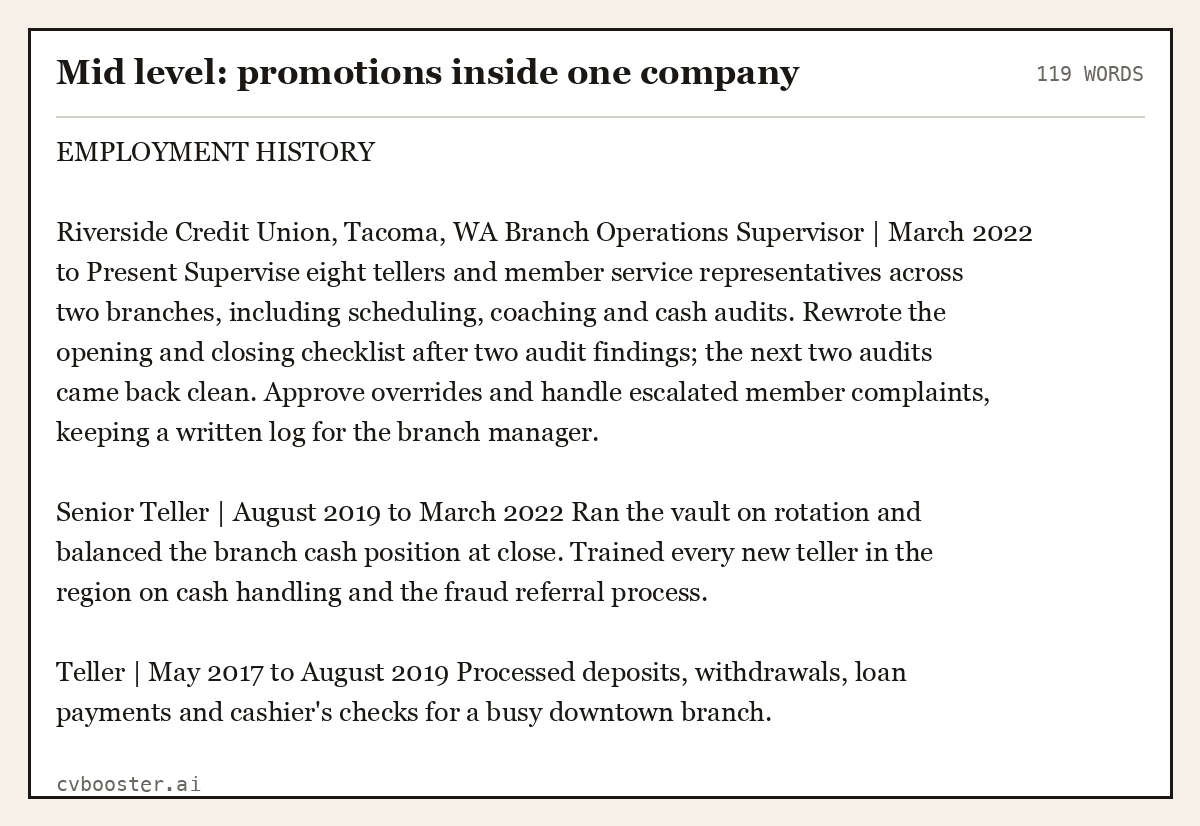
Mid level: promotions inside one company (119 words)
EMPLOYMENT HISTORY
Riverside Credit Union, Tacoma, WA Branch Operations Supervisor | March 2022 to Present Supervise eight tellers and member service representatives across two branches, including scheduling, coaching and cash audits. Rewrote the opening and closing checklist after two audit findings; the next two audits came back clean. Approve overrides and handle escalated member complaints, keeping a written log for the branch manager.
Senior Teller | August 2019 to March 2022 Ran the vault on rotation and balanced the branch cash position at close. Trained every new teller in the region on cash handling and the fraud referral process.
Teller | May 2017 to August 2019 Processed deposits, withdrawals, loan payments and cashier's checks for a busy downtown branch.
Contract, temp and agency work goes under the agency as employer, with the client named in the first bullet, or under the client with "(contract)" after the title. Pick one style and keep it. Freelancers list their own business as the employer and name two or three clients in the bullets.
Employment history with gaps or a career change
A gap of a few months needs nothing. A longer one gets one honest line in the timeline, in the same format as a job: "Career break, family caregiving, May 2021 to January 2023". Our employment gaps guide has wording for health, layoffs, study and relocation. What you should never do is stretch the dates of the job either side. Background checks verify dates, and a stretched date is the one thing on a resume that turns a maybe into a no.
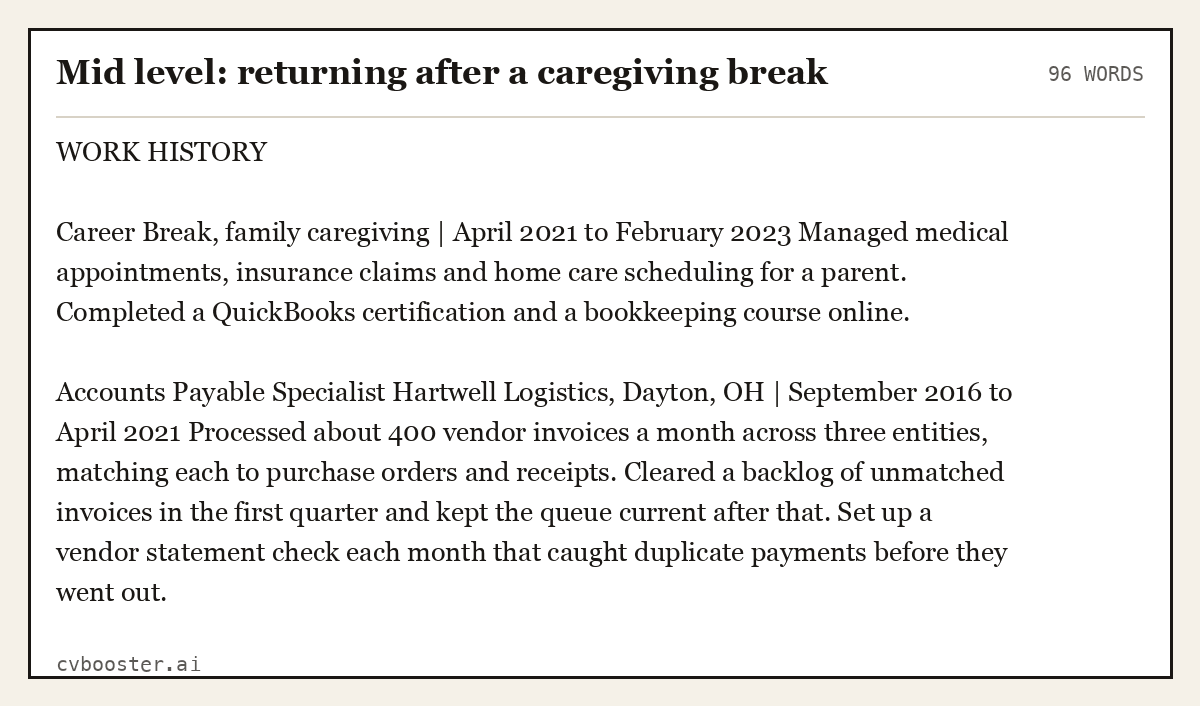
Mid level: returning after a caregiving break (96 words)
WORK HISTORY
Career Break, family caregiving | April 2021 to February 2023 Managed medical appointments, insurance claims and home care scheduling for a parent. Completed a QuickBooks certification and a bookkeeping course online.
Accounts Payable Specialist Hartwell Logistics, Dayton, OH | September 2016 to April 2021 Processed about 400 vendor invoices a month across three entities, matching each to purchase orders and receipts. Cleared a backlog of unmatched invoices in the first quarter and kept the queue current after that. Set up a vendor statement check each month that caught duplicate payments before they went out.
Career changers keep the old jobs but rewrite the bullets toward the new field. A teacher moving into training and development writes about designing lessons, assessing results and presenting to groups, not about bus duty. If the old field is a long way from the new one, the career change resume guide shows when to lead with a skills block instead.
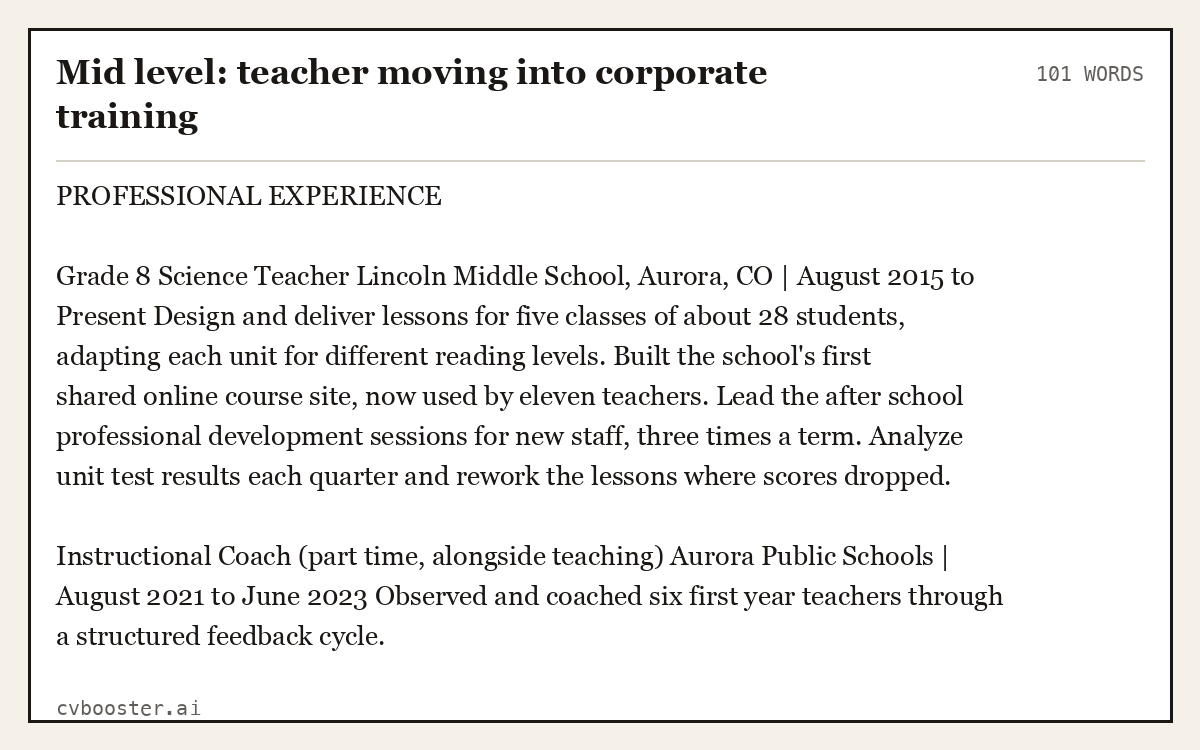
Mid level: teacher moving into corporate training (101 words)
PROFESSIONAL EXPERIENCE
Grade 8 Science Teacher Lincoln Middle School, Aurora, CO | August 2015 to Present Design and deliver lessons for five classes of about 28 students, adapting each unit for different reading levels. Built the school's first shared online course site, now used by eleven teachers. Lead the after school professional development sessions for new staff, three times a term. Analyze unit test results each quarter and rework the lessons where scores dropped.
Instructional Coach (part time, alongside teaching) Aurora Public Schools | August 2021 to June 2023 Observed and coached six first year teachers through a structured feedback cycle.
What to write under each job
The MIT career advising resume guide puts the rule plainly: "Your experience descriptions shouldn’t read like job descriptions." The posting already tells a recruiter what a customer service associate is supposed to do. Your bullets have to say what you did that the next applicant did not. One way to check: if the bullet could be pasted onto a coworker's resume unchanged, it is a duty, not an achievement. Our resume action verbs list helps with the first word. For a worked case of turning a duty list into proof, see our bank teller responsibilities for resume page.
- Three to five bullets for recent jobs, one or two for older ones.
- One number per job where you honestly have one: volume, team size, frequency, time saved.
- The newest job gets the most space, even if an older one was more impressive.
Senior employment history: keep it to two pages
Senior candidates have the opposite problem: too much. Give the last ten to fifteen years in full and compress everything before it.
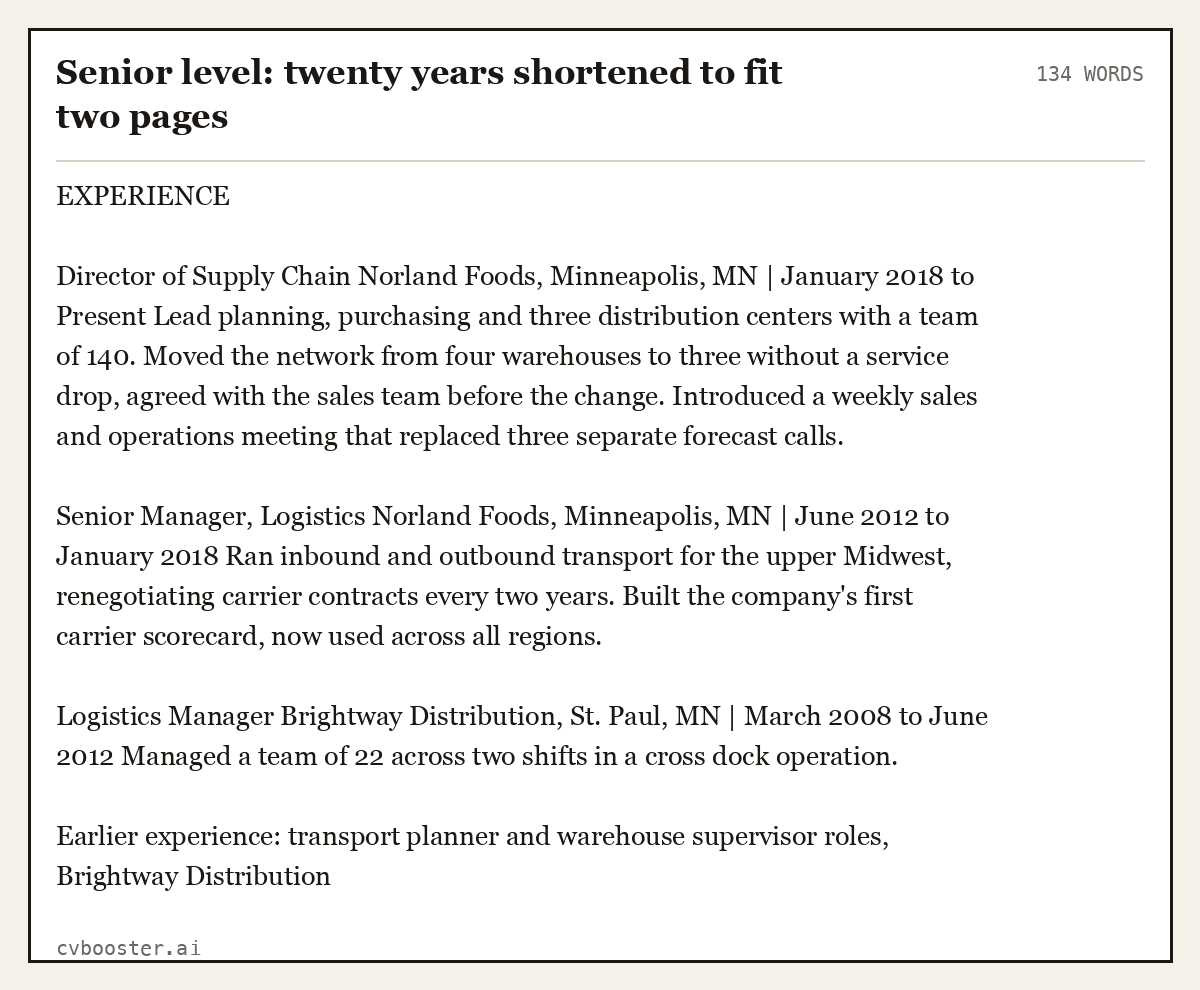
Senior level: twenty years shortened to fit two pages (134 words)
EXPERIENCE
Director of Supply Chain Norland Foods, Minneapolis, MN | January 2018 to Present Lead planning, purchasing and three distribution centers with a team of 140. Moved the network from four warehouses to three without a service drop, agreed with the sales team before the change. Introduced a weekly sales and operations meeting that replaced three separate forecast calls.
Senior Manager, Logistics Norland Foods, Minneapolis, MN | June 2012 to January 2018 Ran inbound and outbound transport for the upper Midwest, renegotiating carrier contracts every two years. Built the company's first carrier scorecard, now used across all regions.
Logistics Manager Brightway Distribution, St. Paul, MN | March 2008 to June 2012 Managed a team of 22 across two shifts in a cross dock operation.
Earlier experience: transport planner and warehouse supervisor roles, Brightway Distribution
If you have held a long list of short jobs, such as seasonal work, restaurant shifts or gig work, group similar roles under one heading with a combined date range and two bullets for the whole group. A recruiter wants to see that you worked and what you can do, not twelve near identical entries.
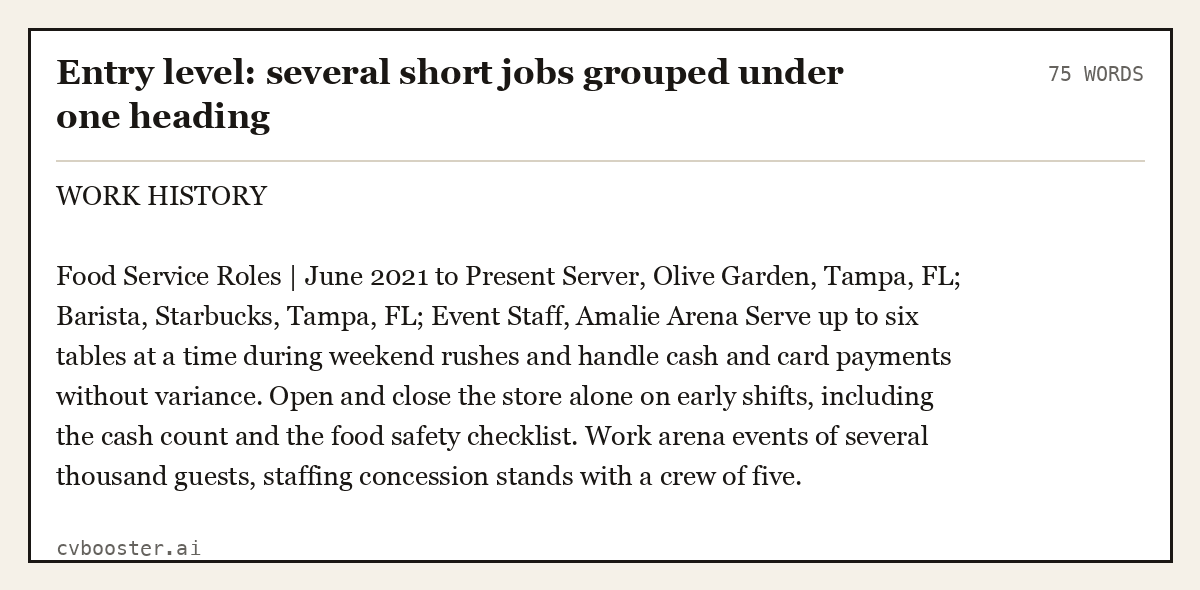
Entry level: several short jobs grouped under one heading (75 words)
WORK HISTORY
Food Service Roles | June 2021 to Present Server, Olive Garden, Tampa, FL; Barista, Starbucks, Tampa, FL; Event Staff, Amalie Arena Serve up to six tables at a time during weekend rushes and handle cash and card payments without variance. Open and close the store alone on early shifts, including the cash count and the food safety checklist. Work arena events of several thousand guests, staffing concession stands with a crew of five.
Frequently asked questions
What is employment history on a resume?
It is the section listing your jobs, newest first. Each entry gives the title, employer, city and state, start and end month and year, and a few bullets about what you did and what changed. It is usually called Work History, Experience or Professional Experience, and all three mean the same thing to a recruiter.
How far back should employment history go on a resume?
Ten to fifteen years is the standard, following the US Department of Labor's CareerOneStop guidance. Older jobs can be one line each or grouped under "Earlier experience". Keep an older role in full only when it is the reason you are qualified for the job you want now.
Do I need to list every job in my employment history?
No. A resume is not a background check form. List the jobs that support the role you want and cover the last ten to fifteen years without unexplained holes. Very short jobs can be left out or grouped. Application forms that ask for complete history are different: answer those fully and truthfully.
Should employment history include months or just years?
Include months. Years alone hide short stays, recruiters know it, and they assume the worst. Write "June 2023 to Present" or "06/2023 to Present" and use the same style for every job on the page.
How do I show a gap in my employment history?
Put it in the timeline as a line of its own, with dates and a short honest reason, such as a career break for caregiving or study. Add one bullet if you kept your skills current. Never stretch the dates of the job before or after, because background checks verify them.
Related articles
- Accounting Executive Resume: 5 Examples by Career Level
- Administration Resume Examples: 8 Samples, Entry to Manager
- Another Word for Resume: CV, Bio and 10 More Options
- Apple Pages Resume Template: 6 Examples Built for ATS
More articles
- Engineering Cover Letter Examples: 6 Samples by Discipline
- Entry Level Project Manager: 5 Routes In With No Degree
- Entry Level Roles With No Experience: 6 Routes That Work
Looking for a worked example for your job title? Browse the resume examples by job title.