Career Gap Resume Examples: what a hiring manager reads
Write a Career Gap Resume That Answers the Question Directly
By Mustafa Tarabya, founder of CVBooster · Published · Updated
Career gap resume example, keyword list and writing guide covering gap statements, year-only dates, refresher training and returning to paid work.
Sample resumes for a career gap
The same career gap content laid out in three CVBooster templates, so you can see what the finished document looks like before you write a word.
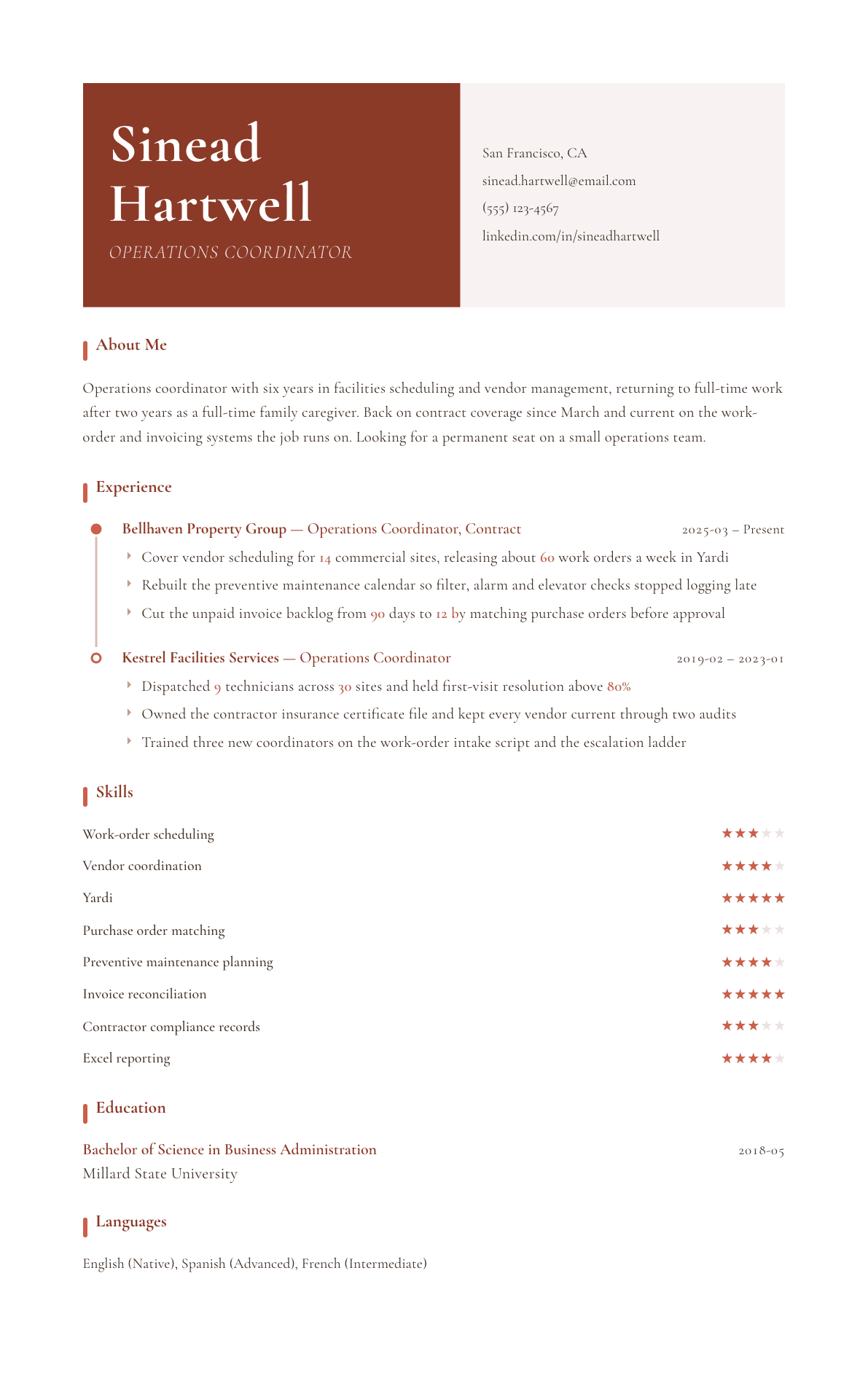
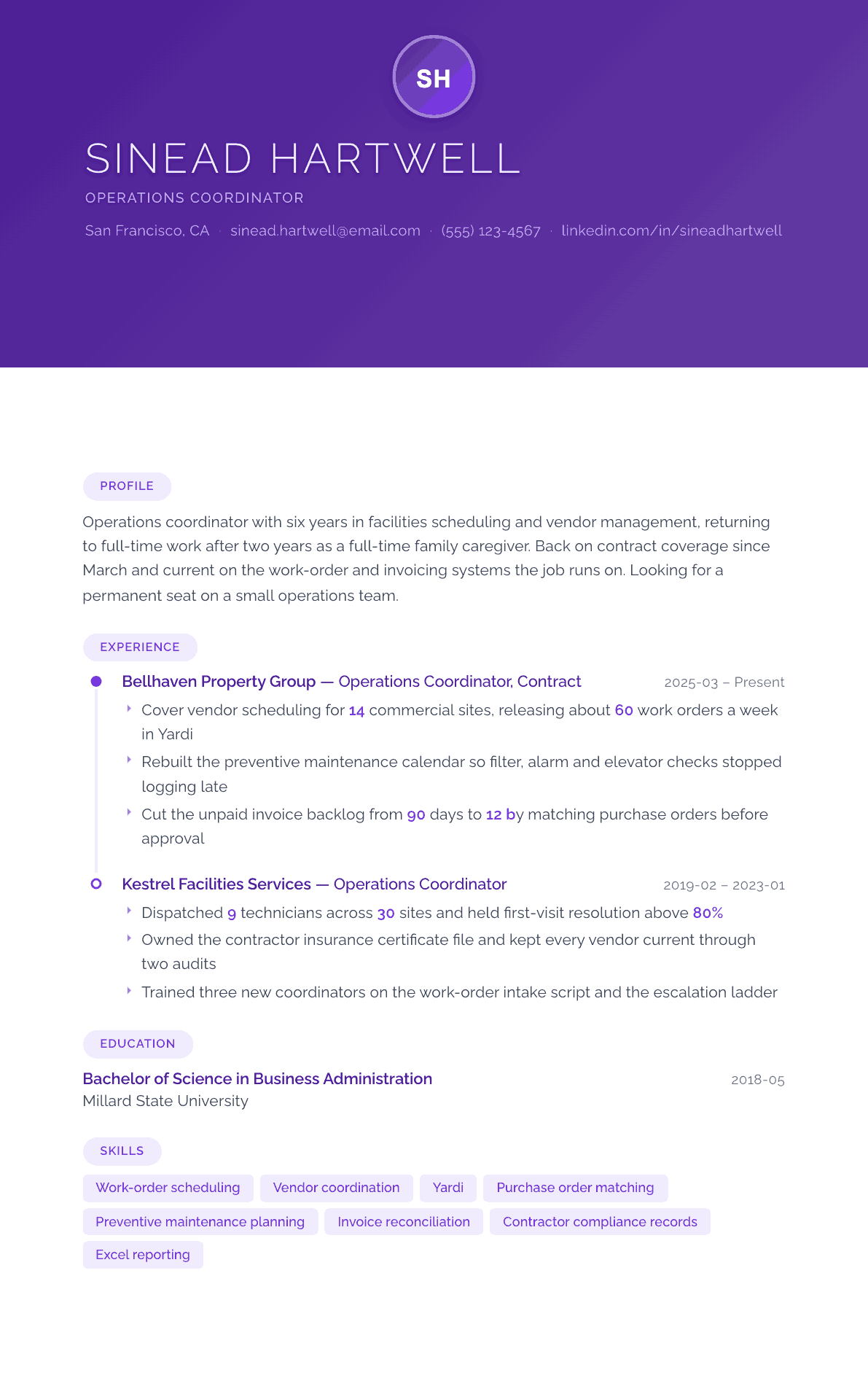
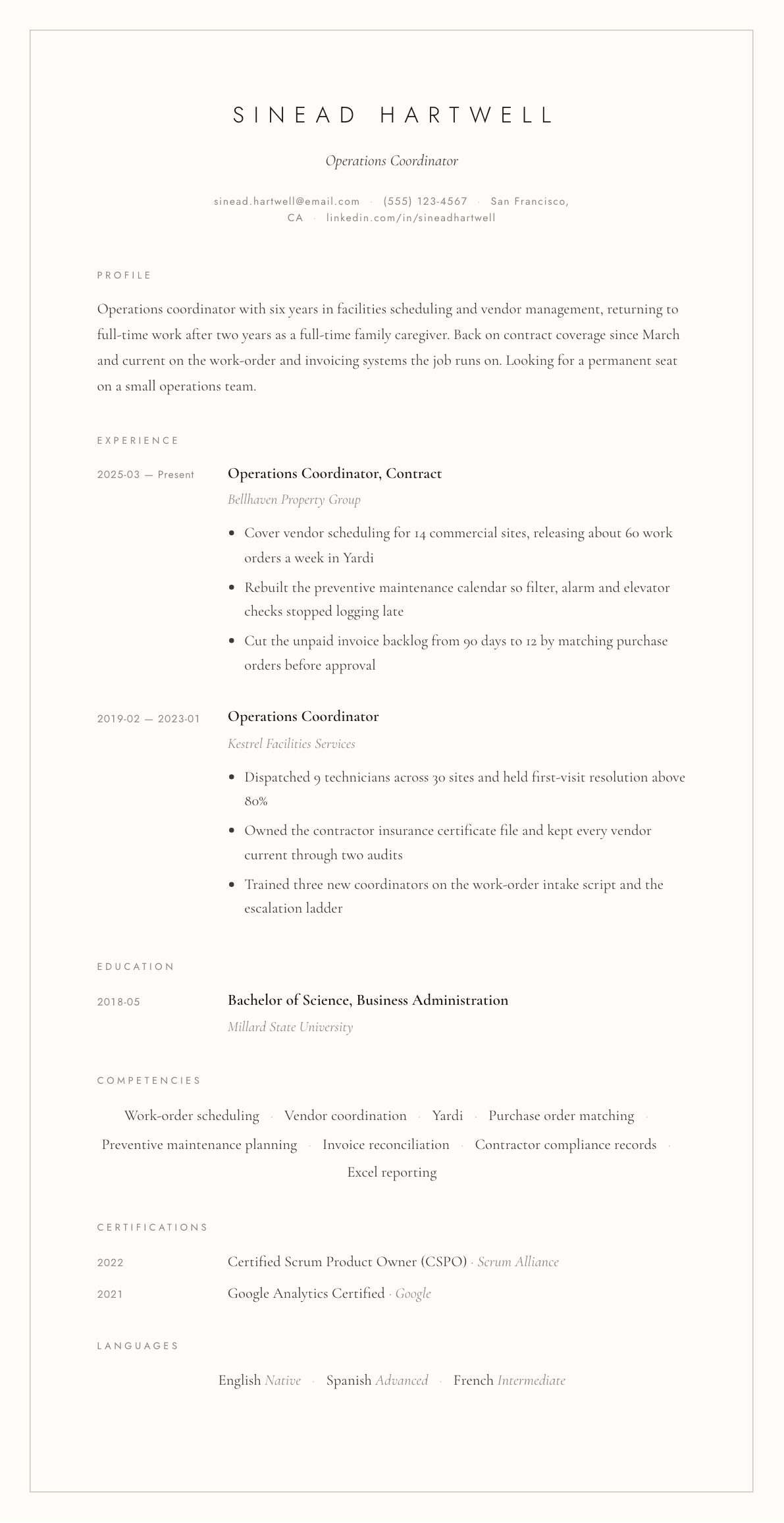
Example Career Gap summary
Operations professional with six years of facilities and vendor coordination, back in full-time work after a planned two-year caregiving break. Restarted through a contract coverage role, current on Yardi and purchase order workflows, and holds a clean record on preventive maintenance compliance. Seeking a permanent coordinator position with a property or facilities team that runs a multi-site portfolio.
Skills to list on a Career Gap resume
- Reverse chronological formatting
- Gap statement writing
- Contract and temporary work
- Skills refresh planning
- Software currency
- Reference management
- Interview framing
- License and certification renewal
- Volunteer coordination
- Transferable skill mapping
- Applicant tracking system keywords
- Cover letter positioning
What actually gets this resume read
- Write one plain line naming the reason for the break and the month you became available again.
- Keep reverse chronological order, because a functional layout signals a hidden gap before anyone reads it.
- Use year-only dates when the break sits between two jobs in the same calendar year.
- Put any contract, temporary or part-time work during the break on the page as a real job entry.
- Name the software you have used since returning, since the doubt is usually about currency, not ability.
- List refresher courses, license renewals and volunteer work inside the gap window with their completion dates.
How to write a career gap resume
A career gap is not a flaw on a resume, it is an unanswered question. The recruiter reading your page sees one job ending in the spring and the next starting two years later, and the mind fills that silence with the worst available story: fired, unwell, unemployable. Every hour you spend disguising the gap makes that story louder. The candidates who get called back are the ones who name the break in eight words and then spend the rest of the page proving they are current.
Screeners for a returning candidate check three things in a specific order. Is the break explained. Is the person available now. Are the skills still live. The third is where most returners lose the interview, because they present a resume frozen at the moment they stopped working, with the software versions, job titles and reference names of a different era. A hiring manager will forgive two years away. She will not forgive a candidate who has no idea what the team uses today.
This guide covers how to date a resume around a break, where the gap statement belongs, how to turn contract and volunteer work inside the gap into real entries, and how to handle the interview question that always follows. It also covers the returnship route, which is now the fastest way back into a corporate function after a long absence.
Format: stay reverse chronological and let the gap sit in plain sight
Returners are told constantly to switch to a functional or skills-based layout that hides dates. Do not. Recruiters know exactly why that layout exists, and reaching for it converts a two-year break into a suspicion that something worse is being covered. Reverse chronological, with honest dates, in the standard order: contact, summary, a one-line availability or gap note, experience, education, certifications.
The one legitimate dating trick is granularity. If your last job ended in one calendar year and the new one starts in the same one, year-only dates close a short break without misleading anyone. Anything longer than a few months should carry months, because a recruiter who discovers a hidden year during a background check treats it as dishonesty rather than formatting.
- Header carries city, state, phone, a current email domain and a professional profile link.
- One line under the summary: the reason for the break, the month it ended, and your availability.
- Contract, temporary, freelance and substantial volunteer work inside the gap get full job entries.
- Certifications, license renewals and courses taken during the break get their own dated section.
- Keep the whole document to one page under about ten years of history, two beyond that.
The gap statement: one line, factual, no apology
Write the break as a neutral fact and move on. Caregiving for a parent, raising children, recovering from a health issue, a relocation with a partner, a redundancy followed by a deliberate retraining year: all of these are ordinary and none of them require an explanation longer than a sentence. The tone that fails is the defensive one, where a candidate spends a paragraph justifying the decision. Length reads as guilt.
Put the statement where it cannot be missed but does not lead: directly under the professional summary, or as a dated entry in the experience list with a title such as Career Break, Family Caregiving. Naming it as an entry has a quiet advantage, because it lets you attach bullets to it: the course you finished, the treasurer role you held at the community club, the two clients you kept on a reduced schedule.
If the break is still ongoing, say when you are available. A manager filling a seat next month will screen out a candidate whose start date is a mystery, even a strong one.
Proving currency: the section that actually wins the interview
Currency is the real objection. Answer it with dated evidence rather than assurances. A finance returner who lists a completed refresher on the current revenue recognition standard, a nurse who lists a renewed license and a completed skills validation, an operations coordinator who names the version of the work-order system in use on her contract assignment: each of them has removed the doubt before it was raised.
Any paid work during the break belongs in the experience section with the same treatment as a permanent job. Contract coverage, agency shifts, seasonal retail, a few days of consulting a month. It is not a lesser entry, and describing it as filling in wastes the strongest currency evidence you own.
Where there was no paid work at all, use what there was. Managing a family member's care means coordinating providers, tracking medication schedules, handling insurance appeals and keeping records. Written as a normal job entry with real nouns, it reads as administration, because that is what it was. Written as a personal reflection, it reads as filler.
- Refresher courses and micro-credentials with the completion month and the issuing body.
- Professional license renewals and continuing education hours, with the renewal date.
- Contract, temp, per diem and seasonal work as full entries with employer and dates.
- Volunteer roles that carried responsibility: treasurer, coordinator, committee chair, tutor.
- Named software you have used since returning, with the current version or release.
Experience: rebuild the pre-gap jobs for the job you want now
The instinct on return is to copy the old resume forward untouched. That resume was written for a different market and often a different you. Go back through the pre-gap roles and rewrite the bullets against the posting in front of you today, keeping the facts identical and changing the emphasis. A coordinator who spent five years scheduling technicians should lead with the volume, the systems and the compliance record, not the daily duty list.
Cut the oldest jobs hard. Anything more than about fifteen years back can collapse into a two-line prior experience block. Space on the page is better spent on the recent contract assignment that proves you are working now.
Watch the language drift. Job titles change, tools get renamed, and returners often describe their old work in vocabulary the applicant tracking system no longer indexes. Read three current postings for the role and adopt the nouns they use.
The returnship route and how to apply for it
Many large employers run structured return-to-work programs aimed specifically at people who have been out for a year or more. They are paid, time-boxed, and designed around exactly the currency problem this guide describes, which makes them a far higher-yield application than a general opening where you compete against continuously employed candidates.
A returnship application inverts the usual weighting. The screener expects the gap and wants the prior depth, so lead with the seniority you reached before the break, name the function precisely, and be explicit about the break length. Hiding it in that context works against you, because the program exists for people who have one.
Career Gap resume summary examples
Short break, early career
Administrative coordinator with 3 years in a clinic front office, available immediately after a nine-month relocation break. Completed a medical terminology refresher and returned to part-time reception coverage in March. Comfortable in scheduling systems and insurance verification, and looking for a full-time practice coordinator seat.
Two-year caregiving break
Operations coordinator with 6 years in multi-site facilities scheduling, returning to full-time work after two years of family caregiving. Restarted in March on a contract assignment covering 14 sites, current on work-order and invoicing systems, and holding an invoice backlog under two weeks. Seeking a permanent coordinator role.
Senior returner after a long absence
Finance manager with 12 years across controllership and reporting, out of the workforce for 4 years and back through a structured return program. Completed refresher training on current revenue standards, rebuilt the close checklist for a mid-size subsidiary, and now seeking a permanent reporting manager role.
Work experience bullets: before and after
Before: Took time off for personal reasons.
After: Career break, family caregiving, February 2023 to February 2025: managed care coordination for a parent, completed a bookkeeping refresher, and kept two part-time clients on a reduced schedule.
A dated, named entry with real activity turns an empty stretch into a readable part of the history.
Before: Currently doing some temp work while looking for a job.
After: Covering operations scheduling on a contract assignment across 14 commercial sites since March 2025, releasing about 60 work orders a week in the client's current system.
Naming the employer, the volume and the system proves the skills are live rather than remembered.
Before: Kept my skills up to date during my break.
After: Completed a 40-hour payroll refresher in November 2024 and renewed the state license in January 2025, both before applying.
Dated, named training answers the currency objection where a general claim of staying sharp never does.
Before: Was responsible for scheduling and vendors before my break.
After: Dispatched 9 technicians across 30 sites, held first-visit resolution above 80%, and kept every contractor insurance certificate current through two audits.
The pre-gap role earns its place only when the numbers show what level you were operating at.
Before: Volunteered at my child's school during my time away.
After: Served as treasurer of a parent association for two years, reconciling a small activity account monthly and producing the annual statement reviewed by the school board.
A responsibility with a title, a cycle and an output reads as work, not as a way to fill a line.
Hard skills
- Reverse chronological resume structure
- Gap statement drafting
- Date granularity decisions
- Contract and temporary work presentation
- Skills refresh and continuing education
- License and certification renewal tracking
- Applicant tracking system keyword alignment
- Transferable skill mapping
- Reference list rebuilding
- Returnship program applications
- Portfolio and work sample assembly
- Cover letter positioning
Soft skills
- Answering the gap question without apology
- Reframing caregiving as coordination work
- Rebuilding professional contacts after time away
- Realistic self-assessment of rusty areas
- Persistence through a longer search cycle
Mistakes that cost career gap candidates the interview
- Switching to a functional layout to hide the dates, which recruiters read as concealment rather than design.
- Writing a paragraph of justification for the break when one factual sentence closes the question faster.
- Leaving contract, agency and seasonal work off the page because it felt like a step down.
- Sending the pre-break resume unchanged, complete with tools and titles that have since been renamed.
- Giving no availability date, which pushes you out of any search where the seat needs filling this quarter.
- Listing references who last worked with you before the break and have since moved on or retired.
- Applying only to open postings and skipping structured return programs built for exactly this situation.
Career Gap resume questions
How long does a gap have to be before I need to explain it?
Anything under about three months usually passes without comment, especially between jobs in the same year. Past six months, add a short dated line. Past a year, give it a proper entry in the experience section with whatever you did inside it.
Should I put my career break in the experience section or under the summary?
Either works, but the experience section is stronger when you have something to attach to it, such as a course, a volunteer role or part-time work. Use a line under the summary when the break was short and genuinely empty of activity.
What do I write if the break was for my own health?
Say you took a planned break for health reasons, that it has been resolved, and that you are available from a specific date. You owe no diagnosis and no detail. Keep the sentence short and let the currency evidence below it carry the rest.
Does volunteer work during a career break really count as experience?
It counts when it carried responsibility and can be described in the same terms as a job: a title, a date range, hours per week and an outcome. Running a food bank rota or a club treasury counts. Occasional weekend help does not carry the same weight.
How do I answer the gap question in the interview itself?
Use three short beats: the reason, that it is finished, and what you did to stay current. Then turn the conversation to the work. Interviewers are checking whether the topic makes you defensive, so a calm forty-word answer settles it better than a careful one.