Interview Questions for Job Promotion: 6 Full Answers
By Mustafa Tarabya, founder of CVBooster · Published · Updated
10 min read
Interview questions for a job promotion ask what an outside candidate is asked, plus one thing nobody outside can answer: what you have already done here that proves you can do the bigger job. The constraint is that the panel knows your work, your mistakes and your manager, so a polished answer that ignores what they have seen falls flat. Promotion interviews are often structured in the same way as hiring interviews; the US Office of Personnel Management lists structured interviews as "Used for recruitment, selection and promotion purposes" in its guide to structured interviews. Below are the questions that come up when you are interviewing for a promotion, six complete answers from a first team lead to a senior manager, and how to prepare. Written by Mustafa Tarabya, who hired for his own company, read every application himself and now writes CVBooster's guides.
It is a strange meeting. Your interviewer approved your vacation in July, and today you both pretend to be meeting for the first time.
Interview questions for job promotion: what they ask
The questions fall into four groups, and a promotion panel often asks from all four:
- Motivation: Why do you want this promotion? Why now?
- Evidence: Why should we promote you rather than hire from outside? What have you done beyond your current role?
- The new job: How will you manage people who were your peers? What would you change in your first ninety days?
- Judgment: Tell me about a time you led without authority. What will you do if you do not get the role?
Harvard's career office explains why the evidence questions dominate in its interviewing guide: "The principle behind this type of interview is that past behavior is a good predictor of future behavior." For an internal candidate, that past behavior is already on file, so pick stories the panel can check.
Why do you want this promotion?
Answer with the work, not the title or the pay. Name what you have been doing that points at the new role, and what you want to do more of. Keep it under a minute.
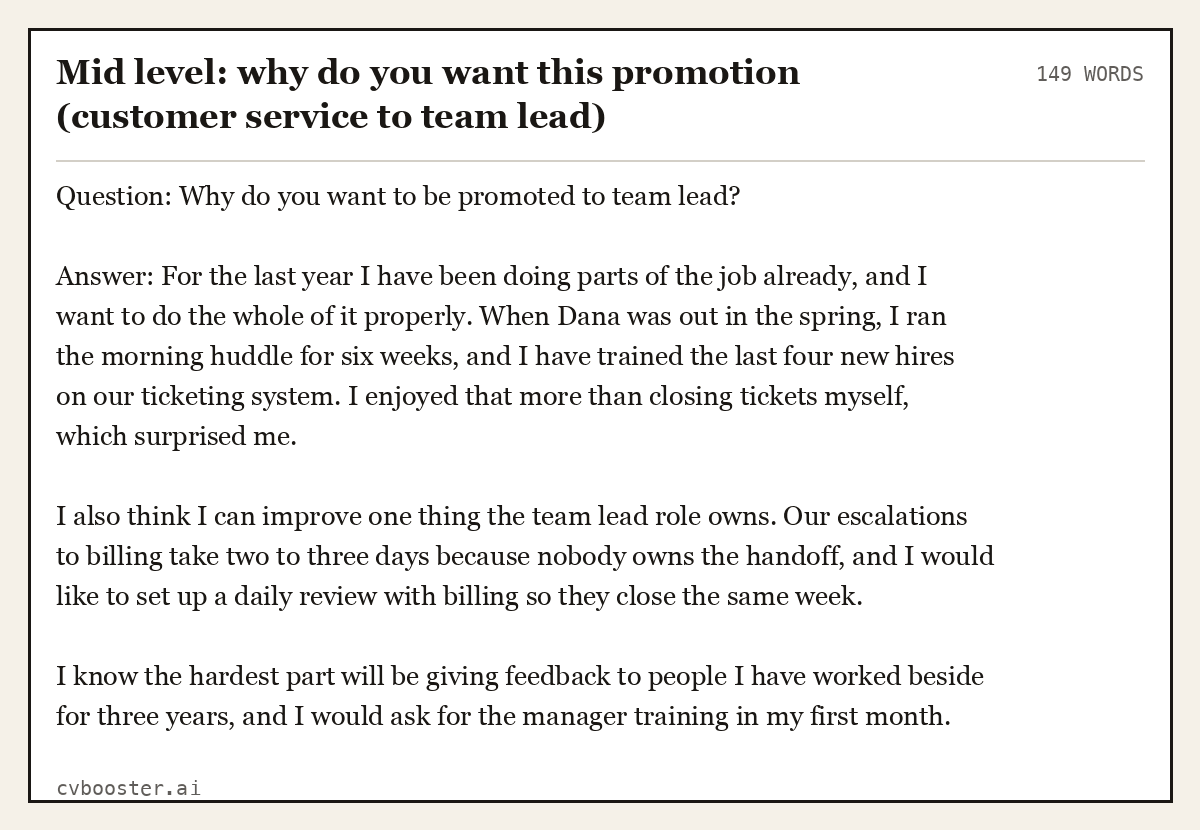
Mid level: why do you want this promotion (customer service to team lead) (149 words)
Question: Why do you want to be promoted to team lead?
Answer: For the last year I have been doing parts of the job already, and I want to do the whole of it properly. When Dana was out in the spring, I ran the morning huddle for six weeks, and I have trained the last four new hires on our ticketing system. I enjoyed that more than closing tickets myself, which surprised me.
I also think I can improve one thing the team lead role owns. Our escalations to billing take two to three days because nobody owns the handoff, and I would like to set up a daily review with billing so they close the same week.
I know the hardest part will be giving feedback to people I have worked beside for three years, and I would ask for the manager training in my first month.
Why should we promote you over an outside candidate?
This is the question internal candidates fear most, and it is the one you are best placed to answer. An outside hire needs months to learn the systems, the people and the history. You do not. Say that plainly, then give the evidence, then name the gap honestly and how you are closing it.
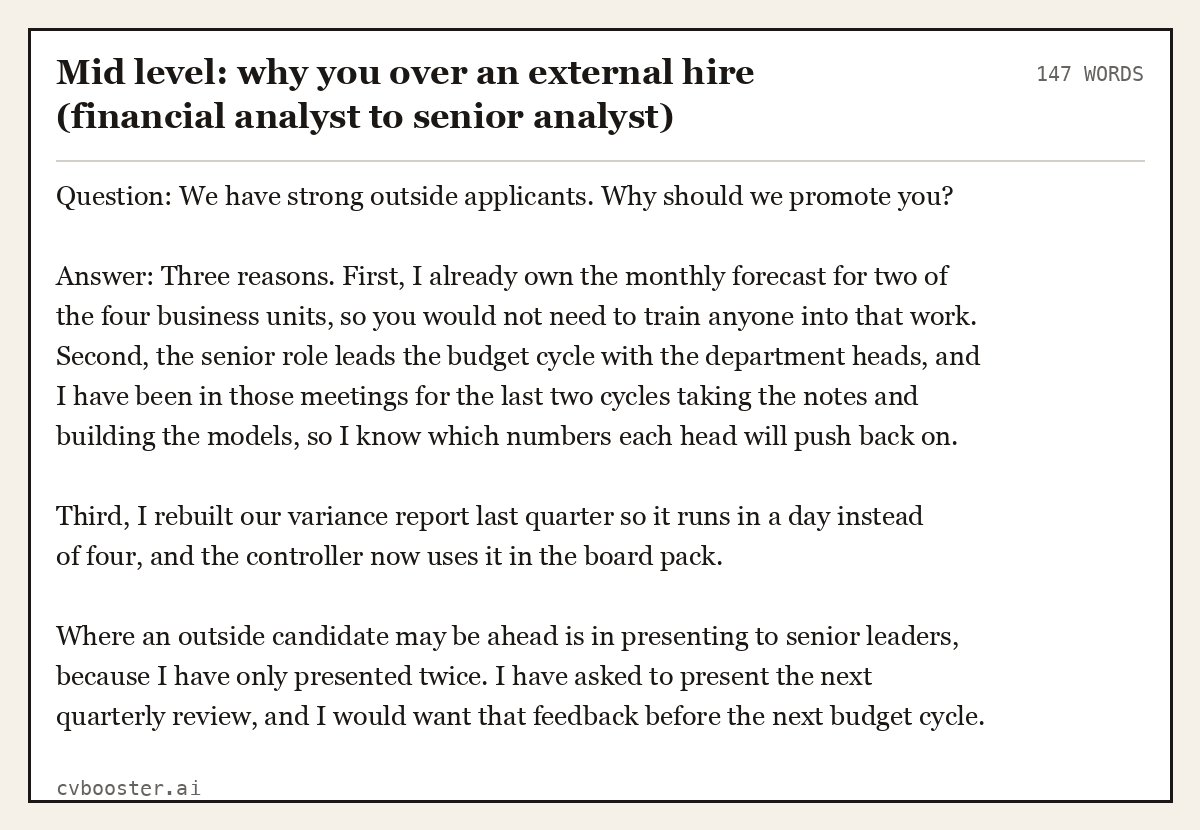
Mid level: why you over an external hire (financial analyst to senior analyst) (147 words)
Question: We have strong outside applicants. Why should we promote you?
Answer: Three reasons. First, I already own the monthly forecast for two of the four business units, so you would not need to train anyone into that work. Second, the senior role leads the budget cycle with the department heads, and I have been in those meetings for the last two cycles taking the notes and building the models, so I know which numbers each head will push back on.
Third, I rebuilt our variance report last quarter so it runs in a day instead of four, and the controller now uses it in the board pack.
Where an outside candidate may be ahead is in presenting to senior leaders, because I have only presented twice. I have asked to present the next quarterly review, and I would want that feedback before the next budget cycle.
How will you manage your former peers?
This question is asked in almost every first promotion into management. The panel wants to hear that you know the relationship changes, that you will be fair, and that you will have the difficult conversation rather than avoid it.
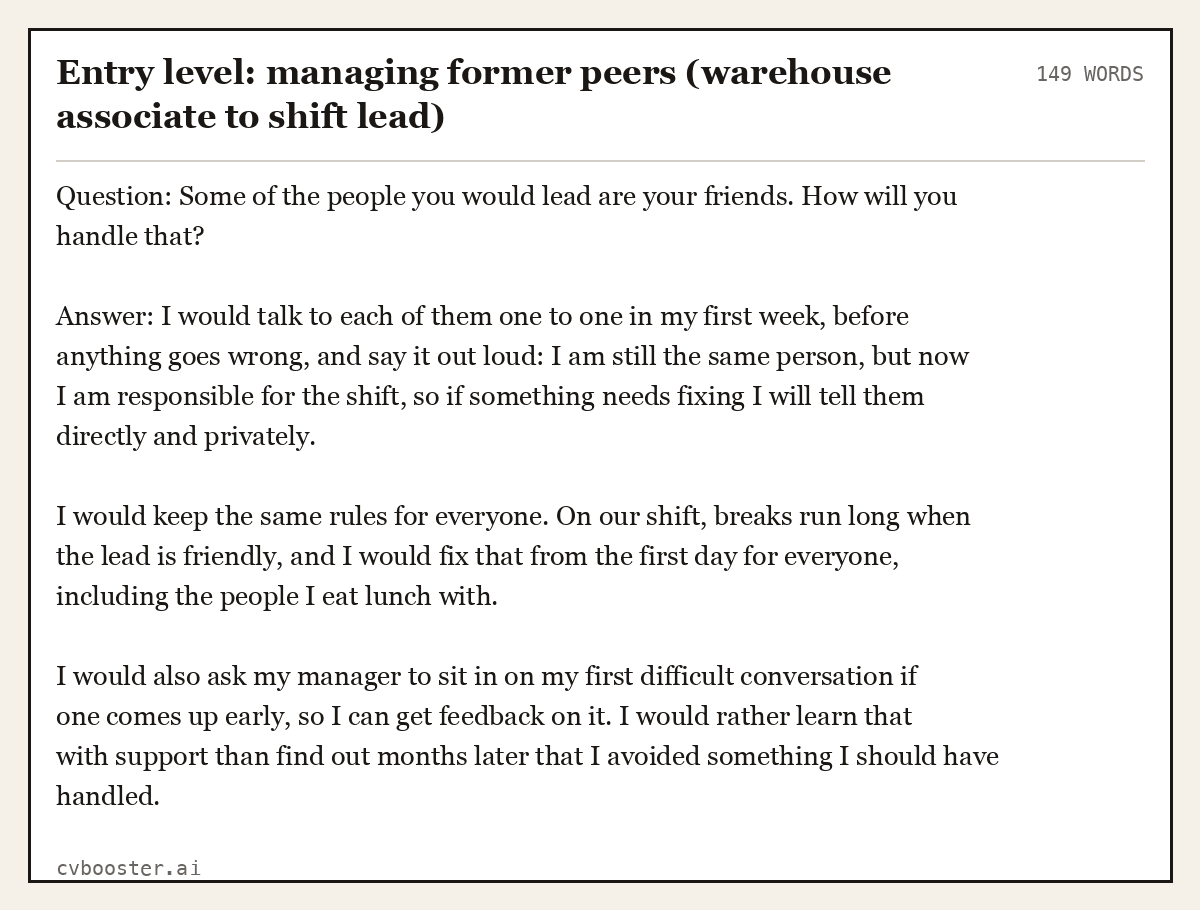
Entry level: managing former peers (warehouse associate to shift lead) (149 words)
Question: Some of the people you would lead are your friends. How will you handle that?
Answer: I would talk to each of them one to one in my first week, before anything goes wrong, and say it out loud: I am still the same person, but now I am responsible for the shift, so if something needs fixing I will tell them directly and privately.
I would keep the same rules for everyone. On our shift, breaks run long when the lead is friendly, and I would fix that from the first day for everyone, including the people I eat lunch with.
I would also ask my manager to sit in on my first difficult conversation if one comes up early, so I can get feedback on it. I would rather learn that with support than find out months later that I avoided something I should have handled.
What would you change in your first ninety days?
Internal candidates often get this question with a trap inside it: the people who built the current process may be on the panel. Name a real problem, show you understand why it is the way it is, and describe how you would decide rather than announce the fix.
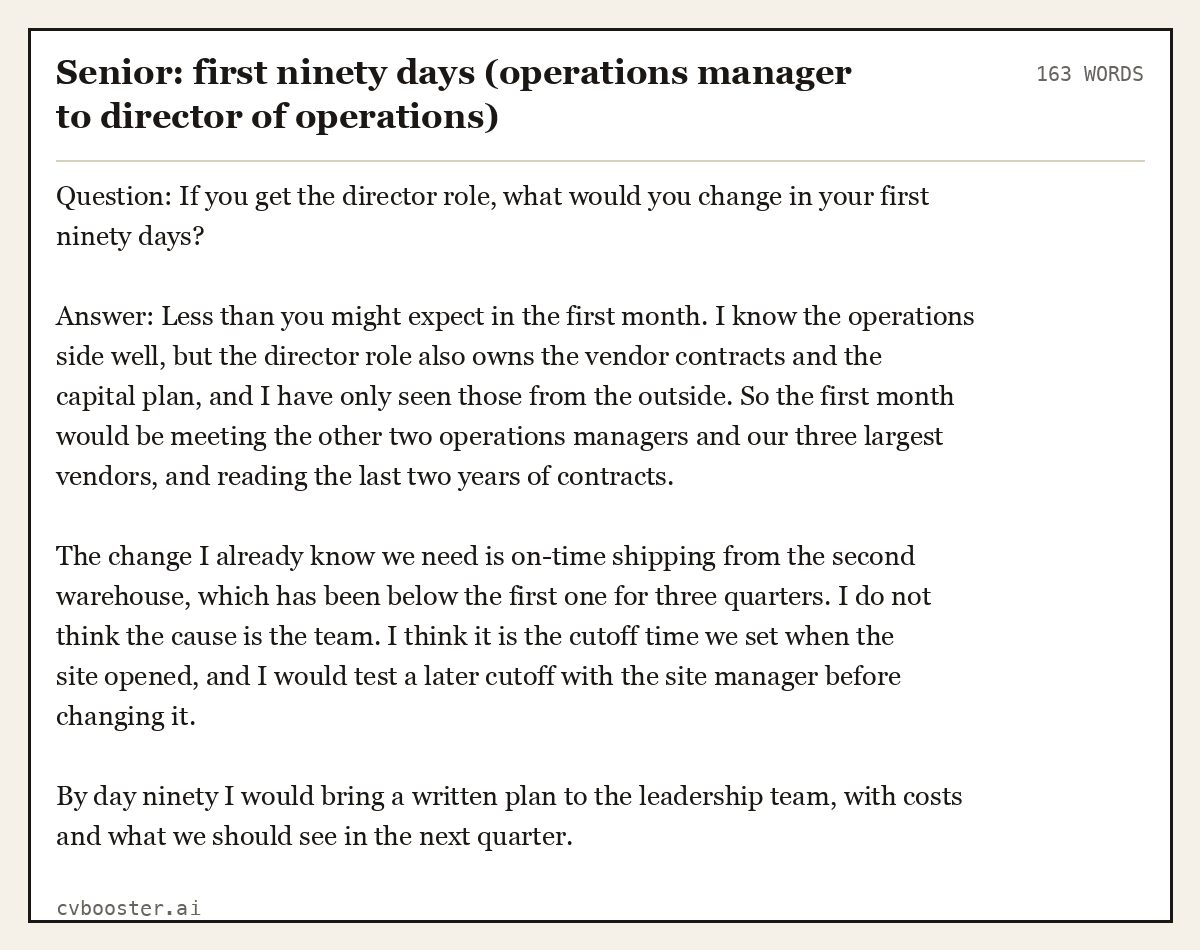
Senior: first ninety days (operations manager to director of operations) (163 words)
Question: If you get the director role, what would you change in your first ninety days?
Answer: Less than you might expect in the first month. I know the operations side well, but the director role also owns the vendor contracts and the capital plan, and I have only seen those from the outside. So the first month would be meeting the other two operations managers and our three largest vendors, and reading the last two years of contracts.
The change I already know we need is on-time shipping from the second warehouse, which has been below the first one for three quarters. I do not think the cause is the team. I think it is the cutoff time we set when the site opened, and I would test a later cutoff with the site manager before changing it.
By day ninety I would bring a written plan to the leadership team, with costs and what we should see in the next quarter.
Tell me about a time you led without authority
Before a promotion, almost all your leadership happened without the title. Pick one project where you got people who did not report to you to do something, and show how. Harvard's guide gives the shape: "1. Situation, 2. Action, 3. Result". Our STAR interview questions guide has more answers built the same way.
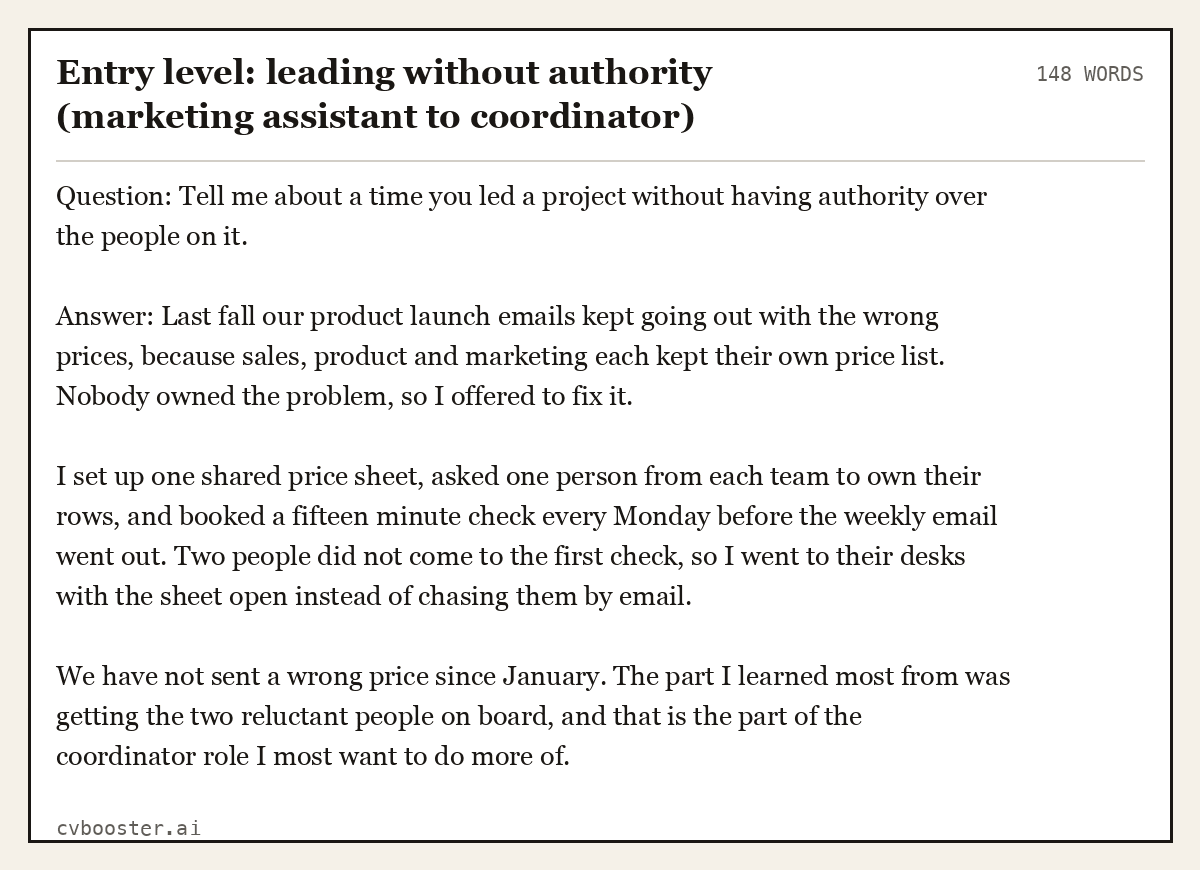
Entry level: leading without authority (marketing assistant to coordinator) (148 words)
Question: Tell me about a time you led a project without having authority over the people on it.
Answer: Last fall our product launch emails kept going out with the wrong prices, because sales, product and marketing each kept their own price list. Nobody owned the problem, so I offered to fix it.
I set up one shared price sheet, asked one person from each team to own their rows, and booked a fifteen minute check every Monday before the weekly email went out. Two people did not come to the first check, so I went to their desks with the sheet open instead of chasing them by email.
We have not sent a wrong price since January. The part I learned most from was getting the two reluctant people on board, and that is the part of the coordinator role I most want to do more of.
What if you do not get the promotion?
The panel asks this to see if you will stay and stay useful. Say you would want the feedback, that you would keep doing your job well, and what you would work on before the next opening. Do not threaten to leave, and do not pretend you would not mind.
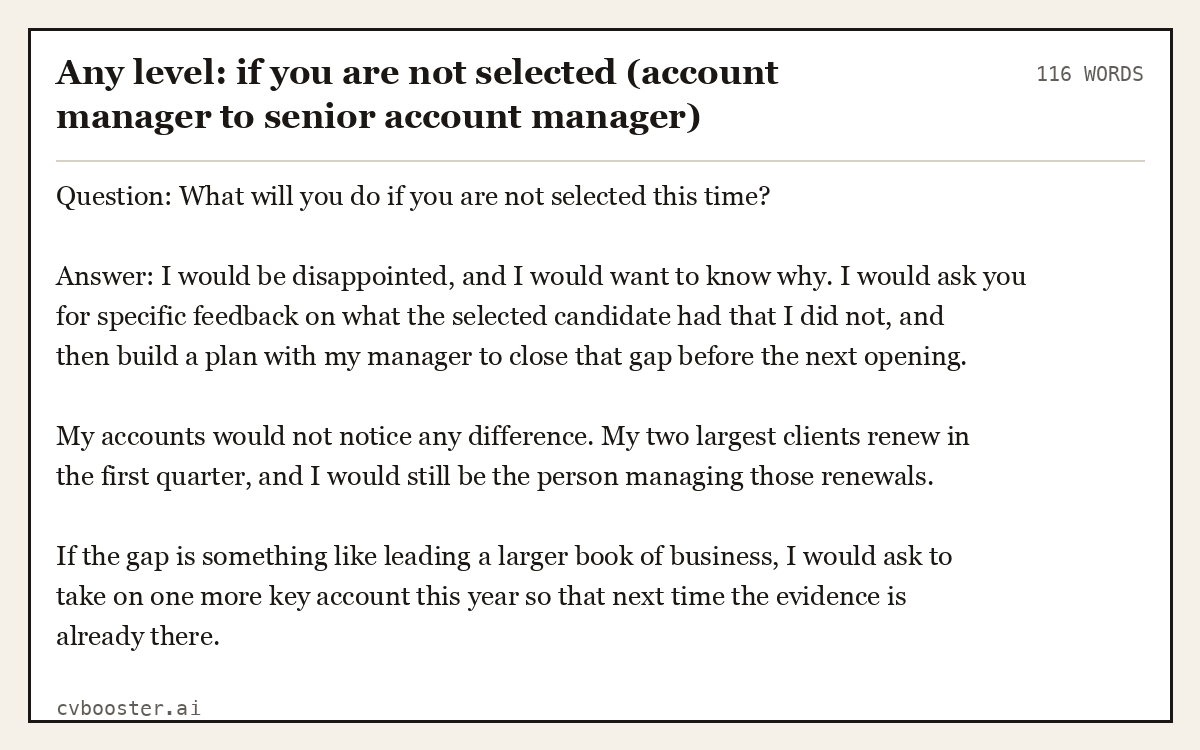
Any level: if you are not selected (account manager to senior account manager) (116 words)
Question: What will you do if you are not selected this time?
Answer: I would be disappointed, and I would want to know why. I would ask you for specific feedback on what the selected candidate had that I did not, and then build a plan with my manager to close that gap before the next opening.
My accounts would not notice any difference. My two largest clients renew in the first quarter, and I would still be the person managing those renewals.
If the gap is something like leading a larger book of business, I would ask to take on one more key account this year so that next time the evidence is already there.
Promotional interview questions in the public sector
Public employers usually call these promotional interview questions. Police, fire and other civil service promotions often run them as an oral board: every candidate hears the same questions, and each answer is scored against a written rating guide. The four groups of questions at the top of this page still apply, with more weight on judgment scenarios. A short example from a sergeant's oral board:
- Question: An officer from your old shift ignores a new procedure that you are now responsible for enforcing. What do you do?
- Answer: I speak to him privately the same day, explain why the procedure exists and what I need from him, and listen for anything that makes it hard to follow. If it happens again, I document it and follow the department's process, the same way I would for anyone on the team. Being his friend does not change the standard; it only changes how early I have the conversation.
How to prepare for a promotion interview
- Ask how the process works. Find out who is on the panel, whether outside candidates are being interviewed, and what the scoring covers.
- Read the job description as if you had never seen the team. Map each requirement to one story from your current role.
- Update your resume anyway. Many panels read the application before the interview, even from a colleague. Our internal resume examples show how to frame a move inside the same company, and the internal cover letter guide covers the letter.
- Practice out loud. CareerOneStop's interview tips advise: "Review common interview questions. Practice answering them with someone else or in front of a mirror."
- Talk to your manager before the interview. Tell them you are applying, so they hear it from you first.
- Follow up. The same CareerOneStop page says: "Don't forget to send a thank-you email or letter after the interview." For an internal panel, a short email the same day is enough.
If the panel is several people from different teams, our panel interview questions page covers how each seat scores you, and our list of questions to ask in an interview gives you good closing questions for the hiring manager.
Frequently asked questions
What questions are asked in a promotion interview, and what are promotional interview questions?
Expect questions on why you want the promotion, why you over an outside candidate, what you have done beyond your current role, how you would manage former peers, what you would change in your first ninety days, a time you led without authority, and what you would do if you were not selected. Public sector employers call the same set promotional interview questions and often score them on a fixed rating guide.
How do I answer "why do you deserve this promotion"?
Avoid the word deserve and answer with evidence. Name two or three things you have already done that belong to the new role, with a result for each, then name one gap honestly and what you are doing about it. Keep it under two minutes and end on what you would do first in the new job.
How do I prepare for an internal interview for a promotion?
Ask who is on the panel and how it is scored, map each line of the job description to a story from your current job, update your resume, and practice your answers out loud. Tell your manager you are applying before the interview, and prepare one question about the team's priorities for the next year.
Should I treat a promotion interview like an external interview?
Yes, with the same preparation, dress and structure. The difference is that the panel already knows your work, so every claim must match what they have seen. Use examples they can check, and do not assume they remember your achievements; name them clearly with results.
What should I not say in a promotion interview?
Do not criticize your current manager or teammates, do not say you have been there long enough to be owed the role, and do not threaten to leave if you are not chosen. Avoid talking mainly about pay or title. Keep the focus on the work you have done and the work you want to do.
Related articles
- Accountancy CV Example: 6 UK Accounts CVs by Career Level
- Accounting Interview Questions and Answers: 7 Full Examples
- Activity Resume Example: 6 Samples for College Applications
- Administration CV Example: 6 Admin CVs from Entry to Senior
More articles
- PSW Resume Example: 7 Samples for Personal Support Workers
- Psychology Resumes Samples: 6 Full Examples by Career Stage
- How to Write Publications in a Resume: 6 Full Examples
Looking for a worked example for your job title? Browse the resume examples by job title.