Short Careers That Pay Well: 8 With Two Years of Training
By Mustafa Tarabya, founder of CVBooster · Published · Updated
9 min read
A short career that pay well is almost always a clinical technologist job, and in September 2026 the best of them pays a median of $105,310 a year after roughly two years of study. The constraint is accreditation, not length: the program has to be an accredited one, because the certification exam will not admit you otherwise, and the exam is what the employer actually checks. O*NET puts all eight occupations below in Job Zone Three, where "Employees in these occupations usually need one or two years of training involving both on-the-job experience and informal training with experienced workers." Every wage is the 2025 median from that occupation's own O*NET page, read on 12 September 2026, and every job gets the CV line that gets the interview. Written by Mustafa Tarabya, who hired for his own company, read every application himself and now writes CVBooster's guides.
The line that gets a two-year graduate hired
New graduates from these programs all look identical on paper. Clinical hours, modality counts and the exam date break the tie.
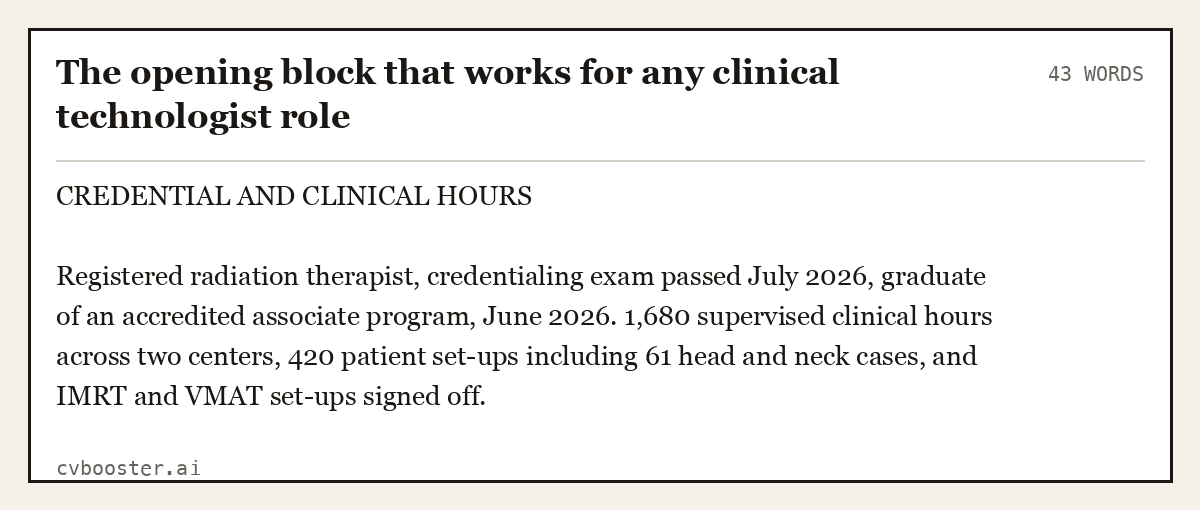
The opening block that works for any clinical technologist role (43 words)
CREDENTIAL AND CLINICAL HOURS
Registered radiation therapist, credentialing exam passed July 2026, graduate of an accredited associate program, June 2026. 1,680 supervised clinical hours across two centers, 420 patient set-ups including 61 head and neck cases, and IMRT and VMAT set-ups signed off.
The eight careers, with the code, the median and the study
| Career | O*NET code | Median wage, 2025 | Typical study | O*NET Job Zone |
|---|---|---|---|---|
| Radiation therapist | 29-1124.00 | $105,310 a year, $50.63 an hour | Two-year accredited program | Three |
| Nuclear medicine technologist | 29-2033.00 | $101,370 a year, $48.74 an hour | Two-year program plus certification | Three |
| Dental hygienist | 29-1292.00 | $98,100 a year, $47.16 an hour | Two-year accredited program, state license | Three |
| Diagnostic medical sonographer | 29-2032.00 | $96,590 a year, $46.44 an hour | Two years, or a one-year certificate after another credential | Three |
| Magnetic resonance imaging technologist | 29-2035.00 | $95,480 a year, $45.91 an hour | Radiography credential plus MRI cross-training | Three |
| Respiratory therapist | 29-1126.00 | $82,280 a year, $39.56 an hour | Two-year accredited program plus board exams | Three |
| Cardiovascular technologist or technician | 29-2031.00 | $74,310 a year, $35.73 an hour | One to two years plus certification | Three |
| Occupational therapy assistant | 31-2011.00 | $72,300 a year, $34.76 an hour | Two-year accredited program plus license | Three |
Job Zone Three is O*NET's own rating, and it describes exactly the trade this article is about: "Most occupations in this zone require training in vocational schools, related on-the-job experience, or an associate's degree."
Radiation therapist: the highest paid two-year credential
The radiation therapist occupation page records a 2025 median of $105,310 a year, or $50.63 an hour, the highest here. Programs are usually two years, entry is competitive, and the work is a fixed daily treatment list in one department rather than a rotating hospital floor.
Hiring managers compare clinical logs. Give set-up counts by site and by technique.
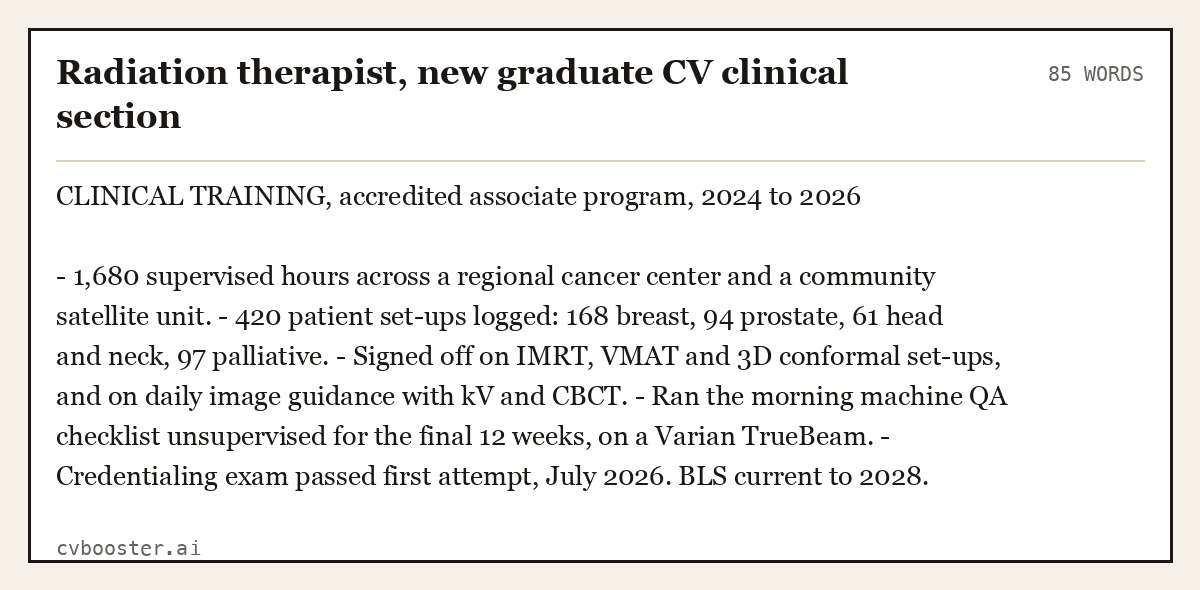
Radiation therapist, new graduate CV clinical section (85 words)
CLINICAL TRAINING, accredited associate program, 2024 to 2026
- 1,680 supervised hours across a regional cancer center and a community satellite unit. - 420 patient set-ups logged: 168 breast, 94 prostate, 61 head and neck, 97 palliative. - Signed off on IMRT, VMAT and 3D conformal set-ups, and on daily image guidance with kV and CBCT. - Ran the morning machine QA checklist unsupervised for the final 12 weeks, on a Varian TrueBeam. - Credentialing exam passed first attempt, July 2026. BLS current to 2028.
Nuclear medicine and MRI: the two technologist ladders
Both pay above $95,000. The nuclear medicine technologist page records $101,370 a year, and the MRI technologist page records $95,480. MRI is usually reached by cross-training after a radiography credential, which makes it the fastest pay rise available to an existing radiographer.
For both, the CV question is volume and safety, in that order.
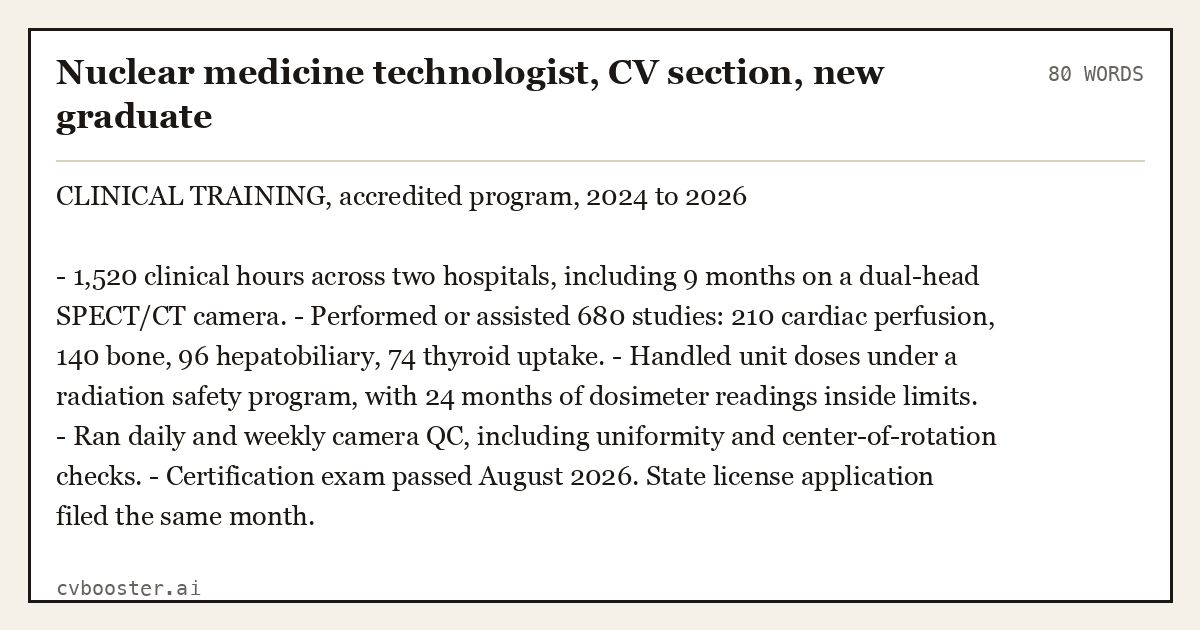
Nuclear medicine technologist, CV section, new graduate (80 words)
CLINICAL TRAINING, accredited program, 2024 to 2026
- 1,520 clinical hours across two hospitals, including 9 months on a dual-head SPECT/CT camera. - Performed or assisted 680 studies: 210 cardiac perfusion, 140 bone, 96 hepatobiliary, 74 thyroid uptake. - Handled unit doses under a radiation safety program, with 24 months of dosimeter readings inside limits. - Ran daily and weekly camera QC, including uniformity and center-of-rotation checks. - Certification exam passed August 2026. State license application filed the same month.
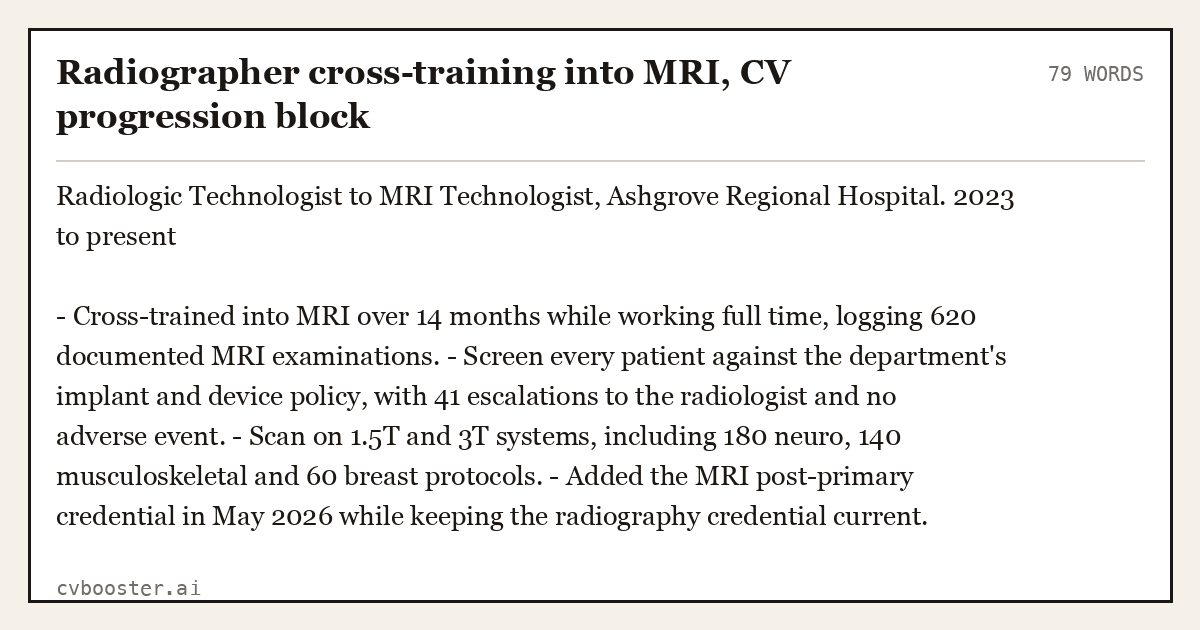
Radiographer cross-training into MRI, CV progression block (79 words)
Radiologic Technologist to MRI Technologist, Ashgrove Regional Hospital. 2023 to present
- Cross-trained into MRI over 14 months while working full time, logging 620 documented MRI examinations. - Screen every patient against the department's implant and device policy, with 41 escalations to the radiologist and no adverse event. - Scan on 1.5T and 3T systems, including 180 neuro, 140 musculoskeletal and 60 breast protocols. - Added the MRI post-primary credential in May 2026 while keeping the radiography credential current.
Dental hygienist: the one with the most predictable week
The dental hygienist page records $98,100 a year, from a two-year accredited program plus a state license. Practices hire on recall list speed and on periodontal charting, and the schedule is the most predictable on this list.
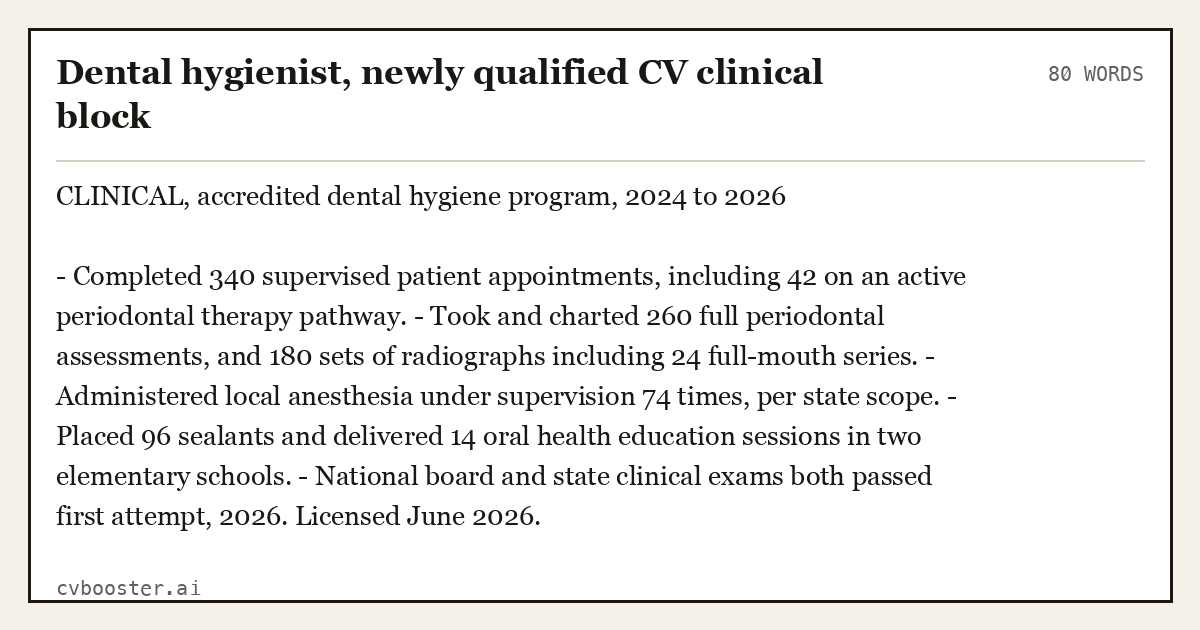
Dental hygienist, newly qualified CV clinical block (80 words)
CLINICAL, accredited dental hygiene program, 2024 to 2026
- Completed 340 supervised patient appointments, including 42 on an active periodontal therapy pathway. - Took and charted 260 full periodontal assessments, and 180 sets of radiographs including 24 full-mouth series. - Administered local anesthesia under supervision 74 times, per state scope. - Placed 96 sealants and delivered 14 oral health education sessions in two elementary schools. - National board and state clinical exams both passed first attempt, 2026. Licensed June 2026.
Sonographer and cardiovascular technologist: the scanning pair
The diagnostic medical sonographer page records $96,590 a year and the cardiovascular technologist page records $74,310. Sonography is the shorter route for anyone who already holds a clinical credential, because a one-year certificate program can be enough.
Both jobs are hired on image quality, which on a CV means specialties and study counts.
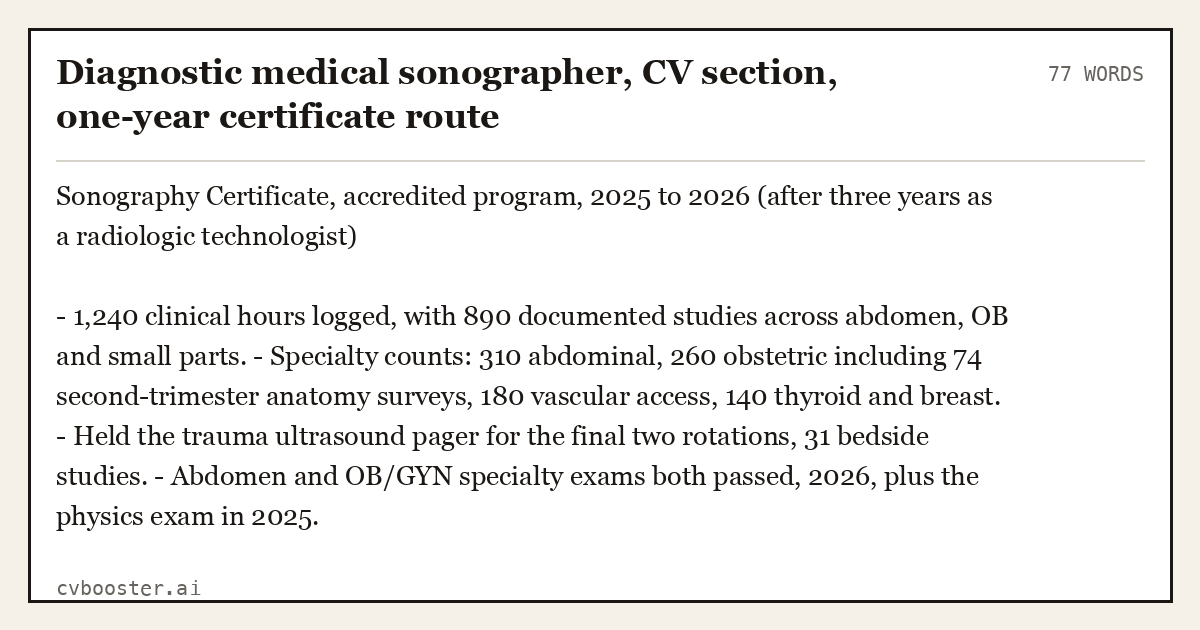
Diagnostic medical sonographer, CV section, one-year certificate route (77 words)
Sonography Certificate, accredited program, 2025 to 2026 (after three years as a radiologic technologist)
- 1,240 clinical hours logged, with 890 documented studies across abdomen, OB and small parts. - Specialty counts: 310 abdominal, 260 obstetric including 74 second-trimester anatomy surveys, 180 vascular access, 140 thyroid and breast. - Held the trauma ultrasound pager for the final two rotations, 31 bedside studies. - Abdomen and OB/GYN specialty exams both passed, 2026, plus the physics exam in 2025.
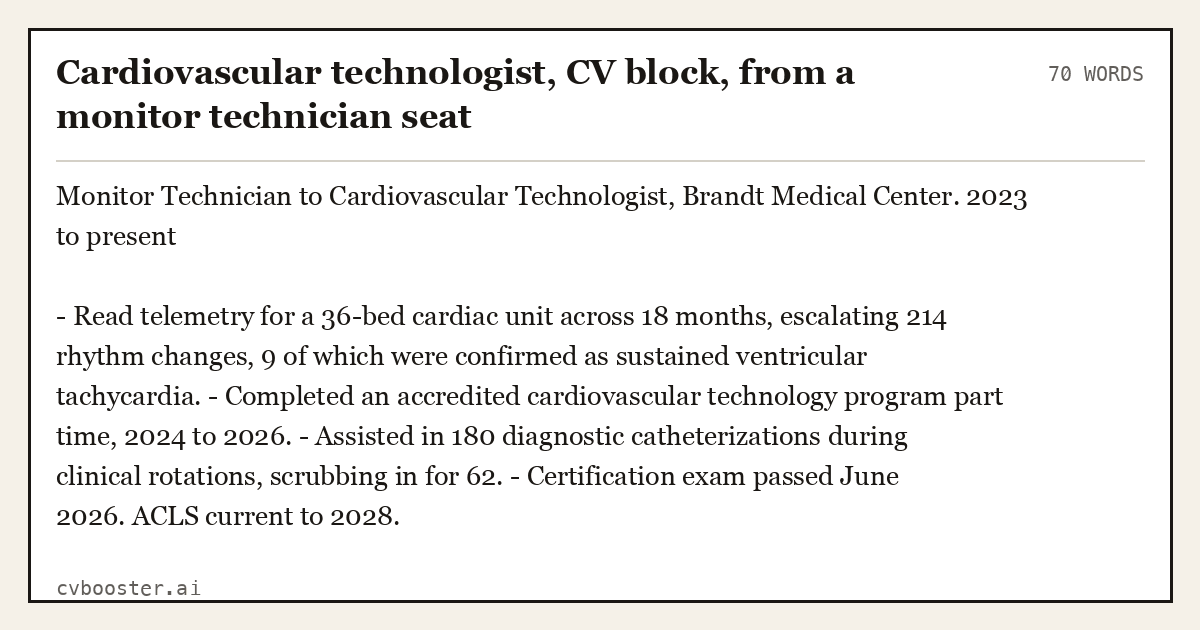
Cardiovascular technologist, CV block, from a monitor technician seat (70 words)
Monitor Technician to Cardiovascular Technologist, Brandt Medical Center. 2023 to present
- Read telemetry for a 36-bed cardiac unit across 18 months, escalating 214 rhythm changes, 9 of which were confirmed as sustained ventricular tachycardia. - Completed an accredited cardiovascular technology program part time, 2024 to 2026. - Assisted in 180 diagnostic catheterizations during clinical rotations, scrubbing in for 62. - Certification exam passed June 2026. ACLS current to 2028.
Respiratory therapist and occupational therapy assistant: the two with the widest employer choice
The respiratory therapist page records $82,280 a year and the occupational therapy assistant page records $72,300. Both come from two-year accredited programs, and both work across hospitals, clinics, schools and home care, which makes them the easiest of the eight to relocate with.
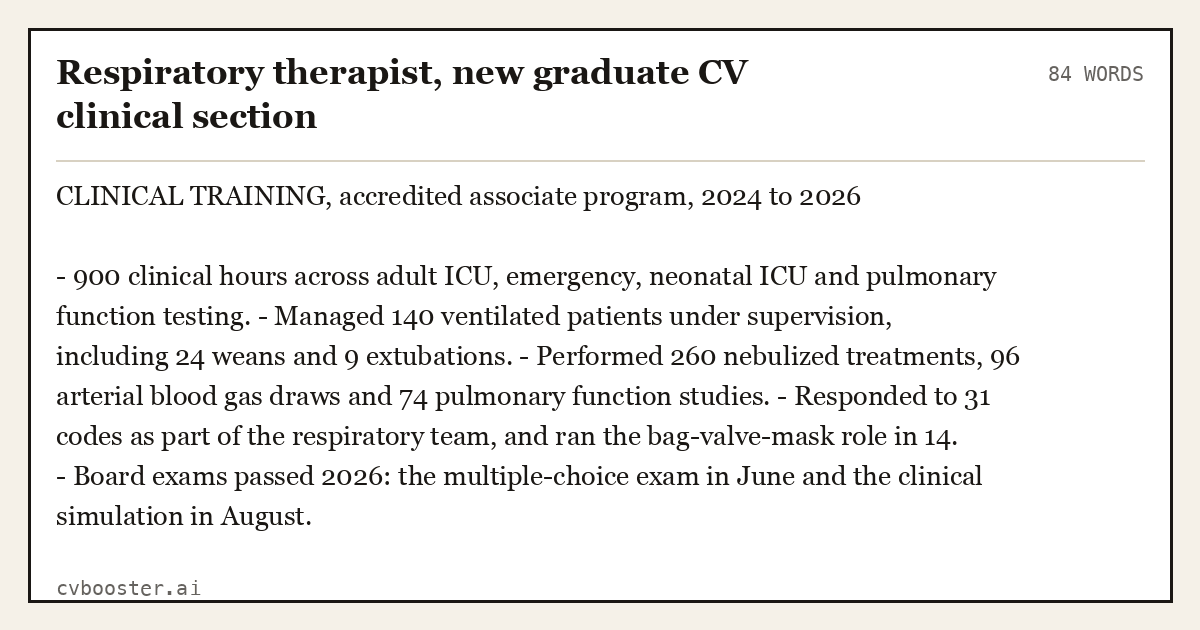
Respiratory therapist, new graduate CV clinical section (84 words)
CLINICAL TRAINING, accredited associate program, 2024 to 2026
- 900 clinical hours across adult ICU, emergency, neonatal ICU and pulmonary function testing. - Managed 140 ventilated patients under supervision, including 24 weans and 9 extubations. - Performed 260 nebulized treatments, 96 arterial blood gas draws and 74 pulmonary function studies. - Responded to 31 codes as part of the respiratory team, and ran the bag-valve-mask role in 14. - Board exams passed 2026: the multiple-choice exam in June and the clinical simulation in August.
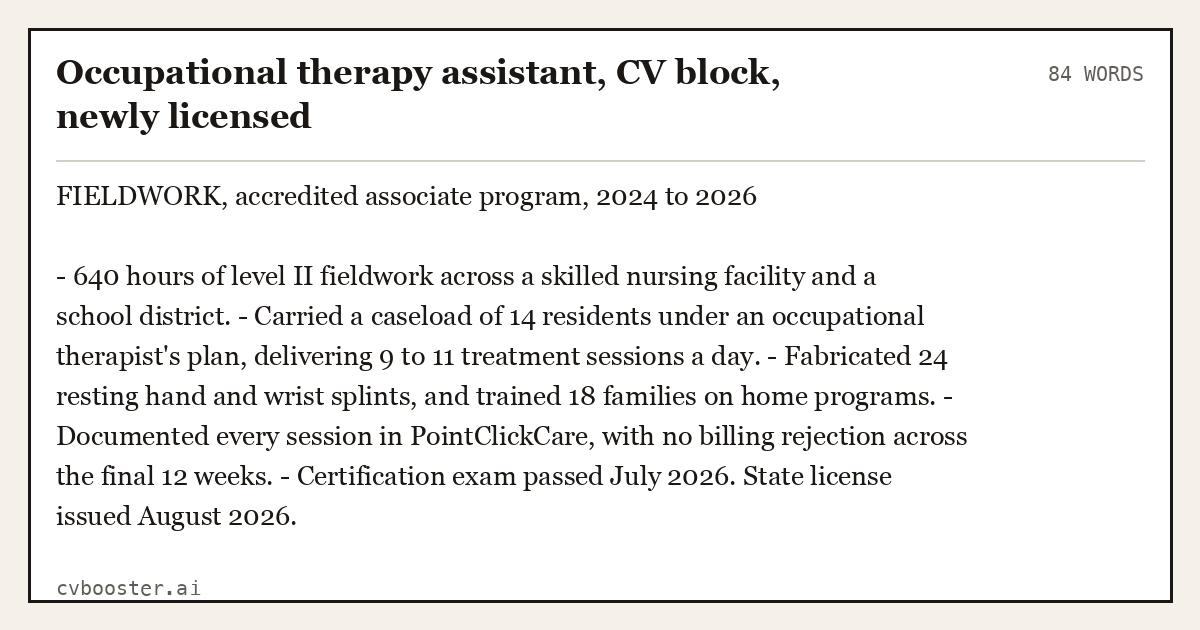
Occupational therapy assistant, CV block, newly licensed (84 words)
FIELDWORK, accredited associate program, 2024 to 2026
- 640 hours of level II fieldwork across a skilled nursing facility and a school district. - Carried a caseload of 14 residents under an occupational therapist's plan, delivering 9 to 11 treatment sessions a day. - Fabricated 24 resting hand and wrist splints, and trained 18 families on home programs. - Documented every session in PointClickCare, with no billing rejection across the final 12 weeks. - Certification exam passed July 2026. State license issued August 2026.
How the pay numbers were checked
- Every figure is the "Median wages (2025)" value printed on that occupation's own O*NET OnLine summary page, read on 12 September 2026. The occupation code is in the table so the same page can be opened and the same number read.
- The study length in the table is what O*NET's Job Zone panel states for these occupations, not an estimate from a college website. All eight sit in Job Zone Three, which O*NET describes as needing "one or two years of training".
- O*NET OnLine is sponsored by the US Department of Labor, Employment and Training Administration. For a state or metro figure rather than a national median, use the Department of Labor's salary finder on CareerOneStop and enter the same occupation.
- None of these numbers is a starting salary. A median is the midpoint of everyone in the occupation, so a first-year technologist will usually sit below it and a senior one above it.
What shortens the route, and what does not
- An existing clinical credential shortens it most. Sonography and MRI both have one-year post-primary routes for people who already hold a radiography or another clinical credential.
- A registered apprenticeship can shorten it too. Health support apprenticeships are published on the Department of Labor's apprenticeship job finder and pay from week one.
- An unaccredited program shortens nothing, because the certification exam is the gate and it checks the accreditation of your program. Confirm the program's accreditation before paying a deposit.
Write the document with how to make a resume, put the credentials where they get read using the resume skills section, and tighten the summary with professional summary examples. For the licensed operating jobs that pay more than any of these, see the best paying non degree jobs.
Frequently asked questions
What is a great job that pays well?
On this list, radiation therapist, at a 2025 O*NET median of $105,310 a year after a two-year accredited program. It also has the most contained working day of the eight, because treatment lists are scheduled in advance in one department rather than driven by admissions.
What a good job that pays well?
One where the credential, not the employer, carries your pay. All eight careers here are gated by a certification exam, which means the qualification travels with you between hospitals, clinics and states, and you can price a move before you make it.
What is a good career that pays well?
A career with a published exam and an accredited two-year route. Radiation therapy, nuclear medicine, dental hygiene, sonography, respiratory care and occupational therapy assistance all work this way, with medians between $72,300 and $105,310 on their O*NET pages.
What are jobs that pay alot?
At the top of this list, radiation therapist at $105,310, nuclear medicine technologist at $101,370 and dental hygienist at $98,100. All three are Job Zone Three occupations, meaning O*NET records one or two years of training rather than a four-year degree.
What are good careers that pay well?
Careers where a second short credential raises pay again. A radiographer who cross-trains into MRI moves towards the $95,480 median, and a technologist who adds a sonography specialty moves towards $96,590, in both cases with about a year of part-time study.
What are some good jobs that pay well?
Eight are listed above with their occupation codes. To test any other candidate job the same way, open its O*NET page, read the 2025 median and the Job Zone together, and reject anything in Job Zone Four or Five if two years is your limit.
More in this series: Jobs that pay well without a degree
- Best Paying Non Degree Jobs in the US: 8 With CV Lines
- High Paying Low Stress Jobs in the UK: 10 With CV Lines
- Highest Paying Jobs in Fashion: 8 Salaries and CV Lines
- Less Stress Jobs That Pay Well in the UK: 8 With CV Lines
- Well Paid Trades in Australia: 12 Ranked by Real Pay
Related articles
- Best Paying Non Degree Jobs in the US: 8 With CV Lines
- High Paying Low Stress Jobs in the UK: 10 With CV Lines
- Highest Paying Jobs in Fashion: 8 Salaries and CV Lines
- Less Stress Jobs That Pay Well in the UK: 8 With CV Lines
More articles
- Short Cover Letter Examples: Get Hired With Less
- Skills to Put on a Job Application Form
- Skills to Put on a Resume (and What to Cut)
Looking for a worked example for your job title? Browse the resume examples by job title.