Signs Your Interview Went Bad, and What to Send Next
By Mustafa Tarabya, founder of CVBooster · Published · Updated
8 min read
The real signs your interview went bad are about the interviewer's behavior, not your nerves: the meeting ended well before its scheduled time, nobody explained the next steps, they stopped asking follow-up questions, and they never tried to sell you the job. One of those alone means little. Three together is a pattern. The one constraint is that you cannot read a single interviewer's face with any accuracy, so judge the whole meeting and then act anyway. CareerOneStop, the Department of Labor's career site, says to send a thank-you note "even if the interview didn't go well," and this page gives you six to copy. Written by Mustafa Tarabya, who hired for his own company, read every application himself and now writes CVBooster's guides.
You are replaying the moment you said "I think my biggest weakness is caring too much" for the ninth time in the parking lot. Stop. Here is what actually counts.
The follow-up email that recovers a weak answer
Start with the fix, because it is the part you control. CareerOneStop's follow-up guidance says to "Briefly include anything you forgot, or wish you had said in the interview." That is your second chance at the answer you fumbled.
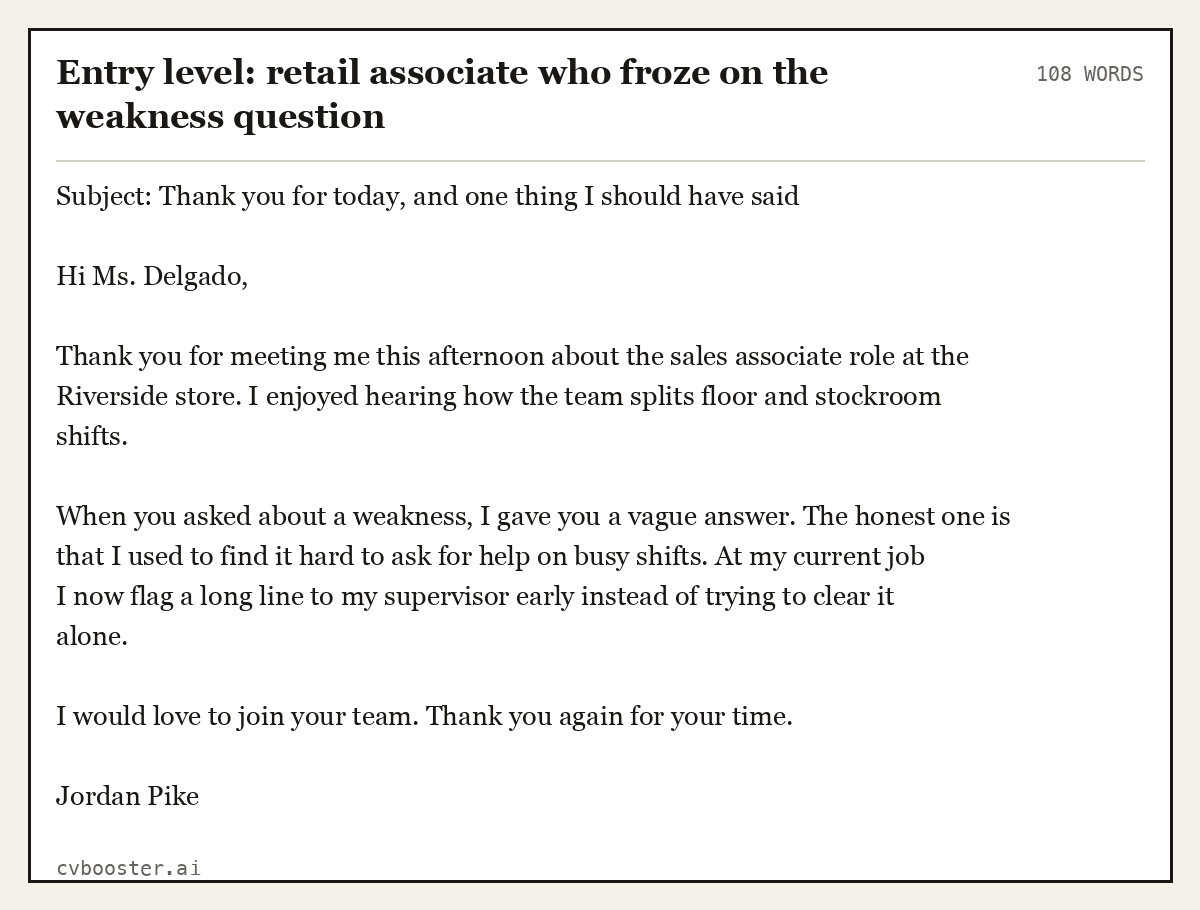
Entry level: retail associate who froze on the weakness question (108 words)
Subject: Thank you for today, and one thing I should have said
Hi Ms. Delgado,
Thank you for meeting me this afternoon about the sales associate role at the Riverside store. I enjoyed hearing how the team splits floor and stockroom shifts.
When you asked about a weakness, I gave you a vague answer. The honest one is that I used to find it hard to ask for help on busy shifts. At my current job I now flag a long line to my supervisor early instead of trying to clear it alone.
I would love to join your team. Thank you again for your time.
Jordan Pike
Signs your interview went bad that actually mean something
These are the clues worth taking seriously, roughly in order of how much they tell you:
- It ended far earlier than scheduled. A 45 minute slot that wraps up in 15 often means the interviewer heard enough to decide. It can also mean they were simply efficient, so check it against the others below.
- No next steps. A good interview usually ends with a timeline: who you meet next, when they decide. A bad one ends with "we will be in touch."
- They stopped following up. Interested interviewers dig into your answers. If every answer got a nod and the next scripted question, they may have stopped evaluating.
- They never sold the job. When someone wants you, they talk about the team, the perks and why people stay. If you heard none of that, they may not have been trying.
- Questions kept circling one gap. Three questions about the same missing skill means that gap is the concern. Address it in your follow-up.
- You did not meet anyone else. If the plan was to meet the team and that quietly did not happen, that is a signal.
- They mentioned how many strong candidates there are. Sometimes that is just honesty. Sometimes it is softening a no.
Signs that feel bad but usually mean nothing
Plenty of interviews feel terrible and turn into offers. These are the false alarms:
- A poker face. Many interviewers stay neutral on purpose, especially in structured interviews where everyone gets the same questions.
- Note taking instead of eye contact. They are writing your answers down so they can compare candidates fairly.
- A hard question you could not answer. Interviewers often push until they find the edge of what you know. Reaching it is the point.
- A short interview for a junior role. Entry level screens are often brief by design.
When I interviewed for my own company, some of the shortest conversations were the easiest yes decisions, because the person answered the advert point by point and there was nothing left to ask.
Interview went bad because of nerves? A note after you blanked
CareerOneStop's interview tips advise that you "Restate any strengths and experiences that you might not have emphasized earlier." If nerves wiped your best example, put it in writing.
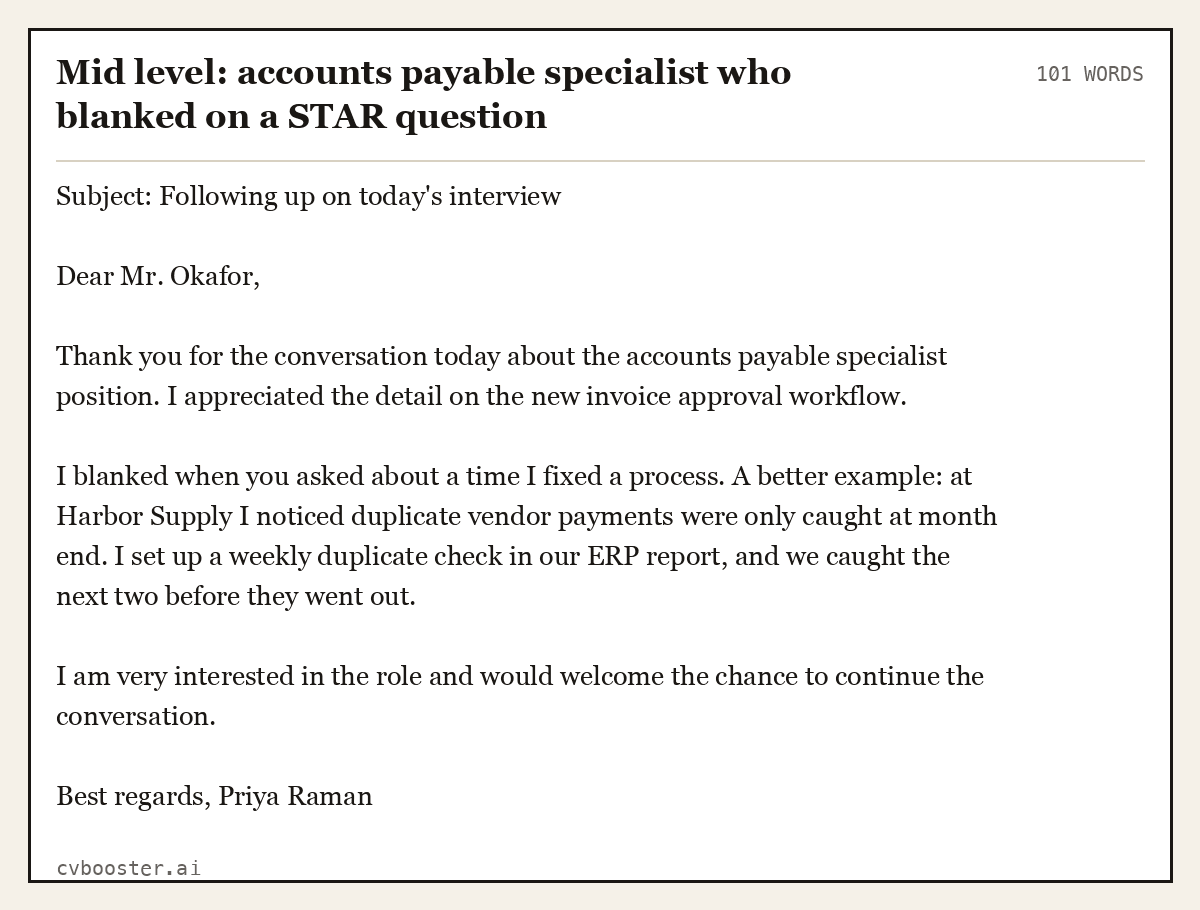
Mid level: accounts payable specialist who blanked on a STAR question (101 words)
Subject: Following up on today's interview
Dear Mr. Okafor,
Thank you for the conversation today about the accounts payable specialist position. I appreciated the detail on the new invoice approval workflow.
I blanked when you asked about a time I fixed a process. A better example: at Harbor Supply I noticed duplicate vendor payments were only caught at month end. I set up a weekly duplicate check in our ERP report, and we caught the next two before they went out.
I am very interested in the role and would welcome the chance to continue the conversation.
Best regards, Priya Raman
A follow-up after a panel interview that felt cold
Send each panel member their own note or one note to the chair. CareerOneStop's thank-you note guidance says to "Send a separate thank-you note to each person you interviewed with, or send a single thank-you to a key person for distribution."
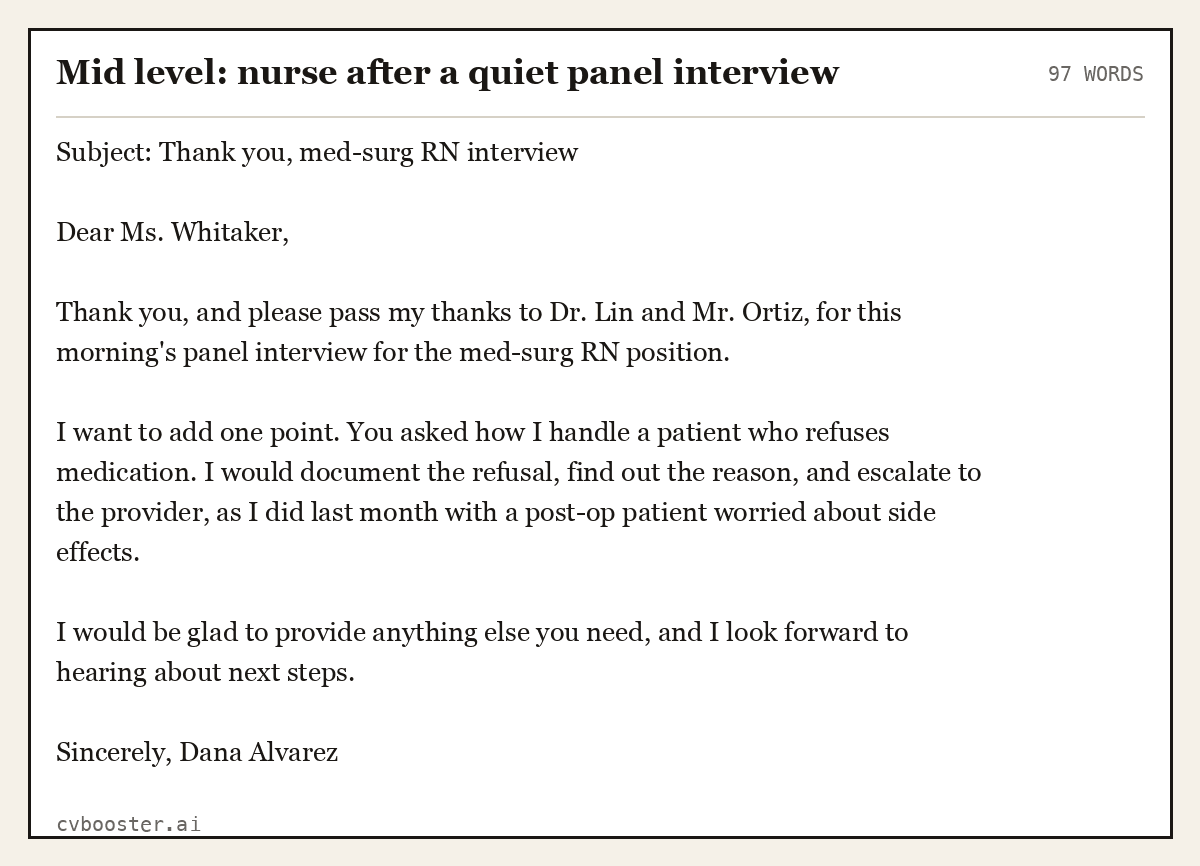
Mid level: nurse after a quiet panel interview (97 words)
Subject: Thank you, med-surg RN interview
Dear Ms. Whitaker,
Thank you, and please pass my thanks to Dr. Lin and Mr. Ortiz, for this morning's panel interview for the med-surg RN position.
I want to add one point. You asked how I handle a patient who refuses medication. I would document the refusal, find out the reason, and escalate to the provider, as I did last month with a post-op patient worried about side effects.
I would be glad to provide anything else you need, and I look forward to hearing about next steps.
Sincerely, Dana Alvarez
When the interview ended early with no next steps
If they did not give you a timeline, ask for one politely. The same CareerOneStop tips say to "Indicate a time when you may contact the employer to learn of the decision."
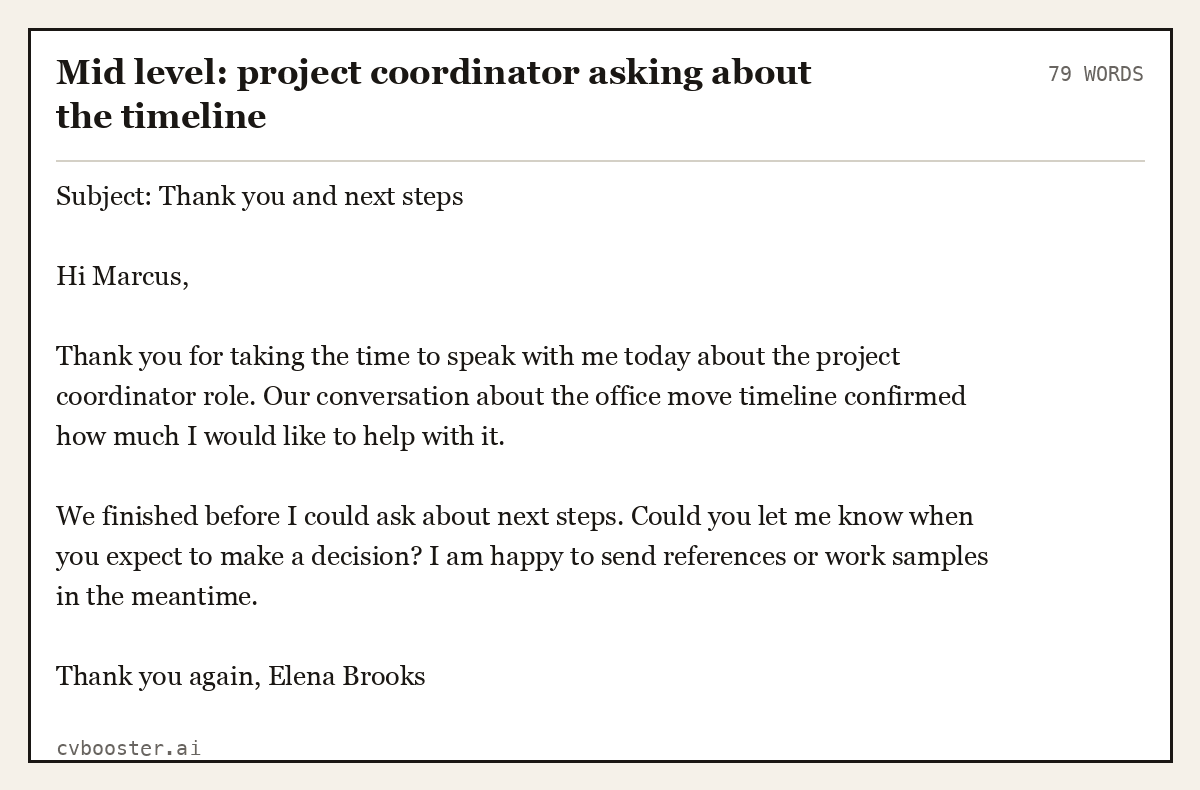
Mid level: project coordinator asking about the timeline (79 words)
Subject: Thank you and next steps
Hi Marcus,
Thank you for taking the time to speak with me today about the project coordinator role. Our conversation about the office move timeline confirmed how much I would like to help with it.
We finished before I could ask about next steps. Could you let me know when you expect to make a decision? I am happy to send references or work samples in the meantime.
Thank you again, Elena Brooks
A senior candidate addressing the concern head on
At senior level, a bad interview usually means one concern took over. Name it and answer it.
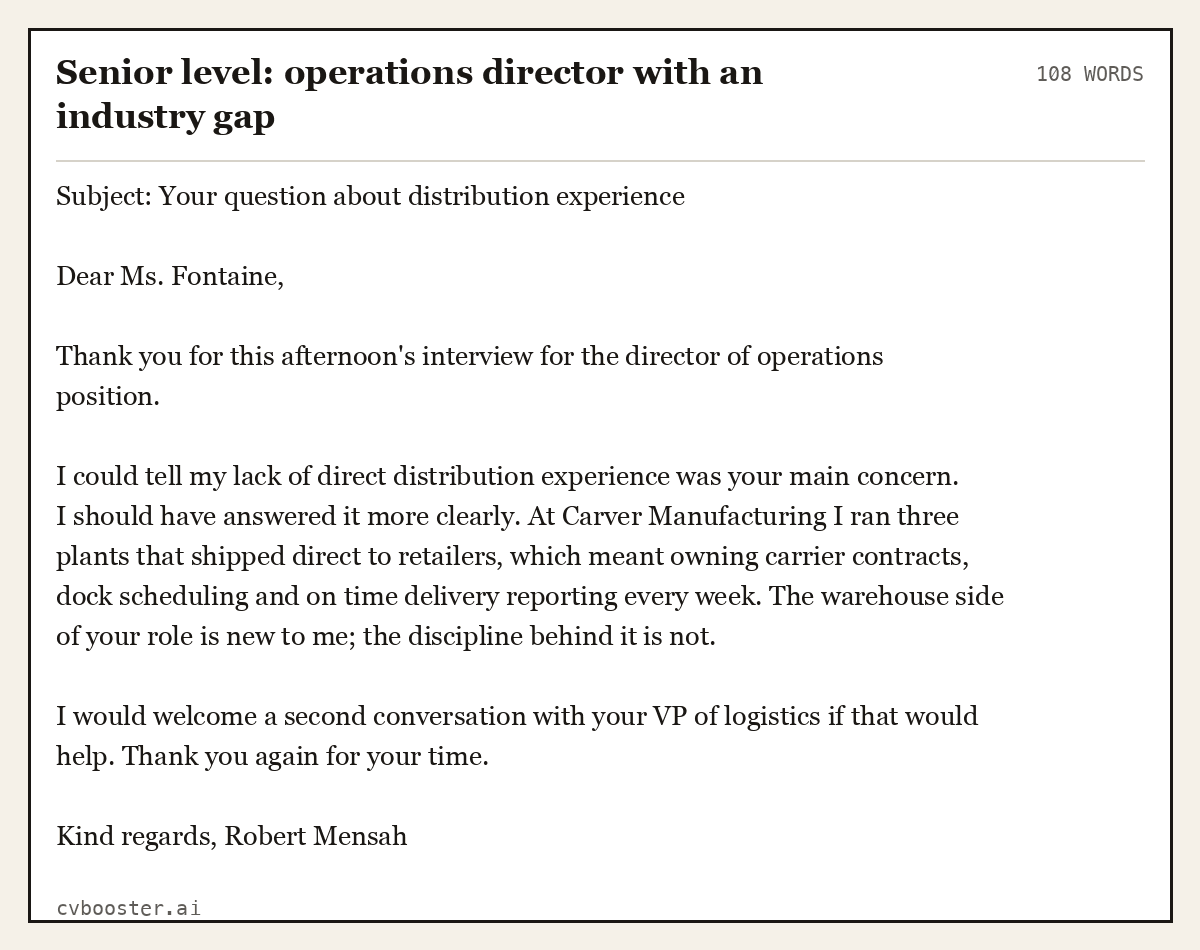
Senior level: operations director with an industry gap (108 words)
Subject: Your question about distribution experience
Dear Ms. Fontaine,
Thank you for this afternoon's interview for the director of operations position.
I could tell my lack of direct distribution experience was your main concern. I should have answered it more clearly. At Carver Manufacturing I ran three plants that shipped direct to retailers, which meant owning carrier contracts, dock scheduling and on time delivery reporting every week. The warehouse side of your role is new to me; the discipline behind it is not.
I would welcome a second conversation with your VP of logistics if that would help. Thank you again for your time.
Kind regards, Robert Mensah
When a bad interview means a bad employer
Sometimes the interview went badly because of them. The EEOC notes on pre-employment inquiries that questions which "may indicate the applicant's race, sex, national origin, disability status, age, religion, color or ancestry if answered, should generally be avoided." If you were asked about your age, children, religion or health, that tells you something about the employer, and you can still decline the role politely.
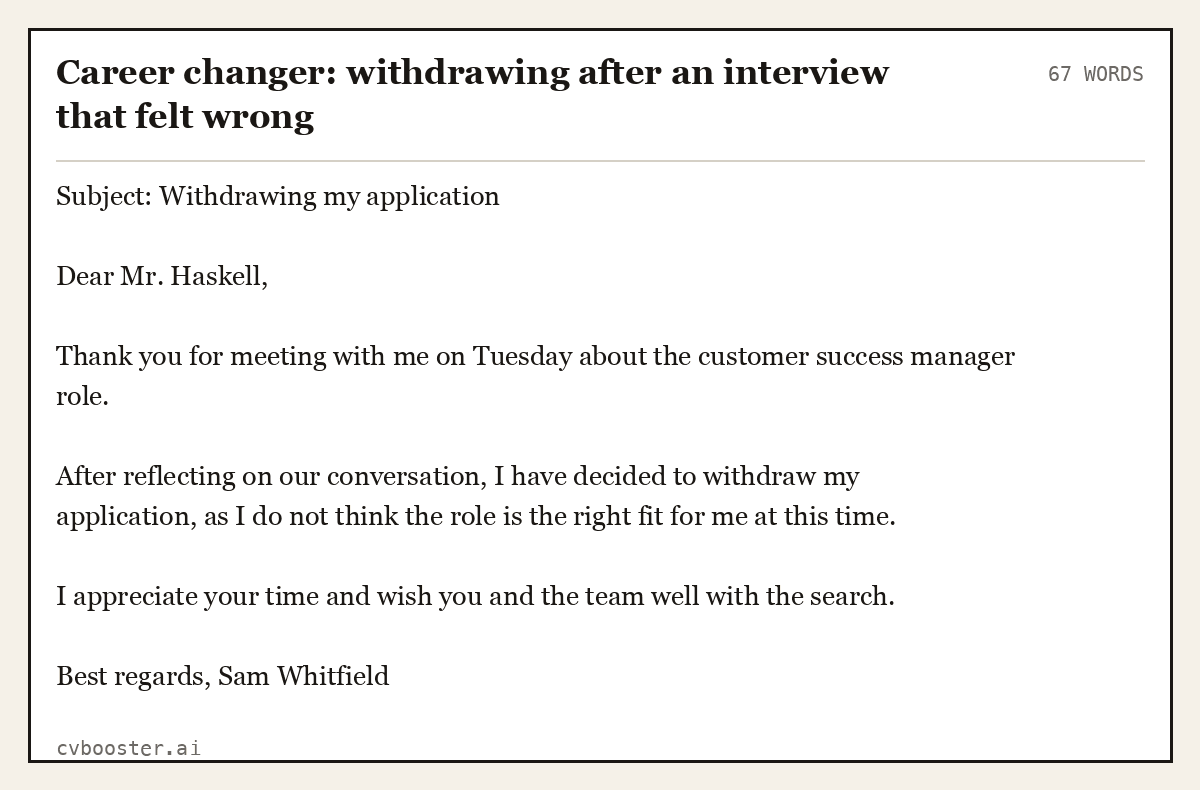
Career changer: withdrawing after an interview that felt wrong (67 words)
Subject: Withdrawing my application
Dear Mr. Haskell,
Thank you for meeting with me on Tuesday about the customer success manager role.
After reflecting on our conversation, I have decided to withdraw my application, as I do not think the role is the right fit for me at this time.
I appreciate your time and wish you and the team well with the search.
Best regards, Sam Whitfield
What to do in the 24 hours after a bad interview
- Write down what happened. CareerOneStop suggests you "take some time to evaluate your responses and make notes for future interviews."
- Send the note the same day. Keep it short, fix one answer at most, and do not apologize for the whole interview.
- Keep applying. One interview is one data point. Line up the next one.
- Prepare better questions. If the end of the interview fell flat, our list of questions to ask in an interview gives you strong closers.
- Practice the odd ones. If an unexpected question threw you, run through these creative interview questions before the next round.
For more templates, see the full thank you letter guide, and the job interview tips timeline covers the whole process from preparation to follow-up.
Frequently asked questions
How do you know if an interview went badly?
Look for a pattern rather than one moment: the interview ended much earlier than planned, there was no talk of next steps, the interviewer stopped asking follow-up questions and never described why people like working there. If three or more of those happened, it probably did not go well. A neutral face alone means nothing.
Is a short interview a bad sign?
Not always. A short interview can mean the interviewer decided quickly in either direction, or that it was a brief screening call by design. Judge it together with the other signs. If they explained next steps and asked about your availability, a short interview may still be a good one.
Should I send a thank-you note after a bad interview?
Yes. CareerOneStop says to write the note no later than 24 hours after the interview, even if it did not go well. A short, specific note that fixes one weak answer can change how the interviewer remembers you, and it never hurts your chances.
Can you still get the job after a bad interview?
Yes. Candidates often judge their own interviews more harshly than the interviewer did, and the decision depends on how you compare with the other applicants. Send a follow-up, add the example you missed, and keep applying elsewhere while you wait for an answer.
How long should I wait to hear back after a bad interview?
Wait until the date they gave you, then send one polite check-in. If they gave no date, a week to ten days after your thank-you note is reasonable. After one follow-up with no reply, move your energy to other applications rather than writing again.
Related articles
- Case Manager Interview Questions: 7 Answers That Score
- Creative Interview Questions With 6 Sample Answers
- ED Nurse Interview Questions With 9 Full Sample Answers
- Female Job Interview Attire: Six UK Outfits by Job Type
More articles
- Situational Interview Questions: 8 Full Sample Answers
- Sixth Form Personal Statement Examples: 6 Full Samples
- Skills Based CV Template and Format: 6 UK Examples
Looking for a worked example for your job title? Browse the resume examples by job title.