Strong Synonym for Resume: 30 Better Words With Examples
By Mustafa Tarabya, founder of CVBooster · Published · Updated
7 min read
The best strong synonyms for a resume are skilled, proficient, advanced, solid, dependable and decisive, chosen by what you mean rather than by which one sounds biggest. The one constraint: "strong" is a grade you give yourself, so the replacement has to be a fact the reader can check. The Cambridge Dictionary defines the word as "having or using great force or control", which is a lot of weight for a resume line to carry on its own. Below are 30 alternatives in six groups, seven before and after lines from entry level to senior, and the cases where "strong" is fine. Written by Mustafa Tarabya, who hired for his own company, read every application himself and now writes CVBooster's guides.
Every applicant has "strong communication skills". Nobody has average ones. A word everybody claims has stopped telling the reader anything.
One line, fixed before you read further
Here is the usual problem. A mid-level office manager has real skills and hides them behind the one adjective all the other applicants chose too.
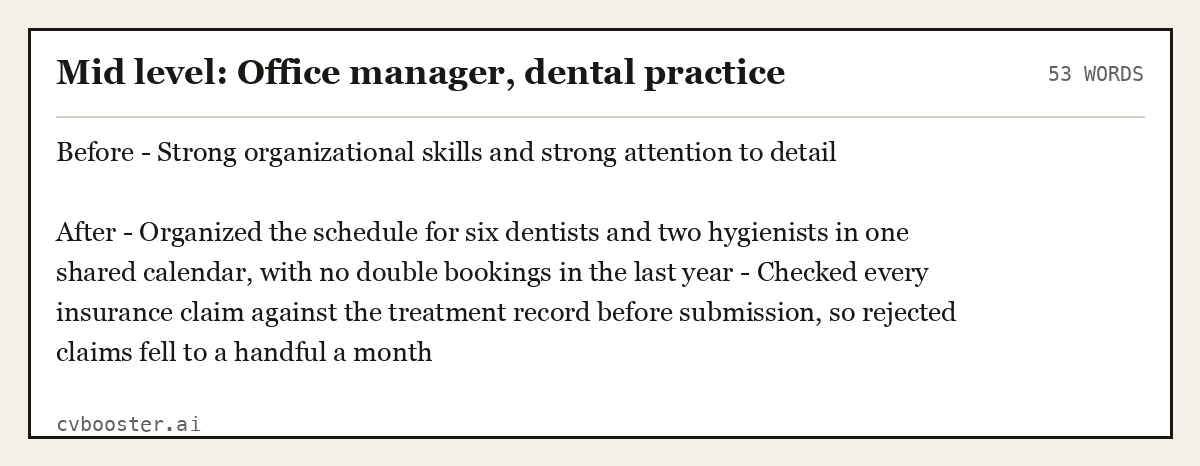
Mid level: Office manager, dental practice (53 words)
Before - Strong organizational skills and strong attention to detail
After - Organized the schedule for six dentists and two hygienists in one shared calendar, with no double bookings in the last year - Checked every insurance claim against the treatment record before submission, so rejected claims fell to a handful a month
The after version has no adjective at all. The reader cannot see "strong" in it and does not miss it, because the work does the describing.
Create my CV
Or start from one of our free resume templates
30 strong synonyms, grouped by what you mean
"Strong" covers at least six different claims. Pick the group first, then the word.
- You are good at a skill: skilled, proficient, advanced, experienced, fluent, adept
- Your knowledge is deep: solid, thorough, extensive, in-depth, working, expert
- You do it every time: consistent, dependable, reliable, steady, disciplined
- You make the call: decisive, confident, assertive, firm, determined
- You can take pressure: resilient, steady, composed, durable, tough-minded
- You get results: high-performing, effective, productive, proven, successful
Two of those groups are the ones people mean most often. "Strong background in" usually means solid or extensive, and "strong work ethic" usually means dependable or consistent. If you can finish the sentence "I know this because..." the word is allowed to stay. If you cannot, it should go.
Harvard's guide to a strong resume lists resume language that should be "Specific rather than general". That is the whole test for this page: every replacement below is more specific than the word it replaces.
Before and after, one rewrite per group
Each pair keeps the same job and the same facts. Only the word and the detail change.
Proficient and advanced: a skill with a level
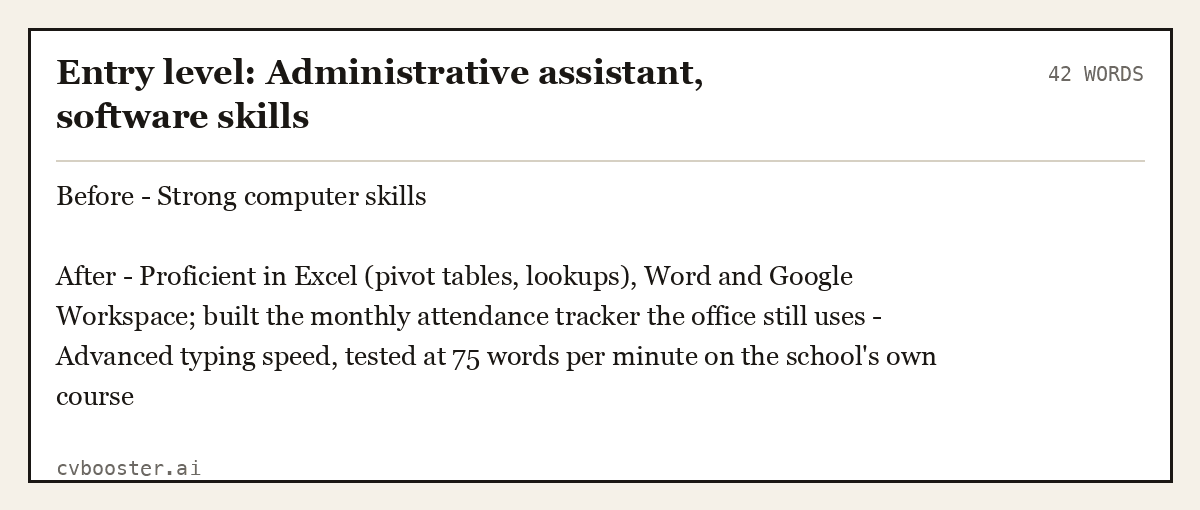
Entry level: Administrative assistant, software skills (42 words)
Before - Strong computer skills
After - Proficient in Excel (pivot tables, lookups), Word and Google Workspace; built the monthly attendance tracker the office still uses - Advanced typing speed, tested at 75 words per minute on the school's own course
Solid and thorough: knowledge with depth
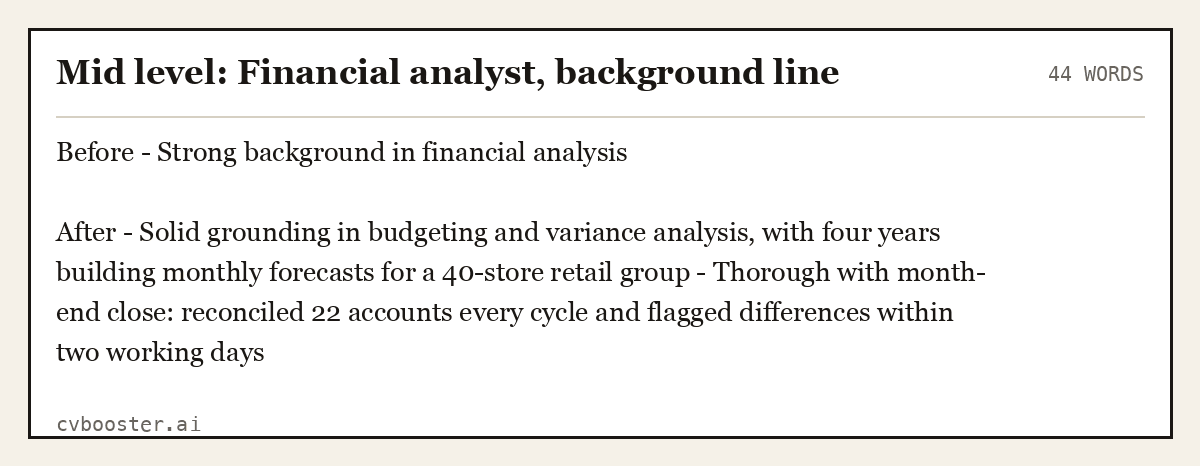
Mid level: Financial analyst, background line (44 words)
Before - Strong background in financial analysis
After - Solid grounding in budgeting and variance analysis, with four years building monthly forecasts for a 40-store retail group - Thorough with month-end close: reconciled 22 accounts every cycle and flagged differences within two working days
Dependable and consistent: you do it every time
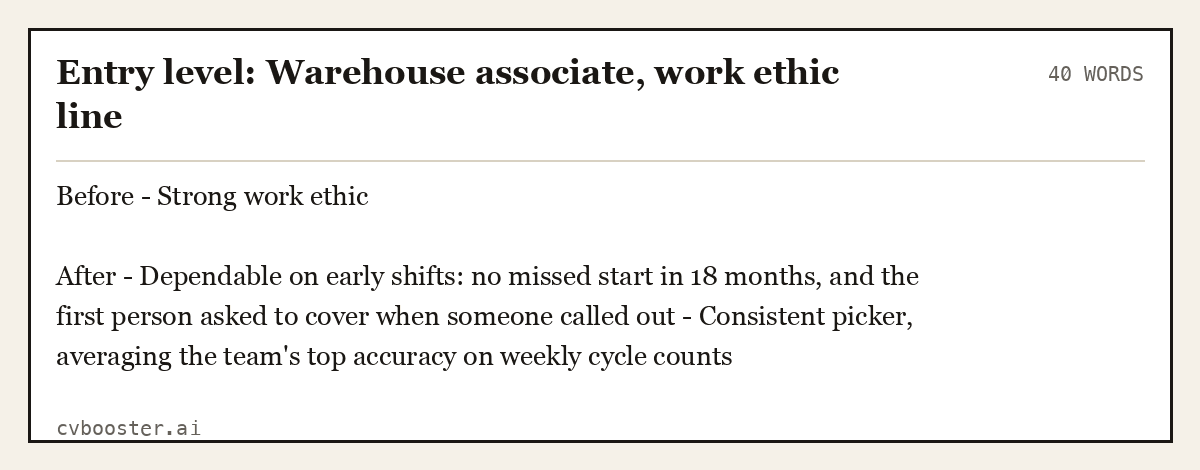
Entry level: Warehouse associate, work ethic line (40 words)
Before - Strong work ethic
After - Dependable on early shifts: no missed start in 18 months, and the first person asked to cover when someone called out - Consistent picker, averaging the team's top accuracy on weekly cycle counts
Decisive: you make the call
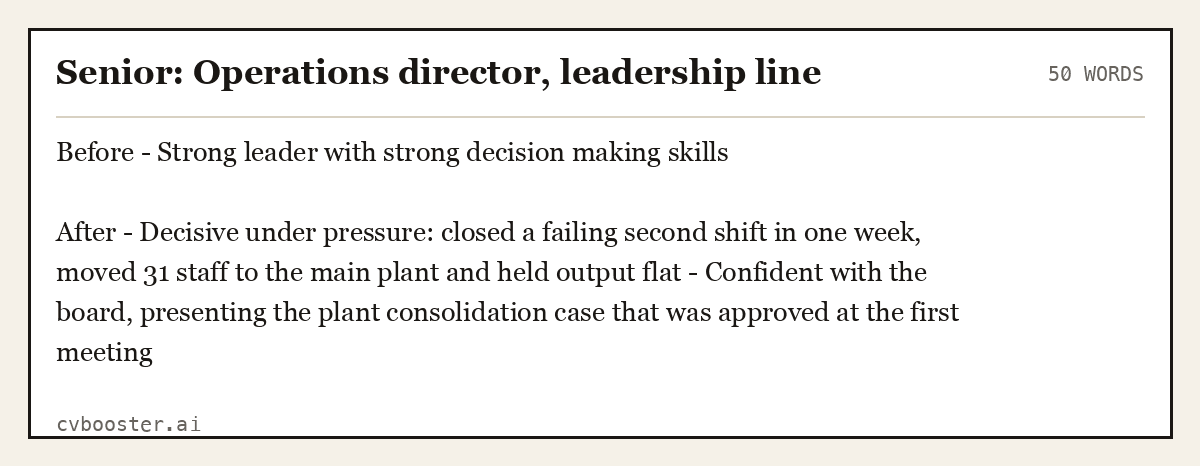
Senior: Operations director, leadership line (50 words)
Before - Strong leader with strong decision making skills
After - Decisive under pressure: closed a failing second shift in one week, moved 31 staff to the main plant and held output flat - Confident with the board, presenting the plant consolidation case that was approved at the first meeting
Resilient and composed: pressure
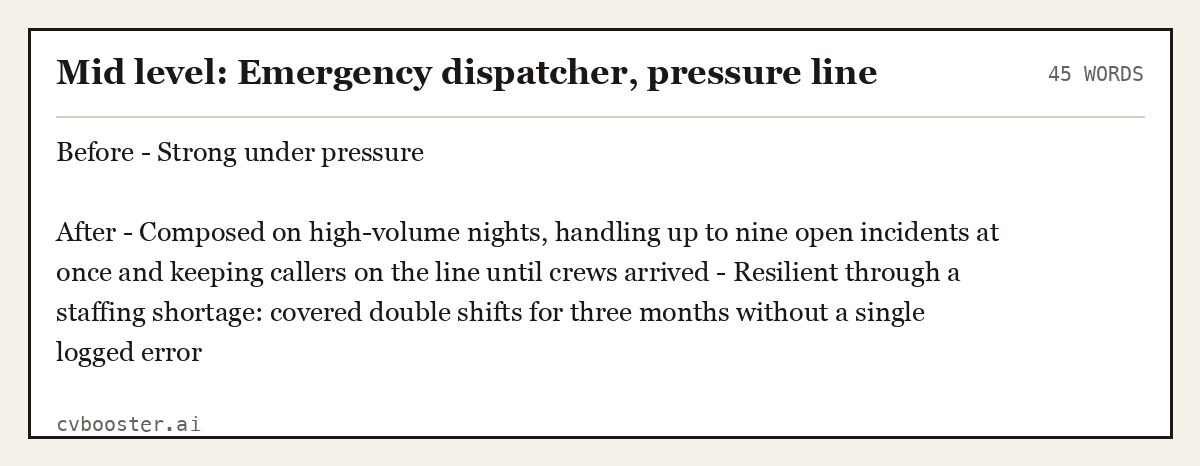
Mid level: Emergency dispatcher, pressure line (45 words)
Before - Strong under pressure
After - Composed on high-volume nights, handling up to nine open incidents at once and keeping callers on the line until crews arrived - Resilient through a staffing shortage: covered double shifts for three months without a single logged error
The same word at entry, mid and senior level
"Strong" should rise with the job, and the better word rises with it. One skill, project management, written at three levels:
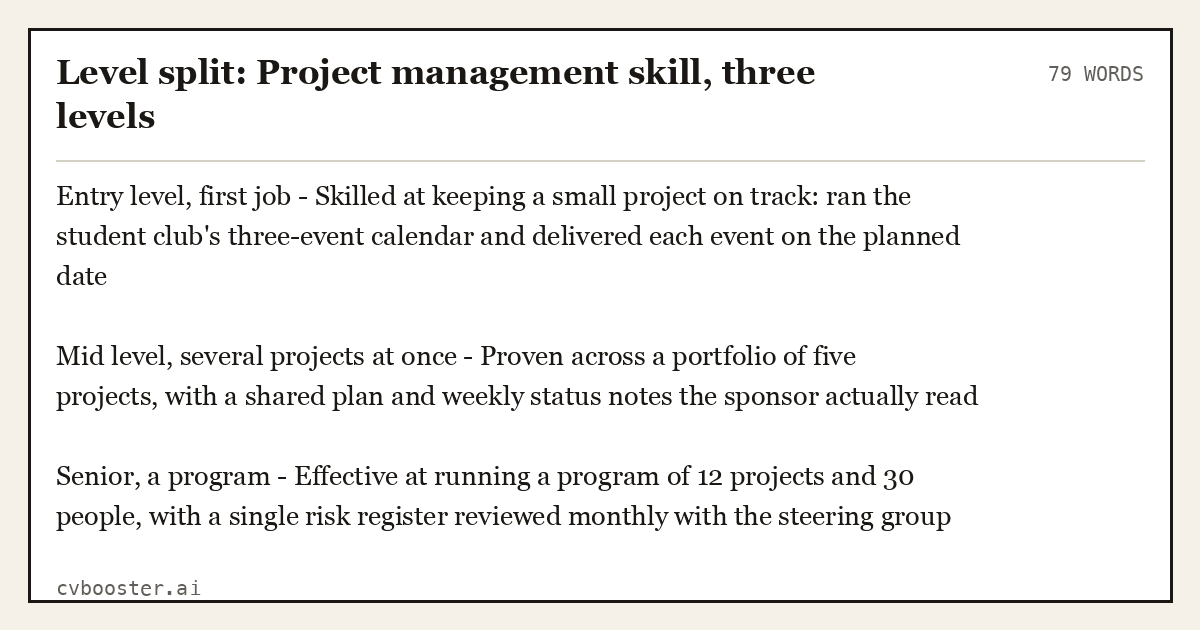
Level split: Project management skill, three levels (79 words)
Entry level, first job - Skilled at keeping a small project on track: ran the student club's three-event calendar and delivered each event on the planned date
Mid level, several projects at once - Proven across a portfolio of five projects, with a shared plan and weekly status notes the sponsor actually read
Senior, a program - Effective at running a program of 12 projects and 30 people, with a single risk register reviewed monthly with the steering group
Skilled, proven, effective. The adjective got more demanding as the job did, and each one is backed by a number or a document.
Why "strong" costs you the interview
MIT's career office tells students to "Record accomplishments and contributions, not just responsibilities" in its resume guide. "Strong" is a responsibility-level word. It describes the person, not the work. An applicant tracking system will not rank it, and a human reader has seen it four hundred times.
There is one more problem. "Strong" is relative. Stronger than whom? A reader fills the gap with their own doubt, and doubt is not what you want to leave behind.
For other worn-out verbs, see our page on resume synonyms, and for a long list of verbs by theme, our resume action verbs guide. If the problem is a word in the skills section, the resume skills page shows how to list them.
When to keep the word strong
Sometimes "strong" is the accurate word, and accurate beats clever. Keep it in these cases:
- The job ad uses it. If the posting asks for "strong written communication", use the phrase once for the keyword match, then prove it in a bullet. Our page on ATS keywords in real job ads shows how exact wording gets read.
- It is a physical fact. Strong grip, strong swimmer or strong lifter are real requirements in trades, lifeguarding and warehouse work. Say what you can lift or how far you can swim.
- A recognised rating uses it. "Strong Interest Inventory" and similar named tools are titles, not adjectives.
- A reference said it. "Described by my supervisor as a strong closer" is a quote you can attach to a name if asked.
Words that sound stronger and are not
A thesaurus returns everything that shares a meaning, not everything that fits a resume. These come up and should stay out:
- Robust, formidable, mighty: engineering and military words that sound odd for a person.
- Powerful: it suggests force, not skill.
- Rock-solid: a cliche, and it invites a joke from the interviewer.
- Passionate: a feeling, not a skill; our passionate synonym page has better options.
- Superb, outstanding, excellent: self-grades that carry the same problem as "strong".
Frequently asked questions
What is a better word than strong on a resume?
It depends on what you mean. For a skill, use skilled, proficient or advanced. For knowledge, use solid or thorough. For reliability, use dependable or consistent. For leadership, use decisive. Then add the proof: the number, the system, the result or the length of time that makes the word believable.
What can I say instead of strong communication skills?
Replace the label with what you did. "Wrote the weekly client update for 14 accounts and presented it by phone every Monday" shows communication without naming it. If the posting uses the phrase, keep it once in the skills section and put the proof in your experience bullets.
Is strong a weak word on a resume?
It is weak when it stands alone, because everyone uses it and nobody can check it. It becomes useful when it repeats the posting's own wording and a bullet backs it up. Harvard's career office asks for language that is specific rather than general, and "strong" is general by nature.
What is a synonym for strong work ethic?
Dependable, diligent, consistent and reliable all fit. Use the one that matches a fact you can prove, such as full attendance for a year, early starts, or being the person asked to cover shifts. A work ethic is shown by what you did on a day nobody was watching.
More on resume synonyms
- Another Word for Established: Resume Verbs and Examples
- Collaborated Synonym: Teamwork Verbs for Resume Bullets
- Contribute Synonym: 30 Stronger Resume Words With Examples
- Excited Synonym for Professional Emails and Cover Letters
- Experienced Synonym: Resume Words That Prove the Years
- Implemented Synonym: Resume Verbs by What You Actually Did
- Maintain Synonym for Resume: 30 Specific Verbs With Examples
- Motivated Synonym: Stronger Words and 6 Resume Rewrites
- Oversaw Synonyms: Resume Verbs for People, Budgets, Projects
- Participate Synonym for Resume: 26 Verbs That Show Your Role
- Passionate Synonym for Resume: 28 Words That Prove It
- Performed Synonym: Better Resume Verbs for Duties and Tasks
Related articles
- Budtender Resume Examples: 6 Samples From Entry to Lead
- Combination Resume Examples: 6 Complete Hybrid Samples
- Encouraged Synonym for Resume: 25 Stronger Words to Use
- Ensure Synonym for Resume: 25 Stronger Verbs to Use
More articles
- Summa Cum Laude: Meaning and How to List It on a Resume
- Application Letter for Supervisor Position: 6 Examples
- Supervisor Resume Examples: 6 Samples From First Shift Lead
Looking for a worked example for your job title? Browse the resume examples by job title.