ATS Keywords: What 20,405 Real Job Ads Actually Ask For
By Mustafa Tarabya, founder of CVBooster · Published · Updated
13 min read
ATS keywords are the terms a job ad leans on, and a real ad leans on a lot of them: in 1,088 English-language ads, our checker found a median of 33 terms per ad, and 32.9 percent of the ads filled its whole list of 40. The catch is that a CV written for a job title, not for one ad, barely touches them. The ads are every posting published on Platsbanken, the public job board of Arbetsförmedlingen, the Swedish Public Employment Service, between 12 and 25 September 2026, taken from its open data. Below are the headline numbers, six of our own sample CVs scored against real ads, and the full method. Written by Mustafa Tarabya, who hired for his own company, read every application himself and now writes CVBooster's guides.
The headline numbers
| What we measured | Result | Out of |
|---|---|---|
| Ads with no pay figure anywhere in the text | 97.1 percent (19,809 ads) | 20,405 ads |
| Ads that mention a university degree | 13.1 percent | 20,405 ads |
| English-language ads that mention a university degree | 38.1 percent | 1,088 ads |
| Ads that mention AI at all | 4.6 percent | 20,405 ads |
| English-language ads that mention AI | 20 percent | 1,088 ads |
| Terms our checker needs in a CV to reach 80, median | 23 | 1,088 English ads |
| Our own sample CVs against same-title ads, median score | 20 out of 100 | 551 CV and ad pairs |
| Pairs where our sample CV reached 80 | 0 | 551 pairs |
The last two rows are the uncomfortable ones, and they are about us.
Our own sample CVs against real ads
We publish a finished sample CV on each of our 1,637 role pages. We took every English-language ad whose headline carried one of those role names, 551 pairs across 210 roles, and scored our sample against the ad with the same free keyword check that runs in the builder. The median score was 20 out of 100. The best single pair reached 65. None reached 80.
That is not a verdict on the samples. They were written for a job title, and the checker only reads the ad. Six roles with enough ads:
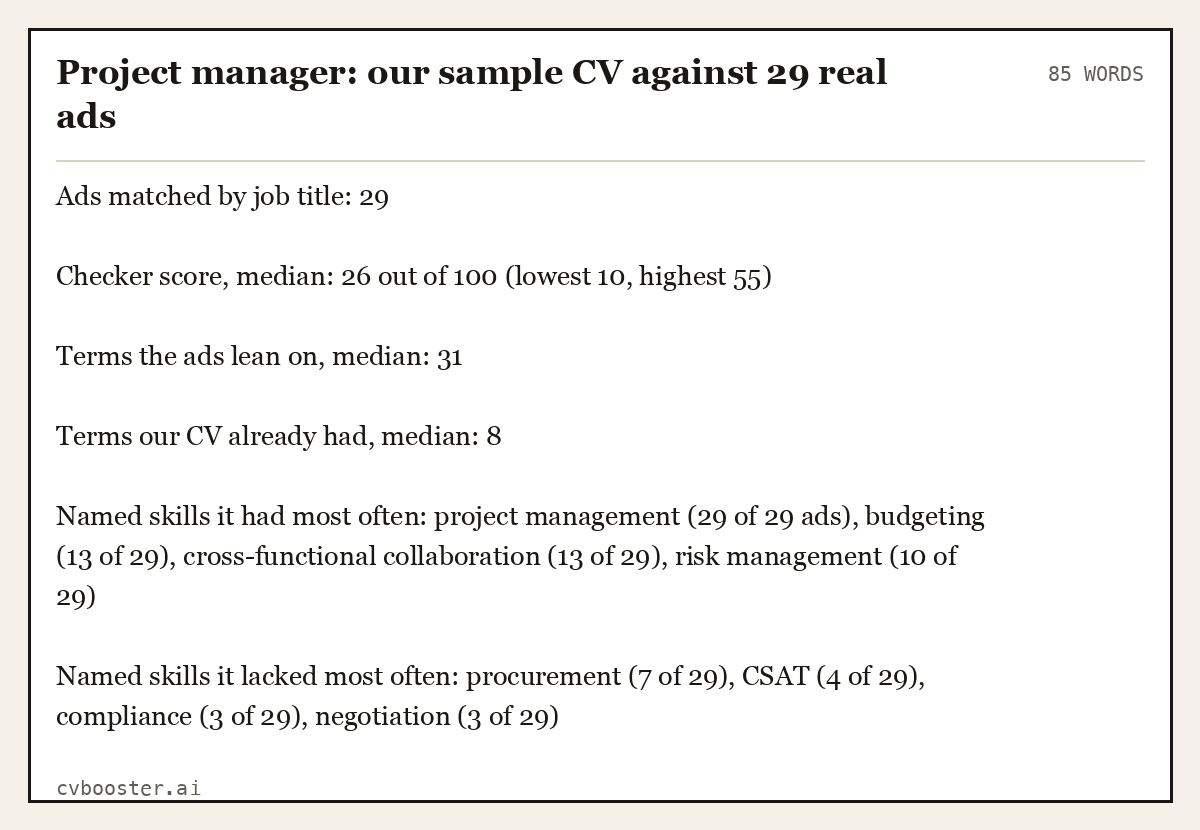
Project manager: our sample CV against 29 real ads (85 words)
Ads matched by job title: 29
Checker score, median: 26 out of 100 (lowest 10, highest 55)
Terms the ads lean on, median: 31
Terms our CV already had, median: 8
Named skills it had most often: project management (29 of 29 ads), budgeting (13 of 29), cross-functional collaboration (13 of 29), risk management (10 of 29)
Named skills it lacked most often: procurement (7 of 29), CSAT (4 of 29), compliance (3 of 29), negotiation (3 of 29)
Project management matched in all 29 ads, and the median score was still 26. One matching term does not move a score built from 31.
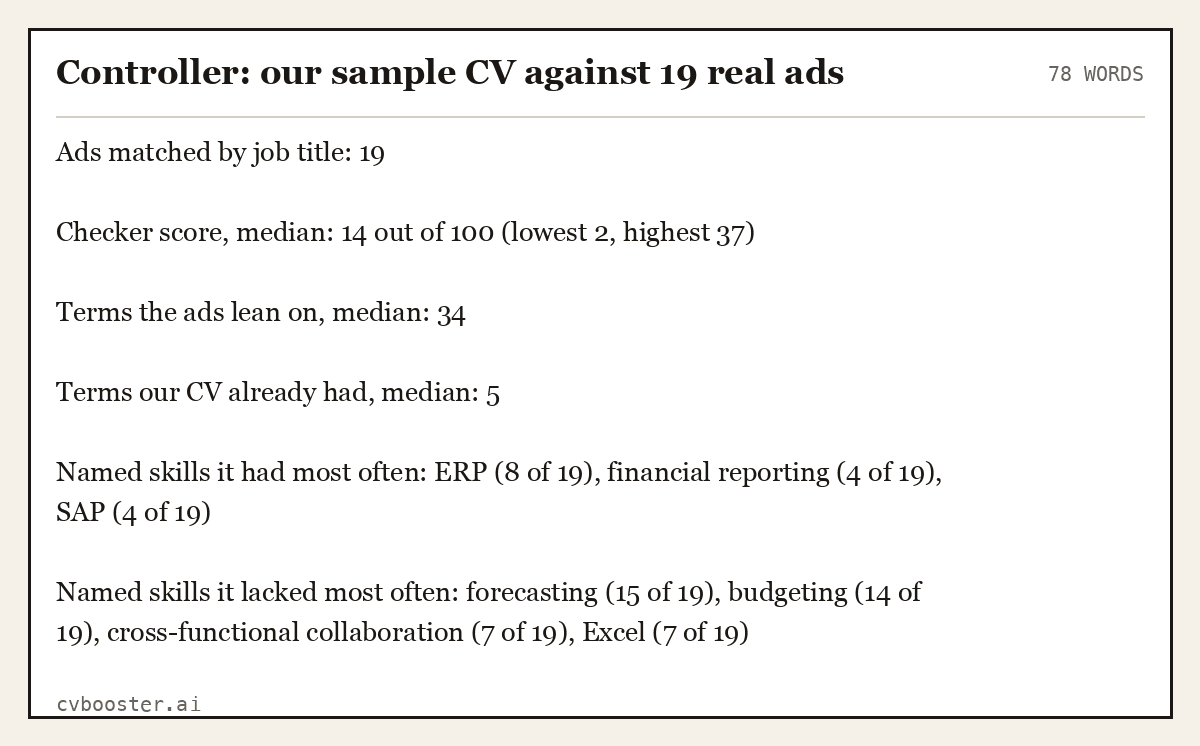
Controller: our sample CV against 19 real ads (78 words)
Ads matched by job title: 19
Checker score, median: 14 out of 100 (lowest 2, highest 37)
Terms the ads lean on, median: 34
Terms our CV already had, median: 5
Named skills it had most often: ERP (8 of 19), financial reporting (4 of 19), SAP (4 of 19)
Named skills it lacked most often: forecasting (15 of 19), budgeting (14 of 19), cross-functional collaboration (7 of 19), Excel (7 of 19)
Forecasting was missing in 15 of 19 controller ads. If you do forecasting and your CV calls it "planning", the check does not know that. Use the ad's word.
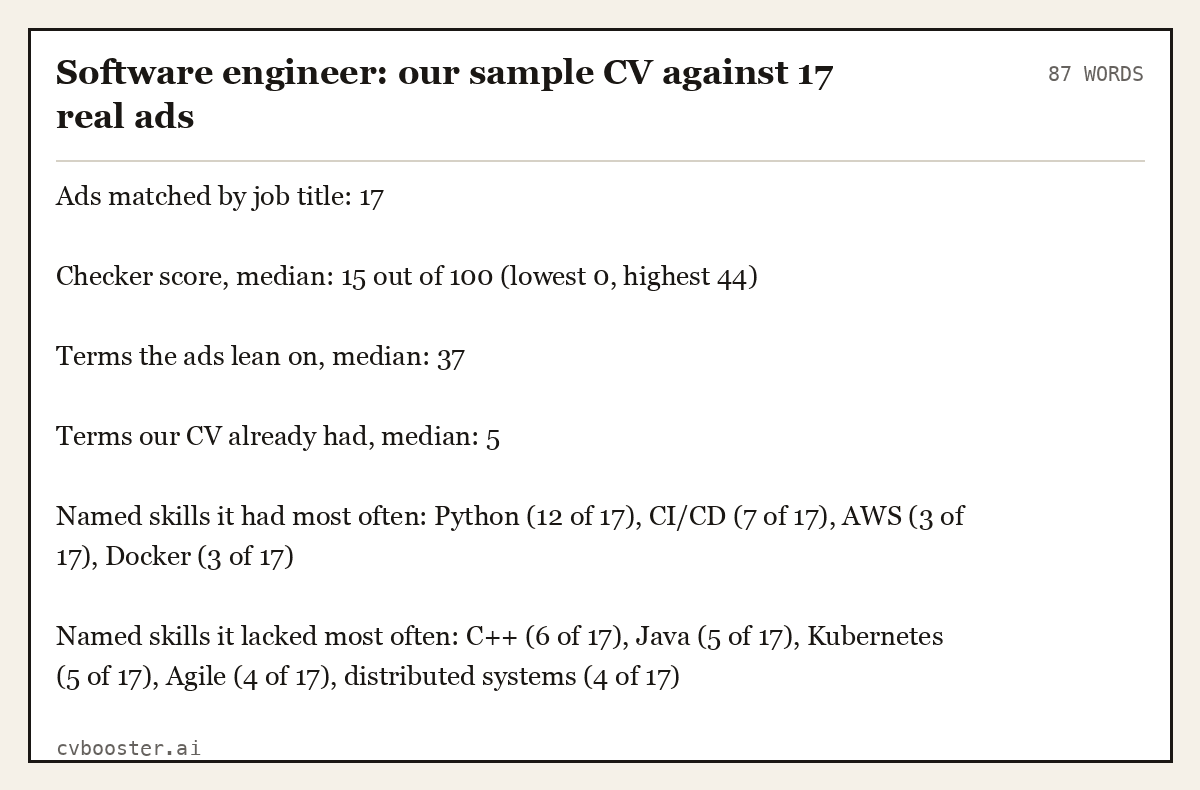
Software engineer: our sample CV against 17 real ads (87 words)
Ads matched by job title: 17
Checker score, median: 15 out of 100 (lowest 0, highest 44)
Terms the ads lean on, median: 37
Terms our CV already had, median: 5
Named skills it had most often: Python (12 of 17), CI/CD (7 of 17), AWS (3 of 17), Docker (3 of 17)
Named skills it lacked most often: C++ (6 of 17), Java (5 of 17), Kubernetes (5 of 17), Agile (4 of 17), distributed systems (4 of 17)
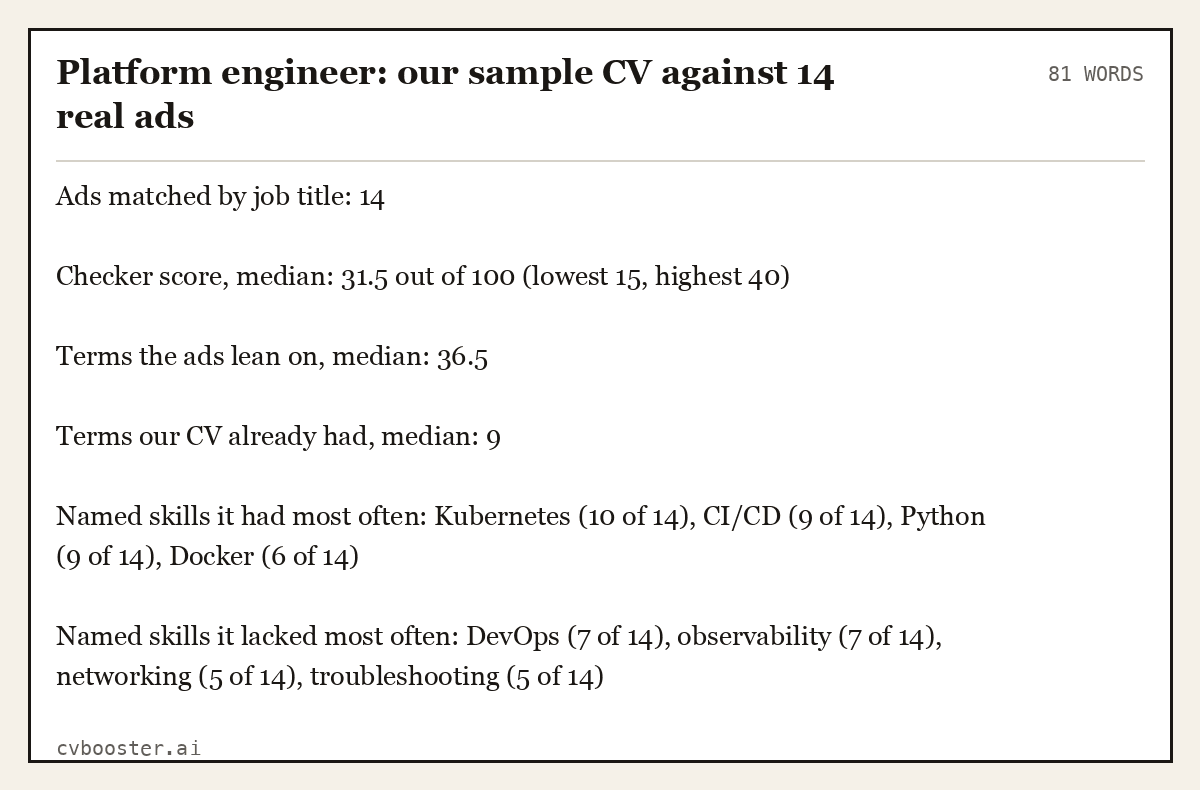
Platform engineer: our sample CV against 14 real ads (81 words)
Ads matched by job title: 14
Checker score, median: 31.5 out of 100 (lowest 15, highest 40)
Terms the ads lean on, median: 36.5
Terms our CV already had, median: 9
Named skills it had most often: Kubernetes (10 of 14), CI/CD (9 of 14), Python (9 of 14), Docker (6 of 14)
Named skills it lacked most often: DevOps (7 of 14), observability (7 of 14), networking (5 of 14), troubleshooting (5 of 14)
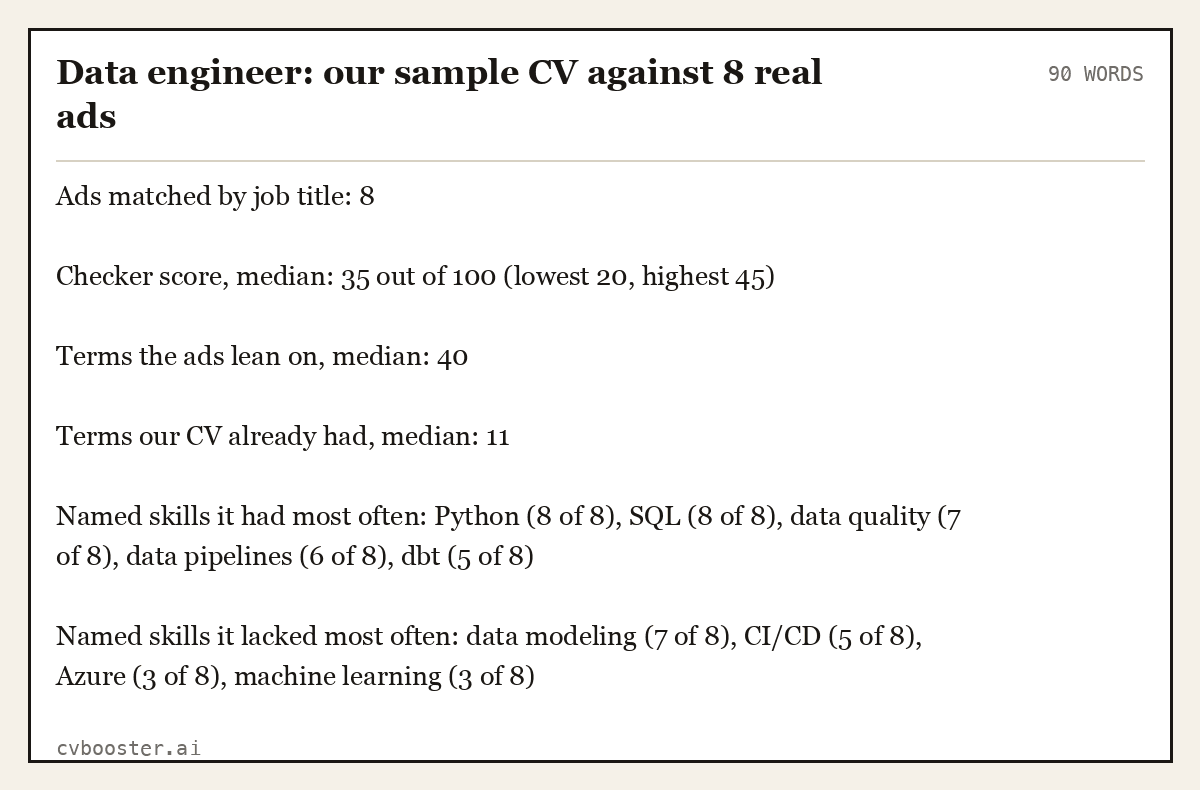
Data engineer: our sample CV against 8 real ads (90 words)
Ads matched by job title: 8
Checker score, median: 35 out of 100 (lowest 20, highest 45)
Terms the ads lean on, median: 40
Terms our CV already had, median: 11
Named skills it had most often: Python (8 of 8), SQL (8 of 8), data quality (7 of 8), data pipelines (6 of 8), dbt (5 of 8)
Named skills it lacked most often: data modeling (7 of 8), CI/CD (5 of 8), Azure (3 of 8), machine learning (3 of 8)
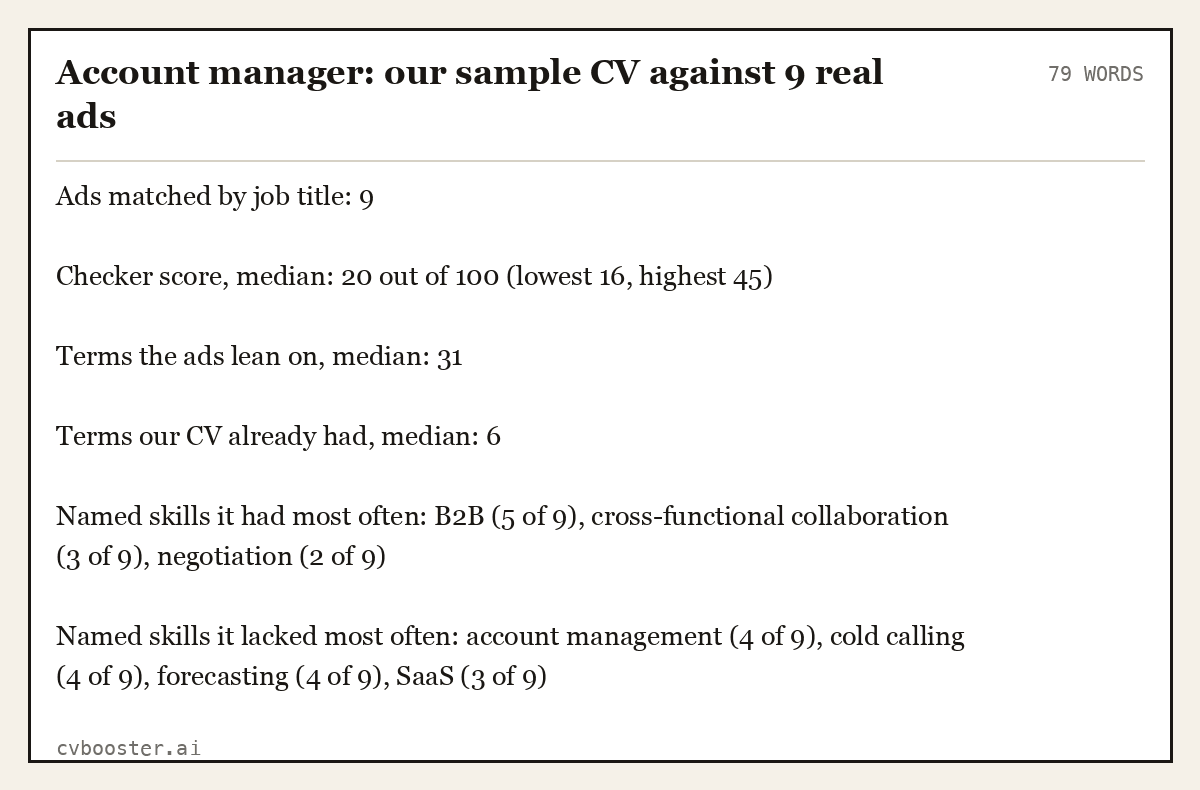
Account manager: our sample CV against 9 real ads (79 words)
Ads matched by job title: 9
Checker score, median: 20 out of 100 (lowest 16, highest 45)
Terms the ads lean on, median: 31
Terms our CV already had, median: 6
Named skills it had most often: B2B (5 of 9), cross-functional collaboration (3 of 9), negotiation (2 of 9)
Named skills it lacked most often: account management (4 of 9), cold calling (4 of 9), forecasting (4 of 9), SaaS (3 of 9)
The data engineer sample did best of the six, and it is the one that already had the most of the ads' terms, a median 11. That is the whole lesson in one row. The posting is the brief. A CV is an answer to one advert, and rewriting it for each job is the only thing that reliably moves the number. The step by step is in how to tailor a resume for a job application.
How many keywords one ad asks for
Our checker reads an ad the way the free ATS checker does: known skills first, then acronyms, then plain words the ad repeats. It stops at 40 terms so the list stays readable. In 1,088 English-language ads the median ad gave it 33 terms, and 32.9 percent reached the ceiling of 40. The middle half of ads came out between 25 and 40 terms.
Not all of them are skills. The median ad named 5 skills our lexicon recognises, such as SQL, budgeting or Kubernetes. The rest are the ad's own repeated words, the things it keeps coming back to.
To score 80 with our checker, a CV needs the heaviest terms first. Sorting each ad's terms by weight and counting down, the median ad needed 23 of them, a median 68.4 percent of its list. The middle half of ads needed between 17 and 26. That is why a generic CV lands in the teens. It is not wrong. It is just answering a different ad.
We also found out what our checker got wrong, and it was funnier than we would like. 78 of these English ads close with "we look forward to receiving your application", and our checker read "receiving" as the warehouse skill goods receiving. A "safe workplace" became SAFe, the agile framework, which only 11 ads actually wrote with that capital F. Across the 1,088 ads, the old checker listed goods receiving in 267 and SAFe in 164. We fixed the checker before publishing this page. It now reads SAFe only with its capital F, skips the sentences about the application itself, and no longer turns every "network" into networking. Goods receiving now comes up in 0 ads and SAFe in 11. Every number on this page comes from the fixed checker. With the old one, the median sample CV score was 19 instead of 20, and the terms needed for 80 were 26 instead of 23. The finding holds either way.
If you want to know what an applicant tracking system does with these terms once it has them, what ATS software actually does goes through it without the folklore.
Pay: 97.1 percent of ads show no figure
We counted an ad as showing pay when it had a money amount next to a pay word such as lön, salary or earn, or a per-hour or per-month unit, and not next to a benefit word. That rule exists because the first version counted the wellness allowance, the friskvårdsbidrag, as a salary. Under the stricter rule, 596 of 20,405 ads showed a pay figure, 2.9 percent. 5.1 percent said pay is set individually, the Swedish phrase individuell lönesättning, which is a sentence about pay without a number in it.
It varies by field. Sales, purchasing and marketing ads showed a figure 13.5 percent of the time, many of them commission roles that lead with what you can earn. IT ads showed one 0.7 percent of the time.
This matters now because the EU pay transparency directive, Directive (EU) 2023/970, had a transposition deadline this year. Article 34 says:
Quote: "Member States shall bring into force the laws, regulations and administrative provisions necessary to comply with this Directive by 7 June 2026." (Directive (EU) 2023/970, Official Journal)
Be careful with what that does and does not mean for an ad. Article 5 gives applicants a right to the starting pay or its range, and it says how:
Quote: "Such information shall be provided in a manner such as to ensure an informed and transparent negotiation on pay, such as in a published job vacancy notice, prior to the job interview or otherwise." (Directive (EU) 2023/970)
So an ad with no number is not proof of a breach. The range can arrive before the interview instead. What the data shows is simpler: if you want the number before you apply, the ad will almost never give it to you. The European Commission's own page on EU action for equal pay explains the directive and what follows the deadline. When you do get to the number, how to negotiate salary is the next read.
Degrees, licences and years of experience
A university degree came up in 13.1 percent of all ads. In English-language ads it was 38.1 percent, against 11.9 percent in Swedish-language ones. The English ads cluster in IT, engineering, and administration and finance, and those kinds of fields ask for degrees more often: management 44.1 percent, engineering and technical 35.5 percent, IT 29.3 percent, and science 51.7 percent.
Health care looks like the opposite and is not. Only 1.5 percent of health care ads mentioned a degree, but 57.5 percent asked for a licence, the Swedish legitimation that nurses and doctors hold. Education was similar, with 46.8 percent asking for a licence. The paper that matters in those jobs is the licence, and that is the word to put near the top of the CV.
An explicit number of years was rarer than the advice columns suggest. 11.9 percent of ads named one. Where they did, the median was 3 years in Swedish-language ads and 5 in English-language ones. The structured field on the job board says experience is wanted in 93 percent of ads, so most ads want experience and do not say how much.
AI in job ads
4.6 percent of all ads mentioned AI in some form, from generative AI to machine learning. In English-language ads it was 20 percent, and in IT ads 24.4 percent. Naming a specific AI tool, such as ChatGPT, Copilot or an AI assistant, was much rarer: 1 percent of all ads and 7.4 percent of English ones.
A mention is not always a requirement. Some ads describe the company's product, and some describe AI used in the hiring process itself. If an ad you want names a tool you use, put the tool's name in the CV. If it only says the company works with AI, that is a sentence about them, not a keyword for you. Our hard skills for a resume guide covers how to list tools so a checker finds them.
How we did it
Every number on this page comes out of one script run over one saved snapshot. Nothing here is borrowed from a survey, and if we could not count it, it is not on the page.
- Source. The JobSearch API of JobTech, Arbetsförmedlingen's open data service, published under CC0. The job ads dataset page states the licence, and the API is documented in Arbetsförmedlingen's public code repository.
- Window. Every ad published from 12 September 2026 00:00 to 26 September 2026 00:00 and still live when we fetched it on 26 September 2026. 20,405 ads, 247 requests, one request at a time with a pause between each.
- Language. An ad counts as English or Swedish by which language's common small words dominate it. 1,088 ads were English, 19,056 Swedish, and the rest mixed or other.
- The checker. A frozen copy of CVBooster's own keyword code, the same file the builder's free score runs, compiled and run over each English ad with its headline as the title line. The Swedish ads were not scored, because the checker's word lists are built for English.
- Sample CVs. The text of the sample CV behind each role page, built exactly as our site builds it, matched to an ad when the ad's headline contains the role name.
- Hand check. We read a fixed random sample of the ads each text rule flagged. Pay figures were right 23 times in 25, degree mentions 24 in 25, AI mentions 25 in 25, licences 10 in 10 and years of experience 20 in 20. Every rule that failed an earlier check was fixed and re-run before any number went on this page.
What this data cannot tell you
It is one country's public job board over two weeks, not the world. The checker scores only English-language ads, so the keyword numbers describe 1,088 ads, not 20,405. Ads that were removed before 26 September are missing, so short-lived postings count less. Text rules catch what an ad says, not what the employer does: an ad with no pay figure may still give the range before the interview. The keyword counts depend on our checker's word lists, which is why we fixed the everyday-word matches before publishing and give the old checker's numbers next to the new ones. And our sample CVs were never written for these ads, which is the point of that section, not a flaw in it.
Download the data
The aggregate tables are free to reuse with a link back: the summary by language, the breakdown by field and the sample CV results by role, as CSV. The raw ad texts stay with the source, where anyone can fetch them under CC0. We do not republish individual ads or name employers.
Cite this: CVBooster, ATS Keywords: What 20,405 Real Job Ads Actually Ask For, cvbooster.ai/blog/ats-keywords-real-job-ads, data collected 26 September 2026.
To embed a figure, quote it with that line and link the title to this page.
We will re-run the same script on a fresh two-week window every quarter and keep this page on the latest run. If you want to try the check on your own CV and one ad, the free ATS resume checker guide shows how.
Frequently asked questions
How many keywords should a CV have for an ATS?
There is no fixed number, because it depends on the ad. In 1,088 English-language ads, our checker needed a median of 23 of an ad's terms in the CV to score 80. Take them from the ad in front of you, heaviest first, and only the ones that are true of you.
Do job ads in Sweden show the salary?
Rarely. Of 20,405 ads on Platsbanken published between 12 and 25 September 2026, 97.1 percent showed no pay figure in the text. 5.1 percent said pay is set individually. Sales ads showed a figure most often, at 13.5 percent, and IT ads least, at 0.7 percent.
Does the EU pay transparency directive mean every ad must show pay?
No. Directive (EU) 2023/970 gives applicants the right to the starting pay or its range, and says it can be given in the published vacancy notice, before the job interview or otherwise. An ad without a number is not proof of a breach. The transposition deadline was 7 June 2026.
How often do job ads ask for a degree?
In our data, 13.1 percent of all ads mentioned a university degree, and 38.1 percent of English-language ads did. It depends heavily on the field: science 51.7 percent, management 44.1 percent, health care 1.5 percent, where a professional licence was asked for in 57.5 percent of ads instead.
Why did your own sample CVs score so low?
Because they were written for a job title, not for one ad. Against 551 real ads with a matching headline, the median score was 20 out of 100 and none reached 80. The samples show a good CV for a role. Only tailoring to the ad moves the score, and that is what the checker measures.
Can I reuse these numbers?
Yes. Link to this page and name the data date, 26 September 2026. The ads come from Arbetsförmedlingen's open data under CC0, and the aggregate tables are free to download. We do not publish individual ad texts or employer names.
Related articles
- Entry Level Project Manager: 5 Routes In With No Degree
- Entry Level Roles With No Experience: 6 Routes That Work
- Entry Level Sales Jobs With No Experience: 5 Routes
- How to Get Into the Police in the UK: 6 Entry Routes
More articles
- ATS Resume: how to get past the screener, in its own words
- 10 ATS Resume Tips That Actually Work
- Attention to Detail Selection Criteria Examples: 4 Answers
Looking for a worked example for your job title? Browse the resume examples by job title.