Resume Buzzwords: 150 Action Verbs to Use Instead of Cliches
By Mustafa Tarabya, founder of CVBooster · Published · Updated
8 min read
The resume buzzwords that work are action verbs tied to a result, such as "cut", "launched" or "trained", and the ones that hurt are adjectives about yourself, such as "dynamic", "results-driven" or "team player". The constraint is that a verb only helps if the rest of the line proves it: "spearheaded" in front of nothing is just a louder buzzword. MIT's career office gives the rule in one line: "Begin each bullet point statement or phrase with an action verb that points the reader to the skill you are trying to highlight." Below are the buzzwords to cut, about 150 action verbs sorted by skill, and six complete before-and-after bullet sets, checked in October 2026, from entry level to senior. Written by Mustafa Tarabya, who hired for his own company, read every application himself and now writes CVBooster's guides.
Every resume says "results-driven". Nobody has ever written "results-indifferent", which tells you how much the word is doing. A buzzword is a claim the reader cannot check. An action verb with a number after it is a claim they can.
The buzzwords to cut, and what to write instead
| Buzzword | Why it fails | Write this instead |
|---|---|---|
| Results-driven | Everyone claims it | The result itself: "Cut invoice errors by half" |
| Team player | Says nothing about what you did in the team | "Trained", "covered", "coordinated" plus who and how many |
| Hard-working | Unprovable on paper | Hours, volume or shifts: "Ran 40-cover lunch service alone" |
| Detail-oriented | Every advert asks, every resume answers | "Audited", "reconciled", "caught" plus the error |
| Dynamic, passionate | Adjectives about yourself | Delete; show the energy in the bullets |
| Go-getter, self-starter | Reads as filler | "Launched", "started", "set up" plus what |
| Synergy, leverage | Corporate fog | "Combined", "used" |
| Responsible for | Describes a duty, not an outcome | The verb for what you actually did |
| Think outside the box | A cliche about not using cliches | "Redesigned", "replaced", "invented" |
| Excellent communication skills | Claimed by everyone | "Presented", "wrote", "negotiated" plus audience |
The test for any word on your resume: could the reader check it from the line it is in? If not, either add the evidence or cut the word.
Before and after: six bullet sets
The fastest way to see the difference is to watch the same bullets rewritten. Each set below keeps the job and the facts, and changes only the verbs and what follows them.
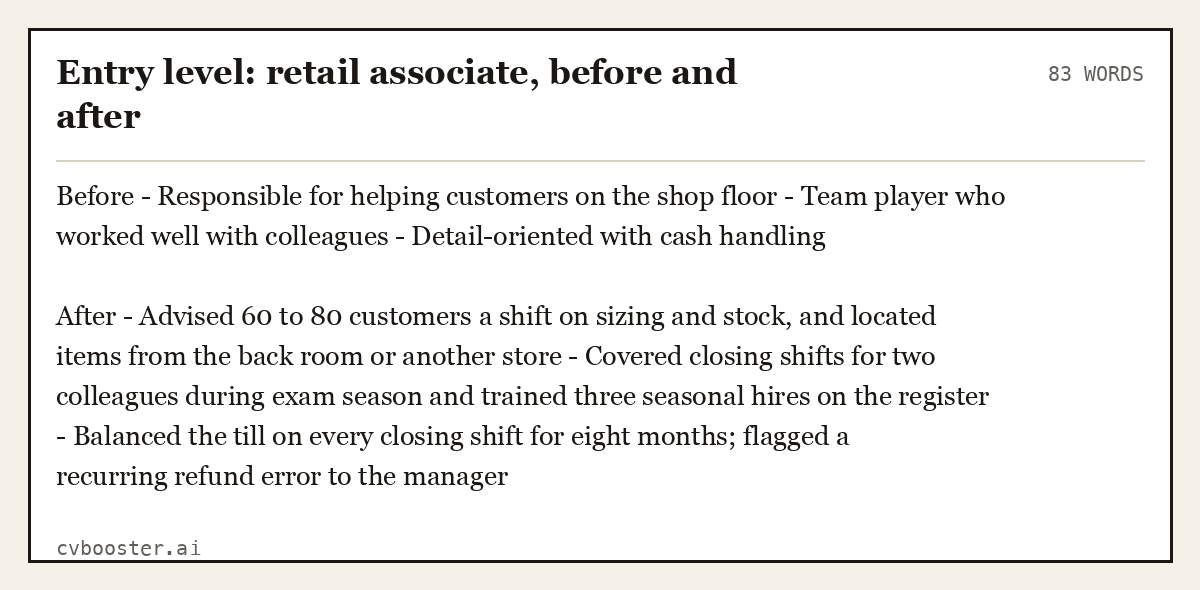
Entry level: retail associate, before and after (83 words)
Before - Responsible for helping customers on the shop floor - Team player who worked well with colleagues - Detail-oriented with cash handling
After - Advised 60 to 80 customers a shift on sizing and stock, and located items from the back room or another store - Covered closing shifts for two colleagues during exam season and trained three seasonal hires on the register - Balanced the till on every closing shift for eight months; flagged a recurring refund error to the manager
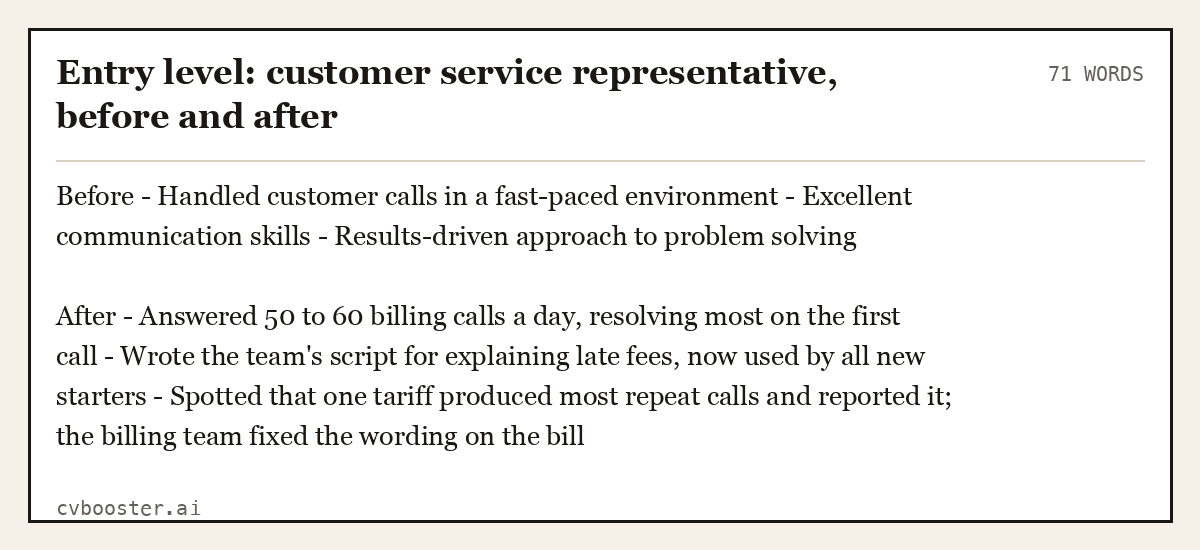
Entry level: customer service representative, before and after (71 words)
Before - Handled customer calls in a fast-paced environment - Excellent communication skills - Results-driven approach to problem solving
After - Answered 50 to 60 billing calls a day, resolving most on the first call - Wrote the team's script for explaining late fees, now used by all new starters - Spotted that one tariff produced most repeat calls and reported it; the billing team fixed the wording on the bill
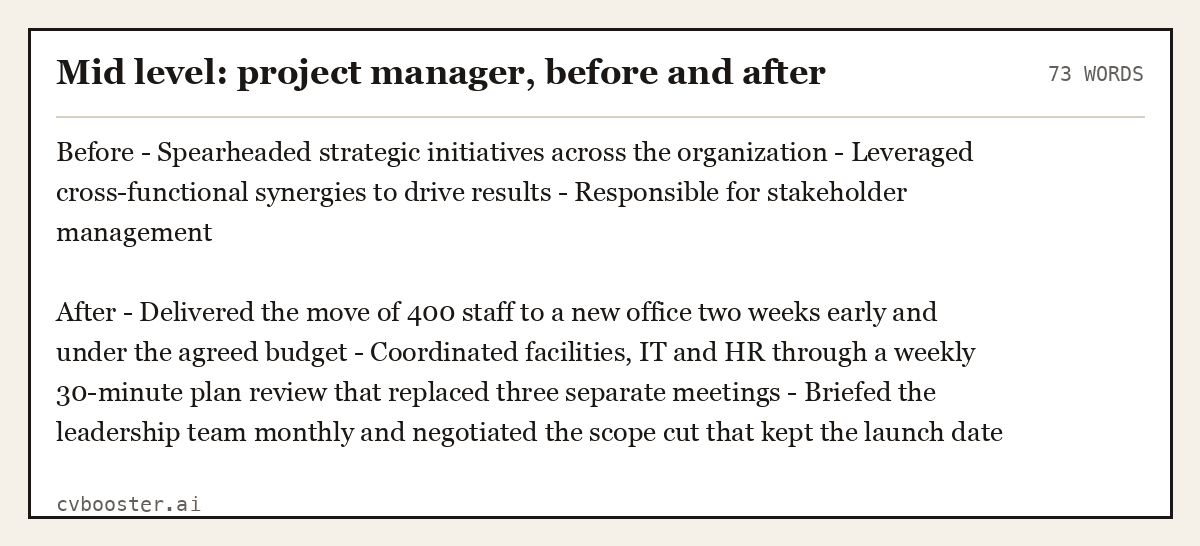
Mid level: project manager, before and after (73 words)
Before - Spearheaded strategic initiatives across the organization - Leveraged cross-functional synergies to drive results - Responsible for stakeholder management
After - Delivered the move of 400 staff to a new office two weeks early and under the agreed budget - Coordinated facilities, IT and HR through a weekly 30-minute plan review that replaced three separate meetings - Briefed the leadership team monthly and negotiated the scope cut that kept the launch date
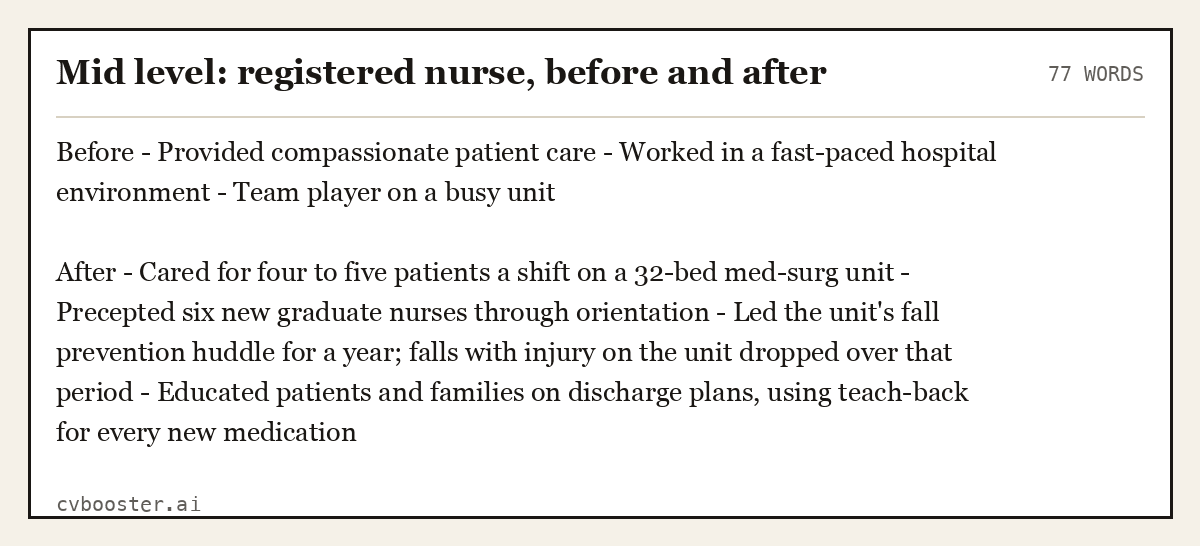
Mid level: registered nurse, before and after (77 words)
Before - Provided compassionate patient care - Worked in a fast-paced hospital environment - Team player on a busy unit
After - Cared for four to five patients a shift on a 32-bed med-surg unit - Precepted six new graduate nurses through orientation - Led the unit's fall prevention huddle for a year; falls with injury on the unit dropped over that period - Educated patients and families on discharge plans, using teach-back for every new medication
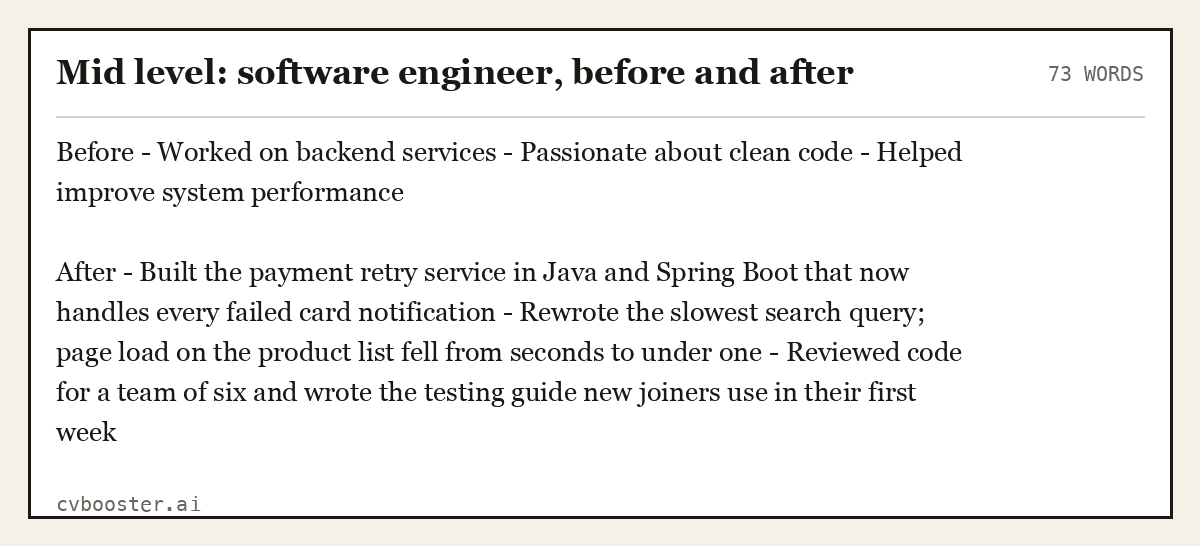
Mid level: software engineer, before and after (73 words)
Before - Worked on backend services - Passionate about clean code - Helped improve system performance
After - Built the payment retry service in Java and Spring Boot that now handles every failed card notification - Rewrote the slowest search query; page load on the product list fell from seconds to under one - Reviewed code for a team of six and wrote the testing guide new joiners use in their first week
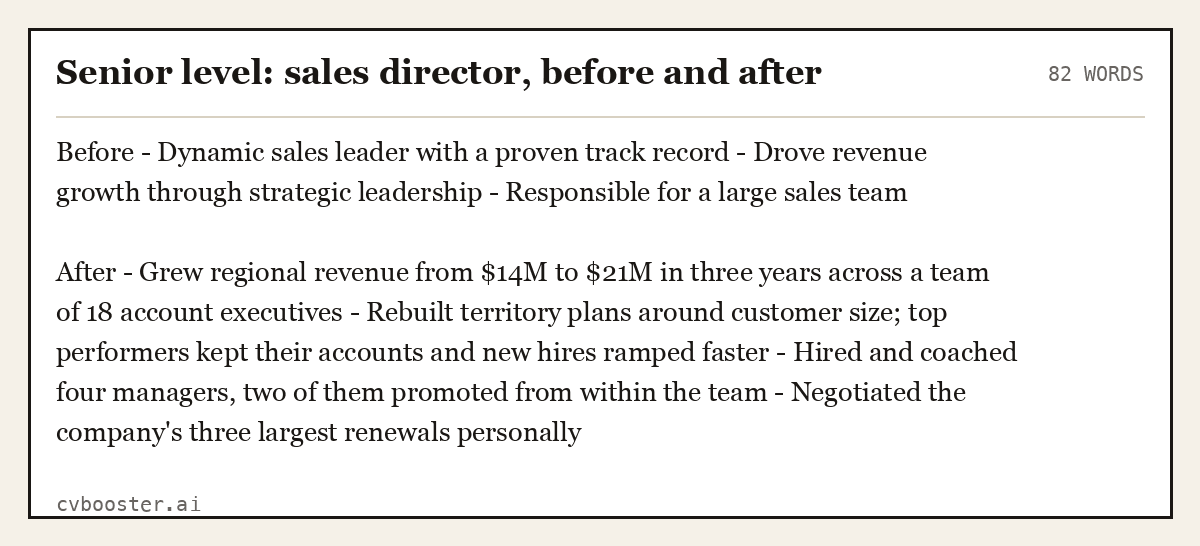
Senior level: sales director, before and after (82 words)
Before - Dynamic sales leader with a proven track record - Drove revenue growth through strategic leadership - Responsible for a large sales team
After - Grew regional revenue from $14M to $21M in three years across a team of 18 account executives - Rebuilt territory plans around customer size; top performers kept their accounts and new hires ramped faster - Hired and coached four managers, two of them promoted from within the team - Negotiated the company's three largest renewals personally
Action verbs by skill
Pick verbs that match the skills in the job advert, then make sure each one is followed by what changed. These lists are sorted by the skill the reader will infer from the verb.
Leading people: led, managed, supervised, coached, mentored, trained, hired, onboarded, delegated, directed, developed, motivated, promoted, scheduled, guided, unified, appointed, evaluated.
Improving results: increased, cut, reduced, raised, doubled, accelerated, expanded, grew, saved, eliminated, shortened, lifted, boosted, recovered, exceeded, outperformed, achieved, attained.
Starting things: launched, built, created, founded, established, introduced, designed, set up, initiated, pioneered, piloted, opened, drafted, invented, devised, conceived.
Fixing and changing things: redesigned, rebuilt, restructured, replaced, simplified, streamlined, standardized, modernized, automated, migrated, consolidated, overhauled, resolved, repaired, troubleshot, corrected.
Communicating: presented, wrote, edited, briefed, negotiated, persuaded, explained, translated, published, pitched, mediated, interviewed, advised, consulted, documented, reported.
Organizing: coordinated, planned, organized, prioritized, tracked, budgeted, allocated, arranged, catalogued, processed, administered, monitored, maintained, dispatched, logged, filed.
Analyzing: analyzed, audited, assessed, calculated, compared, diagnosed, forecast, investigated, measured, modeled, researched, reviewed, surveyed, tested, verified, reconciled.
Serving customers and patients: advised, assisted, cared for, counseled, educated, greeted, handled, informed, referred, resolved, responded, served, supported, welcomed, triaged, de-escalated.
Technical work: coded, configured, deployed, engineered, installed, integrated, programmed, scripted, secured, shipped, tuned, upgraded, debugged, refactored, containerized, provisioned.
Selling and growing accounts: sold, closed, prospected, renewed, upsold, sourced, converted, retained, partnered, secured, won, signed, expanded accounts, generated, qualified, represented.
That is roughly 150 verbs. MIT's career office keeps a longer list on its resume action verbs page, grouped into stronger verbs for accomplishments and verbs by skill.
How to use them without sounding like a thesaurus
- Start every bullet with a verb, past tense for past jobs and present tense for your current one.
- Do not start three bullets in a row with the same verb.
- Pick the plainest verb that is accurate. "Led" beats "spearheaded" if you led it. Grand verbs read as decoration.
- Follow the verb with who, what and how many. The verb points; the rest of the line proves.
- Mirror the advert. If it says "coordinate", use "coordinated" where it is true.
The US government's plain language guidance makes the same point about voice: use active voice, because the reader should know who did what. On a resume, the who is always you, so the sentence starts with the verb.
For skills sections, the words come from the advert and from O*NET, the US Department of Labor's occupation database, whose skills list defines "Writing", for example, as "Communicating effectively in writing as appropriate for the needs of the audience." If you want to claim it, show a document you wrote and who read it.
Buzz words for a CV in the UK: words to use and words to cut
The same rules apply to a CV in the UK, with British spelling: organised, prioritised, analysed, programme. The UK version of "results-driven" is "proactive", and it has the same problem. If you are writing a personal statement for a CV with little work history, the CV personal statement with no experience guide shows how to replace adjectives with evidence.
The words in a CV that earn their place are the ones a reader can check: a verb, an object and a result. Here is one UK line before and after.
- Before: Proactive, highly motivated team player with excellent organisational skills.
- After: Organised the rota for 14 weekend staff and cut late shift changes from weekly to once a month.
The second line uses no buzz words for a CV at all, yet it shows organisation, reliability and teamwork. Keep the adjectives out of the profile too, and let the verbs listed above carry the claim.
I read every application for my own company. The bullets I remember were never the ones with the most impressive verbs. They were the ones where I could picture the person doing the thing. A pretty word is not a strategy; the line after it is.
For more on the top of the page, see the professional summary guide. For the skills block, see skills to put on a resume, and for the soft skills that buzzwords usually try to claim, see soft skills for a resume. For swaps sorted by the tired word itself, such as managed, helped and responsible for, see resume synonyms.
Frequently asked questions
What are buzzwords on a resume?
Buzzwords are words that sound impressive but carry no evidence, such as "results-driven", "dynamic", "team player" and "detail-oriented". The useful kind are action verbs tied to a result, like "cut", "launched" or "trained", followed by who, what and how many. Recruiters skim past the first kind and read the second.
What are the best buzzwords for a resume?
The best ones are plain action verbs that match the job advert: led, built, cut, launched, trained, resolved, negotiated, coordinated. They work because each one points to a skill and invites a number. Choose the verb that is accurate rather than the grandest one, and do not repeat it in consecutive bullets.
Which resume buzzwords should I avoid?
Avoid adjectives about yourself and corporate filler: results-driven, hard-working, team player, detail-oriented, dynamic, passionate, go-getter, synergy, leverage, think outside the box and "responsible for". Replace each one with a verb and evidence from your work, or delete it.
What are good action verbs for a resume?
Group them by skill: led, coached and trained for leadership; increased, cut and saved for results; launched and built for initiative; redesigned and automated for improvement; presented and negotiated for communication. Start each bullet with one and follow it with what changed.
Should I use buzzwords to get past applicant tracking systems?
Use the words from the job advert, not generic buzzwords. Applicant tracking systems match terms from the posting, such as tools, certifications and skills, so "Salesforce" or "ServSafe" matters more than "dynamic". Put each advert keyword where you can back it up with a bullet.
More in this series: Resignation, notice and reference letters
- 2 Week Notice Letter: Five Templates and the US Rules
- Apprenticeship Cover Letter: 6 UK Examples for Every Level
- Bank Teller Interview Questions and 10 Full Sample Answers
- CNA Resume No Experience: 6 Samples That Lead With Clinicals
- Engineering Cover Letter Examples: 8 Samples by Discipline
- Human Resources Cover Letter: 6 HR Samples From Assistant Up
- Notice Letters Sample: Five Templates and the UK Rules
- Notice Period UK: The Rules and Five Notice Letters
- Job Reference Letter of Recommendation: 11 Full Examples
- Supervisor Resume Examples: 6 Samples From First Shift Lead
- Thank You Letter Examples: 9 Templates and Follow-Up Emails
Related articles
- Leadership Skills Examples: 12 Skills and the Resume Lines
- Product Management Keywords: 48 Terms and 6 Resume Examples
- Summa Cum Laude: Meaning and How to List It on a Resume
- Things to Put on a Resume: 9 Sections With Examples
More articles
- How to Use a Resume Example Without Copying It
- Best Font for Resume: 10 Fonts and the Sizes to Use
- Career Goals on a Resume: Examples & How to Write Them
Looking for a worked example for your job title? Browse the resume examples by job title.