Paramedic Salary, Career Path and CV
By CVBooster TeamPublished Updated
The median paramedic salary in the United States is $60,600 a year, or $29.13 an hour, according to the U.S. Bureau of Labor Statistics (BLS), OEWS May 2025. That is the national middle: states, employers and hours move it, and BLS publishes nothing by years of experience. The figures here are for paramedics alone, not the combined EMT and paramedic group on the same BLS page. You get here by way of EMT work first, and the extra training is worth $16,130 a year at the national median.
Below: a check of your own pay, the pay percentiles, hourly pay, pay in every state, the top-paying metro areas, what paramedics do, how to become a paramedic, the skills that go on a CV, and a CV example.
- Median annual pay
- $60,600
- Median hourly pay
- $29.13
- Employed, May 2025
- 100,610
Am I underpaid as a paramedic?
Pick your state and type your pay. You get your place in the BLS pay range for paramedics there, as a percentile.
Paramedic salary in the United States
The BLS counts paramedics in the occupation Paramedics (SOC 29-2043). Half of them earn less than $60,600 a year and half earn more. The average, which a few very high earners pull up, is $63,360. The lowest-paid tenth earn $44,230 or less, and the highest-paid tenth earn $84,850 or more, which is about 1.9 times as much. The ratio is our arithmetic on two BLS figures.
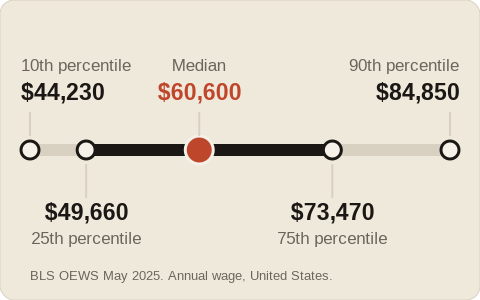
| Measure | Annual wage |
|---|---|
| 10th percentile | $44,230 |
| 25th percentile | $49,660 |
| Median (50th) | $60,600 |
| Mean (average) | $63,360 |
| 75th percentile | $73,470 |
| 90th percentile | $84,850 |
Source: U.S. Bureau of Labor Statistics, Occupational Employment and Wage Statistics (OEWS), May 2025, Paramedics, retrieved 23 to 25 November 2026 from the BLS OEWS May 2025 national, state and metropolitan area files.
Paramedic hourly pay
The median hourly wage for paramedics is $29.13, as published by BLS for May 2025. That is the hourly view of the same national middle as the $60,600 annual median above, so use it when an employer quotes you a rate and not a salary. Annual pay for a job with part-time or shift work depends on the hours you are given, which no national table can tell you.
| Measure | Per hour |
|---|---|
| 10th percentile | $21.26 |
| 25th percentile | $23.88 |
| Median (BLS hourly figure) | $29.13 |
| 75th percentile | $35.32 |
| 90th percentile | $40.79 |
For paramedics the median is the hourly wage BLS publishes. The other rows are our division of the BLS annual percentiles by 2,080 hours, the full-time year BLS uses to turn hourly pay into annual pay.
Paramedic salary by state
Where you work changes the number more than most things. The highest median is in Washington, at $104,310. The lowest published median is in Oklahoma, at $46,790, a gap of $57,520 a year between two states. The gap is our subtraction of two BLS state medians. All figures below are the annual median wage in each state for May 2025.
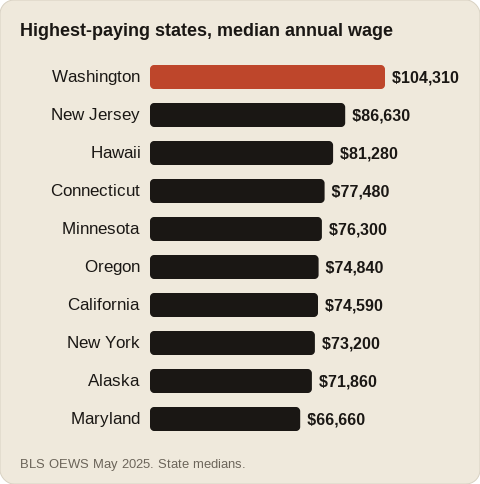
Top-paying states for paramedics
| Rank | State | Median wage | vs US median |
|---|---|---|---|
| 1 | Washington | $104,310 | +$43,710 |
| 2 | New Jersey | $86,630 | +$26,030 |
| 3 | Hawaii | $81,280 | +$20,680 |
| 4 | Connecticut | $77,480 | +$16,880 |
| 5 | Minnesota | $76,300 | +$15,700 |
| 6 | Oregon | $74,840 | +$14,240 |
| 7 | California | $74,590 | +$13,990 |
| 8 | New York | $73,200 | +$12,600 |
| 9 | Alaska | $71,860 | +$11,260 |
| 10 | Maryland | $66,660 | +$6,060 |
Paramedic salary in all 50 states
| State | Median annual wage |
|---|---|
| Washington | $104,310 |
| New Jersey | $86,630 |
| Hawaii | $81,280 |
| Connecticut | $77,480 |
| Minnesota | $76,300 |
| Oregon | $74,840 |
| California | $74,590 |
| New York | $73,200 |
| Alaska | $71,860 |
| Maryland | $66,660 |
| Massachusetts | $66,340 |
| Utah | $65,420 |
| Delaware | $64,240 |
| New Hampshire | $64,210 |
| Wyoming | $64,040 |
| Colorado | $63,910 |
| Rhode Island | $63,550 |
| Maine | $63,050 |
| North Dakota | $62,320 |
| Pennsylvania | $61,000 |
| Illinois | $60,660 |
| Iowa | $60,590 |
| Virginia | $60,480 |
| Idaho | $60,380 |
| Vermont | $60,360 |
| Indiana | $60,320 |
| Florida | $60,140 |
| Wisconsin | $59,710 |
| Nevada | $59,280 |
| Missouri | $59,180 |
| Arizona | $58,600 |
| Tennessee | $57,690 |
| Georgia | $57,660 |
| Texas | $57,500 |
| North Carolina | $57,320 |
| Nebraska | $56,230 |
| Louisiana | $56,050 |
| New Mexico | $55,530 |
| Mississippi | $54,630 |
| South Carolina | $53,550 |
| Michigan | $52,080 |
| Ohio | $51,300 |
| Kansas | $51,020 |
| Montana | $50,890 |
| Arkansas | $50,310 |
| Kentucky | $49,890 |
| South Dakota | $48,830 |
| Alabama | $48,540 |
| West Virginia | $48,460 |
| Oklahoma | $46,790 |
Top-paying metro areas for paramedics
| Metro area | Median wage | Employed |
|---|---|---|
| Seattle-Tacoma-Bellevue, WA | $123,310 | 750 |
| Olympia-Lacey-Tumwater, WA | $120,260 | 100 |
| Bellingham, WA | $119,970 | 70 |
| Bremerton-Silverdale-Port Orchard, WA | $119,700 | 80 |
| Mount Vernon-Anacortes, WA | $109,620 | 70 |
| Kennewick-Richland, WA | $101,250 | 80 |
| Redding, CA | $88,740 | 40 |
| San Jose-Sunnyvale-Santa Clara, CA | $84,480 | 110 |
| San Francisco-Oakland-Fremont, CA | $83,090 | 780 |
| Ogden, UT | $82,650 | 50 |
BLS publishes the paramedic median for 266 metro areas; the national median is $60,600. 6 of these ten count fewer than 100 paramedics or have no published headcount, so treat them as rough. Source: U.S. Bureau of Labor Statistics, OEWS May 2025, metropolitan area estimates.
Compare paramedic pay
Put two states side by side, or set paramedics next to another job. Every figure is from BLS OEWS May 2025.
| Measure | Washington | Oklahoma |
|---|---|---|
| Median annual wage | $104,310 | $46,790 |
| Median hourly wage | $50.15 | $22.50 |
| 10th percentile | $61,010 | $37,180 |
| 25th percentile | $80,320 | $43,930 |
| 75th percentile | $123,310 | $51,860 |
| 90th percentile | $133,040 | $61,310 |
| Employed, May 2025 | 2,110 | 1,590 |
The Washington median is $57,520 a year higher. That difference is our subtraction of two BLS state medians. n/a means this page has only the BLS median for that state so far, or BLS released no figure for it. Source: BLS OEWS May 2025, Paramedics.
Starting pay for paramedics
BLS does not publish pay by years of experience, so nobody can honestly quote an official entry-level paramedic salary. What the data gives is the bottom of the market. One in ten paramedics earns $44,230 or less, and one in four earns $49,660 or less. Read those as the low end of the national range, not as what a new graduate will be offered, because older workers sit in the bottom tenth too.
Employers pay paramedics much alike
For EMTs the industry medians on the BLS page are far apart. For paramedics they are close: local government $61,980, private hospitals $61,370, ambulance services $60,040 and local hospitals $59,260. Between the two biggest employers, local government and ambulance services, the gap is only $1,940.
Offices of physicians, a small employer, are lowest at $55,900. BLS publishes no overtime figures, so how an employer pays for long shifts is a question for the interview. Overall, the choice of employer type matters less here than where in the country you work, which is where the real spread is.
Washington stands apart
Washington has the highest paramedic median of any state, $104,310, against $86,630 in New Jersey, the next state. Of the 10 top-paying metro areas, 6 are in Washington, led by Seattle-Tacoma-Bellevue, WA at $123,310 with about 750 paramedics.
Most of the other Washington metros on the list count fewer than a few hundred paramedics each, so their medians are estimates from small groups. BLS does not say why Washington pays so much more. It publishes a paramedic median for 50 states, so the ranking in the table above is complete.
What the higher license is worth
The paramedic median is $60,600, $16,130 above the EMT median of $44,470. At the median, a paramedic earns more than three in four EMTs do: the top quarter of EMT pay starts at $50,100.
The next move BLS names is nursing, through a paramedic-to-RN program. Registered nurses have a national median of $97,550, though the RN route needs its own license and more schooling.
For paramedics who stay, BLS projects about 5,800 more jobs between 2025 and 2035, as an aging population brings more falls, heart attacks and strokes.
Related jobs
- EMT salary and career path: The license you hold before this one, and the pay you start from.
- Registered Nurse salary and career path: BLS names paramedic-to-RN programs as the accelerated route into nursing.
- Firefighter salary and career path: Some fire departments require paramedic certification for their crews.
What paramedics do
Paramedics give more extensive prehospital care than EMTs. On top of everything an EMT does, they can give a wider range of medications, including intravenously, manage airways at an advanced level and interpret electrocardiograms (EKGs) and other monitoring equipment.
A 911 operator sends them to the scene, where they often work alongside police and firefighters. Some paramedics fly as part of a helicopter or airplane crew, moving critically ill or injured patients to a hospital.
Duties BLS lists
- Answer emergency calls, often working with police and firefighters on scene
- Assess the patient and judge which advanced treatment is needed
- Give medications, including through intravenous lines
- Manage the airway with advanced techniques
- Read EKGs and other monitors to follow heart function
- Keep caring for the patient on the way to the hospital, by road or by air
- Hand over the patient with a full report of findings and treatment
- Check stock and clean equipment after each run
A typical day
Calls come from dispatch and the paramedic usually takes the clinical lead: assess, start an IV line if needed, give medications, secure the airway and read the EKG, then keep treating in the back of the ambulance while a partner drives. At the hospital comes the handover report to the physicians and nurses. On an air ambulance crew the same care happens in a helicopter or airplane.
Where they work
- Local government and ambulance services each employed 38 percent of paramedics, private general hospitals 13 percent, local hospitals 4 percent and offices of physicians 1 percent.
- The work happens indoors and outdoors in all weather, and much of it standing, kneeling and lifting.
- Some paramedics fly on helicopters or airplanes as part of an air ambulance crew.
- Most paramedics work full time, and BLS mentions extended shifts lasting 12, 18 or 24 hours.
Source: U.S. Bureau of Labor Statistics, Occupational Outlook Handbook, EMTs and Paramedics, read 25 November 2026. BLS counted about 102,200 jobs in 2025 and projects 6% growth from 2025 to 2035, faster than the average for all occupations.
How to become a paramedic: the career path
Typical entry-level education, according to BLS: postsecondary nondegree award. Paramedic programs come after EMT-Intermediate certification and EMT work experience, and lead to a nondegree award, an associate's degree or, at some 4-year universities, a bachelor's degree. BLS does not give their length. Each step below comes from the BLS Occupational Outlook Handbook, and the last step is the pay.
- 1Experience
Work as an EMT
BLS says paramedics typically need work experience as an EMT before a paramedic program. Volunteer EMT work may also help.
- 2Credential
EMT-Intermediate certification
Paramedic programs require applicants to hold EMT-Intermediate (Advanced EMT) certification, which itself takes up to 2 years of training.
- 3Study
Paramedic program
Usually at a community college, leading to a nondegree award or an associate's degree, or at a 4-year university for a bachelor's degree. Courses include anatomy and physiology, EKG interpretation and maintaining airflow, with supervised field experience.
- 4License
State paramedic license
All states require paramedics to be licensed. Most require certification and others an equivalent state exam, sometimes with a minimum age and a background check.
- 5Advance
Paramedic-to-RN
With more education paramedics can move into other healthcare jobs. BLS names paramedic-to-RN programs as an accelerated route to registered nurse.
- 6Pay
Median $60,600 a year
BLS median annual wage for paramedics. The lowest-paid tenth earn $44,230 or less and the highest-paid tenth earn $84,850 or more.
The next pay step
Registered nurse
$97,550 median a year
+$36,950 a year vs the paramedic median
BLS says paramedic-to-RN programs offer an accelerated pathway to becoming a registered nurse.
Registered Nurse salary and career path
Pay: U.S. Bureau of Labor Statistics, OEWS May 2025, Registered Nurses, set against Paramedics. Each difference is our subtraction of two BLS national medians, the next job's minus the paramedic median.
Steps 1 to 5 for paramedics: U.S. Bureau of Labor Statistics, Occupational Outlook Handbook, EMTs and Paramedics, "How to Become One", read 25 November 2026. Pay step: U.S. Bureau of Labor Statistics, OEWS May 2025.
Paramedic skills and certifications
These come from the CVBooster paramedic resume guide, which lists what employers look for on a paramedic CV. Put the ones you really have near the top of your CV, in the words the job ad uses.
Core skills
People skills
Licenses and certifications
- Nationally Registered Paramedic (NRP), National Registry of Emergency Medical Technicians
- Advanced Cardiovascular Life Support (ACLS), American Heart Association
- Pediatric Advanced Life Support (PALS), American Heart Association
- Prehospital Trauma Life Support (PHTLS), National Association of Emergency Medical Technicians
- International Trauma Life Support (ITLS), International Trauma Life Support
More guides
Paramedic salary questions
How much does a paramedic make a year?
Paramedics have a national median of $60,600 a year, or $29.13 an hour, and a mean of $63,360. The bottom tenth earn $44,230 or less and the top tenth $84,850 or more, according to BLS for May 2025.
How much more does a paramedic make than an EMT?
At the national median, $16,130 a year more: $60,600 for paramedics against $44,470 for EMTs. Per hour the medians are $29.13 and $21.38. The higher license also brings IV medications, advanced airway work and EKG interpretation.
Which state pays paramedics the most?
Washington, by a wide margin, at $104,310. New Jersey follows at $86,630 and Hawaii at $81,280. The lowest published state median is Oklahoma, at $46,790 a year.
How long does it take to become a paramedic?
You first need EMT-Intermediate certification, which takes up to 2 years, and BLS says paramedics typically work as EMTs before the program. The program then leads to a nondegree award, an associate's degree or a bachelor's degree. BLS does not state how long the paramedic program itself lasts.
Can a paramedic become a nurse?
Yes. BLS says paramedic-to-RN programs offer an accelerated pathway to becoming a registered nurse. The RN national median is $97,550, but you will need the extra education and an RN license before you can work as one.
Do paramedics work on helicopters?
Some do. BLS says some paramedics fly on helicopters or airplanes as part of an air ambulance crew, moving critically ill or injured patients to a hospital. BLS does not publish separate pay for flight paramedics, so the figures on this page cover all paramedics.
Sources and method
- Pay: U.S. Bureau of Labor Statistics, Occupational Employment and Wage Statistics (OEWS), May 2025, Paramedics (SOC 29-2043), national, state and metro area estimates, retrieved 23 to 25 November 2026 from the BLS OEWS May 2025 national, state and metropolitan area files. Wages are before tax. BLS defines what its wage figure includes and leaves out in the OEWS technical notes.
- The job, the route in and the outlook: U.S. Bureau of Labor Statistics, Occupational Outlook Handbook, EMTs and Paramedics, read 25 November 2026.
- Skills and certifications: the CVBooster paramedic resume guide.
- Where we subtract or divide two BLS figures on this paramedic page, the page says so. The pay check is an estimate between the published BLS percentiles for paramedics and says so. Nothing else here is estimated.
Paramedic CV example
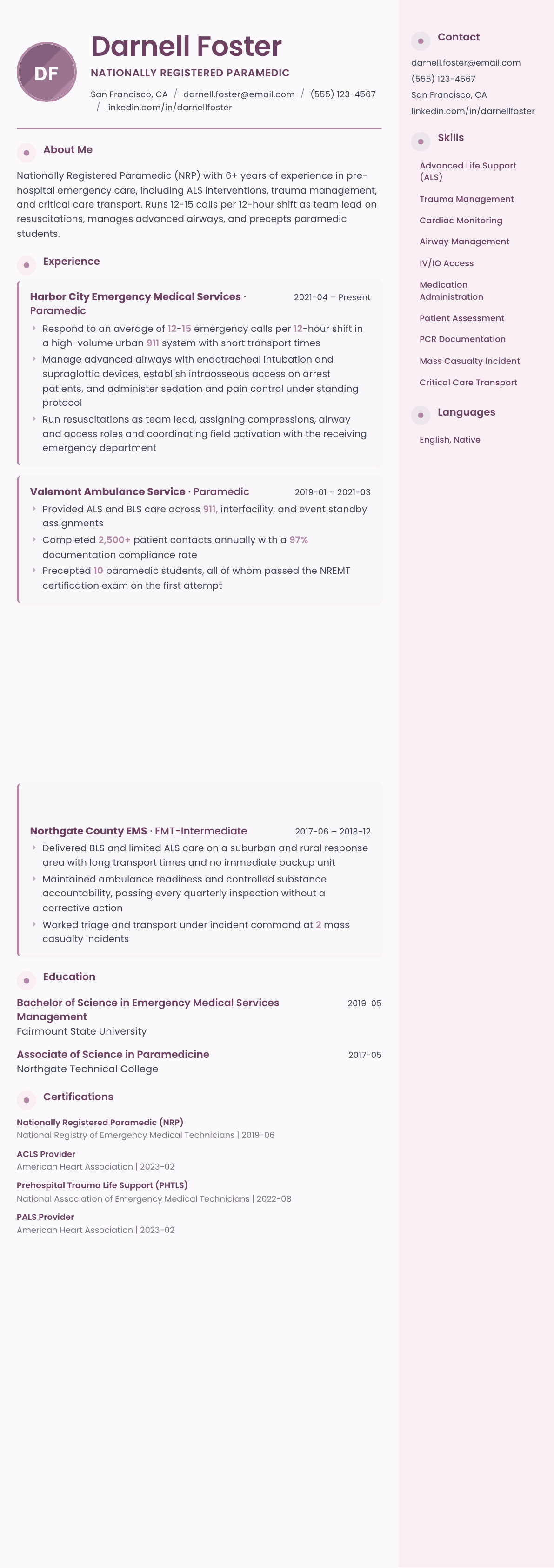
The CVBooster paramedic resume guide has a finished example, three written summaries, before and after bullets and answers to the questions people ask.
Build your paramedic CV
Create my CV