Firefighter Salary, Career Path and CV
By CVBooster TeamPublished Updated
The median firefighter salary in the United States is $59,280 a year, or $28.50 an hour, according to the U.S. Bureau of Labor Statistics (BLS), OEWS May 2025. That is the national middle: states, employers and hours move it, and BLS publishes nothing by years of experience. Most calls are medical, not fires, and the 24-hour shift changes how the pay adds up.
Below: a check of your own pay, the pay percentiles, hourly pay, pay in every state, the top-paying metro areas, what firefighters do, how to become a firefighter, the skills that go on a CV, and a CV example.
- Median annual pay
- $59,280
- Median hourly pay
- $28.50
- Employed, May 2025
- 345,990
Am I underpaid as a firefighter?
Pick your state and type your pay. You get your place in the BLS pay range for firefighters there, as a percentile.
Firefighter salary in the United States
The BLS counts firefighters in the occupation Firefighters (SOC 33-2011). Half of them earn less than $59,280 a year and half earn more. The average, which a few very high earners pull up, is $63,630. The lowest-paid tenth earn $34,910 or less, and the highest-paid tenth earn $101,040 or more, which is about 2.9 times as much. The ratio is our arithmetic on two BLS figures.
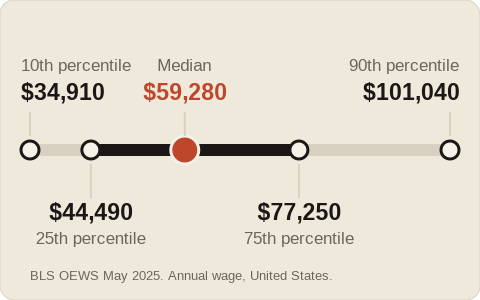
| Measure | Annual wage |
|---|---|
| 10th percentile | $34,910 |
| 25th percentile | $44,490 |
| Median (50th) | $59,280 |
| Mean (average) | $63,630 |
| 75th percentile | $77,250 |
| 90th percentile | $101,040 |
Source: U.S. Bureau of Labor Statistics, Occupational Employment and Wage Statistics (OEWS), May 2025, Firefighters, retrieved 23 to 25 November 2026 from the BLS OEWS May 2025 national, state and metropolitan area files.
Firefighter hourly pay
The median hourly wage for firefighters is $28.50, as published by BLS for May 2025. That is the hourly view of the same national middle as the $59,280 annual median above, so use it when an employer quotes you a rate and not a salary. Annual pay for a job with part-time or shift work depends on the hours you are given, which no national table can tell you.
| Measure | Per hour |
|---|---|
| 10th percentile | $16.78 |
| 25th percentile | $21.39 |
| Median (BLS hourly figure) | $28.50 |
| 75th percentile | $37.14 |
| 90th percentile | $48.58 |
For firefighters the median is the hourly wage BLS publishes. The other rows are our division of the BLS annual percentiles by 2,080 hours, the full-time year BLS uses to turn hourly pay into annual pay.
Firefighter salary by state
Where you work changes the number more than most things. The highest median is in New York, at $100,960. The lowest published median is in Louisiana, at $33,120, a gap of $67,840 a year between two states. The gap is our subtraction of two BLS state medians. All figures below are the annual median wage in each state for May 2025.
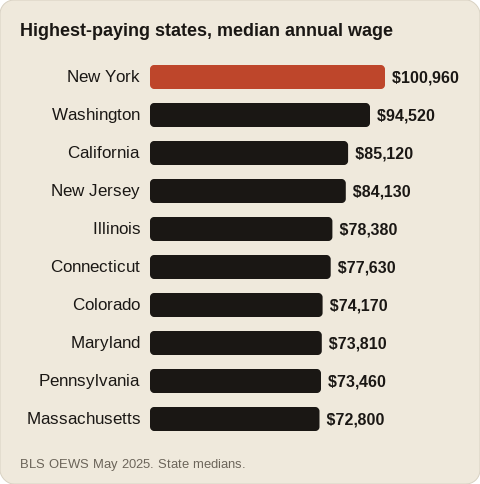
Top-paying states for firefighters
| Rank | State | Median wage | vs US median |
|---|---|---|---|
| 1 | New York | $100,960 | +$41,680 |
| 2 | Washington | $94,520 | +$35,240 |
| 3 | California | $85,120 | +$25,840 |
| 4 | New Jersey | $84,130 | +$24,850 |
| 5 | Illinois | $78,380 | +$19,100 |
| 6 | Connecticut | $77,630 | +$18,350 |
| 7 | Colorado | $74,170 | +$14,890 |
| 8 | Maryland | $73,810 | +$14,530 |
| 9 | Pennsylvania | $73,460 | +$14,180 |
| 10 | Massachusetts | $72,800 | +$13,520 |
Firefighter salary in all 50 states
| State | Median annual wage |
|---|---|
| New York | $100,960 |
| Washington | $94,520 |
| California | $85,120 |
| New Jersey | $84,130 |
| Illinois | $78,380 |
| Connecticut | $77,630 |
| Colorado | $74,170 |
| Maryland | $73,810 |
| Pennsylvania | $73,460 |
| Massachusetts | $72,800 |
| Oregon | $70,900 |
| Rhode Island | $67,380 |
| Nevada | $66,570 |
| Indiana | $62,780 |
| Nebraska | $61,040 |
| Texas | $60,180 |
| Ohio | $59,370 |
| Montana | $59,310 |
| Arizona | $59,280 |
| Alaska | $58,830 |
| Virginia | $58,670 |
| Florida | $58,550 |
| Wyoming | $58,090 |
| New Hampshire | $56,620 |
| Iowa | $55,810 |
| North Dakota | $55,080 |
| Michigan | $54,640 |
| Oklahoma | $49,710 |
| Tennessee | $49,300 |
| Missouri | $49,080 |
| Utah | $48,310 |
| Maine | $48,290 |
| South Dakota | $48,160 |
| Alabama | $47,600 |
| Idaho | $47,320 |
| Wisconsin | $46,850 |
| Delaware | $46,710 |
| Georgia | $46,550 |
| Vermont | $46,430 |
| Kansas | $45,900 |
| South Carolina | $42,570 |
| New Mexico | $41,590 |
| Arkansas | $39,690 |
| Minnesota | $38,110 |
| North Carolina | $37,940 |
| West Virginia | $37,350 |
| Kentucky | $37,150 |
| Mississippi | $35,880 |
| Louisiana | $33,120 |
| Hawaii | Not published by BLS |
BLS does not publish a figure for Hawaii, usually because there are too few firefighters in the survey sample to report one safely.
Top-paying metro areas for firefighters
| Metro area | Median wage | Employed |
|---|---|---|
| San Jose-Sunnyvale-Santa Clara, CA | $152,100 | 1,330 |
| San Francisco-Oakland-Fremont, CA | $113,700 | 3,450 |
| New York-Newark-Jersey City, NY-NJ | $106,420 | 14,960 |
| Bellingham, WA | $101,130 | 320 |
| Seattle-Tacoma-Bellevue, WA | $101,090 | 3,760 |
| Fort Collins-Loveland, CO | $99,930 | 300 |
| Los Angeles-Long Beach-Anaheim, CA | $98,050 | 7,200 |
| Vallejo, CA | $95,950 | 330 |
| Bremerton-Silverdale-Port Orchard, WA | $95,910 | 290 |
| Sacramento-Roseville-Folsom, CA | $94,080 | 2,590 |
BLS publishes the firefighter median for 347 metro areas; the national median is $59,280. Source: U.S. Bureau of Labor Statistics, OEWS May 2025, metropolitan area estimates.
Compare firefighter pay
Put two states side by side, or set firefighters next to another job. Every figure is from BLS OEWS May 2025.
| Measure | New York | Louisiana |
|---|---|---|
| Median annual wage | $100,960 | $33,120 |
| Median hourly wage | $48.54 | $15.92 |
| 10th percentile | $56,390 | $22,510 |
| 25th percentile | $65,420 | $27,510 |
| 75th percentile | $106,430 | $44,770 |
| 90th percentile | $106,440 | $56,670 |
| Employed, May 2025 | 12,950 | 5,230 |
The New York median is $67,840 a year higher. That difference is our subtraction of two BLS state medians. n/a means this page has only the BLS median for that state so far, or BLS released no figure for it. Source: BLS OEWS May 2025, Firefighters.
Starting pay for firefighters
BLS does not publish pay by years of experience, so nobody can honestly quote an official entry-level firefighter salary. What the data gives is the bottom of the market. One in ten firefighters earns $34,910 or less, and one in four earns $44,490 or less. Read those as the low end of the national range, not as what a new graduate will be offered, because older workers sit in the bottom tenth too.
The 24-hour shift and the hourly figure
BLS gives firefighters a median of $59,280 a year and $28.50 an hour. Read the hourly one with care. A common schedule is 24 hours on duty, then 48 or 72 hours off, with overtime common and hours that vary, and BLS does not say how departments count sleeping hours at the station. The yearly median is the safer figure to compare offers with.
Overtime is the other moving part. BLS calls it common but publishes no overtime pay, so the gap between two departments with the same base can come down to how much extra duty is offered.
Who you work for
Local government employs 87 percent of paid firefighters, where BLS puts the median at $59,850. State government, a small employer, pays a higher median of $64,980, and other support services pay $37,520. BLS does not explain why the state figure is higher.
Volunteers do the same duties and are not in these figures at all. In communities of fewer than 25,000 they are the main force, and BLS says a stint as a volunteer may help you land a paid post later.
Top-paying areas, and the medical side
New York has the highest state median at $100,960. By metro area, San Jose-Sunnyvale-Santa Clara, CA leads at $152,100, followed by San Francisco-Oakland-Fremont, CA at $113,700 and New York-Newark-Jersey City, NY-NJ at $106,420, the last with about 14,960 firefighters.
Because most calls are medical, departments often ask for EMT certification, and some for paramedic. For comparison, the national median is $44,470 for EMTs and $60,600 for paramedics, so the firefighter median of $59,280 sits close to the paramedic figure. BLS does not publish what a firefighter who also holds paramedic certification earns.
Related jobs
- EMT salary and career path: The certification many departments require, and a job of its own.
- Paramedic salary and career path: The higher medical credential some departments ask firefighters to hold.
What firefighters do
Firefighters control and put out fires and respond to emergencies that threaten life, property or the environment. BLS says most of their calls are medical emergencies, and they also go to traffic accidents, search-and-rescue operations and disasters.
Some work in hazmat units, trained to control and clean up oil spills and chemical accidents. Wildland firefighters fight forest fires, cut fire lines and use prescribed burns, and smoke jumpers parachute in to reach places no truck can.
Duties BLS lists
- Respond to fires, medical calls and other emergencies
- Drive firetrucks and other emergency vehicles
- Connect hoses to hydrants, run the pumps and climb ladders
- Put out fires with hoses, extinguishers and water pumps
- Find and rescue people from burning buildings and other emergencies
- Treat sick or injured people at the scene
- Write reports on each emergency incident
- Clean, inspect and maintain equipment, and train in rescue and medical drills
A typical day
A shift usually lasts 24 hours at the station. Between calls the crew inspects equipment, runs drills, keeps up physical fitness, and eats and sleeps on site. When the alarm comes it is most often a medical call, sometimes a crash, a rescue or a fire, and every call ends with a written report. Some firefighters also give fire safety talks, for example at schools.
Where they work
- Local government employed 87 percent of paid firefighters, other support services 5 percent and state government 4 percent.
- These counts leave out volunteer firefighters, who BLS says make up the largest share of firefighters nationwide, especially in communities of fewer than 25,000.
- Protective gear can be very heavy and hot. Overtime is common, and a typical pattern is a 24-hour shift followed by 48 or 72 hours off.
- Wildland firefighters may live in a fire camp for days or weeks during a fire, and their work can be seasonal.
Source: U.S. Bureau of Labor Statistics, Occupational Outlook Handbook, Firefighters, read 25 November 2026. BLS counted about 355,300 jobs in 2025 and projects 4% growth from 2025 to 2035, about as fast as the average for all occupations.
How to become a firefighter: the career path
Typical entry-level education, according to BLS: postsecondary nondegree award. Entry-level firefighters train for a few months at a fire academy and then usually serve a probationary period. Each step below comes from the BLS Occupational Outlook Handbook, and the last step is the pay.
- 1Requirements
Diploma, age 18 and a driver's license
Applicants typically need a high school diploma, must be at least 18 and hold a valid driver's license, and must pass a medical exam and a drug screening.
- 2Prepare
Written and physical tests, interviews
Departments test candidates in writing and physically and interview them before hiring. BLS says volunteer firefighting may help in getting a career job.
- 3Train
Fire academy
A few months at an academy run by the department or the state: firefighting and fire prevention, local building codes, emergency medical procedures, and tools such as axes, chain saws, extinguishers and ladders. A probationary period follows.
- 4Certify
EMT, paramedic and driving credentials
Departments may require emergency medical technician (EMT) or paramedic certification, which need continuing education. Some states or localities require a commercial driver's license (CDL) or a firefighter endorsement to drive a firetruck.
- 5Or train
Wildland apprenticeship
Wildland firefighters may train in apprenticeship programs of up to 4 years, combining instruction with work under experienced firefighters.
- 6Advance
Engineer to chief
Promotion runs engineer, lieutenant, captain, battalion chief, assistant chief, deputy chief, chief. Above battalion chief, many departments require a bachelor's degree, preferably in fire science or public administration.
- 7Pay
Median $59,280 a year
BLS median annual wage for firefighters. The lowest-paid tenth earn $34,910 or less and the highest-paid tenth earn $101,040 or more.
The next pay step
Fire lieutenant or captain
$93,530 median a year
+$34,250 a year vs the firefighter median
BLS says firefighters may be promoted to engineer, then lieutenant, captain and on up to chief.
Fire inspector or investigator
$75,920 median a year
+$16,640 a year vs the firefighter median
BLS says some firefighters eventually become fire inspectors or investigators after gaining enough experience.
Pay: U.S. Bureau of Labor Statistics, OEWS May 2025, First-Line Supervisors of Firefighting and Prevention Workers and Fire Inspectors and Investigators, set against Firefighters. Each difference is our subtraction of two BLS national medians, the next job's minus the firefighter median.
Steps 1 to 6 for firefighters: U.S. Bureau of Labor Statistics, Occupational Outlook Handbook, Firefighters, "How to Become One", read 25 November 2026. Pay step: U.S. Bureau of Labor Statistics, OEWS May 2025.
Firefighter skills and certifications
These come from the CVBooster firefighter resume guide, which lists what employers look for on a firefighter CV. Put the ones you really have near the top of your CV, in the words the job ad uses.
Core skills
People skills
Licenses and certifications
- Firefighter I and II, International Fire Service Accreditation Congress
- Hazardous Materials Operations, National Board on Fire Service Professional Qualifications
- Emergency Medical Technician, National Registry of Emergency Medical Technicians
- Candidate Physical Ability Test, International Association of Fire Fighters
Interview questions
Firefighter salary questions
How much do firefighters make a year?
The median is $59,280 a year and the mean is $63,630, according to BLS for May 2025. A tenth of firefighters earn $34,910 or less and a tenth earn $101,040 or more. Volunteer firefighters are not included in these figures.
How much do firefighters make an hour?
The BLS hourly median is $28.50. Many firefighters work 24-hour shifts with 48 or 72 hours off and frequent overtime, and BLS does not say how departments turn those hours into an hourly rate. Compare yearly pay when you can.
Which state pays firefighters the most?
New York has the highest median at $100,960, then Washington at $94,520 and California at $85,120. The lowest published state median is Louisiana at $33,120, so location changes pay a great deal.
Do firefighters need to be EMTs?
Often, yes. BLS says firefighters typically need training in emergency medical services, and many departments require emergency medical technician (EMT) certification, sometimes paramedic certification. The rules vary by state and locality, and continuing education keeps the credentials current.
What is a firefighter schedule like?
A typical pattern is a 24-hour shift on duty followed by 48 or 72 hours off. Firefighters eat and sleep at the station during the shift, and overtime is common. Wildland crews can spend days or weeks at a fire camp, and their work may be seasonal.
How do firefighters get promoted?
BLS lists the ladder as engineer, lieutenant, captain, battalion chief, assistant chief, deputy chief and chief. Beyond battalion chief, many departments want a bachelor's degree, preferably in fire science or public administration. Some experienced firefighters move to fire inspector or investigator jobs.
Sources and method
- Pay: U.S. Bureau of Labor Statistics, Occupational Employment and Wage Statistics (OEWS), May 2025, Firefighters (SOC 33-2011), national, state and metro area estimates, retrieved 23 to 25 November 2026 from the BLS OEWS May 2025 national, state and metropolitan area files. Wages are before tax. BLS defines what its wage figure includes and leaves out in the OEWS technical notes.
- The job, the route in and the outlook: U.S. Bureau of Labor Statistics, Occupational Outlook Handbook, Firefighters, read 25 November 2026.
- Skills and certifications: the CVBooster firefighter resume guide.
- Where we subtract or divide two BLS figures on this firefighter page, the page says so. The pay check is an estimate between the published BLS percentiles for firefighters and says so. Nothing else here is estimated.
Firefighter CV example
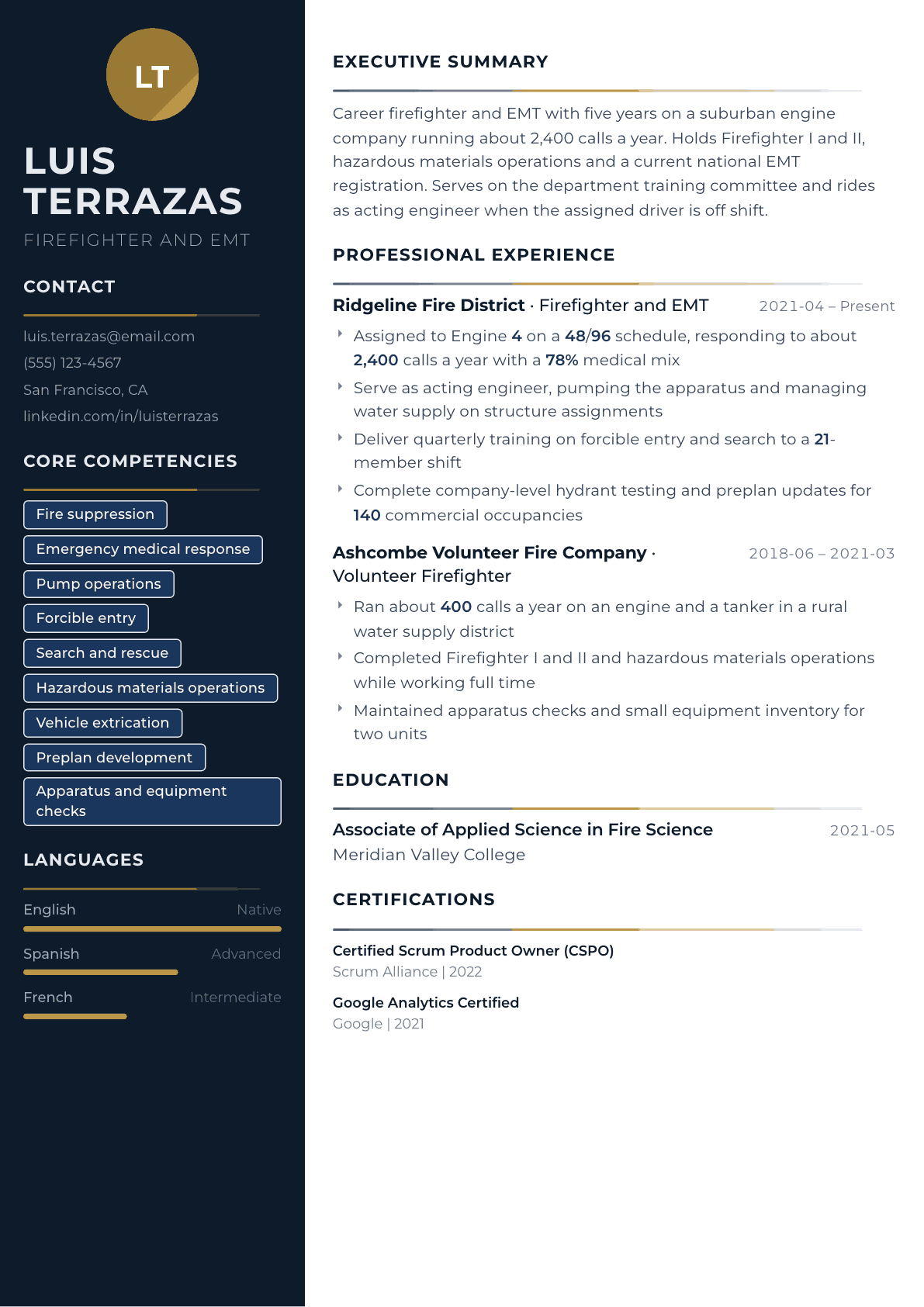
The CVBooster firefighter resume guide has a finished example, three written summaries, before and after bullets and answers to the questions people ask.
Build your firefighter CV
Create my CV