Radiologist Salary, Career Path and CV
By CVBooster TeamPublished Updated
The median radiologist salary in the United States is $420,860 a year, or $202.34 an hour, according to the U.S. Bureau of Labor Statistics (BLS), OEWS May 2025. That is the national middle: states, employers and hours move it, and BLS publishes nothing by years of experience. Only pediatric surgeons and cardiologists have a higher median on the BLS list of physician specialties, and the long training that leads here is laid out step by step below.
Below: a check of your own pay, the pay percentiles, hourly pay, pay by state, the top-paying metro areas, what radiologists do, how to become a radiologist, the skills that go on a CV, and a CV example.
- Median annual pay
- $420,860
- Median hourly pay
- $202.34
- Employed, May 2025
- 26,770
Am I underpaid as a radiologist?
Pick your state and type your pay. You get your place in the BLS pay range for radiologists there, as a percentile.
Radiologist salary in the United States
The BLS counts radiologists in the occupation Radiologists (SOC 29-1224). Half of them earn less than $420,860 a year and half earn more. The average, which a few very high earners pull up, is $381,530. The lowest-paid tenth earn $89,010 or less, and the highest-paid tenth earn $594,410 or more, which is about 6.7 times as much. The ratio is our arithmetic on two BLS figures.
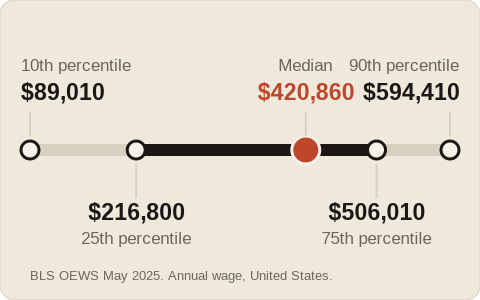
| Measure | Annual wage |
|---|---|
| 10th percentile | $89,010 |
| 25th percentile | $216,800 |
| Median (50th) | $420,860 |
| Mean (average) | $381,530 |
| 75th percentile | $506,010 |
| 90th percentile | $594,410 |
Source: U.S. Bureau of Labor Statistics, Occupational Employment and Wage Statistics (OEWS), May 2025, Radiologists, retrieved 23 to 25 November 2026 from the BLS OEWS May 2025 national, state and metropolitan area files.
Radiologist hourly pay
The median hourly wage for radiologists is $202.34, as published by BLS for May 2025. That is the hourly view of the same national middle as the $420,860 annual median above, so use it when an employer quotes you a rate and not a salary. Annual pay for a job with part-time or shift work depends on the hours you are given, which no national table can tell you.
| Measure | Per hour |
|---|---|
| 10th percentile | $42.79 |
| 25th percentile | $104.23 |
| Median (BLS hourly figure) | $202.34 |
| 75th percentile | $243.27 |
| 90th percentile | $285.77 |
For radiologists the median is the hourly wage BLS publishes. The other rows are our division of the BLS annual percentiles by 2,080 hours, the full-time year BLS uses to turn hourly pay into annual pay.
Radiologist salary by state
Where you work changes the number more than most things. The highest published median is in Minnesota, at $708,340. The lowest published median is in Arkansas, at $75,600, a gap of $632,740 a year between two states. The gap is our subtraction of two BLS state medians. All figures below are the annual median wage in each state for May 2025.
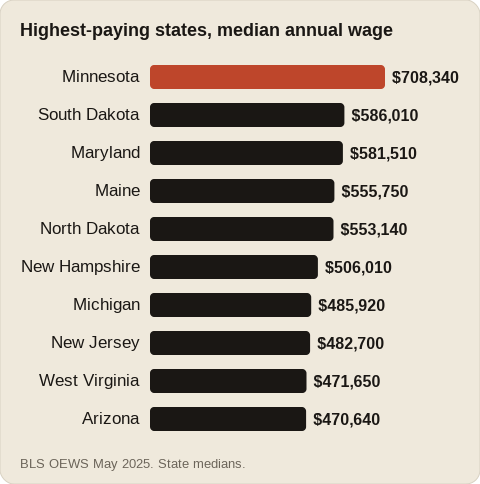
Top-paying states for radiologists
| Rank | State | Median wage | vs US median |
|---|---|---|---|
| 1 | Minnesota | $708,340 | +$287,480 |
| 2 | South Dakota | $586,010 | +$165,150 |
| 3 | Maryland | $581,510 | +$160,650 |
| 4 | Maine | $555,750 | +$134,890 |
| 5 | North Dakota | $553,140 | +$132,280 |
| 6 | New Hampshire | $506,010 | +$85,150 |
| 7 | Michigan | $485,920 | +$65,060 |
| 8 | New Jersey | $482,700 | +$61,840 |
| 9 | West Virginia | $471,650 | +$50,790 |
| 10 | Arizona | $470,640 | +$49,780 |
Radiologist salary by state
| State | Median annual wage |
|---|---|
| Minnesota | $708,340 |
| South Dakota | $586,010 |
| Maryland | $581,510 |
| Maine | $555,750 |
| North Dakota | $553,140 |
| New Hampshire | $506,010 |
| Michigan | $485,920 |
| New Jersey | $482,700 |
| West Virginia | $471,650 |
| Arizona | $470,640 |
| Pennsylvania | $455,380 |
| New York | $441,580 |
| Indiana | $430,640 |
| Massachusetts | $426,560 |
| Florida | $417,690 |
| Utah | $417,250 |
| Iowa | $405,220 |
| Wisconsin | $392,610 |
| Nevada | $386,210 |
| Virginia | $376,270 |
| Montana | $360,330 |
| Colorado | $344,270 |
| Georgia | $335,190 |
| Texas | $319,320 |
| Kentucky | $279,990 |
| California | $270,560 |
| Ohio | $260,000 |
| Connecticut | $191,990 |
| Kansas | $179,990 |
| South Carolina | $174,480 |
| Wyoming | $161,750 |
| New Mexico | $96,170 |
| Arkansas | $75,600 |
| Delaware | $239,200 or more |
| Hawaii | $239,200 or more |
| Illinois | $239,200 or more |
| Oregon | $239,200 or more |
| Washington | $239,200 or more |
| Alabama | Not published by BLS |
| Alaska | Not published by BLS |
| Idaho | Not published by BLS |
| Louisiana | Not published by BLS |
| Mississippi | Not published by BLS |
| Missouri | Not published by BLS |
| Nebraska | Not published by BLS |
| North Carolina | Not published by BLS |
| Oklahoma | Not published by BLS |
| Rhode Island | Not published by BLS |
| Tennessee | Not published by BLS |
| Vermont | Not published by BLS |
In Delaware, Hawaii, Illinois, Oregon, Washington, BLS shows the radiologist median only as $239,200 a year or more, its top code, so those states have no exact figure and are not ranked above.
BLS does not publish a figure for Alabama, Alaska, Idaho, Louisiana, Mississippi, Missouri, Nebraska, North Carolina, Oklahoma, Rhode Island, Tennessee, Vermont, usually because there are too few radiologists in the survey sample to report one safely.
Top-paying metro areas for radiologists
| Metro area | Median wage | Employed |
|---|---|---|
| Minneapolis-St. Paul-Bloomington, MN-WI | $745,230 | 30 |
| Sioux Falls, SD-MN | $669,020 | 50 |
| Huntington-Ashland, WV-KY-OH | $592,050 | 60 |
| Baltimore-Columbia-Towson, MD | $581,510 | n/a |
| Portland-South Portland, ME | $578,230 | n/a |
| Bismarck, ND | $553,140 | 30 |
| Bangor, ME | $550,480 | n/a |
| Phoenix-Mesa-Chandler, AZ | $525,930 | n/a |
| Los Angeles-Long Beach-Anaheim, CA | $488,670 | 310 |
| Charleston, WV | $482,670 | 60 |
BLS publishes the radiologist median for 46 metro areas; the national median is $420,860. 9 of these ten count fewer than 100 radiologists or have no published headcount, so treat them as rough. In 21 more metro areas BLS shows the median only as $239,200 or more, so they cannot be ranked here. Source: U.S. Bureau of Labor Statistics, OEWS May 2025, metropolitan area estimates.
Compare radiologist pay
Put two states side by side, or set radiologists next to another job. Every figure is from BLS OEWS May 2025.
| Measure | Minnesota | Arkansas |
|---|---|---|
| Median annual wage | $708,340 | $75,600 |
| Median hourly wage | $340.55 | $36.35 |
| 10th percentile | $81,490 | $63,800 |
| 25th percentile | $196,980 | $66,640 |
| 75th percentile | $708,340 | $289,680 |
| 90th percentile | $708,340 | $289,680 |
| Employed, May 2025 | 440 | 150 |
The Minnesota median is $632,740 a year higher. That difference is our subtraction of two BLS state medians. n/a means this page has only the BLS median for that state so far, or BLS released no figure for it. Source: BLS OEWS May 2025, Radiologists.
Starting pay for radiologists
BLS does not publish pay by years of experience, so nobody can honestly quote an official entry-level radiologist salary. What the data gives is the bottom of the market. One in ten radiologists earns $89,010 or less, and one in four earns $216,800 or less. Read those as the low end of the national range, not as what a new graduate will be offered, because older workers sit in the bottom tenth too.
Diagnostic and interventional: one pay figure for both
The two branches feel different day to day. A diagnostic radiologist works mostly from images and reports, recommending the next step to someone else. An interventional radiologist also treats the patient, using minimally invasive techniques.
BLS does not split the wage data by branch. The $420,860 median covers every radiologist in the OEWS survey, about 26,770 people, so it says nothing about which branch pays more. A fellowship of 1 to 3 years is how radiologists subspecialize, and BLS does not publish pay by subspecialty either.
The physician at the end of the imaging chain
Radiologic technologists and MRI technologists run the scanners; the radiologist reads what they produce. The pay gap is large. The median radiologic technologist earns $80,110 and the median MRI technologist $95,480, so a radiologist's median is about 5 times the first and 4 times the second, by our division of the BLS medians.
BLS describes the technologist jobs on a separate OOH page, with their own education route. Our radiology tech and MRI tech pages cover those jobs in full.
A state range wider than most jobs
Among the 33 states with an exact BLS median, Minnesota is highest at $708,340 and Arkansas lowest at $75,600. Nationally, the lowest tenth earn $89,010 or less and the highest tenth $594,410 or more. BLS does not explain the low state medians. The top-coded states, Delaware, Hawaii, Illinois, Oregon, Washington, appear only as the top code and are not ranked.
The top metro medians rest on very few people: Minneapolis-St. Paul-Bloomington, MN-WI ($745,230, about 30 radiologists) and Sioux Falls, SD-MN ($669,020, about 50 radiologists). With headcounts that small, treat those medians as rough estimates. A steadier reference in the top ten is Los Angeles-Long Beach-Anaheim, CA ($488,670, about 310 radiologists).
Related jobs
- Radiology Tech salary and career path: The technologists who take the x rays and scans radiologists read.
- MRI Tech salary and career path: The MRI side of the imaging team, with its own pay and training.
- Anesthesiologist salary and career path: Another high-paid physician specialty from the same BLS page.
What radiologists do
Radiologists are physicians who review and interpret x rays and other medical images, such as ultrasounds, to diagnose injuries and diseases. Their findings go back to the doctors treating the patient as a written or dictated report.
BLS names two directions within the field. Diagnostic radiology means reading images and recommending treatment or more testing. Interventional radiology means diagnosing patients and then treating them with minimally invasive techniques.
Duties BLS lists
- Read x rays, ultrasounds and other medical images
- Spot abnormal findings in imaging and other test results
- Write or dictate reports that describe what the images show
- Recommend treatment or further testing to the referring physician
- Treat patients with minimally invasive techniques, in interventional radiology
- Order tests and consultations from other physicians and staff
- Keep patient charts current with findings and treatment
A typical day
For a diagnostic radiologist the day turns on images: studies come in, each one is read for anything abnormal, and the findings go out as a clear report the treating doctor can act on. Interventional radiologists add hands-on procedures to that. Schedules can include long shifts, overnight hours and on-call time, and some physicians travel between an office and the hospital.
Where they work
- Radiologists held 28,700 of the 862,800 physician and surgeon jobs BLS counts for 2025. The page gives no employer breakdown for radiologists alone.
- Physicians work in clinical settings such as offices and hospitals, and some in nonclinical ones such as government agencies, nonprofit organizations and insurance companies.
- Many work in a group practice or healthcare organization. BLS says this helps coordinate patient care but leaves less independence than a solo practice.
- Most physicians work full time, some more than 40 hours a week. When on call, a physician may handle a patient's concerns by phone or go out for an emergency visit.
Source: U.S. Bureau of Labor Statistics, Occupational Outlook Handbook, Physicians and Surgeons, read 25 November 2026. BLS counted about 28,700 jobs in 2025 and projects 3% growth from 2025 to 2035, about as fast as the average for all occupations.
How to become a radiologist: the career path
Typical entry-level education, according to BLS: doctoral or professional degree. After a bachelor's degree, BLS counts 4 more years for the medical degree, then a residency of 3 to 9 years by specialty, and a fellowship of 1 to 3 years for those who subspecialize. Each step below comes from the BLS Occupational Outlook Handbook, and the last step is the pay.
- 1Study
Undergraduate degree
Any major can lead to medical school, though most applicants studied biology, physical science or a healthcare field. Some schools run combined undergraduate and medical programs of 6 to 8 years.
- 2Study
Medical school, M.D. or D.O.
Admission needs transcripts, MCAT scores, recommendation letters and usually an interview. The degree takes 4 years: classroom science first, then supervised clerkships in areas such as internal medicine, pediatrics and surgery.
- 3Train
Radiology residency
Residencies take place in a hospital or clinic and last 3 to 9 years across all specialties. BLS does not give a length for radiology on its own.
- 4Specialize
Fellowship, if you subspecialize
Subspecializing means a fellowship of 1 to 3 years on top of the residency.
- 5License
Physician license
All states license physicians. Candidates graduate from an accredited medical school, complete residency in their specialty and pass standardized national exams; your state medical board has the rules.
- 6Certify
Specialty board exam
Board certification is optional, though BLS says it may improve job prospects. It requires a finished residency and a passed specialty exam from a medical certifying board.
- 7Pay
Median $420,860 a year
BLS median annual wage for radiologists. The lowest-paid tenth earn $89,010 or less and the highest-paid tenth earn $594,410 or more.
Steps 1 to 6 for radiologists: U.S. Bureau of Labor Statistics, Occupational Outlook Handbook, Physicians and Surgeons, "How to Become One", read 25 November 2026. Pay step: U.S. Bureau of Labor Statistics, OEWS May 2025.
Radiologist skills and certifications
These come from the CVBooster radiologist resume guide, which lists what employers look for on a radiologist CV. Put the ones you really have near the top of your CV, in the words the job ad uses.
Core skills
People skills
Licenses and certifications
- Diagnostic Radiology Certification, American Board of Radiology
- Neuroradiology Subspecialty Certification, American Board of Radiology
- Pediatric Radiology Subspecialty Certification, American Board of Radiology
- Vascular and Interventional Radiology Certification, American Board of Radiology
- Basic Life Support (BLS), American Heart Association
More guides
Radiologist salary questions
What is the average radiologist salary?
BLS puts the mean radiologist wage at $381,530 a year and the median at $420,860. The median is the better guide here, because the lowest tenth earn $89,010 or less and pull the mean down. Figures are OEWS, May 2025.
How many years does it take to become a radiologist?
Count a bachelor's degree, then 4 years of medical school, then residency. BLS puts residencies at 3 to 9 years depending on the specialty, without a separate figure for radiology, and subspecialty fellowships add 1 to 3 years.
What is the difference between a radiologist and a radiology tech?
The radiologist is a physician who interprets images and diagnoses. The technologist performs the imaging. BLS medians are $420,860 for radiologists and $80,110 for radiologic technologists.
How much do radiologists make per hour?
The BLS median hourly wage for radiologists is $202.34. Many physicians work more than 40 hours a week and take on-call time, so the annual figure is usually the more useful one.
What state pays radiologists the most?
Minnesota has the highest exact BLS median, $708,340, followed by South Dakota at $586,010. 5 states show only the BLS top code, so their exact pay is not published and they cannot be compared.
What does an interventional radiologist do?
BLS describes interventional radiology as diagnosing patients and treating them with minimally invasive techniques. Diagnostic radiologists, by contrast, review images and recommend treatment or more testing. BLS publishes one wage figure for radiologists as a whole.
Sources and method
- Pay: U.S. Bureau of Labor Statistics, Occupational Employment and Wage Statistics (OEWS), May 2025, Radiologists (SOC 29-1224), national, state and metro area estimates, retrieved 23 to 25 November 2026 from the BLS OEWS May 2025 national, state and metropolitan area files. Wages are before tax. BLS defines what its wage figure includes and leaves out in the OEWS technical notes.
- The job, the route in and the outlook: U.S. Bureau of Labor Statistics, Occupational Outlook Handbook, Physicians and Surgeons, read 25 November 2026.
- Skills and certifications: the CVBooster radiologist resume guide.
- Where we subtract or divide two BLS figures on this radiologist page, the page says so. The pay check is an estimate between the published BLS percentiles for radiologists and says so. Nothing else here is estimated.
Radiologist CV example
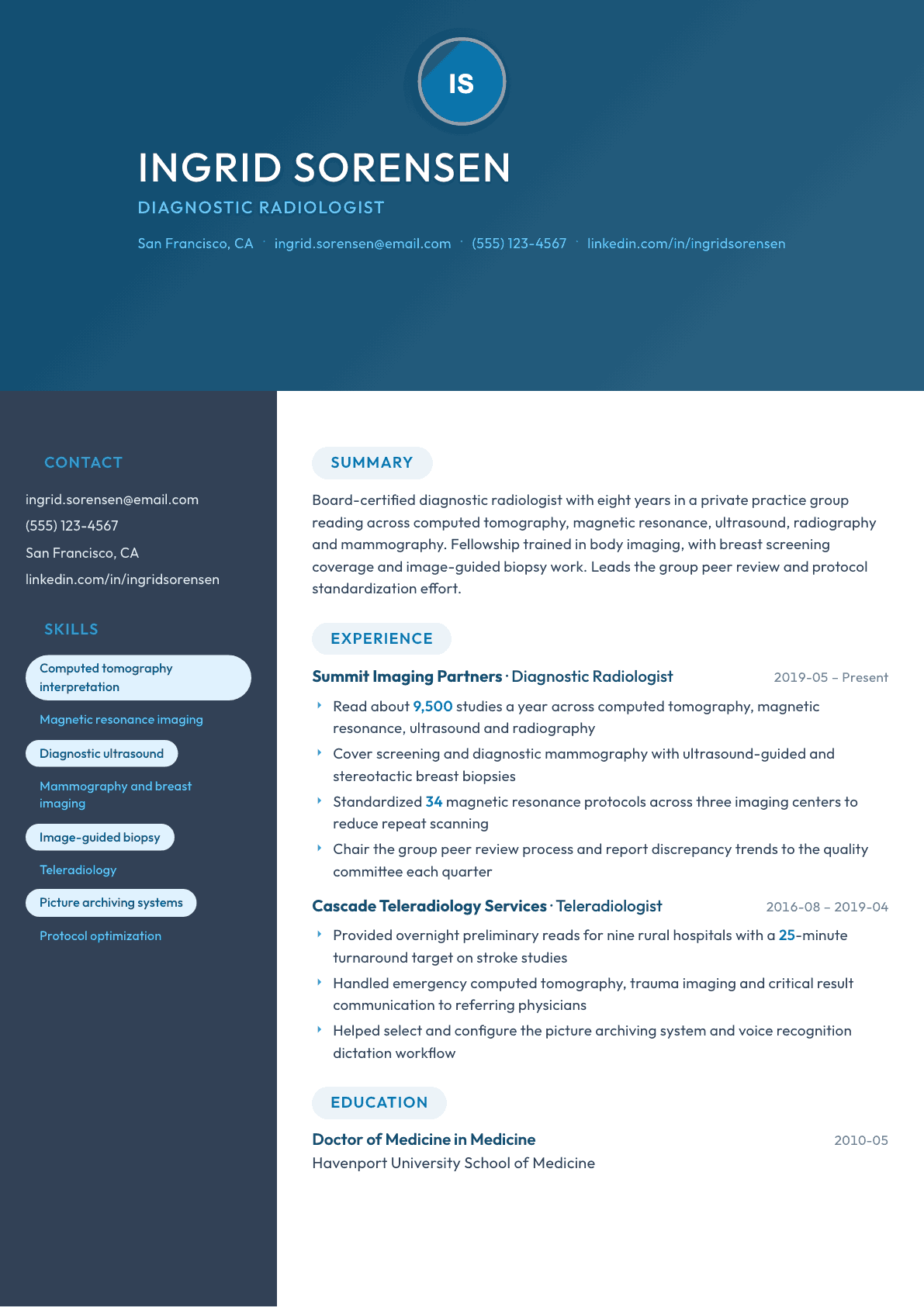
The CVBooster radiologist resume guide has a finished example, three written summaries, before and after bullets and answers to the questions people ask.
Build your radiologist CV
Create my CV