MRI Tech Salary, Career Path and CV
By CVBooster TeamPublished Updated
The median MRI tech salary in the United States is $95,480 a year, or $45.91 an hour, according to the U.S. Bureau of Labor Statistics (BLS), OEWS May 2025. That is the national middle: states, employers and hours move it, and BLS publishes nothing by years of experience. BLS calls the job magnetic resonance imaging technologist. The usual road to the scanner runs through x ray work, and the step is worth $15,370 a year at the median.
Below: a check of your own pay, the pay percentiles, hourly pay, pay in every state, the top-paying metro areas, what MRI techs do, how to become an MRI tech, the skills that go on a CV, and a CV example.
- Median annual pay
- $95,480
- Median hourly pay
- $45.91
- Employed, May 2025
- 43,390
Am I underpaid as an MRI tech?
Pick your state and type your pay. You get your place in the BLS pay range for MRI techs there, as a percentile.
MRI Tech salary in the United States
The BLS counts MRI techs in the occupation Magnetic Resonance Imaging Technologists (SOC 29-2035). Half of them earn less than $95,480 a year and half earn more. The average, which a few very high earners pull up, is $96,120. The lowest-paid tenth earn $68,890 or less, and the highest-paid tenth earn $127,670 or more, which is about 1.9 times as much. The ratio is our arithmetic on two BLS figures.
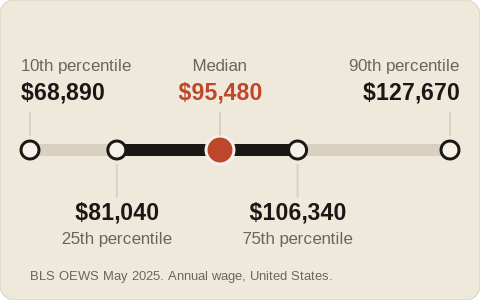
| Measure | Annual wage |
|---|---|
| 10th percentile | $68,890 |
| 25th percentile | $81,040 |
| Median (50th) | $95,480 |
| Mean (average) | $96,120 |
| 75th percentile | $106,340 |
| 90th percentile | $127,670 |
Source: U.S. Bureau of Labor Statistics, Occupational Employment and Wage Statistics (OEWS), May 2025, Magnetic Resonance Imaging Technologists, retrieved 23 to 25 November 2026 from the BLS OEWS May 2025 national, state and metropolitan area files.
MRI Tech hourly pay
The median hourly wage for MRI techs is $45.91, as published by BLS for May 2025. That is the hourly view of the same national middle as the $95,480 annual median above, so use it when an employer quotes you a rate and not a salary. Annual pay for a job with part-time or shift work depends on the hours you are given, which no national table can tell you.
| Measure | Per hour |
|---|---|
| 10th percentile | $33.12 |
| 25th percentile | $38.96 |
| Median (BLS hourly figure) | $45.91 |
| 75th percentile | $51.13 |
| 90th percentile | $61.38 |
For MRI techs the median is the hourly wage BLS publishes. The other rows are our division of the BLS annual percentiles by 2,080 hours, the full-time year BLS uses to turn hourly pay into annual pay.
MRI Tech salary by state
Where you work changes the number more than most things. The highest median is in California, at $124,000. The lowest published median is in Mississippi, at $71,710, a gap of $52,290 a year between two states. The gap is our subtraction of two BLS state medians. All figures below are the annual median wage in each state for May 2025.
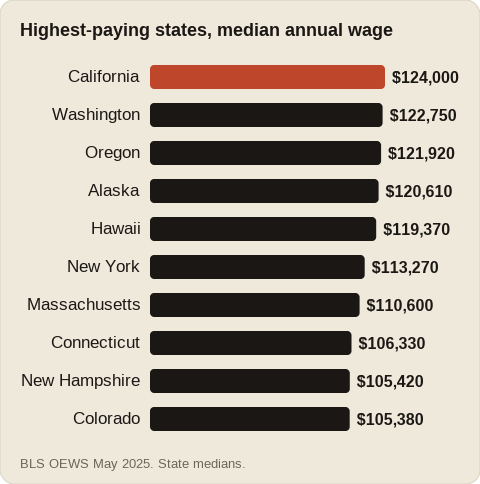
Top-paying states for MRI techs
| Rank | State | Median wage | vs US median |
|---|---|---|---|
| 1 | California | $124,000 | +$28,520 |
| 2 | Washington | $122,750 | +$27,270 |
| 3 | Oregon | $121,920 | +$26,440 |
| 4 | Alaska | $120,610 | +$25,130 |
| 5 | Hawaii | $119,370 | +$23,890 |
| 6 | New York | $113,270 | +$17,790 |
| 7 | Massachusetts | $110,600 | +$15,120 |
| 8 | Connecticut | $106,330 | +$10,850 |
| 9 | New Hampshire | $105,420 | +$9,940 |
| 10 | Colorado | $105,380 | +$9,900 |
MRI Tech salary in all 50 states
| State | Median annual wage |
|---|---|
| California | $124,000 |
| Washington | $122,750 |
| Oregon | $121,920 |
| Alaska | $120,610 |
| Hawaii | $119,370 |
| New York | $113,270 |
| Massachusetts | $110,600 |
| Connecticut | $106,330 |
| New Hampshire | $105,420 |
| Colorado | $105,380 |
| Maryland | $105,230 |
| Rhode Island | $105,060 |
| New Jersey | $103,930 |
| Delaware | $103,510 |
| Vermont | $103,070 |
| Idaho | $101,680 |
| Minnesota | $100,900 |
| Arizona | $100,600 |
| Virginia | $98,640 |
| Nevada | $98,260 |
| Texas | $96,780 |
| Illinois | $95,380 |
| Wisconsin | $94,720 |
| Maine | $94,140 |
| Georgia | $92,060 |
| Wyoming | $92,010 |
| Utah | $91,150 |
| Pennsylvania | $91,120 |
| New Mexico | $87,850 |
| Ohio | $87,670 |
| Oklahoma | $87,480 |
| Montana | $86,950 |
| Indiana | $86,880 |
| North Carolina | $85,120 |
| Michigan | $84,620 |
| Florida | $84,330 |
| South Carolina | $83,550 |
| Missouri | $83,110 |
| Nebraska | $82,710 |
| Kansas | $82,670 |
| Kentucky | $82,200 |
| Iowa | $81,420 |
| North Dakota | $80,610 |
| West Virginia | $80,490 |
| Alabama | $78,890 |
| Arkansas | $78,780 |
| Tennessee | $78,610 |
| Louisiana | $77,510 |
| South Dakota | $77,010 |
| Mississippi | $71,710 |
Top-paying metro areas for MRI techs
| Metro area | Median wage | Employed |
|---|---|---|
| San Jose-Sunnyvale-Santa Clara, CA | $176,950 | 220 |
| Vallejo, CA | $176,650 | 30 |
| San Francisco-Oakland-Fremont, CA | $146,260 | 420 |
| Sacramento-Roseville-Folsom, CA | $144,810 | 220 |
| Seattle-Tacoma-Bellevue, WA | $130,460 | 460 |
| Modesto, CA | $126,980 | 50 |
| Santa Maria-Santa Barbara, CA | $125,660 | 30 |
| Boston-Cambridge-Newton, MA-NH | $123,910 | 1,160 |
| San Diego-Chula Vista-Carlsbad, CA | $123,080 | 320 |
| Bridgeport-Stamford-Danbury, CT | $121,930 | 80 |
BLS publishes the MRI tech median for 174 metro areas; the national median is $95,480. 4 of these ten count fewer than 100 MRI techs or have no published headcount, so treat them as rough. Source: U.S. Bureau of Labor Statistics, OEWS May 2025, metropolitan area estimates.
Compare MRI tech pay
Put two states side by side, or set MRI techs next to another job. Every figure is from BLS OEWS May 2025.
| Measure | California | Mississippi |
|---|---|---|
| Median annual wage | $124,000 | $71,710 |
| Median hourly wage | $59.62 | $34.48 |
| 10th percentile | $74,360 | $54,080 |
| 25th percentile | $92,970 | $62,730 |
| 75th percentile | $151,760 | $79,710 |
| 90th percentile | $174,030 | $82,730 |
| Employed, May 2025 | 3,570 | 250 |
The California median is $52,290 a year higher. That difference is our subtraction of two BLS state medians. n/a means this page has only the BLS median for that state so far, or BLS released no figure for it. Source: BLS OEWS May 2025, Magnetic Resonance Imaging Technologists.
Starting pay for MRI techs
BLS does not publish pay by years of experience, so nobody can honestly quote an official entry-level MRI tech salary. What the data gives is the bottom of the market. One in ten MRI techs earns $68,890 or less, and one in four earns $81,040 or less. Read those as the low end of the national range, not as what a new graduate will be offered, because older workers sit in the bottom tenth too.
What the move from x ray to MRI is worth
BLS puts the MRI technologist median at $95,480 and the radiologic technologist median at $80,110. That is $15,370 a year more for MRI, by our subtraction. Both jobs start with an associate's degree, so BLS does not explain the gap, but it does say MRI work typically needs less than 5 years of related experience first, most often in radiologic work.
The difference holds at the low end too. The MRI 10th percentile, $68,890, is above the point a quarter of the way up the radiologic technologist range, $64,810. BLS also projects 8 percent growth for MRI technologists against 5 percent for radiologic technologists, though the MRI group is far smaller.
Where the scanner pays most
Employer type barely moves MRI pay. BLS gives industry medians of $95,920 in hospitals, $93,880 in offices of physicians and $93,540 in medical and diagnostic laboratories. Place moves it much more: 7 of the ten highest-paying metro areas are in California, led by San Jose-Sunnyvale-Santa Clara, CA at $176,950.
Read the metro list with care. Vallejo, CA (about 30 technologists); Modesto, CA (about 50 technologists); Santa Maria-Santa Barbara, CA (about 30 technologists) are small groups, and BLS metro medians for small groups are estimates that can shift a lot from one year to the next. The state medians in the tables above rest on more workers.
Magnets, not x rays
The BLS rules on radiation badges, lead aprons and lifetime dose records are written for radiologic technologists, who work with equipment that uses radiation. MRI technologists work with magnetic fields and contrast agents instead. BLS does not say whether MRI staff wear radiation badges.
Licensing differs in the same way. Most states license or certify radiologic technologists, while few states require a license for MRI technologists. In practice the employer sets the bar, since BLS says certification is typically required or preferred either way.
Related jobs
- Radiology Tech salary and career path: The x ray and CT job most MRI technologists come from, with its own pay by state.
- Ultrasound Tech salary and career path: Another imaging job BLS lists as similar, also usually entered with an associate's degree.
- Radiologist salary and career path: The physicians who read the images MRI technologists produce.
What MRI techs do
MRI technologists operate magnetic resonance imaging scanners to make the diagnostic images a physician uses to find medical problems. BLS profiles them on the same page as radiologic technologists, who work in x ray and computed tomography (CT), but MRI technologists specialize in the magnetic scanner alone.
For many scans they inject the patient with contrast media, such as a dye, so the tissue shows up. The scanner then combines magnetic fields with that contrast agent to produce the pictures.
Duties BLS lists
- Set up, adjust and look after the MRI scanner
- Work from the physician's order on which part of the body to scan
- Take a medical history and get the patient ready before the scan
- Inject contrast media, such as a dye, so the images show up on the scanner
- Position the patient and the equipment to capture the image the order asks for
- Run the computerized controls that produce the images
- Go over the images with physicians and decide whether more are needed
- Keep a detailed record for every patient scanned
A typical day
Each scan follows the same arc. Read the order, take the history, put a patient who may be stressed or in pain at ease, inject contrast where it is used, position them, operate the scanner, then check the images with the physician and write the record. Because imaging is sometimes needed in emergencies, some shifts fall in the evening, at weekends or overnight.
Where they work
- Hospitals (state, local and private) employed 61 percent of MRI technologists, medical and diagnostic laboratories 17 percent and offices of physicians 14 percent.
- BLS counted about 43,900 MRI technologist jobs in 2025, out of 278,100 for radiologic and MRI technologists together.
- Long stretches on your feet are normal, and technologists may need to lift or turn patients who cannot move on their own.
- Like other healthcare workers, MRI technologists may be exposed to infectious diseases.
Source: U.S. Bureau of Labor Statistics, Occupational Outlook Handbook, Radiologic and MRI Technologists, read 25 November 2026. BLS counted about 43,900 jobs in 2025 and projects 8% growth from 2025 to 2035, much faster than the average for all occupations.
How to become an MRI tech: the career path
Typical entry-level education, according to BLS: associate's degree. On top of the degree, BLS says MRI technologists typically need less than 5 years of related work experience, most often as a radiologic technologist. Each step below comes from the BLS Occupational Outlook Handbook, and the last step is the pay.
- 1Study
Associate's degree
The typical entry education. Coursework covers anatomy, pathology, patient care, radiation physics and protection, and image evaluation, usually with clinical work. Graduate certificate and bachelor's programs in related fields also exist.
- 2Experience
Related work first
MRI technologists typically need less than 5 years of experience in a related occupation, most often as a radiologic technologist.
- 3Certify
Certification employers ask for
Employers typically require or prefer certified technologists even where the state does not. Many also want certification in CPR or basic life support (BLS).
- 4License
Check the state health board
Few states require a license for MRI technologists and the rules vary, so BLS sends you to the state health board for the exact requirements.
- 5Work
Hospitals and imaging labs
Most MRI jobs are in hospitals. The rest are mainly in medical and diagnostic laboratories and physician offices.
- 6Pay
Median $95,480 a year
BLS median annual wage for MRI techs. The lowest-paid tenth earn $68,890 or less and the highest-paid tenth earn $127,670 or more.
Steps 1 to 5 for MRI techs: U.S. Bureau of Labor Statistics, Occupational Outlook Handbook, Radiologic and MRI Technologists, "How to Become One", read 25 November 2026. Pay step: U.S. Bureau of Labor Statistics, OEWS May 2025.
MRI Tech skills and certifications
These come from the CVBooster MRI tech resume guide, which lists what employers look for on a MRI tech CV. Put the ones you really have near the top of your CV, in the words the job ad uses.
Core skills
People skills
Licenses and certifications
- Magnetic Resonance Imaging postprimary certification, R.T.(MR), American Registry of Radiologic Technologists
- MR Safety Officer (MRSO), American Board of Magnetic Resonance Safety
- Basic Life Support (BLS), American Heart Association
More guides
MRI Tech salary questions
How much do MRI techs make a year?
Half of MRI technologists earned more than $95,480 in May 2025 and half earned less. The mean was $96,120. The bottom tenth earned $68,890 or less and the top tenth $127,670 or more, according to U.S. Bureau of Labor Statistics, OEWS May 2025.
What is the hourly pay for an MRI technologist?
The BLS median is $45.91 an hour. Most MRI technologists work full time, and some cover evening, weekend or overnight imaging for emergencies. BLS does not publish a separate rate for those shifts, so ask each employer about differentials.
Do MRI techs make more than x ray techs?
Yes, at the median. MRI technologists earn $95,480 and radiologic technologists and technicians $80,110, a difference of $15,370 a year by our subtraction of the two BLS medians. The MRI job typically asks for related experience first, most often in radiologic work.
Which state pays MRI technologists the most?
California, with a median of $124,000. Washington ($122,750) and Oregon ($121,920) come next, and the lowest published state median is Mississippi at $71,710. BLS publishes a figure for 50 states, all in the table above.
Can you become an MRI tech without being an x ray tech first?
BLS says MRI technologists may start out as radiologic technologists and typically need less than 5 years of related experience, most often from that work. Both jobs usually start with an associate's degree. BLS does not describe a route that skips related experience, so check what employers near you ask for.
Do MRI technologists need a license?
Few states require one, BLS says, and the rules vary, so the state health board has the final word. Employers are stricter: they typically require or prefer certified technologists, and many also ask for CPR or basic life support certification.
Sources and method
- Pay: U.S. Bureau of Labor Statistics, Occupational Employment and Wage Statistics (OEWS), May 2025, Magnetic Resonance Imaging Technologists (SOC 29-2035), national, state and metro area estimates, retrieved 23 to 25 November 2026 from the BLS OEWS May 2025 national, state and metropolitan area files. Wages are before tax. BLS defines what its wage figure includes and leaves out in the OEWS technical notes.
- The job, the route in and the outlook: U.S. Bureau of Labor Statistics, Occupational Outlook Handbook, Radiologic and MRI Technologists, read 25 November 2026.
- Skills and certifications: the CVBooster MRI tech resume guide.
- Where we subtract or divide two BLS figures on this MRI tech page, the page says so. The pay check is an estimate between the published BLS percentiles for MRI techs and says so. Nothing else here is estimated.
MRI Tech CV example
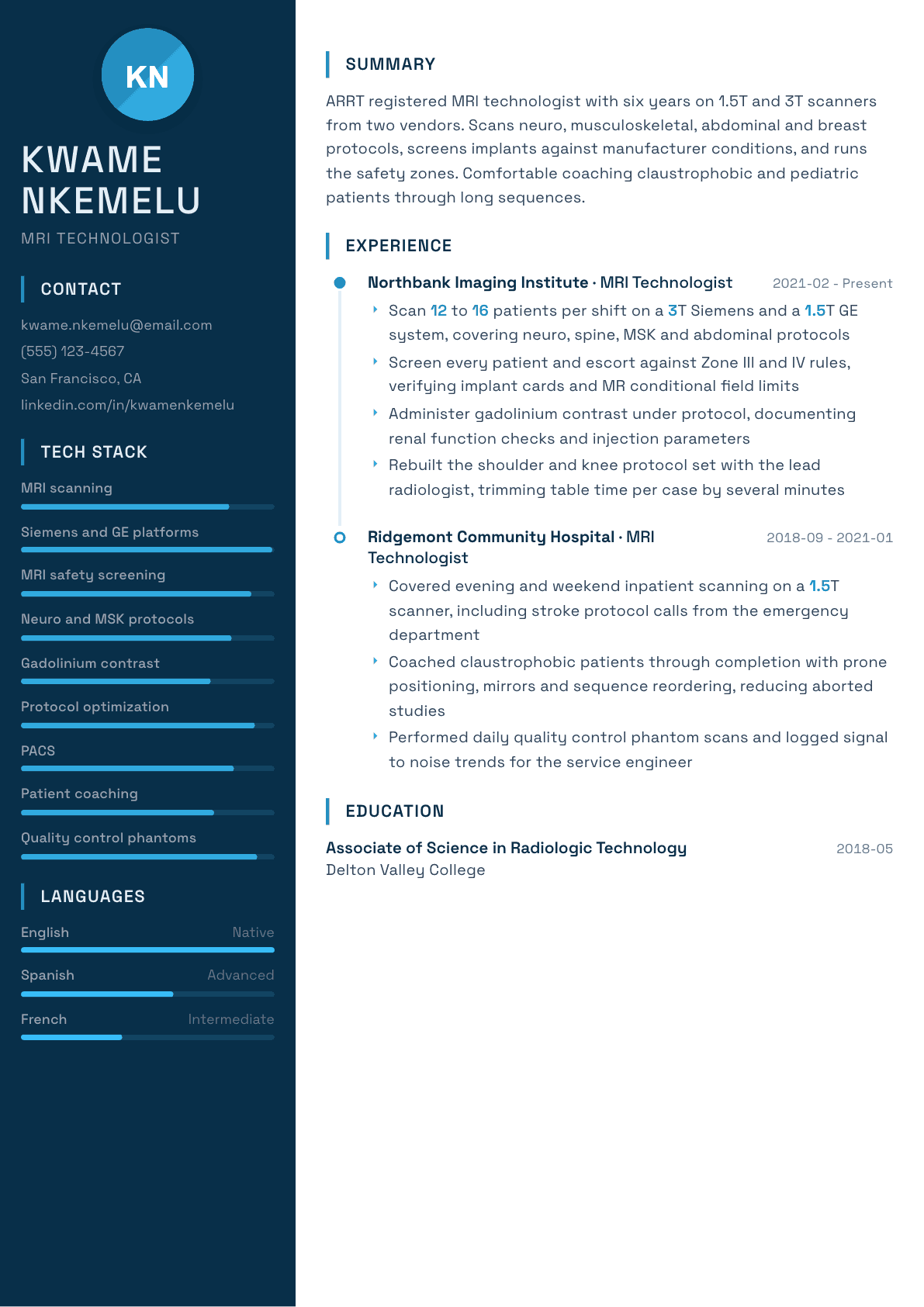
The CVBooster MRI tech resume guide has a finished example, three written summaries, before and after bullets and answers to the questions people ask.
Build your MRI tech CV
Create my CV