Electrical Engineer Salary, Career Path and CV
By CVBooster TeamPublished Updated
The median electrical engineer salary in the United States is $120,630 a year, or $58.00 an hour, according to the U.S. Bureau of Labor Statistics (BLS), OEWS May 2025. That is the national middle: states, employers and hours move it, and BLS publishes nothing by years of experience. BLS covers electrical and electronics engineers on one OOH page. The pay figures here are for electrical engineers alone. Motors, power plants, radar, the wiring of a car or a plane: what you design decides a good part of what you earn.
Below: a check of your own pay, the pay percentiles, hourly pay, pay in every state, the top-paying metro areas, what electrical engineers do, how to become an electrical engineer, the skills that go on a CV, and a CV example.
- Median annual pay
- $120,630
- Median hourly pay
- $58.00
- Employed, May 2025
- 198,750
Am I underpaid as an electrical engineer?
Pick your state and type your pay. You get your place in the BLS pay range for electrical engineers there, as a percentile.
Electrical Engineer salary in the United States
The BLS counts electrical engineers in the occupation Electrical Engineers (SOC 17-2071). Half of them earn less than $120,630 a year and half earn more. The average, which a few very high earners pull up, is $125,100. The lowest-paid tenth earn $76,550 or less, and the highest-paid tenth earn $184,300 or more, which is about 2.4 times as much. The ratio is our arithmetic on two BLS figures.
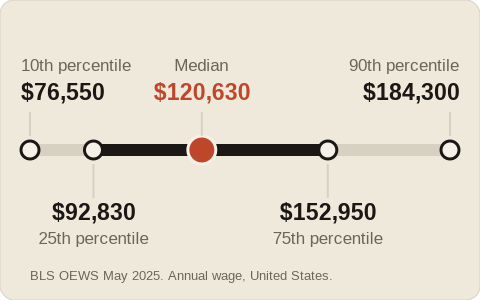
| Measure | Annual wage |
|---|---|
| 10th percentile | $76,550 |
| 25th percentile | $92,830 |
| Median (50th) | $120,630 |
| Mean (average) | $125,100 |
| 75th percentile | $152,950 |
| 90th percentile | $184,300 |
Source: U.S. Bureau of Labor Statistics, Occupational Employment and Wage Statistics (OEWS), May 2025, Electrical Engineers, retrieved 23 to 25 November 2026 from the BLS OEWS May 2025 national, state and metropolitan area files.
Electrical Engineer hourly pay
The median hourly wage for electrical engineers is $58.00, as published by BLS for May 2025. That is the hourly view of the same national middle as the $120,630 annual median above, so use it when an employer quotes you a rate and not a salary. Annual pay for a job with part-time or shift work depends on the hours you are given, which no national table can tell you.
| Measure | Per hour |
|---|---|
| 10th percentile | $36.80 |
| 25th percentile | $44.63 |
| Median (BLS hourly figure) | $58.00 |
| 75th percentile | $73.53 |
| 90th percentile | $88.61 |
For electrical engineers the median is the hourly wage BLS publishes. The other rows are our division of the BLS annual percentiles by 2,080 hours, the full-time year BLS uses to turn hourly pay into annual pay.
Electrical Engineer salary by state
Where you work changes the number more than most things. The highest median is in New Mexico, at $158,520. The lowest published median is in Montana, at $87,360, a gap of $71,160 a year between two states. The gap is our subtraction of two BLS state medians. All figures below are the annual median wage in each state for May 2025.
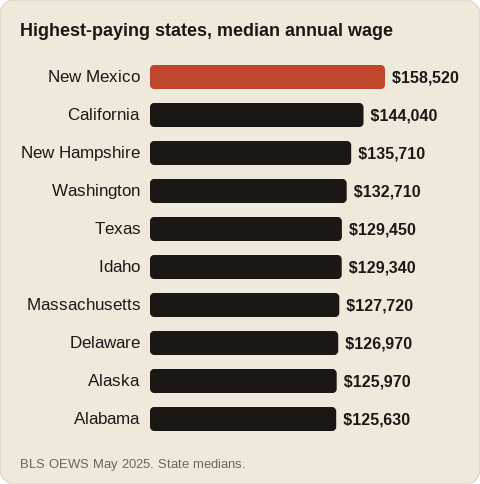
Top-paying states for electrical engineers
| Rank | State | Median wage | vs US median |
|---|---|---|---|
| 1 | New Mexico | $158,520 | +$37,890 |
| 2 | California | $144,040 | +$23,410 |
| 3 | New Hampshire | $135,710 | +$15,080 |
| 4 | Washington | $132,710 | +$12,080 |
| 5 | Texas | $129,450 | +$8,820 |
| 6 | Idaho | $129,340 | +$8,710 |
| 7 | Massachusetts | $127,720 | +$7,090 |
| 8 | Delaware | $126,970 | +$6,340 |
| 9 | Alaska | $125,970 | +$5,340 |
| 10 | Alabama | $125,630 | +$5,000 |
Electrical Engineer salary in all 50 states
| State | Median annual wage |
|---|---|
| New Mexico | $158,520 |
| California | $144,040 |
| New Hampshire | $135,710 |
| Washington | $132,710 |
| Texas | $129,450 |
| Idaho | $129,340 |
| Massachusetts | $127,720 |
| Delaware | $126,970 |
| Alaska | $125,970 |
| Alabama | $125,630 |
| New Jersey | $125,370 |
| Oregon | $125,160 |
| Maryland | $125,150 |
| Louisiana | $123,710 |
| Colorado | $120,760 |
| Virginia | $119,030 |
| New York | $119,010 |
| Missouri | $118,670 |
| Maine | $114,620 |
| West Virginia | $113,420 |
| Wyoming | $111,740 |
| Vermont | $111,310 |
| Pennsylvania | $110,820 |
| North Dakota | $110,810 |
| North Carolina | $110,130 |
| Minnesota | $109,510 |
| Illinois | $107,860 |
| Oklahoma | $107,760 |
| Nevada | $107,400 |
| Nebraska | $107,260 |
| Hawaii | $106,350 |
| Michigan | $106,070 |
| Iowa | $105,820 |
| Utah | $105,720 |
| Mississippi | $104,990 |
| Florida | $104,780 |
| Tennessee | $104,450 |
| Connecticut | $104,160 |
| Indiana | $102,670 |
| Kansas | $102,630 |
| Ohio | $100,620 |
| Arizona | $100,550 |
| Wisconsin | $99,700 |
| South Dakota | $98,980 |
| Kentucky | $98,550 |
| South Carolina | $98,440 |
| Arkansas | $96,860 |
| Montana | $87,360 |
| Georgia | Not published by BLS |
| Rhode Island | Not published by BLS |
BLS does not publish a figure for Georgia, Rhode Island, usually because there are too few electrical engineers in the survey sample to report one safely.
Top-paying metro areas for electrical engineers
| Metro area | Median wage | Employed |
|---|---|---|
| San Jose-Sunnyvale-Santa Clara, CA | $187,060 | 4,160 |
| Slidell-Mandeville-Covington, LA | $167,010 | 50 |
| San Francisco-Oakland-Fremont, CA | $166,030 | 2,470 |
| Santa Rosa-Petaluma, CA | $164,880 | 100 |
| Albuquerque, NM | $163,720 | 1,280 |
| Vallejo, CA | $160,060 | 150 |
| Manchester-Nashua, NH | $159,360 | 1,050 |
| Austin-Round Rock-San Marcos, TX | $145,360 | 4,070 |
| Seattle-Tacoma-Bellevue, WA | $140,210 | 4,930 |
| Los Angeles-Long Beach-Anaheim, CA | $139,780 | 8,970 |
BLS publishes the electrical engineer median for 317 metro areas; the national median is $120,630. 1 of these ten count fewer than 100 electrical engineers or have no published headcount, so treat them as rough. Source: U.S. Bureau of Labor Statistics, OEWS May 2025, metropolitan area estimates.
Compare electrical engineer pay
Put two states side by side, or set electrical engineers next to another job. Every figure is from BLS OEWS May 2025.
| Measure | New Mexico | Montana |
|---|---|---|
| Median annual wage | $158,520 | $87,360 |
| Median hourly wage | $76.21 | $42.00 |
| 10th percentile | $102,880 | $72,910 |
| 25th percentile | $127,540 | $76,400 |
| 75th percentile | $196,240 | $112,760 |
| 90th percentile | $202,680 | $133,180 |
| Employed, May 2025 | 2,560 | 790 |
The New Mexico median is $71,160 a year higher. That difference is our subtraction of two BLS state medians. n/a means this page has only the BLS median for that state so far, or BLS released no figure for it. Source: BLS OEWS May 2025, Electrical Engineers.
Starting pay for electrical engineers
BLS does not publish pay by years of experience, so nobody can honestly quote an official entry-level electrical engineer salary. What the data gives is the bottom of the market. One in ten electrical engineers earns $76,550 or less, and one in four earns $92,830 or less. Read those as the low end of the national range, not as what a new graduate will be offered, because older workers sit in the bottom tenth too.
Electrical or electronics: two jobs on one BLS page
The OOH page combines two occupations, and the split matters if you are choosing a specialty. Electrical engineers held 199,700 jobs in 2025 and are projected to grow 10 percent by 2035. Electronics engineers, except computer, held 98,200 jobs, with 4 percent growth projected. The combined group is 297,900 jobs and 8 percent growth.
Pay runs the other way. Electronics engineers have a median of $130,220 against $120,630 for electrical engineers. The electronics side leans on the federal government, telecommunications and semiconductor makers, while electrical engineers cluster in engineering services and power utilities.
Product makers pay more than consultancies
Engineering services firms are the biggest employer of electrical engineers, with 22 percent of the jobs, but their median is $105,780. Transportation equipment manufacturing pays $129,210 and computer and electronic product manufacturing $128,320. Electric power generation, transmission and distribution sits at $122,430 and construction at $98,870.
Read plainly, an electrical engineer on staff at a vehicle or aircraft maker has a higher median than one doing design work for clients at an engineering services firm. BLS does not give the reasons.
Where electrical engineers earn the most
New Mexico has the highest state median, at $158,520. Albuquerque, NM alone counts about 1,280 electrical engineers at $163,720. The top metro is San Jose-Sunnyvale-Santa Clara, CA at $187,060. BLS does not say what drives the New Mexico figure.
Watch the small ones on the metro list: Slidell-Mandeville-Covington, LA, about 50 jobs; Santa Rosa-Petaluma, CA, about 100 jobs; Vallejo, CA, about 150 jobs. A BLS median for a group that small is a rough estimate. The national hourly median is $58.00.
Related jobs
- Mechanical Engineer salary and career path: The engineers you work beside on motors, vehicles and machines, with their own pay and PE route.
- Civil Engineer salary and career path: The infrastructure side of engineering, where government is a big employer.
- Electrician salary and career path: The trade side of electrical work, compared on the same BLS pay data.
What electrical engineers do
Electrical engineers design, develop, test and supervise the manufacturing of electrical systems and equipment, such as electric motors, radar and navigation systems, communications systems and power generation equipment. They also design the electrical systems of automobiles and aircraft.
BLS says their work often overlaps with electronics engineers, who design the components and circuitry inside electronic products, and the two frequently work together. Some specialize in electric power, radio communications or control systems.
Duties BLS lists
- Design and develop electrical devices, products and systems
- Determine product or system requirements
- Create models, diagrams and layouts with engineering or design software
- Inspect and test the reliability and safety of devices, products and systems
- Supervise the manufacturing or construction of products or systems
- Prepare documentation on system requirements and maintenance
- Evaluate systems and recommend design changes or equipment repair
A typical day
Mostly office work at a design tool: settle the requirements, lay out the model or diagram, then run the reliability and safety checks on what was built. Documentation follows every design. Some days take you out to a plant, a construction job or a project site to look at a problem or a complex piece of equipment, and to keep technicians and contractors on the plan.
Where they work
- Electrical engineers held about 199,700 jobs in 2025. Engineering services employed 22 percent, electric power generation, transmission and distribution 10 percent, computer and electronic product manufacturing 10 percent, transportation equipment manufacturing 7 percent and construction 6 percent.
- The work is generally in an office, with travel to project sites when a problem or a piece of complex equipment needs a look.
- Most electrical and electronics engineers work full time.
Source: U.S. Bureau of Labor Statistics, Occupational Outlook Handbook, Electrical and Electronics Engineers, read 25 November 2026. BLS counted about 199,700 jobs in 2025 and projects 10% growth from 2025 to 2035, much faster than the average for all occupations.
How to become an electrical engineer: the career path
Typical entry-level education, according to BLS: bachelor's degree. BLS says the job typically needs a bachelor's degree in electrical engineering, electronics engineering or a related field, and employers also value internships or cooperative engineering programs. Each step below comes from the BLS Occupational Outlook Handbook, and the last step is the pay.
- 1Prepare
Physics and math in high school
BLS names algebra, trigonometry and calculus, and says engineering, digital electronics and drafting courses can help too.
- 2Study
Bachelor's degree in electrical engineering
Or electronics engineering or a related field. Programs mix classroom, laboratory and field study, with courses such as digital systems design, calculus and electrical circuit theory. Some employers prefer a master's degree.
- 3Experience
Co-op or internship
Cooperative education programs and internships with local businesses give practical experience during the degree, which BLS says employers value.
- 4License
Professional Engineering (PE) license, later
Not needed for entry-level jobs. It usually takes an engineering degree, a passing score on the Fundamentals of Engineering (FE) exam, several years of work experience and a passing score on the PE exam. A PE can sign off on projects and serve the public directly.
- 5Advance
Supervisor or manager
BLS says electrical engineers may move into supervisory or management positions leading a team of engineers and technicians.
- 6Pay
Median $120,630 a year
BLS median annual wage for electrical engineers. The lowest-paid tenth earn $76,550 or less and the highest-paid tenth earn $184,300 or more.
The next pay step
Architectural and engineering manager
$171,270 median a year
+$50,640 a year vs the electrical engineer median
BLS says electrical and electronics engineers may advance to supervisory or management positions and points to the profile on architectural and engineering managers.
Pay: U.S. Bureau of Labor Statistics, OEWS May 2025, Architectural and Engineering Managers, set against Electrical Engineers. Each difference is our subtraction of two BLS national medians, the next job's minus the electrical engineer median.
Steps 1 to 5 for electrical engineers: U.S. Bureau of Labor Statistics, Occupational Outlook Handbook, Electrical and Electronics Engineers, "How to Become One", read 25 November 2026. Pay step: U.S. Bureau of Labor Statistics, OEWS May 2025.
Electrical Engineer skills and certifications
These come from the CVBooster electrical engineer resume guide, which lists what employers look for on a electrical engineer CV. Put the ones you really have near the top of your CV, in the words the job ad uses.
Core skills
People skills
Licenses and certifications
- Professional Engineer (PE), Electrical and Computer, State board of professional engineers, exam by NCEES
- Engineer in Training (EIT) after the FE exam, NCEES and the state licensing board
- IPC Certified Interconnect Designer (CID), IPC
- Certified LabVIEW Associate Developer, NI
- Certified Six Sigma Green Belt (CSSGB), American Society for Quality
More guides
Electrical Engineer salary questions
What is the average electrical engineer salary?
BLS gives a mean of $125,100 and a median of $120,630 for electrical engineers in May 2025. The middle half earns between $92,830 and $152,950. The median hourly wage is $58.00.
Do electrical engineers earn more than mechanical or civil engineers?
On BLS medians, yes. Electrical engineers sit at $120,630, mechanical engineers at $104,110 and civil engineers at $100,840. That is $16,520 ahead of mechanical and $19,790 ahead of civil, before any state or industry difference.
Do electrical engineers need a PE license?
Not to start. BLS says licensure is not required for entry-level electrical engineer jobs. Experienced engineers may get a Professional Engineering (PE) license, which lets them oversee other engineers, sign off on projects and offer services directly to the public. Several states require continuing education to keep it.
Electrical engineer or electronics engineer: which pays more?
Electronics engineers, except computer, have the higher BLS median at $130,220, compared with $120,630 for electrical engineers. Electrical engineering has more jobs, 199,700 against 98,200, and faster projected growth, 10 percent against 4 percent.
Is a master's degree worth it for electrical engineering?
BLS says a bachelor's degree is the typical entry and that some employers may prefer to hire workers with a master's degree. It does not publish pay by degree level, so the size of any raise from a master's is not in the BLS data.
Is electrical engineering a growing field?
BLS projects electrical engineer jobs to grow 10 percent from 2025 to 2035, adding 19,800. For electrical and electronics engineers together it expects about 16,300 openings a year, with work in consumer electronics, solar arrays, semiconductors and communications.
Sources and method
- Pay: U.S. Bureau of Labor Statistics, Occupational Employment and Wage Statistics (OEWS), May 2025, Electrical Engineers (SOC 17-2071), national, state and metro area estimates, retrieved 23 to 25 November 2026 from the BLS OEWS May 2025 national, state and metropolitan area files. Wages are before tax. BLS defines what its wage figure includes and leaves out in the OEWS technical notes.
- The job, the route in and the outlook: U.S. Bureau of Labor Statistics, Occupational Outlook Handbook, Electrical and Electronics Engineers, read 25 November 2026.
- Skills and certifications: the CVBooster electrical engineer resume guide.
- Where we subtract or divide two BLS figures on this electrical engineer page, the page says so. The pay check is an estimate between the published BLS percentiles for electrical engineers and says so. Nothing else here is estimated.
Electrical Engineer CV example
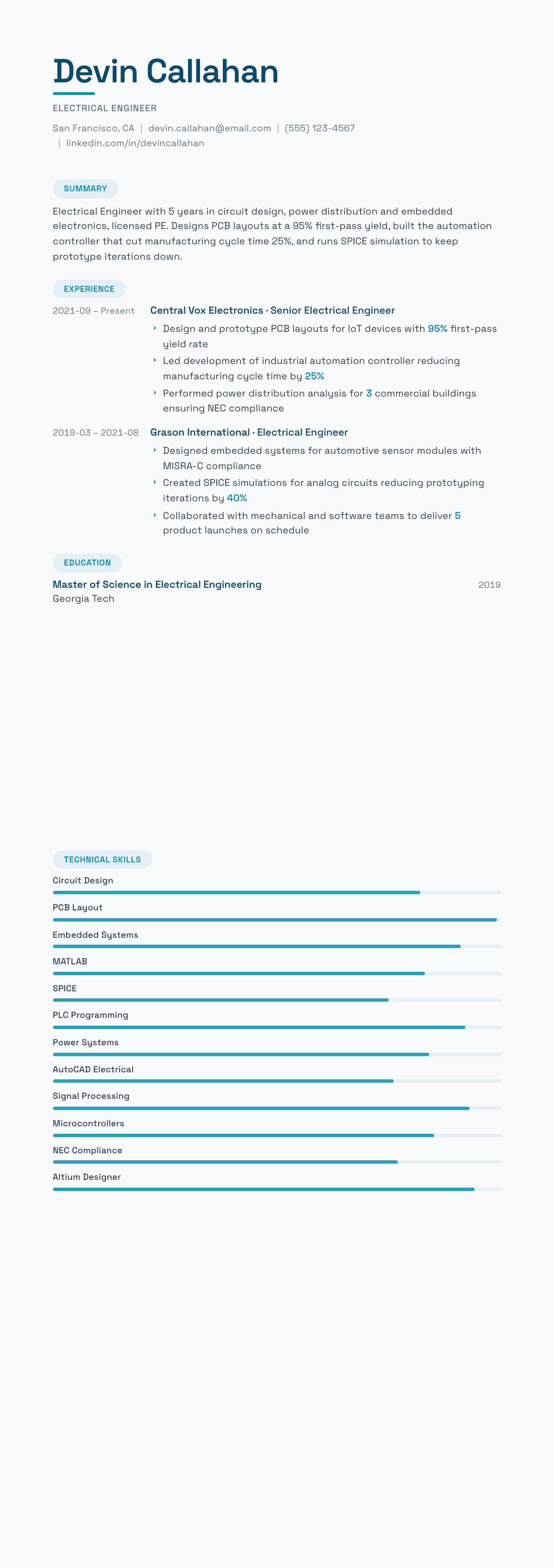
The CVBooster electrical engineer resume guide has a finished example, three written summaries, before and after bullets and answers to the questions people ask.
Build your electrical engineer CV
Create my CV