Radiologist Resume Examples: free ATS score and gap list
Create a Radiologist Resume That Quantifies Reading Volume and Modalities
By Mustafa Tarabya, founder of CVBooster · Published · Updated
A radiologist resume guide with modality and read volume examples, subspecialty keywords, teleradiology positioning and bullets that practices actually value.
Sample resumes for a radiologist
The same radiologist content laid out in three CVBooster templates, so you can see what the finished document looks like before you write a word.
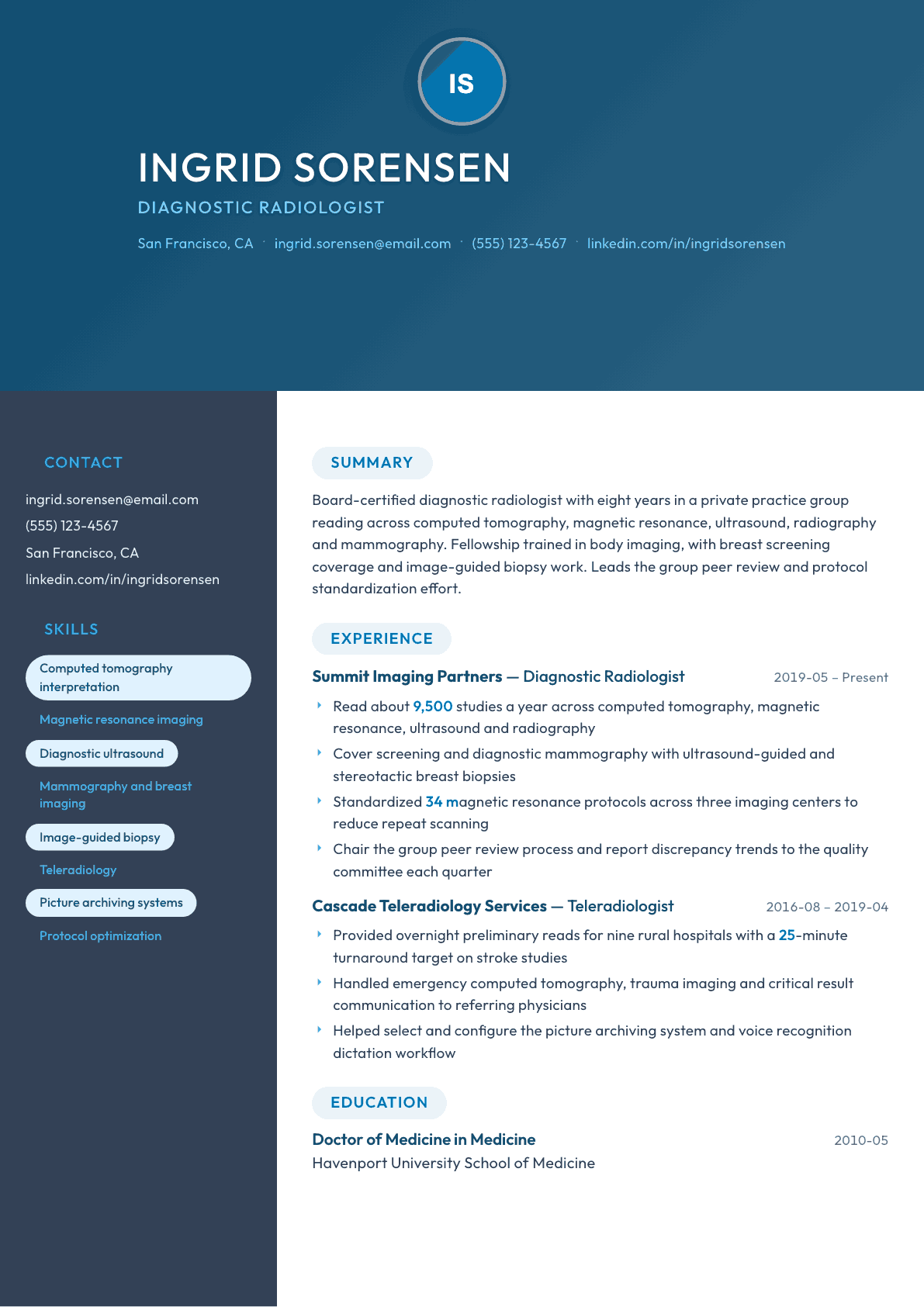
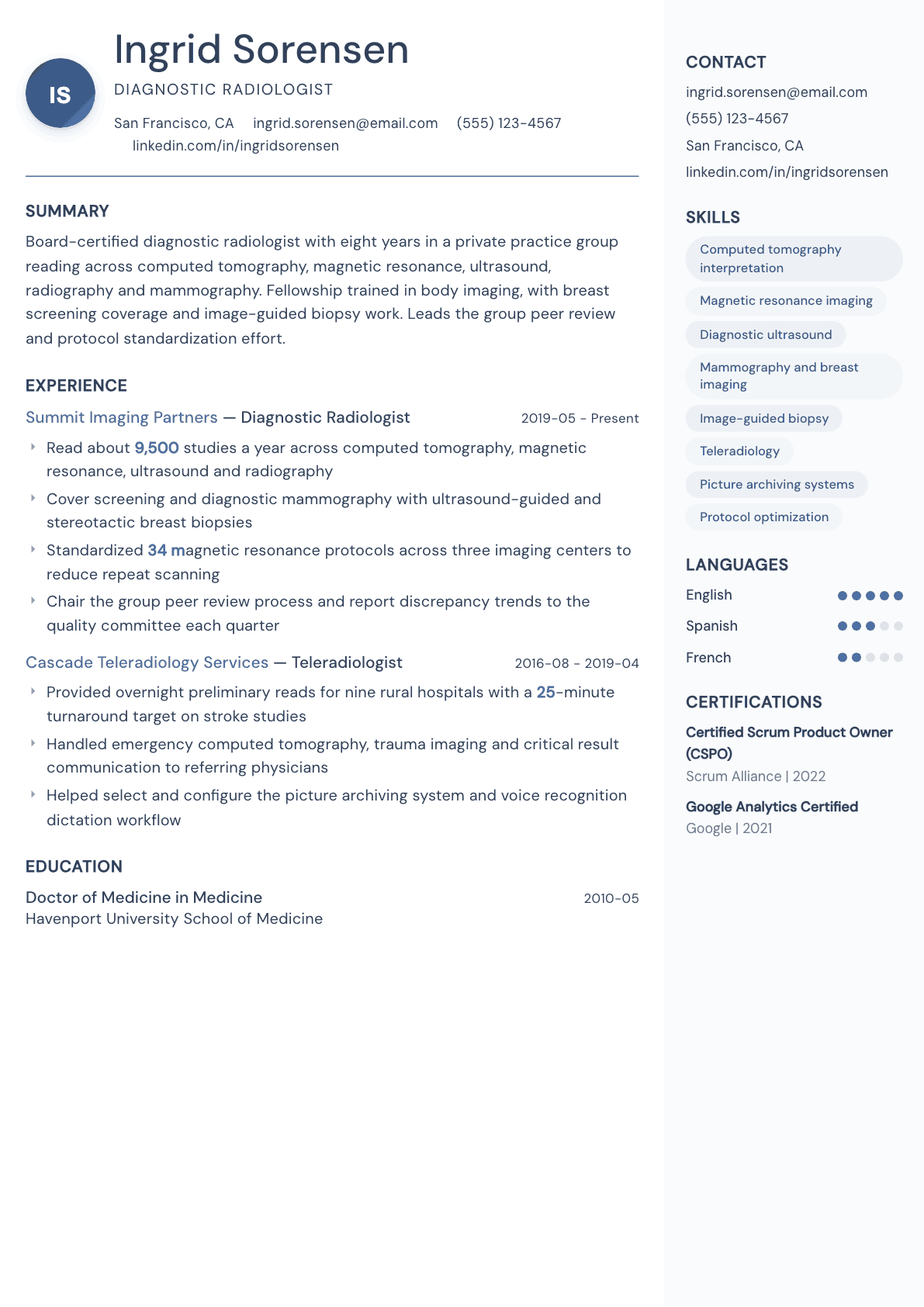
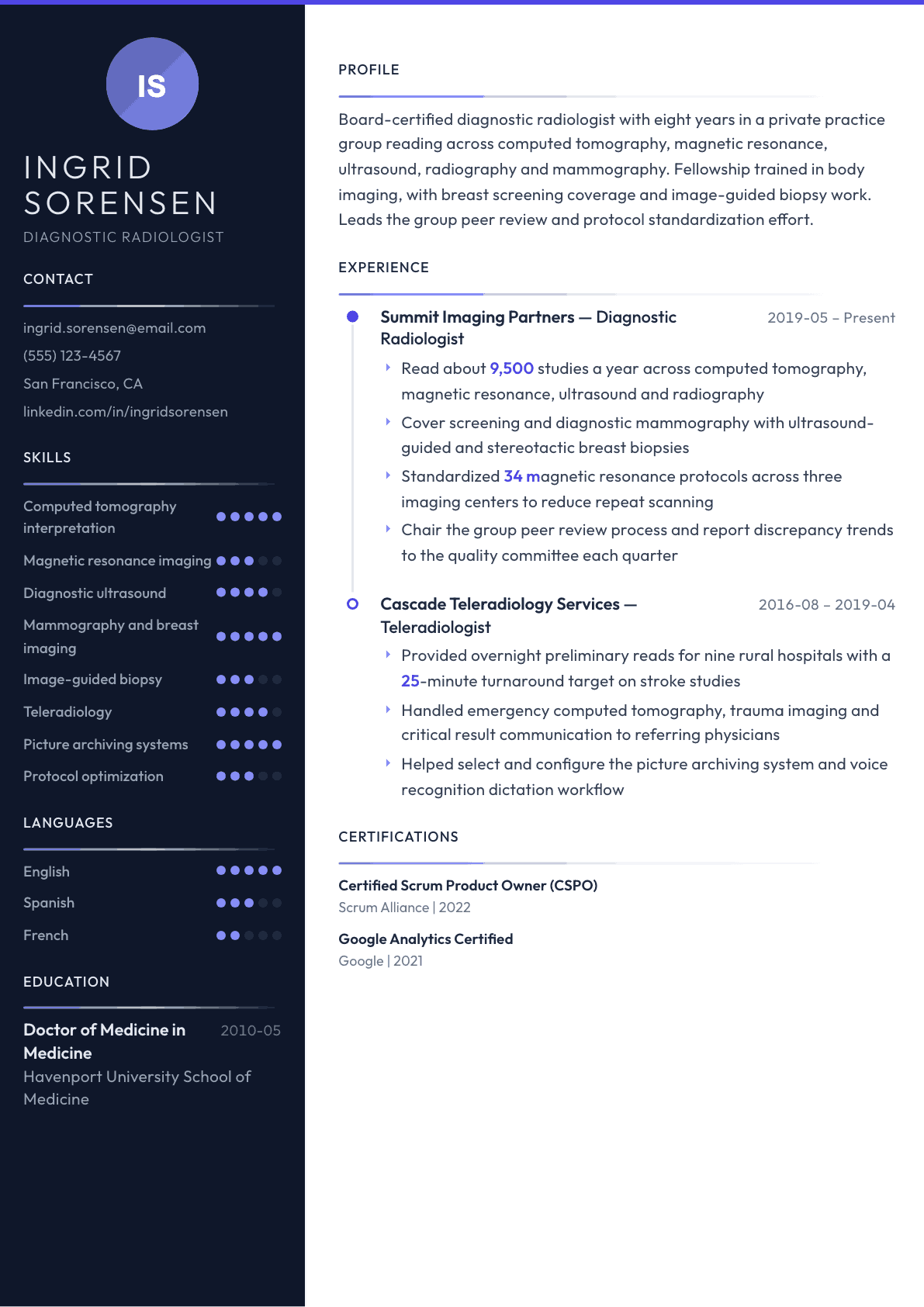
Example Radiologist summary
Board-certified diagnostic radiologist with eight years in private practice, reading about 9,500 studies a year across computed tomography, magnetic resonance, ultrasound and radiography. Fellowship trained in body imaging with mammography coverage and image-guided breast biopsy work. Standardized magnetic resonance protocols across three centers and chairs the group peer review process. Comfortable with teleradiology and seeking a partnership track practice.
Skills to list on a Radiologist resume
- Diagnostic radiology
- Computed tomography interpretation
- Magnetic resonance imaging
- Diagnostic ultrasound
- Radiography interpretation
- Mammography and breast imaging
- Body imaging
- Neuroimaging
- Musculoskeletal imaging
- Image-guided biopsy and drainage
- Fluoroscopy
- Teleradiology
- Picture archiving and communication systems
- Radiology protocol design
- Peer review and quality assurance
What actually gets this resume read
- Give annual read volume and break it down by modality, because groups hire against a specific reading backlog.
- Name your fellowship subspecialty and say how much of your work is actually in that area today.
- State mammography experience separately, since federal certification requirements make breast imaging coverage a hiring constraint.
- List the picture archiving system, dictation platform and worklist software you have used in production.
- Describe procedures you perform, such as biopsies, drainages, arthrograms or fluoroscopy, with a rough annual count.
- Mention peer review, protocol design and turnaround time work, which show you improve a practice beyond your own list.
How to write a radiologist resume
Radiology groups hire against a worklist. Somebody is retiring, a hospital contract added overnight coverage, a new magnet went in and the magnetic resonance backlog is growing, or the breast center cannot staff its screening days. A radiologist resume is read to find out which of those problems you would solve.
That makes modality mix and read volume the center of the document. How many studies you interpret in a year, split across computed tomography, magnetic resonance, ultrasound, radiography, mammography and fluoroscopy, plus the procedures you perform and the turnaround expectations you have worked under.
This guide covers modality reporting, subspecialty positioning against generalist coverage, mammography and procedural credentialing, the practice systems worth naming, and the questions radiologists ask when moving between private groups, hospital employment, academic departments and remote reading.
Format: credentials block, then modality mix
Two pages, reverse chronological, plain layout. Under the header put a credentials block: board certification and status, subspecialty certification, state licenses with expiration, and any additional licenses you maintain for remote reading across state lines.
Radiology positions frequently involve reading for hospitals in several states, so license breadth is a direct hiring advantage. Candidates leave it off because it feels like paperwork, and it is one of the few lines that can create an interview by itself.
- Header: name and degree, city and state, phone, email.
- Credentials: board certification, subspecialty certification, all state licenses.
- Then summary, practice history, fellowship, residency, education, procedures, systems, quality roles.
Summary: subspecialty, volume, modality mix, coverage
Name your fellowship subspecialty and how much of your current work sits inside it, then the annual read volume, the modality mix, and whether you take call, overnight or weekend coverage. A practice comparing candidates is comparing subspecialty fit against generalist flexibility, and both belong in this paragraph.
Say plainly whether you want a subspecialty-heavy list or a generalist one. Many groups still read broadly at night and on weekends, and a radiologist who says they will only read neuroimaging narrows the roles available sharply.
Experience: volume by modality, then coverage model
Open each position with the practice: group size, the number of hospitals and outpatient centers covered, the scanner inventory if it is unusual, and whether reading is subspecialty divided or generalist. Those facts describe the job better than any title.
Then annual read volume, broken down by modality and rounded. Computed tomography, magnetic resonance, ultrasound, radiography, mammography, nuclear medicine and fluoroscopy. Add turnaround expectations: same-day outpatient reporting, a defined stroke study target, or preliminary read windows on overnight coverage.
Coverage comes last and matters more than candidates think. Call rotation, weekend and holiday obligation, remote reading from home, and whether you covered emergency departments with a fixed turnaround target. A group with a coverage problem will hire the candidate whose current coverage most resembles the gap.
- Group size, sites covered, scanner inventory, subspecialty or generalist reading model.
- Annual reads by modality, rounded.
- Turnaround targets you worked to, including emergency and stroke studies.
- Call structure, weekend obligation, and remote reading arrangements.
Procedures, breast imaging and credentialing detail
List the procedures you perform with a rough annual count: image-guided biopsy under ultrasound or computed tomography, stereotactic breast biopsy, abscess drainage, thyroid and lymph node sampling, arthrography, lumbar puncture, and fluoroscopic studies. A group choosing between two readers will pick the one who can also do the procedure list.
Breast imaging deserves separate treatment because it carries its own regulatory continuing education and interpretation volume requirements. State clearly that you read screening and diagnostic mammography, whether you perform breast biopsies, and whether you have worked with tomosynthesis and breast magnetic resonance.
If you have supervised technologists, set protocols or handled contrast reaction management and radiation dose oversight, say so. Those duties belong to a radiologist a practice can put in charge of a site.
Systems, quality and keywords
Name the picture archiving and communication system, the reporting and dictation platform, the worklist software and the electronic record you have used. Practices know how long onboarding takes on an unfamiliar system, and matching platforms shortens the ramp measurably.
Quality work is the promotable half of a radiology career: peer review participation and leadership, protocol standardization across sites, dose reduction, structured reporting templates, discrepancy tracking and accreditation for imaging modalities. Write what you changed and what it produced.
Radiology postings repeat a narrow vocabulary: diagnostic radiology, cross-sectional imaging, subspecialty reading, turnaround time, teleradiology, peer review, protocol optimization, structured reporting. Mirror the exact phrasing once in the skills block and once in a bullet.
Radiologist resume summary examples
Finishing fellowship
Diagnostic radiology board eligible, completing a body imaging fellowship with roughly 7,000 studies read during fellowship across computed tomography, magnetic resonance and ultrasound. Performed 120 image-guided biopsies and drainages. Seeking a general practice position with body imaging emphasis and a share of emergency coverage.
Eight years in private practice
Board-certified diagnostic radiologist reading about 9,500 studies a year across computed tomography, magnetic resonance, ultrasound and radiography, with screening and diagnostic mammography plus image-guided breast biopsy. Standardized magnetic resonance protocols across three imaging centers and chairs the group peer review process.
Director of imaging
Radiologist and director of imaging with seventeen years of practice, responsible for protocol standards, peer review, accreditation and technologist training across five sites and fourteen radiologists. Built the structured reporting library, led a dose reduction effort on computed tomography, and maintains a full personal reading list.
Work experience bullets: before and after
Before: Interpreted a wide range of imaging studies.
After: Read about 9,500 studies a year split across computed tomography, magnetic resonance, ultrasound and radiography, with same-day reporting on outpatient examinations.
Annual volume with a modality split and a reporting expectation tells a group how much worklist you would absorb.
Before: Performed image-guided procedures.
After: Performed roughly 180 image-guided procedures a year including ultrasound and computed tomography guided biopsies, abscess drainages and stereotactic breast biopsies.
A procedure count with the guidance modalities is billable capability rather than a general capability claim.
Before: Helped standardize imaging protocols.
After: Standardized 34 magnetic resonance protocols across three imaging centers, cutting repeat scanning and making studies interchangeable between sites for reading and comparison.
The protocol count and the operational effect turn a committee task into a measurable improvement.
Before: Provided overnight teleradiology reads.
After: Provided overnight preliminary reads for nine rural hospitals with a 25-minute turnaround target on stroke studies and direct telephone communication of critical findings.
Site count, the turnaround target and the critical result process describe the service level you actually held.
Before: Participated in peer review.
After: Chaired the group peer review process, tracked discrepancy categories by modality and presented quarterly trends with targeted teaching cases to the quality committee.
Leading the process and closing the loop with teaching shows quality ownership rather than compliance.
Hard skills
- Computed tomography interpretation
- Magnetic resonance imaging interpretation
- Diagnostic ultrasound
- Radiography and fluoroscopy
- Screening and diagnostic mammography
- Breast tomosynthesis and breast magnetic resonance
- Image-guided biopsy and drainage
- Stereotactic breast biopsy
- Nuclear medicine interpretation
- Emergency and trauma imaging
- Structured reporting and template design
- Protocol optimization and dose reduction
- Picture archiving and communication systems
- Peer review and discrepancy tracking
Soft skills
- Clear and actionable report writing
- Critical result communication
- Referring clinician relationships
- Technologist teaching and protocol coaching
- Sustained focus across a long reading list
- Prioritizing urgent studies on a worklist
Certifications worth listing
- Diagnostic Radiology Certification (American Board of Radiology)
- Neuroradiology Subspecialty Certification (American Board of Radiology)
- Pediatric Radiology Subspecialty Certification (American Board of Radiology)
- Vascular and Interventional Radiology Certification (American Board of Radiology)
- Basic Life Support (BLS) (American Heart Association)
Mistakes that cost radiologist candidates the interview
- Listing modalities with no annual read volume, which leaves a group unable to model how the worklist would change.
- Failing to say how much of your work is actually in your fellowship subspecialty today.
- Omitting mammography status when breast coverage is one of the hardest gaps for a practice to fill.
- Leaving procedures off the page, which makes you look like a reader in a group that needs both.
- Skipping the picture archiving and reporting systems you have used, which lengthens the expected onboarding.
- Listing only one state license when the position includes remote reading for hospitals elsewhere.
- Ignoring peer review, protocol and accreditation work, the usual route into an imaging leadership role.
Radiologist resume questions
How should a radiologist report annual read volume?
Give a rounded total and then split it by modality, since a group cares far more about the mix than the headline figure. Add the turnaround expectations you worked under, because throughput at a defined service level is what a practice is buying.
Do I need to say how much subspecialty work I do?
Yes. Fellowship training alone does not tell a group what your week looks like. Say what share of your list is subspecialty reading and what share is general, then state whether you are willing to keep reading broadly on nights and weekends.
How important is mammography experience?
It is one of the hardest coverage gaps in most practices, so state it clearly if you read breast studies. Note whether you cover screening, diagnostic work, tomosynthesis and breast magnetic resonance, and whether you perform ultrasound-guided and stereotactic biopsies.
How do I present teleradiology experience?
Give the number of client hospitals, the modalities covered, whether reads were preliminary or final, the turnaround targets you met and how critical results were communicated. Remote reading is judged on service level, and those details are the service level.
What systems should a radiologist name on a resume?
The picture archiving and communication system, the dictation and reporting platform, the worklist tool and the hospital electronic record. Matching platforms shortens onboarding noticeably, and a group with a large scheduling backlog treats that as a real advantage.