Vet Tech Salary, Career Path and CV
By CVBooster TeamPublished Updated
The median vet tech salary in the United States is $47,380 a year, or $22.78 an hour, according to the U.S. Bureau of Labor Statistics (BLS), OEWS May 2025. That is the national middle: states, employers and hours move it, and BLS publishes nothing by years of experience. BLS counts veterinary technologists and technicians as one occupation. The two-year route and the four-year route share one pay table. Here it is.
Below: a check of your own pay, the pay percentiles, hourly pay, pay in every state, what vet techs do, how to become a vet tech, the skills that go on a CV, and a CV example.
- Median annual pay
- $47,380
- Median hourly pay
- $22.78
- Employed, May 2025
- 129,140
Am I underpaid as a vet tech?
Pick your state and type your pay. You get your place in the BLS pay range for vet techs there, as a percentile.
Vet Tech salary in the United States
The BLS counts vet techs in the occupation Veterinary Technologists and Technicians (SOC 29-2056). Half of them earn less than $47,380 a year and half earn more. The average, which a few very high earners pull up, is $49,120. The lowest-paid tenth earn $35,710 or less, and the highest-paid tenth earn $63,180 or more, which is about 1.8 times as much. The ratio is our arithmetic on two BLS figures.
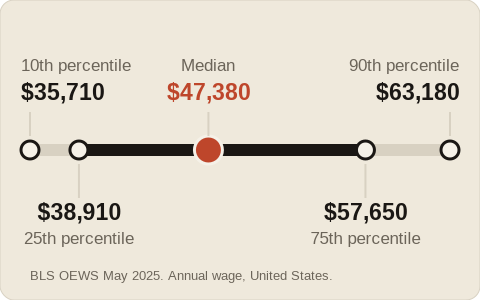
| Measure | Annual wage |
|---|---|
| 10th percentile | $35,710 |
| 25th percentile | $38,910 |
| Median (50th) | $47,380 |
| Mean (average) | $49,120 |
| 75th percentile | $57,650 |
| 90th percentile | $63,180 |
Source: U.S. Bureau of Labor Statistics, Occupational Employment and Wage Statistics (OEWS), May 2025, Veterinary Technologists and Technicians, retrieved 23 and 24 November 2026 through the BLS Public Data API.
Vet Tech hourly pay
The median hourly wage for vet techs is $22.78, as published by BLS for May 2025. That is the hourly view of the same national middle as the $47,380 annual median above, so use it when an employer quotes you a rate and not a salary. Annual pay for a job with part-time or shift work depends on the hours you are given, which no national table can tell you.
| Measure | Per hour |
|---|---|
| 10th percentile | $17.17 |
| 25th percentile | $18.71 |
| Median (BLS hourly figure) | $22.78 |
| 75th percentile | $27.72 |
| 90th percentile | $30.38 |
The median is the hourly wage BLS publishes. The other rows are our division of the BLS annual percentiles by 2,080 hours, the full-time year BLS uses to turn hourly pay into annual pay.
Vet Tech salary by state
Where you work changes the number more than most things. The highest median is in California, at $60,630. The lowest published median is in Louisiana, at $35,530, a gap of $25,100 a year between two states. The gap is our subtraction of two BLS state medians. All figures below are the annual median wage in each state for May 2025.
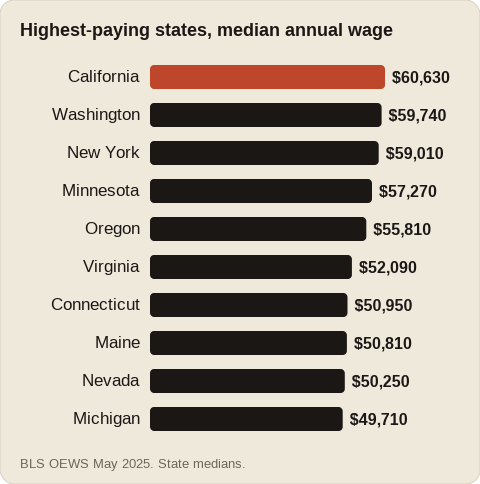
Top-paying states for vet techs
| Rank | State | Median wage | vs US median |
|---|---|---|---|
| 1 | California | $60,630 | +$13,250 |
| 2 | Washington | $59,740 | +$12,360 |
| 3 | New York | $59,010 | +$11,630 |
| 4 | Minnesota | $57,270 | +$9,890 |
| 5 | Oregon | $55,810 | +$8,430 |
| 6 | Virginia | $52,090 | +$4,710 |
| 7 | Connecticut | $50,950 | +$3,570 |
| 8 | Maine | $50,810 | +$3,430 |
| 9 | Nevada | $50,250 | +$2,870 |
| 10 | Michigan | $49,710 | +$2,330 |
Vet Tech salary in all 50 states
| State | Median annual wage |
|---|---|
| California | $60,630 |
| Washington | $59,740 |
| New York | $59,010 |
| Minnesota | $57,270 |
| Oregon | $55,810 |
| Virginia | $52,090 |
| Connecticut | $50,950 |
| Maine | $50,810 |
| Nevada | $50,250 |
| Michigan | $49,710 |
| Colorado | $49,650 |
| Massachusetts | $49,540 |
| Vermont | $49,490 |
| New Jersey | $49,050 |
| North Dakota | $48,790 |
| New Hampshire | $48,780 |
| Indiana | $48,720 |
| Hawaii | $48,550 |
| Delaware | $48,370 |
| Ohio | $47,990 |
| North Carolina | $47,620 |
| Maryland | $47,350 |
| Wisconsin | $47,020 |
| Alaska | $46,480 |
| Illinois | $46,440 |
| Pennsylvania | $46,430 |
| Florida | $46,380 |
| Arizona | $46,300 |
| Kansas | $45,810 |
| Iowa | $45,560 |
| Rhode Island | $45,310 |
| South Dakota | $45,300 |
| New Mexico | $44,790 |
| Nebraska | $43,680 |
| Missouri | $43,520 |
| Georgia | $43,060 |
| Tennessee | $42,810 |
| Idaho | $42,120 |
| Montana | $41,170 |
| Utah | $40,560 |
| Kentucky | $39,590 |
| Texas | $39,410 |
| Oklahoma | $39,100 |
| South Carolina | $39,020 |
| Wyoming | $38,650 |
| Arkansas | $38,360 |
| West Virginia | $37,700 |
| Alabama | $36,590 |
| Mississippi | $36,380 |
| Louisiana | $35,530 |
Compare vet tech pay
Put two states side by side, or set vet techs next to another job. Every figure is from BLS OEWS May 2025.
| Measure | California | Louisiana |
|---|---|---|
| Median annual wage | $60,630 | $35,530 |
| Median hourly wage | n/a | n/a |
| 10th percentile | n/a | n/a |
| 25th percentile | n/a | n/a |
| 75th percentile | n/a | n/a |
| 90th percentile | n/a | n/a |
| Employed, May 2025 | n/a | n/a |
The California median is $25,100 a year higher. That difference is our subtraction of two BLS state medians. n/a means this page has only the BLS median for that state so far, or BLS released no figure for it. Source: BLS OEWS May 2025, Veterinary Technologists and Technicians.
Starting pay for vet techs
BLS does not publish pay by years of experience, so nobody can honestly quote an official entry-level vet tech salary. What the data gives is the bottom of the market. One in ten vet techs earns $35,710 or less, and one in four earns $38,910 or less. Read those as the low end of the national range, not as what a new graduate will be offered, because older workers sit in the bottom tenth too.
What vet techs do
Veterinary technologists and technicians do medical tests that help diagnose animals' injuries and illnesses, working under a licensed veterinarian.
Technicians usually work in private clinics. Technologists, with a bachelor's degree, more often work in research and laboratories.
Duties BLS lists
- Observe the behavior and condition of animals
- Provide nursing care or emergency first aid to recovering or injured animals
- Bathe animals, clip nails or claws, and brush or cut their hair
- Restrain animals during exams or procedures
- Give anesthesia to animals and monitor their responses
- Take x rays and do laboratory tests, such as urinalyses and blood counts
- Prepare animals and instruments for surgery
- Give medications, vaccines and treatments prescribed by a veterinarian
- Collect and record animals' case histories
A typical day
In a clinic: hold and calm the patient for the exam, take blood and run the tests, take x rays, prepare and monitor anesthesia for surgery, give the treatments the vet prescribed, and explain aftercare to the owner.
Where they work
- Veterinary services employed 89 percent of veterinary technologists and technicians, and educational services 4 percent.
- Evenings, weekends or holidays can be part of the job.
Source: U.S. Bureau of Labor Statistics, Occupational Outlook Handbook, Veterinary Technologists and Technicians, read 24 November 2026. BLS counted about 131,400 jobs in 2025 and projects 9% growth from 2025 to 2035, much faster than the average for all occupations.
How to become a vet tech: the career path
Typical entry-level education, according to BLS: associate's degree. BLS says technicians usually complete a 2-year associate's degree and technologists a 4-year bachelor's degree in veterinary technology. Each step below comes from the BLS Occupational Outlook Handbook, and the last step is the pay.
- 1Study
Associate's or bachelor's degree
Technicians usually take a 2-year associate's degree in veterinary technology, technologists a 4-year bachelor's degree.
- 2Credential
Credentialing exam
Both typically pass a credentialing exam and become registered, licensed or certified, depending on the state. Most states require an exam.
- 3Work
Veterinary clinics
Nearly nine in ten work in veterinary services.
- 4Specialize
A specialty
BLS says technicians may specialize in areas such as dentistry, anesthesia, emergency and critical care, or zoological medicine.
- 5Pay
Median $47,380 a year
BLS median annual wage for vet techs. The lowest-paid tenth earn $35,710 or less and the highest-paid tenth earn $63,180 or more.
Steps 1 to 4: U.S. Bureau of Labor Statistics, Occupational Outlook Handbook, Veterinary Technologists and Technicians, "How to Become One", read 24 November 2026. Pay step: U.S. Bureau of Labor Statistics, OEWS May 2025.
Vet Tech skills and certifications
These come from the CVBooster vet tech resume guide, which lists what employers look for on a vet tech CV. Put the ones you really have near the top of your CV, in the words the job ad uses.
Core skills
People skills
Licenses and certifications
- Veterinary Technician Specialist (VTS) in Anesthesia and Analgesia, Academy of Veterinary Technicians in Anesthesia and Analgesia
- Veterinary Technician Specialist (VTS) in Emergency and Critical Care, Academy of Veterinary Emergency and Critical Care Technicians and Nurses
- Veterinary Technician Specialist (VTS) in Dentistry, Academy of Veterinary Dental Technicians
- Fear Free Certified Professional, Fear Free
- Veterinary Technician National Examination (VTNE), American Association of Veterinary State Boards
Vet Tech salary questions
How much does a vet tech make a year?
The median is $47,380 a year in the United States and the mean is $49,120. The lowest-paid tenth earn $35,710 or less and the highest-paid tenth earn $63,180 or more. Source: U.S. Bureau of Labor Statistics, OEWS May 2025, Veterinary Technologists and Technicians.
How much does a vet tech make an hour?
The median hourly wage is $22.78, the BLS figure for May 2025 across the whole country. Clinics can need evening, weekend and holiday cover, so your hours change what a year adds up to.
Which state pays vet techs the most?
California has the highest median at $60,630, followed by Washington at $59,740 and New York at $59,010. These are state medians for May 2025 from U.S. Bureau of Labor Statistics, OEWS May 2025, and the table above lists every state BLS publishes.
What does a new vet tech earn?
BLS does not publish pay by years of experience. The 10th percentile is $35,710 and the 25th percentile is $38,910, which is the nearest honest guide to the bottom of the market, not a starting offer.
How long does it take to become a vet tech?
Veterinary technicians usually take a 2-year associate's degree, and technologists a 4-year bachelor's degree. Most states then require a credentialing exam before you can be registered, licensed or certified.
Is vet tech a growing job?
BLS projects 9% employment growth from 2025 to 2035, much faster than the average for all occupations, adding about 12,300 jobs to the 131,400 held in 2025.
Sources and method
- Pay: U.S. Bureau of Labor Statistics, Occupational Employment and Wage Statistics (OEWS), May 2025, Veterinary Technologists and Technicians (SOC 29-2056), national and state estimates, retrieved 23 and 24 November 2026 through the BLS Public Data API. Wages are before tax. BLS defines what its wage figure includes and leaves out in the OEWS technical notes.
- The job, the route in and the outlook: U.S. Bureau of Labor Statistics, Occupational Outlook Handbook, Veterinary Technologists and Technicians, read 24 November 2026.
- Skills and certifications: the CVBooster vet tech resume guide.
- Where we subtract or divide two BLS figures, the page says so. The pay check is an estimate between published BLS percentiles and says so. Nothing else on this page is estimated.
Vet Tech CV example

The CVBooster resume guide for this job has a finished example, three written summaries, before and after bullets and answers to the questions people ask.
Build your vet tech CV
Create my CV