Veterinary Technician Resume Examples: read this first
Craft a Veterinary Technician Resume Hospitals Shortlist
By Mustafa Tarabya, founder of CVBooster · Published · Updated
Veterinary technician resume examples and a vet tech resume template filled in as a sample: anesthesia, dentistry, lab work and credential placement.
Sample resumes for a veterinary technician
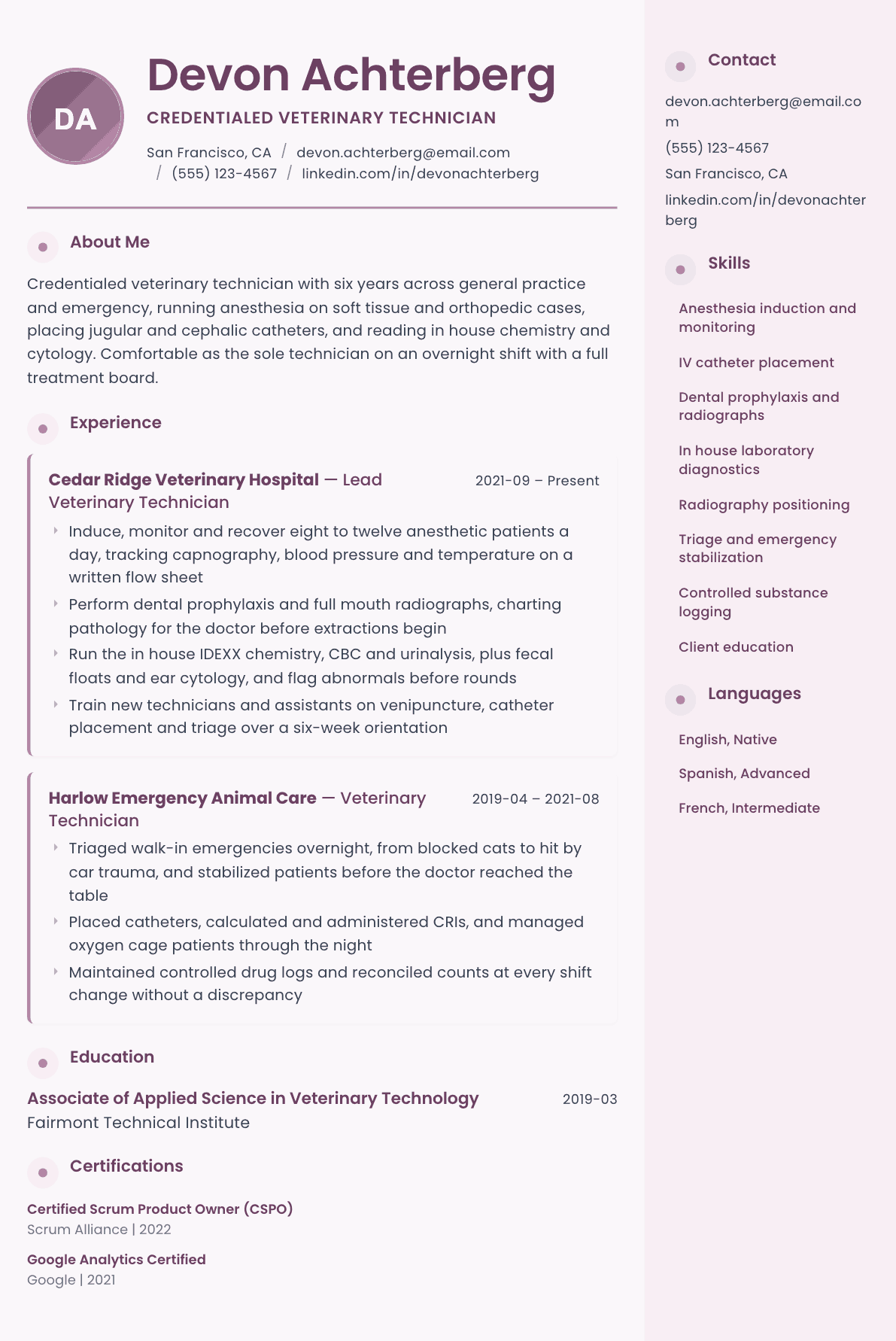
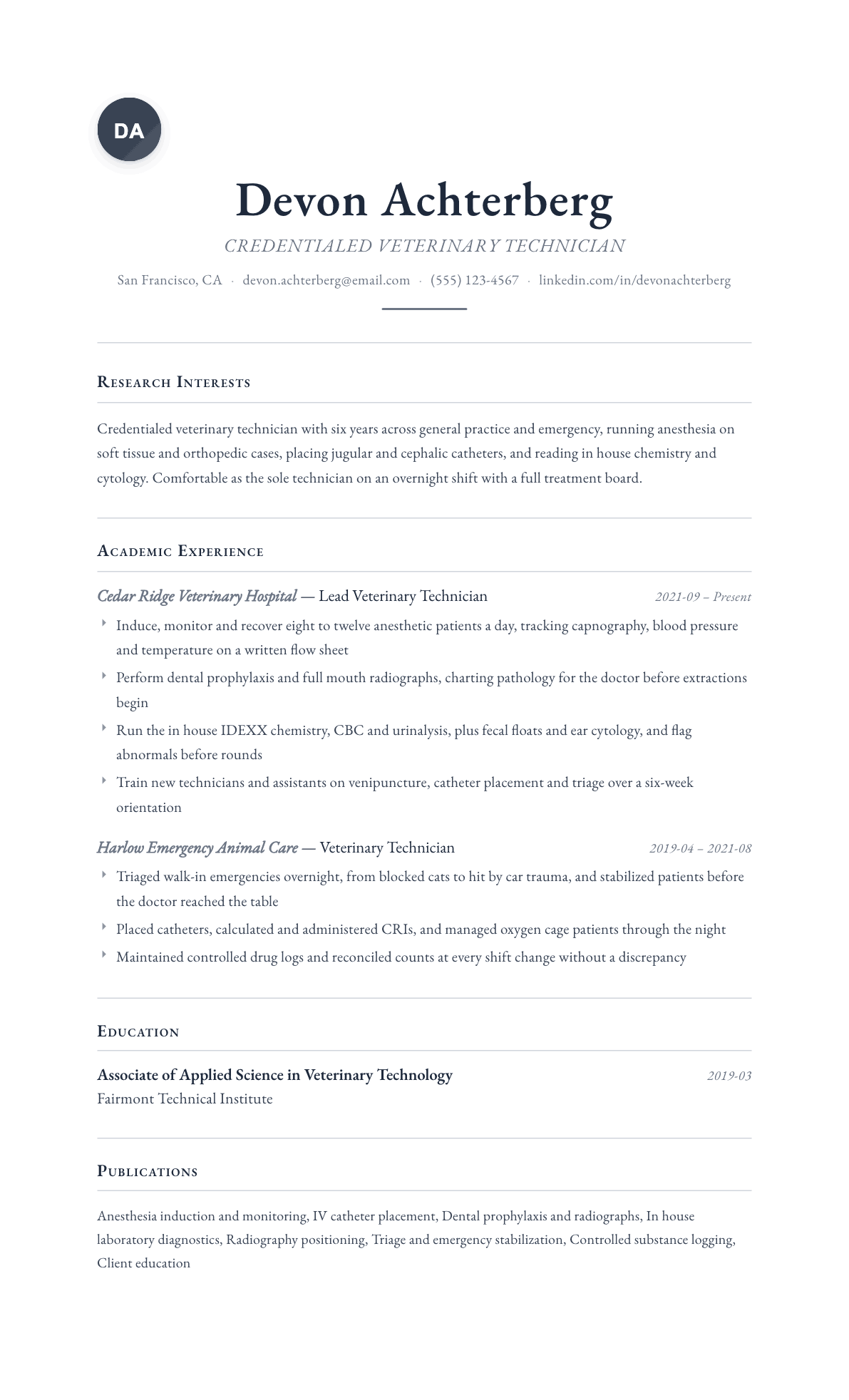
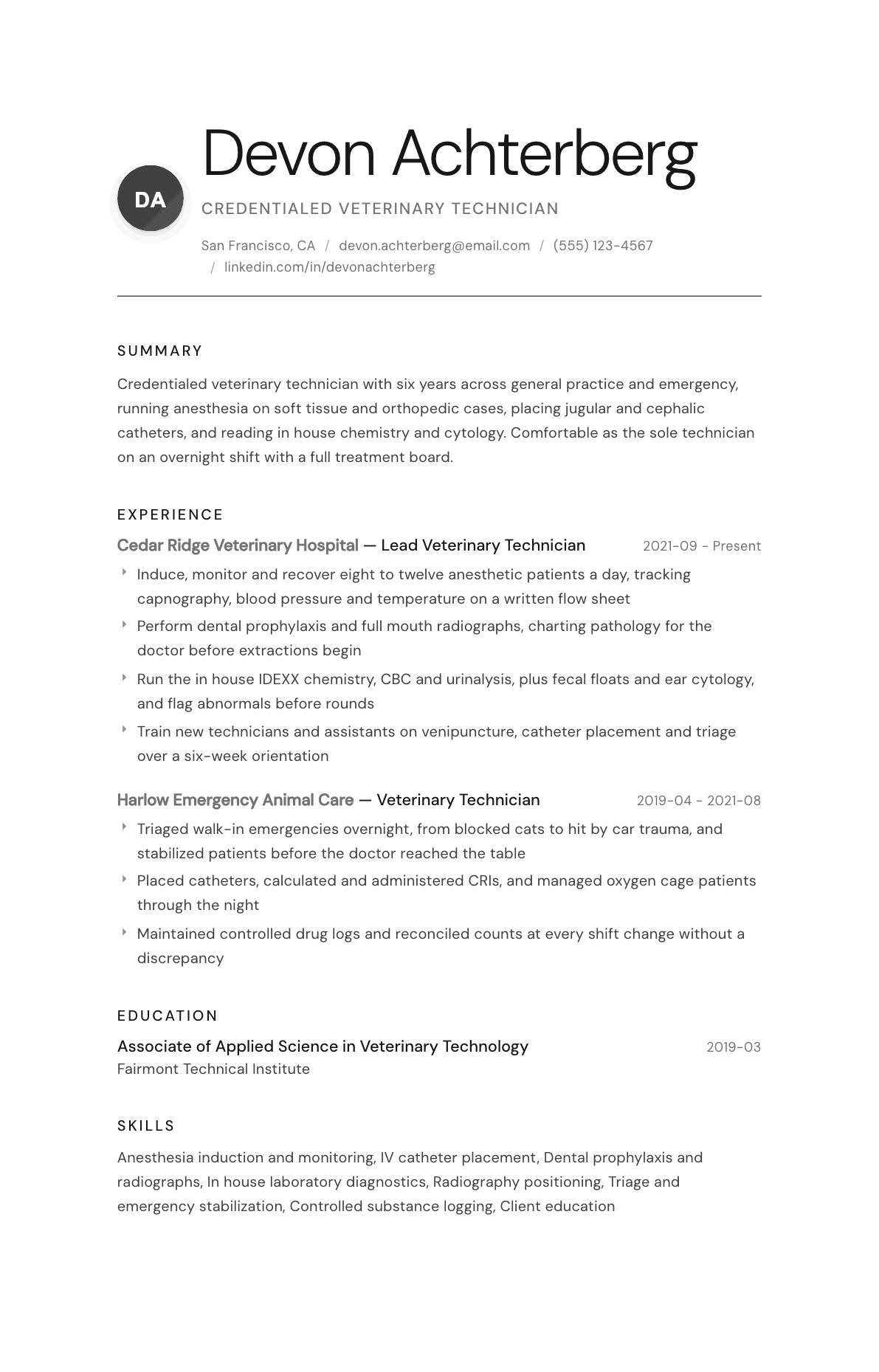
The same veterinary technician content laid out in three CVBooster templates, so you can see what the finished document looks like before you write a word.
Example Veterinary Technician summary
Credentialed veterinary technician with five years in a busy general practice and two years of overnight emergency work. Runs anesthesia on soft tissue and dental cases, places catheters on difficult patients, and turns in house diagnostics around before the doctor finishes the exam. Trains new hires on triage and venipuncture, and keeps controlled drug records audit ready.
Skills to list on a Veterinary Technician resume
- Anesthesia monitoring
- Anesthetic induction and intubation
- IV and jugular catheter placement
- Venipuncture
- Dental prophylaxis
- Dental radiography
- Digital radiography positioning
- In house chemistry and CBC
- Cytology and fecal analysis
- Emergency triage
- Fluid therapy and CRI calculation
- Controlled substance records
- Surgical assisting and instrument packs
- Cornerstone
- Avimark
- Client communication
What actually gets this resume read
- Put your credential and state after your name, since hospitals filter for licensed, registered or certified technicians first.
- Name the practice type for every job: general practice, emergency, specialty referral, shelter or large animal.
- Quantify anesthesia work by daily case volume and the parameters you monitor, not by the word "assisted".
- List the laboratory analyzers and imaging equipment you have run, including in house chemistry, digital radiography and dental units.
- Show the technical procedures you own independently, such as catheters, venipuncture, intubation and dental charting.
- Mention the practice software you have used, because Cornerstone, Avimark and ezyVet appear in most job postings.
How to write a veterinary technician resume
The person hiring a veterinary technician is almost always the practice manager or the lead technician, and both of them are reading for one thing: what can this person do without supervision on a busy Tuesday. Anesthesia, catheters, dental radiographs, in house laboratory work and triage are the skills that decide whether you are an extra pair of hands or the reason the doctor can see more cases.
Credentials come first because titles differ by state. Licensed, registered and certified veterinary technician all describe the same credentialed professional, and hospitals filter on the word their state uses. Put yours in the header with the state named, and never let a reader wonder whether you are a credentialed technician or an assistant with experience.
What follows is the section order veterinary hospitals expect, a vet tech resume template filled in as a sample, how to describe anesthesia and diagnostics in the language a lead technician recognizes, three summaries from new graduate to lead, five before and after bullets, and the questions technicians ask when they rewrite this resume for a specialty or emergency job.
Format: one page early, two after five years
Reverse-chronological, one column, no icons over the skills. Hospital hiring is credential driven and the reader is scanning for procedures, so give her plain text she can skim while the treatment board is filling up.
Write your credential after your name the way your state board writes it, for example "Devon Achterberg, LVT" or "RVT" or "CVT", then repeat it with the state and license number placeholder in a short credentials block.
- Header: name, credential, city and state, phone, email.
- Order: summary, credentials, clinical experience, technical skills, education.
- New graduates add a clinical rotations or externship block with hours and species.
Summary: practice type, case load, and what you run alone
Say the practice type first, because general practice, emergency, referral specialty, shelter, equine and production animal work are different jobs. Then the years, the daily case mix, and the one or two procedures you own independently. Anesthesia is usually the strongest thing to lead with, because it is the skill hospitals are shortest on.
If you are moving from general practice into emergency or specialty, name the bridge: overnight coverage, high acuity admissions, CRI calculations, or the emergency shifts you have already picked up.
Experience: anesthesia, diagnostics, and the treatment board
Lead each job with the hospital profile: number of doctors, whether it is AAHA accredited, the daily appointment and surgery volume, and whether the hospital runs emergency or referral cases. Then write bullets around the four blocks a lead technician cares about.
Anesthesia first. Give the daily case count, whether you induce and intubate, and the parameters you monitor: capnography, pulse oximetry, blood pressure, ECG and temperature. Say whether you calculate your own drug doses and maintain a written anesthetic record. That paragraph alone separates candidates.
Then diagnostics: the in house analyzers you run, the sample types, cytology and fecal work, and the imaging you position for including dental radiographs. Then the technical procedures: cephalic and jugular catheters, venipuncture on difficult patients, urinary catheterization, fluid therapy and CRI calculation, and dental prophylaxis with charting.
Close with the parts of the job that are not clinical but keep a hospital running: controlled substance logs, inventory, training new technicians, and client communication on discharges and estimates.
Skills: species, equipment, and software
Split the block into procedures, equipment and software. Under equipment, name the anesthetic machine type, the multiparameter monitor, the in house chemistry and hematology analyzers, the digital radiography system and the dental unit. Practices buy these on long cycles and hire for familiarity.
Name your species experience honestly. Small animal, exotics, pocket pets, avian, reptile, equine and food animal all appear in postings, and a hospital that sees rabbits and guinea pigs will move an exotics-capable technician straight to the top of the pile.
Keywords veterinary hospitals scan for
Postings recycle the same vocabulary: anesthetic monitoring, venipuncture, catheter placement, radiographic positioning, dental prophylaxis, client education, laboratory diagnostics, surgical assisting and controlled substance handling. Use each term once in a bullet where it is true, and once in the skills block, and do not pad with terms you cannot demonstrate in a working interview.
Vet tech resume template, filled in as a sample
A vet tech resume template that works in most hospitals has six blocks in a fixed order, and the sample below fills each one for an invented technician, Priya Lund, with four years in a busy small animal practice. Keep the order, swap in your own credential, hospital profile and procedures, and delete any line you could not demonstrate in a working interview.
A new graduate uses the same template with the clinical rotations block moved above experience. A lead technician adds a line on scheduling, training and the protocols she wrote.
- Header: Priya Lund, RVT, Fort Collins, CO, phone, email.
- Summary: Registered veterinary technician with four years in a four doctor AAHA accredited small animal hospital. Runs anesthesia on eight to twelve surgical and dental cases a day, places catheters on difficult patients, and trains new assistants on the treatment floor.
- Credentials: Registered Veterinary Technician, Colorado, license number on request; VTNE passed; Fear Free certified.
- Experience, Riverbend Animal Hospital, current role. Bullets: induced, intubated and monitored anesthesia with capnography, blood pressure and ECG, keeping a written record for every case; took full mouth dental radiographs and charted findings for the doctor; ran in house chemistry, CBC, urinalysis and fecal flotation.
- Technical skills: cephalic, saphenous and jugular catheters, CRI calculation, radiographic positioning, controlled substance logs, practice management software.
- Education: Associate of Applied Science in Veterinary Technology, with externship hours in emergency and exotics.
Veterinary Technician resume summary examples
New graduate technician
Veterinary technology graduate, newly credentialed, with 480 clinical hours across small animal general practice, emergency and a specialty surgery rotation. Places cephalic catheters, monitors anesthesia on routine spays and neuters, runs in house chemistry and CBC, and positions radiographs without a second attempt.
Five years in general practice
Credentialed veterinary technician with five years in a four-doctor small animal hospital, monitoring eight to twelve anesthetic patients a day and performing dental prophylaxis with full mouth radiographs. Runs the in house laboratory, places jugular catheters on unstable patients, and keeps controlled drug logs reconciled every shift.
Lead technician
Lead veterinary technician with ten years across general practice and overnight emergency, now running the treatment floor for a six-doctor hospital. Builds the technician schedule, trains new hires through a six-week orientation, manages inventory and controlled substances, and takes the highest acuity anesthesia cases herself.
Work experience bullets: before and after
Before: Assisted with surgeries and monitored patients.
After: Induced, intubated and monitored eight to twelve anesthetic patients daily, recording capnography, blood pressure and temperature on a written anesthetic flow sheet.
It names the parts of anesthesia you own and the parameters you record, which is what a lead technician is checking for.
Before: Performed dental cleanings.
After: Performed dental prophylaxis and full mouth radiographs, charting periodontal pockets and pathology for the doctor before extraction planning.
Adding radiographs and charting turns a cleaning into the diagnostic work the doctor depends on.
Before: Ran lab tests in the clinic.
After: Ran in house chemistry, CBC and urinalysis plus fecal floats and ear cytology, flagging abnormal results to the doctor before morning rounds.
Naming the panels and the timing shows the result is useful, not simply produced.
Before: Helped with emergency cases at night.
After: Triaged overnight walk-ins including blocked cats, toxin ingestions and vehicular trauma, and stabilized patients with oxygen and fluids before the doctor reached the table.
Real presentations and the stabilization work prove independent judgment under pressure.
Before: Trained new employees.
After: Trained four new technicians and two assistants through a six-week orientation covering venipuncture, catheter placement and triage, with a signed skills checklist for each.
The structure and the checklist show a repeatable training program rather than informal help.
Hard skills
- Anesthetic induction, intubation and monitoring
- Capnography and multiparameter monitoring
- Cephalic and jugular catheter placement
- Venipuncture on fractious patients
- Dental prophylaxis and dental radiographs
- Digital radiography positioning
- In house chemistry, CBC and urinalysis
- Cytology and fecal flotation
- Fluid therapy and CRI calculation
- Emergency triage and stabilization
- Surgical assisting and pack preparation
- Controlled substance logging and reconciliation
Soft skills
- Triage prioritization
- Client education on discharge instructions
- Composure during codes
- Handoff communication between shifts
- Mentoring assistants
Certifications worth listing
- Veterinary Technician Specialist (VTS) in Anesthesia and Analgesia (Academy of Veterinary Technicians in Anesthesia and Analgesia)
- Veterinary Technician Specialist (VTS) in Emergency and Critical Care (Academy of Veterinary Emergency and Critical Care Technicians and Nurses)
- Veterinary Technician Specialist (VTS) in Dentistry (Academy of Veterinary Dental Technicians)
- Fear Free Certified Professional (Fear Free)
- Veterinary Technician National Examination (VTNE) (American Association of Veterinary State Boards)
Mistakes that cost veterinary technician candidates the interview
- Blurring the line between credentialed technician and assistant work, which makes a hiring manager assume the lower of the two.
- Writing "assisted with anesthesia" when you induce, intubate, monitor and recover, which is the whole reason you would be hired.
- Leaving out the hospital profile, so a reader cannot tell a two-doctor clinic from a referral center with overnight care.
- Listing every species you have ever touched instead of the ones you can handle unsupervised.
- Omitting the practice software, when Cornerstone, Avimark and ezyVet appear in the posting itself.
- Burying a specialty credential at the bottom of the page under education.
Veterinary Technician resume questions
Should I write LVT, RVT or CVT on my resume?
Use the title your state issues, and name the state next to it. If you are applying across state lines, add a line saying you hold a credential in one state and are eligible for reciprocity, so the hiring manager does not screen you out by mistake.
How do I show anesthesia experience on a veterinary technician resume?
Give the daily or weekly case count, say whether you induce and intubate, list the parameters you monitor, and mention the drug protocols and dose calculations you handle. Add the case types, such as dentals, spays, orthopedic or emergency exploratory surgery.
Do I need to list clinical rotations if I just graduated?
Yes. Give each rotation the facility type, the hours and the procedures you performed, not observed. Keep this block for about two years, then replace it with paid experience once you have a full year on a treatment floor.
How do I move from general practice into emergency medicine?
Lead with high acuity work you already do: catheter placement on unstable patients, CRI calculations, oxygen support, triage decisions and overnight coverage. Then say clearly in the summary that you are targeting emergency, so the reader stops looking for it.
Is a veterinary technician specialty credential worth adding?
Yes, and it belongs in the header and in its own credentials block. Specialty academies grant these after documented case logs and an examination, so they carry real weight with referral hospitals and often decide who gets the interview.