911 Dispatcher Resume Examples: the lines they read
Build a 911 Dispatcher Resume That Clears Background Screening
By Mustafa Tarabya, founder of CVBooster · Published · Updated
A 911 dispatcher resume that shows call volume, CAD systems, EMD certification and radio discipline, with a sample resume and a full writing guide.
Sample resumes for a 911 dispatcher
The same 911 dispatcher content laid out in three CVBooster templates, so you can see what the finished document looks like before you write a word.
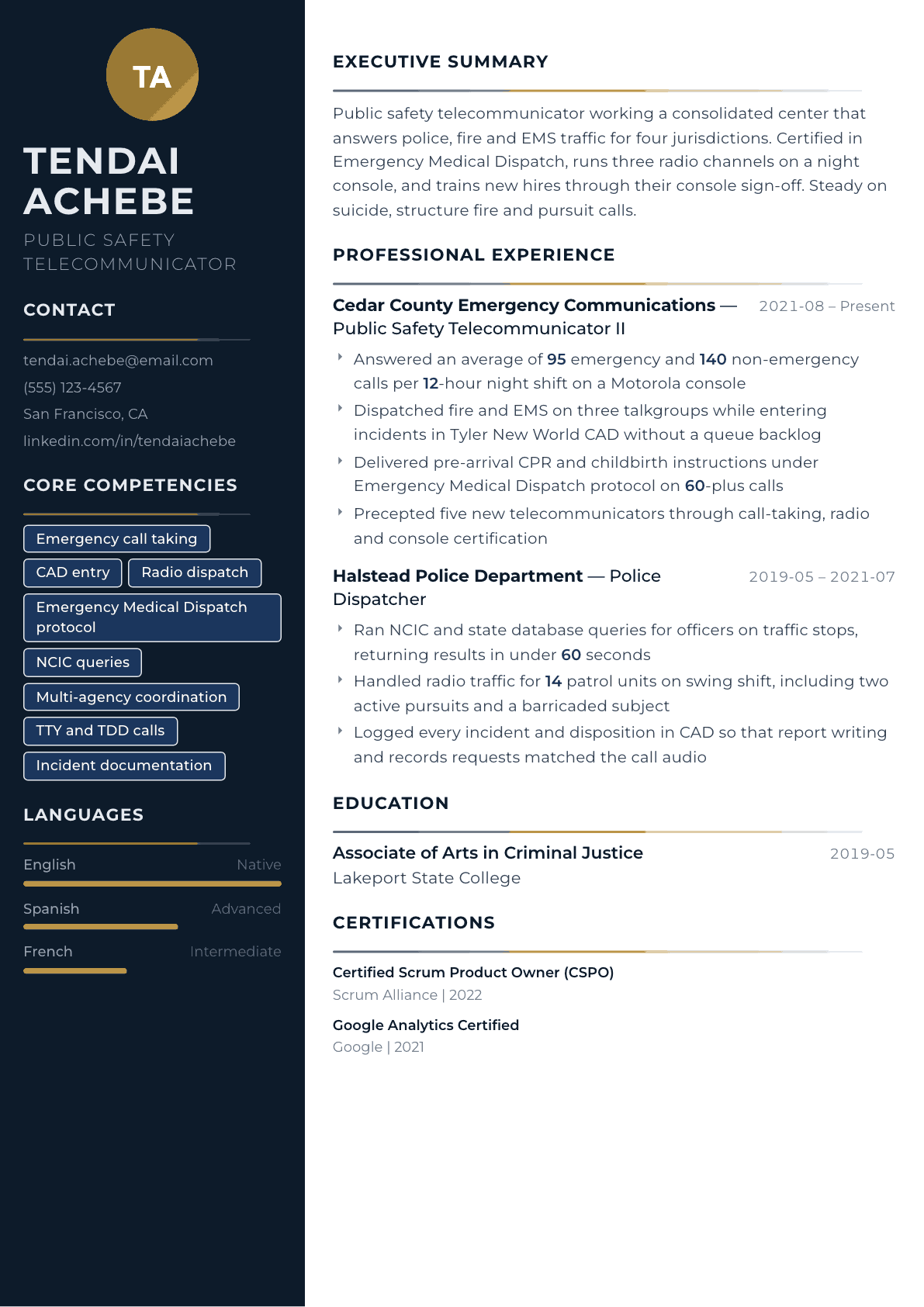
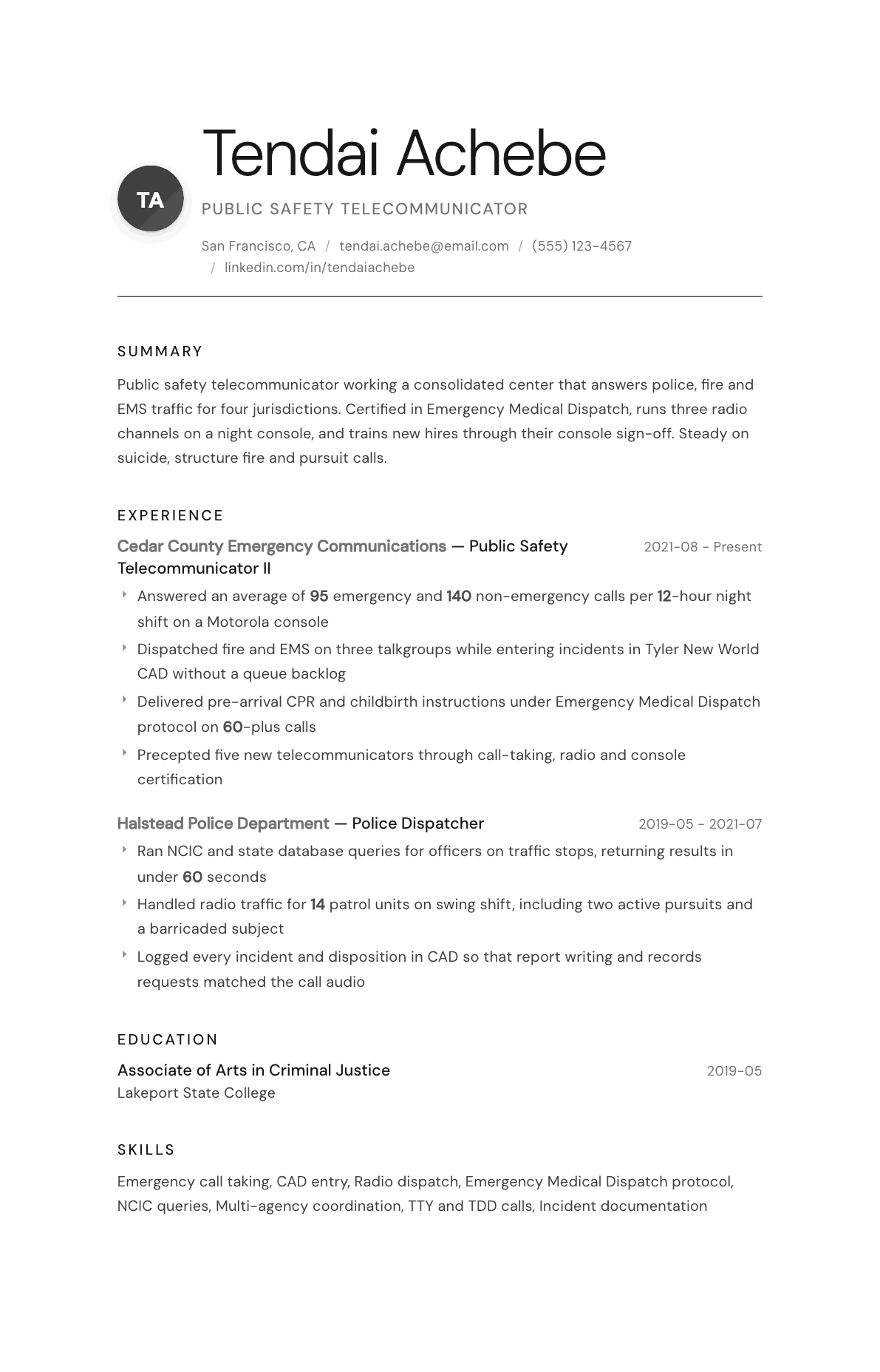
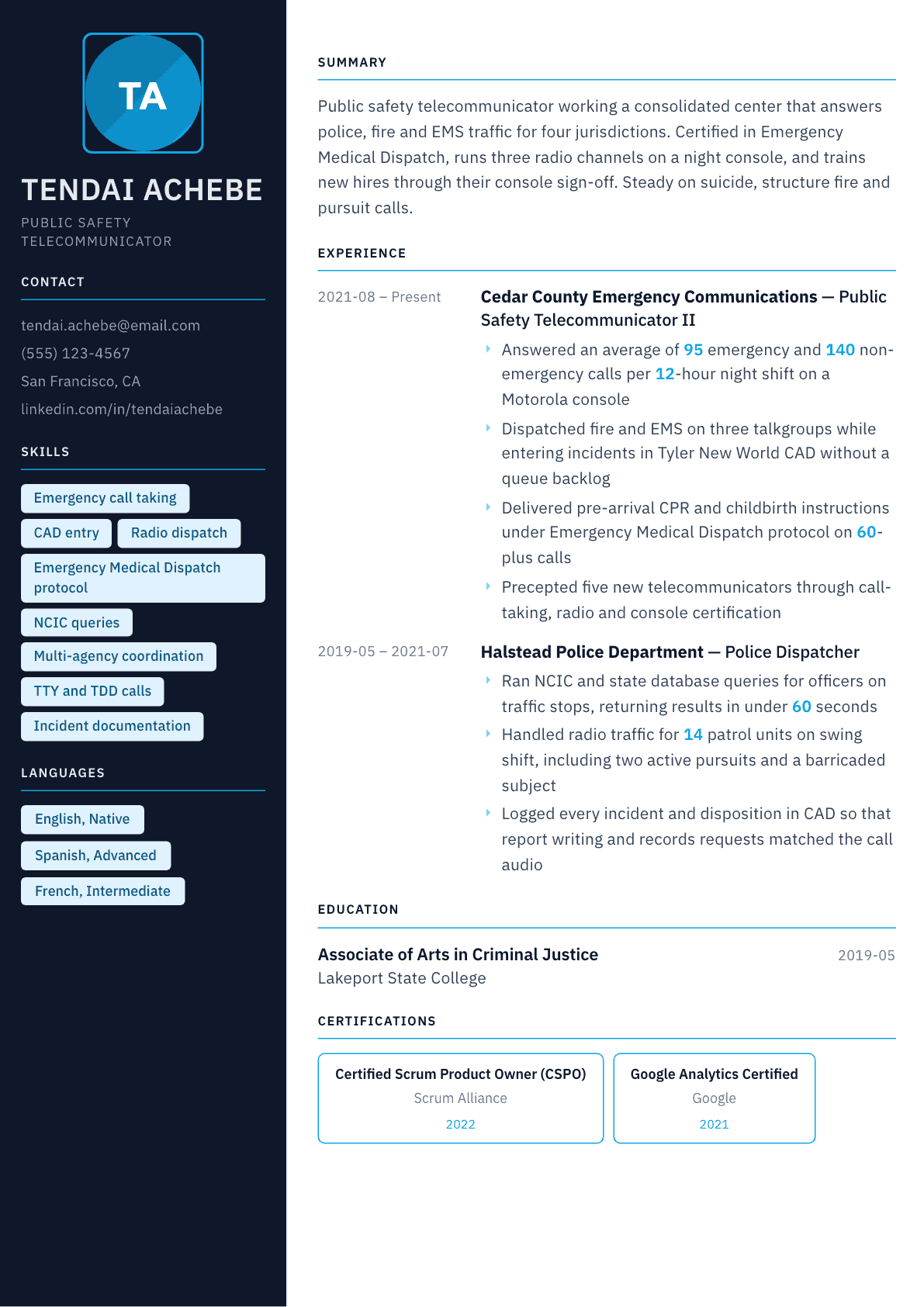
Example 911 Dispatcher summary
Public safety telecommunicator with five years in a consolidated center answering police, fire and EMS for four agencies. Emergency Medical Dispatch certified, comfortable running three talkgroups and CAD entry at the same time on a night console. Trained five new hires to sign-off and holds a clean record through two background reinvestigations. Seeking a lead telecommunicator role.
Skills to list on a 911 Dispatcher resume
- Emergency call taking
- CAD systems
- Radio protocol
- Emergency Medical Dispatch
- NCIC and NLETS
- Multi-line phone systems
- Fire dispatch
- EMS dispatch
- Law enforcement dispatch
- TTY and TDD
- Incident triage
- Call prioritization
- CJIS security awareness
- Shift handoff documentation
What actually gets this resume read
- Give the call volume per shift and the agencies you dispatched for, because center size changes what the job demands.
- Name the CAD product and the radio system by vendor, since hiring centers screen for people who need less console training.
- List every state telecommunicator certification with the issuing body and the expiry, near the top of the page.
- Mention CritiCall, typing speed and any multitasking test you have already passed to move faster through screening.
- Show call types you have carried: cardiac arrest, structure fire, pursuit, domestic violence, active threat, suicide in progress.
- Keep your work history complete with no gaps, because a public safety background investigation checks every month.
How to write a 911 dispatcher resume
A 911 dispatcher resume is read twice by two very different readers. A communications supervisor scans it for console readiness: call volume, agencies served, CAD product, radio channels, and whether you already hold state telecommunicator certification. A background investigator then reads the same page line by line looking for gaps, inconsistent dates and anything that will not survive verification.
That second reader is the reason a public safety resume follows different rules from a normal one. Every month of employment should be accounted for, every certification should carry the issuing body and the expiry, and nothing should be rounded up. A single unexplained gap can hold a file for weeks in a hiring process that already runs long.
This guide walks the sections in the order a center reads them, gives summaries for a candidate with no console time, a certified telecommunicator and a lead, rewrites the bullets that appear on almost every dispatcher application, and answers the questions candidates ask before they submit.
Format: complete history, plain layout, no gaps
Use reverse chronological order and account for every period of employment, including short jobs and unrelated ones. A center would rather see a six-month retail job than a hole it has to ask about. If you were in school, caring for family or deployed, say so in one line rather than leaving blank space on the timeline.
Keep the design simple. Many centers still run applications through a civil service portal or a parser that mangles columns, tables and graphics. One column, standard headings and a clean font protect the content. Put the certifications section near the top because it is the first filter a supervisor applies.
- Header: name, city and state, phone, email, and availability for rotating or night shifts.
- Certifications section immediately after the summary, each with issuer and expiry.
- Full employment history with month and year, no unexplained gaps.
- Education, then any language ability, which many centers count as a real operational asset.
Summary: center type, agencies, call load, certification
Three lines that tell a supervisor what console you can sit at. Name the type of center, whether it is a single agency police desk or a consolidated center handling police, fire and EMS, the number of agencies or jurisdictions, the typical call load per shift, and the certifications you hold. That is the entire filter for a lateral hire.
If you have no console time, the summary should carry the qualifying things instead: a passed CritiCall or equivalent screening test, typing speed, high-volume phone work, medical or military background, and the shift availability you can commit to. Say plainly that you are seeking an entry telecommunicator position rather than leaving the reader to infer it.
Experience: call types, console load, and what you carried alone
Give each dispatch job a first line with the center size, the agencies covered, and the positions you were signed off on: call taking, law enforcement radio, fire and EMS radio, or all of them. Sign-off matters. A candidate certified on three positions on a night console needs less training than one who only took calls.
Then write bullets around volume and call type. Emergency and non-emergency calls per shift, talkgroups or channels monitored, units dispatched, and the incident types you have actually run: cardiac arrest, structure fire, pursuit, domestic violence in progress, active threat, water rescue, suicidal caller. Naming call types is how you show a supervisor you will not freeze on the fourth one.
Include the pieces beyond the console: pre-arrival instructions delivered under protocol, quality assurance reviews, training new telecommunicators, being the person who took the mutual aid channel during a major incident. Those are the lines that move someone from a stack of applications to a panel interview.
Certifications, testing and clearances
List each credential with the issuing body and the expiry date: state telecommunicator certification, Emergency Medical Dispatch, Emergency Fire Dispatch, Emergency Police Dispatch, CPR, and any state law enforcement database access certification. If a credential lapsed, either say when you will renew or leave it out, because an unclear certification date invites a phone call rather than an interview.
Testing counts too. If you have already passed CritiCall or another entry examination, put the date and the administering center on the page. Many agencies accept a recent passing score and will move you straight to interview, which shortens their process and yours.
- State telecommunicator certification with the issuing state agency.
- Protocol certifications for medical, fire or police dispatch with the issuer.
- CPR and any first aid credential with expiry.
- Passed entry examinations, with date and where you sat them.
Keywords and the language centers use
Public safety postings reuse the same vocabulary: telecommunicator, call taker, computer aided dispatch, talkgroup, pre-arrival instructions, triage, protocol compliance, records queries, multi-agency coordination, and the name of the CAD and radio vendors. Use the terms the posting uses, and use them where they carry a fact rather than in a keyword block.
Be careful with abbreviations. Spell out the certification once in full and then use the short form, because civil service reviewers who are not from the dispatch floor sometimes screen the first pass.
911 Dispatcher resume summary examples
No console time yet
Customer service professional with three years on a 12-line inbound desk averaging 120 calls per day, seeking an entry telecommunicator position. Passed CritiCall with a typing speed of 62 words per minute, holds current CPR certification, and available for rotating nights, weekends and holidays.
Certified telecommunicator
State certified public safety telecommunicator with four years in a consolidated center serving four agencies. Signed off on call taking, law enforcement radio and fire and EMS radio, averaging 95 emergency calls per night shift, and certified in Emergency Medical Dispatch protocol.
Communications training officer
Communications training officer with nine years on the floor and three running the training program for a center covering seven jurisdictions. Trains new hires to independent console sign-off, performs quality assurance reviews on recorded calls, and holds Emergency Medical and Fire Dispatch certifications.
Work experience bullets: before and after
Before: Answered emergency calls and dispatched units.
After: Answered an average of 95 emergency and 140 non-emergency calls per 12-hour night shift while dispatching police, fire and EMS on three talkgroups.
Call volume, shift length and channel count give a supervisor the console picture the generic line hides.
Before: Used CAD to enter calls.
After: Entered and updated incidents in Tyler New World CAD in real time during multi-unit responses, keeping the queue clear through an entire night shift without a backlog.
Naming the product and the pressure it was used under proves real system fluency.
Before: Gave instructions to callers before help arrived.
After: Delivered pre-arrival CPR, choking and childbirth instructions under Emergency Medical Dispatch protocol on more than 60 calls, documenting protocol compliance on each one.
The protocol name, call types and documentation turn a soft claim into verifiable clinical work.
Before: Ran checks for officers.
After: Ran NCIC and state database queries during traffic stops and warrant checks, returning results to officers in under 60 seconds while holding open radio traffic.
A response time and the simultaneous radio load show the multitasking the job is graded on.
Before: Trained new employees.
After: Precepted five new telecommunicators through call taking, radio and full console sign-off, using recorded call reviews to close specific protocol gaps.
Counting trainees and naming the method makes the training claim something a supervisor can trust.
Hard skills
- Emergency call taking
- Computer aided dispatch entry
- Law enforcement radio dispatch
- Fire and EMS radio dispatch
- Emergency Medical Dispatch protocol
- NCIC and state database queries
- Multi-line emergency phone systems
- TTY and TDD communication
- Call triage and prioritization
- Incident documentation
- Mutual aid coordination
- Quality assurance call review
Soft skills
- Composure under pressure
- Active listening
- Voice control and clarity
- Sustained multitasking
- Empathy with distressed callers
- Teamwork across agencies
Certifications worth listing
- Emergency Medical Dispatch (EMD) (International Academies of Emergency Dispatch)
- Emergency Fire Dispatch (EFD) (International Academies of Emergency Dispatch)
- Emergency Police Dispatch (EPD) (International Academies of Emergency Dispatch)
- Public Safety Telecommunicator 1 (APCO International)
- Communications Training Officer (APCO International)
- CPR and AED for Professional Rescuers (American Red Cross)
Mistakes that cost 911 dispatcher candidates the interview
- Leaving employment gaps unexplained, which stalls a background investigation before anyone reads the console detail.
- Listing certifications without the issuing body or expiry, forcing an investigator to chase records.
- Writing that you handled emergency calls without ever giving a call volume or a shift length.
- Omitting which positions you were signed off on, so the reader assumes call taking only.
- Using a decorative template that a civil service portal strips or reorders.
- Overstating experience with a call type you have run once, which collapses in a scenario interview.
- Forgetting shift availability, when rotating nights and holidays are the reality of every center.
911 Dispatcher resume questions
How do I get hired as a 911 dispatcher with no experience?
Lead with high-volume phone work, a passed entry examination, typing speed and documented shift availability. Centers train call takers from scratch far more often than they hire laterally, so the resume needs to prove screening readiness rather than console history.
Should I list my typing speed on the resume?
Yes. Typing speed is a scored requirement at most centers, usually verified during testing. Put the number and the test you took it on near your certifications, because a supervisor uses it to decide whether to invite you to the examination round.
What certifications matter most for a dispatcher application?
State telecommunicator certification comes first, then protocol certifications for medical, fire or police dispatch, then CPR. If you hold none yet, say which ones you are eligible to test for so the reader can see how long the ramp will be.
Do I need to explain every short job on my work history?
You need to list them all with accurate months. A one-line reason for a short stay is fine and often helpful. What harms an application is a missing period, because the investigator will find it and the file waits while they ask.
How should I describe traumatic calls on a resume?
Name the call types plainly and keep the tone factual: cardiac arrest, structure fire, pursuit, suicidal caller. No narrative and no detail that could identify a caller. The purpose is to show the range of incidents you have carried, not to retell them.
Related resume examples
- Emergency Dispatcher Resume example
- Dispatcher Resume example
- Dispatch Coordinator Resume example
- Customer Service Representative Resume example
- Bus Driver Resume example
- Warehouse Supervisor Resume example